Thank you for visiting SNEWPapers!
Sign up free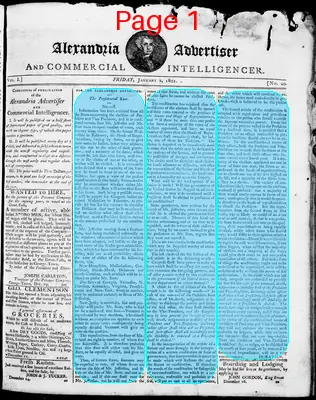
Editorial
January 2, 1801
Alexandria Advertiser And Commercial Intelligencer
Alexandria, Virginia
What is this article about?
This editorial analyzes the tied 1800 U.S. presidential election between Thomas Jefferson and Aaron Burr, each with 73 electoral votes. It details likely state voting alignments in the House, foresees no majority, and argues constitutionally for Congress to provide by law for a presidential vacancy, ensuring government continuity.
Clipping
OCR Quality
95%
Excellent
Full Text
FOR THE ALEXANDRIA ADVERTISER.
The Presidential Knot.
No.-I.
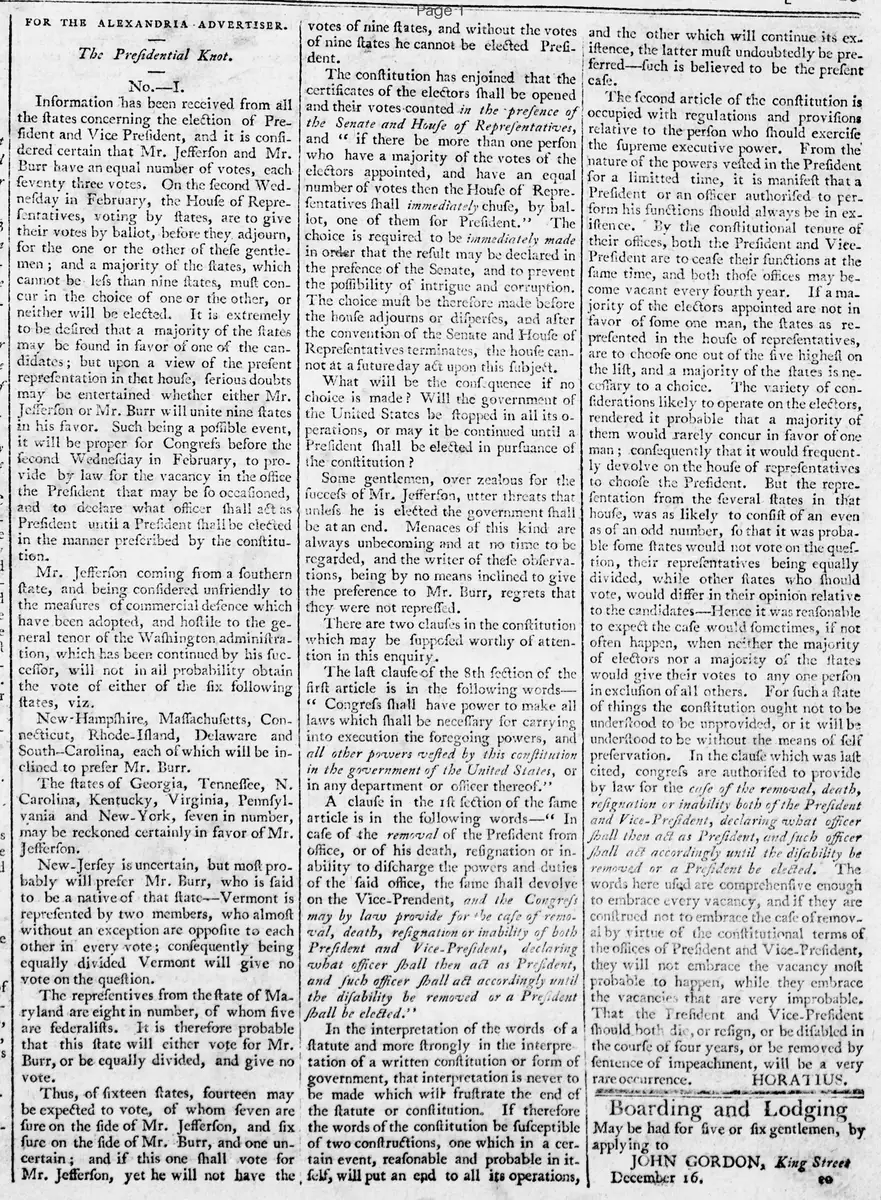
Information has been received from all the states concerning the election of President and Vice President. and it is considered certain that Mr. Jefferson and Mr. Burr have an equal number of votes, each seventy three votes. On the second Wednesday in February, the House of Representatives, voting by states, are to give their votes by ballot, before they adjourn, for the one or the other of these gentlemen ; and a majority of the states, which cannot be less than nine states. must concur in the choice of one or the other, or neither will be elected. It is extremely to be desired that a majority of the states may be found in favor of one of the candidates; but upon a view of the present representation in that house, serious doubts may be entertained whether either Mr. Jefferson or Mr. Burr will unite nine states in his favor. Such being a possible event, it will be proper for Congress before the second Wednesday in February, to provide by law for the vacancy in the office the President that may be so occasioned, and to declare what officer shall act as President until a President shall be elected in the manner prescribed by the constitution.
Mr. Jefferson coming from a southern state, and being considered unfriendly to the measures of commercial defence which have been adopted, and hostile to the general tenor of the Washington administration, which has been continued by his successor, will not in all probability obtain the vote of either of the six following states, viz.
New-Hampshire. Massachusetts, Connecticut, Rhode-Island, Delaware and South-Carolina, each of which will be inclined to prefer Mr. Burr.
The states of Georgia, Tennessee, N. Carolina, Kentucky, Virginia, Pennsylvania and New-York, seven in number, may be reckoned certainly in favor of Mr. Jefferson.
New-Jersey is uncertain, but most probably will prefer Mr. Burr, who is said to be a native of that state--Vermont is represented by two members, who almost without an exception are opposite to each other in every vote; consequently being equally divided Vermont will give no vote on the question.
The representatives from the state of Maryland are eight in number, of whom five are federalists. It is therefore probable that this state will either vote for Mr. Burr, or be equally divided, and give no vote.
Thus, of sixteen states, fourteen may be expected to vote, of whom seven are sure on the side of Mr. Jefferson, and six sure on the side of Mr. Burr, and one uncertain : and if this one shall vote for Mr. Jefferson, yet he will not have the votes of nine states, and without the votes of nine states he cannot be elected President.
The constitution has enjoined that the certificates of the electors shall be opened and their votes counted in the presence of the Senate and House of Representatives, and " if there be more than one person who have a majority of the votes of the electors appointed, and have an equal number of votes then the House of Representatives shall immediately chuse, by ballot, one of them for President." The choice is required to be immediately made in order that the result may be declared in the presence of the Senate, and to prevent the possibility of intrigue and corruption. The choice must be therefore made before the house adjourns or disperses, and after the convention of the Senate and House of Representatives terminates, the house cannot at a future day act upon this subject.
What will be the consequence if no choice is made? Will the government of the United States be stopped in all its operations, or may it be continued until a President shall be elected in pursuance of the constitution ?
Some gentlemen, over zealous for the success of Mr. Jefferson, utter threats that unless he is elected the government shall be at an end. Menaces of this kind are always unbecoming and at no time to be regarded, and the writer of these observations, being by no means inclined to give the preference to Mr. Burr, regrets that they were not repressed.
There are two clauses in the constitution which may be supposed worthy of attention in this enquiry.
The last clause of the 5th section of the first article is in the following words-- " Congress shall have power to make all laws which shall be necessary for carrying into execution the foregoing powers, and all other powers vested by this constitution in the government of the United States, or in any department or officer thereof."
A clause in the 1st section of the same article is in the following words--" In case of the removal of the President from office, or of his death, resignation or inability to discharge the powers and duties of the said office, the same shall devolve on the Vice-President, and the Congress may by law provide for the case of removal, death, resignation or inability of both President and Vice-President, declaring what officer shall then act as President, and such officer shall act accordingly until the disability be removed or a President shall be elected."
In the interpretation of the words of a statute and more strongly in the interpretation of a written constitution or form of government, that interpretation is never to be made which will frustrate the end of the statute or constitution. If therefore the words of the constitution be susceptible of two constructions, one which in a certain event, reasonable and probable in itself, will put an end to all its operations, and the other which will continue its existence, the latter must undoubtedly be preferred--such is believed to be the present case.
The second article of the constitution is occupied with regulations and provisions relative to the person who should exercise the supreme executive power. From the nature of the powers vested in the President for a limited time, it is manifest that a President or an officer authorised to perform his functions should always be in existence. By the constitutional tenure of their offices, both the President and Vice-President are to cease their functions at the same time, and both those offices may become vacant every fourth year. If a majority of the electors appointed are not in favor of some one man. the states as represented in the house of representatives, are to chuse one out of the five highest on the list, and a majority of the states is necessary to a choice. The variety of considerations likely to operate on the electors, rendered it probable that a majority of them would rarely concur in favor of one man ; consequently that it would frequently devolve on the house of representatives to chuse the President. But the representation from the several states in that house, was as likely to consist of an even as of an odd number, so that it was probable some states would not vote on the question, their representatives being equally divided, while other states who should vote, would differ in their opinion relative to the candidates--Hence it was reasonable to expect the case would sometimes, if not often happen, when neither the majority of electors nor a majority of the states would give their votes to any one person in exclusion of all others. For such a state of things the constitution ought not to be understood to be unprovided. or it will be understood to be without the means of self preservation. In the clause which was last cited, congress are authorised to provide by law for the case of the removal, death, resignation or inability both of the President and Vice-President, declaring what officer shall then act as President, and such officer shall act accordingly until the disability be removed or a President be elected. The words here used are comprehensive enough to embrace every vacancy, and if they are construed not to embrace the case of removal by virtue of the constitutional terms of the offices of President and Vice-President, they will not embrace the vacancy most probable to happen, while they embrace the vacancies that are very improbable. That the President and Vice-President should both die, or resign, or be disabled in the course of four years, or be removed by sentence of impeachment, will be a very rare occurrence.
HORATIUS.
The Presidential Knot.
No.-I.
Information has been received from all the states concerning the election of President and Vice President. and it is considered certain that Mr. Jefferson and Mr. Burr have an equal number of votes, each seventy three votes. On the second Wednesday in February, the House of Representatives, voting by states, are to give their votes by ballot, before they adjourn, for the one or the other of these gentlemen ; and a majority of the states, which cannot be less than nine states. must concur in the choice of one or the other, or neither will be elected. It is extremely to be desired that a majority of the states may be found in favor of one of the candidates; but upon a view of the present representation in that house, serious doubts may be entertained whether either Mr. Jefferson or Mr. Burr will unite nine states in his favor. Such being a possible event, it will be proper for Congress before the second Wednesday in February, to provide by law for the vacancy in the office the President that may be so occasioned, and to declare what officer shall act as President until a President shall be elected in the manner prescribed by the constitution.
Mr. Jefferson coming from a southern state, and being considered unfriendly to the measures of commercial defence which have been adopted, and hostile to the general tenor of the Washington administration, which has been continued by his successor, will not in all probability obtain the vote of either of the six following states, viz.
New-Hampshire. Massachusetts, Connecticut, Rhode-Island, Delaware and South-Carolina, each of which will be inclined to prefer Mr. Burr.
The states of Georgia, Tennessee, N. Carolina, Kentucky, Virginia, Pennsylvania and New-York, seven in number, may be reckoned certainly in favor of Mr. Jefferson.
New-Jersey is uncertain, but most probably will prefer Mr. Burr, who is said to be a native of that state--Vermont is represented by two members, who almost without an exception are opposite to each other in every vote; consequently being equally divided Vermont will give no vote on the question.
The representatives from the state of Maryland are eight in number, of whom five are federalists. It is therefore probable that this state will either vote for Mr. Burr, or be equally divided, and give no vote.
Thus, of sixteen states, fourteen may be expected to vote, of whom seven are sure on the side of Mr. Jefferson, and six sure on the side of Mr. Burr, and one uncertain : and if this one shall vote for Mr. Jefferson, yet he will not have the votes of nine states, and without the votes of nine states he cannot be elected President.
The constitution has enjoined that the certificates of the electors shall be opened and their votes counted in the presence of the Senate and House of Representatives, and " if there be more than one person who have a majority of the votes of the electors appointed, and have an equal number of votes then the House of Representatives shall immediately chuse, by ballot, one of them for President." The choice is required to be immediately made in order that the result may be declared in the presence of the Senate, and to prevent the possibility of intrigue and corruption. The choice must be therefore made before the house adjourns or disperses, and after the convention of the Senate and House of Representatives terminates, the house cannot at a future day act upon this subject.
What will be the consequence if no choice is made? Will the government of the United States be stopped in all its operations, or may it be continued until a President shall be elected in pursuance of the constitution ?
Some gentlemen, over zealous for the success of Mr. Jefferson, utter threats that unless he is elected the government shall be at an end. Menaces of this kind are always unbecoming and at no time to be regarded, and the writer of these observations, being by no means inclined to give the preference to Mr. Burr, regrets that they were not repressed.
There are two clauses in the constitution which may be supposed worthy of attention in this enquiry.
The last clause of the 5th section of the first article is in the following words-- " Congress shall have power to make all laws which shall be necessary for carrying into execution the foregoing powers, and all other powers vested by this constitution in the government of the United States, or in any department or officer thereof."
A clause in the 1st section of the same article is in the following words--" In case of the removal of the President from office, or of his death, resignation or inability to discharge the powers and duties of the said office, the same shall devolve on the Vice-President, and the Congress may by law provide for the case of removal, death, resignation or inability of both President and Vice-President, declaring what officer shall then act as President, and such officer shall act accordingly until the disability be removed or a President shall be elected."
In the interpretation of the words of a statute and more strongly in the interpretation of a written constitution or form of government, that interpretation is never to be made which will frustrate the end of the statute or constitution. If therefore the words of the constitution be susceptible of two constructions, one which in a certain event, reasonable and probable in itself, will put an end to all its operations, and the other which will continue its existence, the latter must undoubtedly be preferred--such is believed to be the present case.
The second article of the constitution is occupied with regulations and provisions relative to the person who should exercise the supreme executive power. From the nature of the powers vested in the President for a limited time, it is manifest that a President or an officer authorised to perform his functions should always be in existence. By the constitutional tenure of their offices, both the President and Vice-President are to cease their functions at the same time, and both those offices may become vacant every fourth year. If a majority of the electors appointed are not in favor of some one man. the states as represented in the house of representatives, are to chuse one out of the five highest on the list, and a majority of the states is necessary to a choice. The variety of considerations likely to operate on the electors, rendered it probable that a majority of them would rarely concur in favor of one man ; consequently that it would frequently devolve on the house of representatives to chuse the President. But the representation from the several states in that house, was as likely to consist of an even as of an odd number, so that it was probable some states would not vote on the question, their representatives being equally divided, while other states who should vote, would differ in their opinion relative to the candidates--Hence it was reasonable to expect the case would sometimes, if not often happen, when neither the majority of electors nor a majority of the states would give their votes to any one person in exclusion of all others. For such a state of things the constitution ought not to be understood to be unprovided. or it will be understood to be without the means of self preservation. In the clause which was last cited, congress are authorised to provide by law for the case of the removal, death, resignation or inability both of the President and Vice-President, declaring what officer shall then act as President, and such officer shall act accordingly until the disability be removed or a President be elected. The words here used are comprehensive enough to embrace every vacancy, and if they are construed not to embrace the case of removal by virtue of the constitutional terms of the offices of President and Vice-President, they will not embrace the vacancy most probable to happen, while they embrace the vacancies that are very improbable. That the President and Vice-President should both die, or resign, or be disabled in the course of four years, or be removed by sentence of impeachment, will be a very rare occurrence.
HORATIUS.
What sub-type of article is it?
Constitutional
Partisan Politics
What keywords are associated?
Presidential Election Tie
Jefferson Burr
House Vote By States
Constitutional Vacancy
Government Continuity
Congressional Legislation
What entities or persons were involved?
Mr. Jefferson
Mr. Burr
House Of Representatives
Congress
Washington Administration
Editorial Details
Primary Topic
Resolution Of Tied Presidential Election And Provision For Vacancy
Stance / Tone
Analytical Advocacy For Constitutional Continuity Via Legislation
Key Figures
Mr. Jefferson
Mr. Burr
House Of Representatives
Congress
Washington Administration
Key Arguments
Jefferson And Burr Each Have 73 Electoral Votes
House Must Choose By State Majorities, Needing 9 States
Jefferson Likely Supported By 7 States, Burr By 6, One Uncertain
No Candidate Likely To Reach 9 States
Constitution Requires Immediate Choice Before Adjournment
Congress Should Legislate For Vacancy If No Election
Threats To End Government If Jefferson Not Chosen Are Unbecoming
Constitutional Clauses Allow Provision For Both Offices Vacant
Interpretation Must Ensure Government Continuity
Vacancy By Term End More Probable Than Death Or Removal