Thank you for visiting SNEWPapers!
Sign up free
Letter to Editor
September 20, 1825
Constitutional Whig
Richmond, Virginia
What is this article about?
A spectator recounts the emotional farewell to General Lafayette aboard the USS Brandywine on September 8, 1825, near Washington, D.C., describing the scene's moral sublimity, the presence of dignitaries like the Secretary of the Navy, and symbolic elements like a rainbow representing liberty's spread.
Clipping
OCR Quality
98%
Excellent
Full Text
For the Constitutional Whig.
"Farewell! a word that must be, and hath been--
A sound which makes us linger;--yet--farewell!"
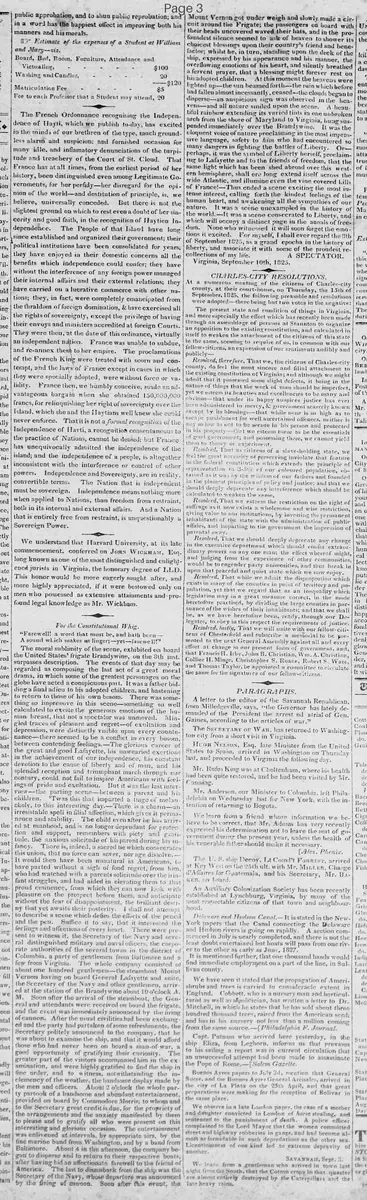
The moral sublimity of the scene, exhibited on board the United States' frigate Brandywine, on the 8th inst. surpasses description. The events of that day may be regarded as composing the last act of a great moral drama, in which some of the greatest personages on the globe have acted a conspicuous part. It was a father bidding a final adieu to his adopted children, and hastening to return to those of his own bosom. There was something so impressive in this scene--something so well calculated to excite the generous emotions of the human breast, that not a spectator was unmoved. Mingled traces of pleasure and regret--of exultation and depression, were distinctly visible upon every countenance--there seemed to be a conflict in every bosom, between contending feelings.--The glorious career of the great and good Lafayette, his unwearied exertions in the achievement of our independence, his constant devotion to the cause of liberty and of man, and his splendid reception and triumphant march through our country, could not fail to inspire Americans with feelings of pride and exultation. But it was the last interview--the parting scene--between a parent and his children. Twas this that imparted a tinge of melancholy, to this interesting day.--There is a charm--an irresistible spell in filial affection, which gives it permanence and stability. The child even after he has arrived at manhood, and is no longer dependant for protection and support, remembers with piety and gratitude, the anxious solicitude of his parent during his infancy. There is, indeed, a sacred tie which consecrates this union, that no force can sever, nor age dissolve.-- It would then have been unnatural in Americans, to have parted without a sigh of fond regret, from him, who had watched with a parent's solicitude over the infant struggles, and had aided in elevating them to that proud eminence, from which they can now look with pleasure on the prospect before them, and anticipate without the fear of disappointment, the brilliant destiny that yet awaits their posterity. I shall not attempt to describe a scene which defies the efforts of the pencil and the pen. Suffice it to say, that it interested the feelings and affections of every heart. There were present to witness it, the Secretary of the Navy and several distinguished military and naval officers, the corporate authorities of the several towns in the district of Columbia, a party of gentlemen from Baltimore and a few from Virginia. The whole company consisted of about one hundred gentlemen--the steamboat Mount Vernon having on board General Lafayette and suite, the Secretary of the Navy and other gentlemen, arrived at the station of the Brandywine about 10 o'clock A. M. Soon after the arrival of the steamboat, the General and attendants were received on board the frigate, and the event was immediately announced by the firing of cannon. After the usual civilities had been exchanged and the party had partaken of some refreshments, the Secretary politely announced to the company, that he was about to examine the ship, and that it would afford those who had never been on board a man-of-war, a good opportunity of gratifying their curiosity. The greater part of the visitors accompanied him in the examination, and were highly gratified to find the ship in fine order, and to witness, notwithstanding the inclemency of the weather, the handsome display made by the men and officers. About 2 o'clock the whole party partook of a handsome and abundant entertainment, provided on board by Commodore Morris; to whom and to the Secretary great credit is due, for the propriety of the arrangements and the anxiety manifested by them to please and to gratify all who were present on this interesting and glorious occasion. The entertainment was enlivened at intervals, by appropriate airs, by the fine marine band from Washington, and by a band from Baltimore. About 4 in the afternoon, the company began to disperse and to return to their respective boats, after having bid an affectionate farewell to the friend of America. The last to disembark from the ship was the Secretary of the Navy, whose departure was announced by the firing of cannon. Soon after this event, the Mount Vernon got under weigh and slowly made a circuit around the Frigate; the passengers on board with their heads uncovered waved their hats, and in the profoundest silence seemed to ask of heaven to shower its choicest blessings upon their country's friend and benefactor; whilst he, in turn, standing upon the deck of the ship, expressed by his appearance and his manner, the overflowing emotions of his heart, and silently breathed a fervent prayer, that a blessing might forever rest on his adopted children. At this moment the heavens were lighted up--the sun beamed forth--the rain which before had fallen almost incessantly, ceased--the clouds began to disperse--an auspicious sign was observed in the heavens--and all nature smiled upon the scene. A beautiful rainbow extending its varied tints in one unbroken arch from the shore of Maryland to Virginia, hung suspended immediately over the Brandywine. It was the eloquent voice of nature proclaiming in the most impressive language, safety to him who had encountered so many dangers in fighting the battles of Liberty. Or perhaps, it was the symbol of Liberty herself, proclaiming to Lafayette and to the friends of freedom, that the same light which has been shed abroad over this western hemisphere, shall ere long extend itself across the wide Atlantic, and illumine even the vine covered hills of France!--Thus ended a scene exciting the most intense interest, calling forth the kindest feelings of the human heart, and awakening all the sympathies of our nature. It was a scene unexampled in the history of the world.--It was a scene consecrated to Liberty, and which will occupy a distinct page in the annals of freedom. None who witnessed it will soon forget the emotions it excited. For myself, I shall ever regard the 8th of September 1825, as a grand epocha in the history of liberty, and associate it with some of the proudest recollections of my life.
A SPECTATOR.
Virginia, September 10th, 1825.
"Farewell! a word that must be, and hath been--
A sound which makes us linger;--yet--farewell!"
The moral sublimity of the scene, exhibited on board the United States' frigate Brandywine, on the 8th inst. surpasses description. The events of that day may be regarded as composing the last act of a great moral drama, in which some of the greatest personages on the globe have acted a conspicuous part. It was a father bidding a final adieu to his adopted children, and hastening to return to those of his own bosom. There was something so impressive in this scene--something so well calculated to excite the generous emotions of the human breast, that not a spectator was unmoved. Mingled traces of pleasure and regret--of exultation and depression, were distinctly visible upon every countenance--there seemed to be a conflict in every bosom, between contending feelings.--The glorious career of the great and good Lafayette, his unwearied exertions in the achievement of our independence, his constant devotion to the cause of liberty and of man, and his splendid reception and triumphant march through our country, could not fail to inspire Americans with feelings of pride and exultation. But it was the last interview--the parting scene--between a parent and his children. Twas this that imparted a tinge of melancholy, to this interesting day.--There is a charm--an irresistible spell in filial affection, which gives it permanence and stability. The child even after he has arrived at manhood, and is no longer dependant for protection and support, remembers with piety and gratitude, the anxious solicitude of his parent during his infancy. There is, indeed, a sacred tie which consecrates this union, that no force can sever, nor age dissolve.-- It would then have been unnatural in Americans, to have parted without a sigh of fond regret, from him, who had watched with a parent's solicitude over the infant struggles, and had aided in elevating them to that proud eminence, from which they can now look with pleasure on the prospect before them, and anticipate without the fear of disappointment, the brilliant destiny that yet awaits their posterity. I shall not attempt to describe a scene which defies the efforts of the pencil and the pen. Suffice it to say, that it interested the feelings and affections of every heart. There were present to witness it, the Secretary of the Navy and several distinguished military and naval officers, the corporate authorities of the several towns in the district of Columbia, a party of gentlemen from Baltimore and a few from Virginia. The whole company consisted of about one hundred gentlemen--the steamboat Mount Vernon having on board General Lafayette and suite, the Secretary of the Navy and other gentlemen, arrived at the station of the Brandywine about 10 o'clock A. M. Soon after the arrival of the steamboat, the General and attendants were received on board the frigate, and the event was immediately announced by the firing of cannon. After the usual civilities had been exchanged and the party had partaken of some refreshments, the Secretary politely announced to the company, that he was about to examine the ship, and that it would afford those who had never been on board a man-of-war, a good opportunity of gratifying their curiosity. The greater part of the visitors accompanied him in the examination, and were highly gratified to find the ship in fine order, and to witness, notwithstanding the inclemency of the weather, the handsome display made by the men and officers. About 2 o'clock the whole party partook of a handsome and abundant entertainment, provided on board by Commodore Morris; to whom and to the Secretary great credit is due, for the propriety of the arrangements and the anxiety manifested by them to please and to gratify all who were present on this interesting and glorious occasion. The entertainment was enlivened at intervals, by appropriate airs, by the fine marine band from Washington, and by a band from Baltimore. About 4 in the afternoon, the company began to disperse and to return to their respective boats, after having bid an affectionate farewell to the friend of America. The last to disembark from the ship was the Secretary of the Navy, whose departure was announced by the firing of cannon. Soon after this event, the Mount Vernon got under weigh and slowly made a circuit around the Frigate; the passengers on board with their heads uncovered waved their hats, and in the profoundest silence seemed to ask of heaven to shower its choicest blessings upon their country's friend and benefactor; whilst he, in turn, standing upon the deck of the ship, expressed by his appearance and his manner, the overflowing emotions of his heart, and silently breathed a fervent prayer, that a blessing might forever rest on his adopted children. At this moment the heavens were lighted up--the sun beamed forth--the rain which before had fallen almost incessantly, ceased--the clouds began to disperse--an auspicious sign was observed in the heavens--and all nature smiled upon the scene. A beautiful rainbow extending its varied tints in one unbroken arch from the shore of Maryland to Virginia, hung suspended immediately over the Brandywine. It was the eloquent voice of nature proclaiming in the most impressive language, safety to him who had encountered so many dangers in fighting the battles of Liberty. Or perhaps, it was the symbol of Liberty herself, proclaiming to Lafayette and to the friends of freedom, that the same light which has been shed abroad over this western hemisphere, shall ere long extend itself across the wide Atlantic, and illumine even the vine covered hills of France!--Thus ended a scene exciting the most intense interest, calling forth the kindest feelings of the human heart, and awakening all the sympathies of our nature. It was a scene unexampled in the history of the world.--It was a scene consecrated to Liberty, and which will occupy a distinct page in the annals of freedom. None who witnessed it will soon forget the emotions it excited. For myself, I shall ever regard the 8th of September 1825, as a grand epocha in the history of liberty, and associate it with some of the proudest recollections of my life.
A SPECTATOR.
Virginia, September 10th, 1825.
What sub-type of article is it?
Reflective
Emotional
Historical
What themes does it cover?
Constitutional Rights
Military War
Politics
What keywords are associated?
Lafayette Farewell
Uss Brandy Wine
American Liberty
September 1825
Washington Dc
Rainbow Symbol
General Lafayette
What entities or persons were involved?
A Spectator.
For The Constitutional Whig.
Letter to Editor Details
Author
A Spectator.
Recipient
For The Constitutional Whig.
Main Argument
the farewell to lafayette on the uss brandywine represents a poignant parental parting symbolizing enduring filial affection and the triumph of liberty, marking a significant epoch in american history.
Notable Details
Quotes Byron's Farewell Verse
Presence Of Secretary Of The Navy, Commodore Morris, And Dignitaries From D.C., Baltimore, Virginia
Entertainment With Marine And Baltimore Bands
Rainbow As Symbol Of Liberty Extending To France