Thank you for visiting SNEWPapers!
Sign up free
Domestic News
June 1, 1818
Daily National Intelligencer
Washington, District Of Columbia
What is this article about?
An article advocating for canal navigation's economic benefits over land carriage in Virginia, citing low construction costs and savings on horse feed, with examples from lower Virginia and the Petersburg-Richmond route.
Clipping
OCR Quality
95%
Excellent
Full Text
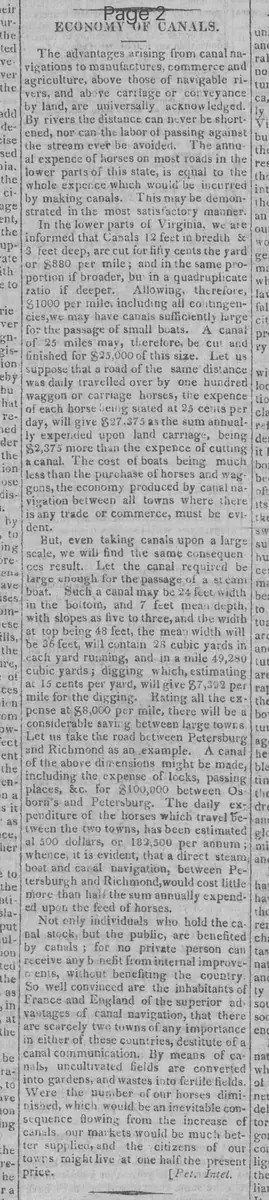
ECONOMY OF CANALS.
The advantages arising from canal navigations to manufactures, commerce and agriculture, above those of navigable rivers, and above carriage or conveyance by land, are universally acknowledged.
By rivers the distance can never be shortened, nor can the labor of passing against the stream ever be avoided. The annual expence of horses on most roads in the lower parts of this state, is equal to the whole expence which would be incurred by making canals. This may be demonstrated in the most satisfactory manner.
In the lower parts of Virginia, we are informed that canals 12 feet in breadth & 3 feet deep, are cut for fifty cents the yard or $80 per mile; and in the same proportion if broader, but in a quadruplicate ratio if deeper. Allowing, therefore, $1000 per mile, including all contingencies, we may have canals sufficiently large for the passage of small boats. A canal of 25 miles may, therefore, be cut and finished for $25,000 of this size. Let us suppose that a road of the same distance was daily travelled over by one hundred waggon or carriage horses, the expence of each horse being stated at 25 cents per day, will give $2,375 as the sum annually expended upon land carriage, being $2,375 more than the expence of cutting a canal. The cost of boats being much less than the purchase of horses and waggons, the economy produced by canal navigation between all towns where there is any trade or commerce, must be evident.
But, even taking canals upon a large scale, we will find the same consequences result. Let the canal required be large enough for the passage of a steam boat. Such a canal may be 24 feet width in the bottom, and 7 feet mean depth, with slopes as five to three, and the width at top being 48 feet, the mean width will be 36 feet, will contain 28 cubic yards in each yard running, and in a mile 49,280 cubic yards; digging which, estimating at 15 cents per yard, will give $7,392 per mile for the digging. Rating all the expence at $8,000 per mile, there will be a considerable saving between large towns.
Let us take the road between Petersburg and Richmond as an example. A canal of the above dimensions might be made, including the expense of locks, passing places, &c. for $100,000 between Osborn's and Petersburg. The daily expenditure of the horses which travel between the two towns, has been estimated at 500 dollars, or $182,500 per annum; whence, it is evident, that a direct steam boat and canal navigation, between Petersburg and Richmond, would cost little more than half the sum annually expended upon the feed of horses.
Not only individuals who hold the canal stock, but the public, are benefited by canals; for no private person can receive any benefit from internal improvements, without benefiting the country.
So well convinced are the inhabitants of France and England of the superior advantages of canal navigation, that there are scarcely two towns of any importance in either of these countries, destitute of a canal communication. By means of canals, uncultivated fields are converted into gardens, and wastes into fertile fields.
Were the number of our horses diminished, which would be an inevitable consequence flowing from the increase of canals, our markets would be much better supplied, and the citizens of our towns might live at one half the present price.
[Pet. Intel.]
The advantages arising from canal navigations to manufactures, commerce and agriculture, above those of navigable rivers, and above carriage or conveyance by land, are universally acknowledged.
By rivers the distance can never be shortened, nor can the labor of passing against the stream ever be avoided. The annual expence of horses on most roads in the lower parts of this state, is equal to the whole expence which would be incurred by making canals. This may be demonstrated in the most satisfactory manner.
In the lower parts of Virginia, we are informed that canals 12 feet in breadth & 3 feet deep, are cut for fifty cents the yard or $80 per mile; and in the same proportion if broader, but in a quadruplicate ratio if deeper. Allowing, therefore, $1000 per mile, including all contingencies, we may have canals sufficiently large for the passage of small boats. A canal of 25 miles may, therefore, be cut and finished for $25,000 of this size. Let us suppose that a road of the same distance was daily travelled over by one hundred waggon or carriage horses, the expence of each horse being stated at 25 cents per day, will give $2,375 as the sum annually expended upon land carriage, being $2,375 more than the expence of cutting a canal. The cost of boats being much less than the purchase of horses and waggons, the economy produced by canal navigation between all towns where there is any trade or commerce, must be evident.
But, even taking canals upon a large scale, we will find the same consequences result. Let the canal required be large enough for the passage of a steam boat. Such a canal may be 24 feet width in the bottom, and 7 feet mean depth, with slopes as five to three, and the width at top being 48 feet, the mean width will be 36 feet, will contain 28 cubic yards in each yard running, and in a mile 49,280 cubic yards; digging which, estimating at 15 cents per yard, will give $7,392 per mile for the digging. Rating all the expence at $8,000 per mile, there will be a considerable saving between large towns.
Let us take the road between Petersburg and Richmond as an example. A canal of the above dimensions might be made, including the expense of locks, passing places, &c. for $100,000 between Osborn's and Petersburg. The daily expenditure of the horses which travel between the two towns, has been estimated at 500 dollars, or $182,500 per annum; whence, it is evident, that a direct steam boat and canal navigation, between Petersburg and Richmond, would cost little more than half the sum annually expended upon the feed of horses.
Not only individuals who hold the canal stock, but the public, are benefited by canals; for no private person can receive any benefit from internal improvements, without benefiting the country.
So well convinced are the inhabitants of France and England of the superior advantages of canal navigation, that there are scarcely two towns of any importance in either of these countries, destitute of a canal communication. By means of canals, uncultivated fields are converted into gardens, and wastes into fertile fields.
Were the number of our horses diminished, which would be an inevitable consequence flowing from the increase of canals, our markets would be much better supplied, and the citizens of our towns might live at one half the present price.
[Pet. Intel.]
What sub-type of article is it?
Infrastructure
Economic
What keywords are associated?
Canals
Navigation
Economy
Virginia
Petersburg
Richmond
Where did it happen?
Virginia
Domestic News Details
Primary Location
Virginia
Event Details
Discussion of advantages and costs of building canals in lower Virginia for navigation, including examples for small boats and steam boats, with economic comparisons to land carriage using horses between towns like Petersburg and Richmond.