Thank you for visiting SNEWPapers!
Sign up free
Gazette Of The United States And Daily Evening Advertiser
Philadelphia, Philadelphia County, Pennsylvania
What is this article about?
A Jerseyman submits to the Gazette of the United States an address to the New Jersey Legislature advocating reforms to criminal law, emphasizing moderate punishments, limiting capital punishment to treason and murder, simplifying the code, and drawing from common law while rejecting severe British statutes.
Merged-components note: These two components form a single continuous letter to the editor discussing criminal law reforms.
Clipping
OCR Quality
Full Text
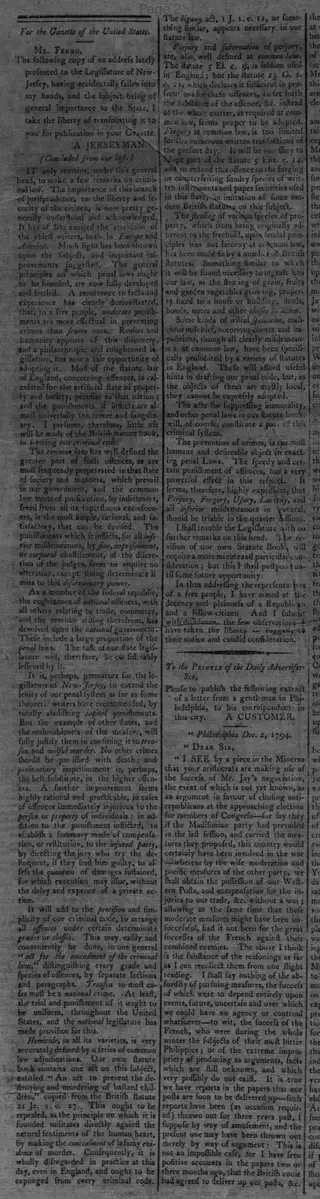
MR. FENNO.
The following copy of an address lately presented to the Legislature of New-Jersey, having accidentally fallen into my hands, and the subject being of general importance to the State, I take the liberty of transmitting it to you for publication in your Gazette.
A JERSEYMAN.
(Concluded from our last.)
It only remains, under this general head, to make a few remarks on criminal law. The importance of this branch of jurisprudence, to the liberty and security of the citizen, is now pretty generally understood and acknowledged. It has of late excited the attention of the ablest writers, both in Europe and America. Much light has been thrown upon the subject, and important improvements suggested. The general principles on which penal laws ought to be founded, are now fully developed and settled. A recurrence to facts and experience has clearly demonstrated, that, to a free people, moderate punishments are more effectual in preventing crimes than severe ones. Reason and humanity approve of this discovery, and a philanthropic and enlightened legislature, has now a fair opportunity of adopting it. Most of the statute law of England, concerning offences, is calculated for the artificial state of property and society, peculiar to that nation; and the punishments it inflicts are almost universally too severe and sanguinary. I presume, therefore, little use will be made of the British Statute book, in framing our criminal code.
The common law has well defined the greater part of such offences, as are most frequently perpetrated in that state of society and manners, which prevail in our government, and the common law mode of prosecution, by indictment, freed from all its superfluous excrescences, is the most simple, rational, and satisfactory, that can be devised. The punishments which it inflicts, for all inferior misdemeanors, by fine, imprisonment, or corporal chastisement, at the discretion of the judges, seem to require no alteration, except fixing determinate limits to this discretionary power.
As a member of the federal republic, the cognizance of national offences, with all others relating to trade, commerce, and the revenue arising therefrom, has devolved upon the national government. These include a large proportion of the penal laws. The task of our state legislature will, therefore, be considerably lessened by it.
It is, perhaps, premature for the legislature of New-Jersey, to extend the lenity of our penal system as far as some theoretic writers have recommended, by totally abolishing capital punishments. But the example of other states, and the reasonableness of the measure, will fully justify them in confining it to treason and wilful murder. No other crimes should be punished with death: and penitentiary imprisonment is, perhaps, the best substitute, in the higher offences. A further improvement seems highly rational and practicable, in cases of offences immediately injurious to the person or property of individuals: in addition to the punishment inflicted, to establish a summary mode of compensation, or restitution, to the injured party, by directing the jury who try the delinquent, if they find him guilty, to assess the quantum of damages sustained, for which execution may issue, without the delay and expense of a private action.
It will add to the precision and simplicity of our criminal code, to arrange all offences under certain determinate grades or classes. This may easily and conveniently be done, in one general "act for the amendment of the criminal law," distinguishing every grade and species of offences, by separate sections and paragraphs. Treason in most cases must be a national crime. At least, the trial and punishment of it ought to be uniform, throughout the United States, and the national legislature has made provision for this.
Homicide, in all its varieties, is very accurately defined by a series of common law adjudications. Our own statute book contains one act on this subject, entitled "An act to prevent the destroying and murdering of bastard children," copied from the British statute 21 Ja. 1. C. 27. This ought to be repealed, as the principle on which it is founded militates directly against the natural sentiments of the human heart, by making the concealment of infamy evidence of murder. Consequently, it is wholly disregarded in practice at this day, even in England, and ought to be expunged from every criminal code.
The bigamy act, 11. 1. c. 11, or something similar, appears necessary in our statute law. Perjury and subornation of perjury, are, also, well defined at common law. The statute 5 El. c. 9, is seldom used in England; but the statute 23 G. 2. c. 11, which declares it sufficient in prosecutions for these offences, to set forth the substance of the offence, &c. instead of the whole matter, as required at common law, seems proper to be adopted.
Forgery at common law, is too limited for the numerous written transactions of the present day. It will be necessary to adopt part of the Statute 5 Eliz. c. 14, and to extend this offence to the forging or counterfeiting sundry species of written instruments and paper securities used in this state, in imitation of some modern British statutes on this subject.
The stealing of sundry species of property, which from being originally adherent to the freehold, upon feudal principles was not larceny at common law, has been made so by a number of British statutes. Something similar to which it will be found necessary to ingraft into our law, as the stealing of grain, fruits and garden vegetables growing, property fixed to a house or building, deeds, bonds, notes and other choses in action.
Some kinds of wilful pollution, malicious mischief, notorious cheats and impositions, though all clearly misdemeanors at common law, have been specifically prohibited by a variety of statutes in England. These will afford useful hints in drafting our penal code, but, as the objects of them are mostly local, they cannot be expressly adopted.
The acts for suppressing immorality, and other penal laws in our statute book, will, of course, constitute a part of this criminal system.
The prevention of crimes, is the most humane and desirable object in enacting penal Laws. The speedy and certain punishment of offences, has a very powerful effect in this respect. It seems, therefore, highly expedient, that Perjury, Forgery, Usury, Larceny, and all inferior misdemeanors in general, should be triable in the quarter sessions. I shall trouble the Legislature with no further remarks on this head. The revision of our own Statute Book will require a more minute and particular consideration; but this I shall postpone until some future opportunity.
In thus addressing the representatives of a free people, I have aimed at the decency and plainness of a Republican and a fellow-citizen: And I submit with diffidence, the few observations I have taken the liberty to suggest, to their notice and candid consideration.
What sub-type of article is it?
What themes does it cover?
What keywords are associated?
What entities or persons were involved?
Letter to Editor Details
Author
A Jerseyman
Recipient
Mr. Fenno
Main Argument
the address urges the new jersey legislature to reform criminal law by adopting moderate punishments, limiting capital punishment to treason and willful murder, simplifying the code based on common law, rejecting severe british statutes, and incorporating practical improvements like restitution and trial efficiencies.
Notable Details