Thank you for visiting SNEWPapers!
Sign up free
Story
July 6, 1872
The Kentucky Gazette
Lexington, Fayette County, Kentucky
What is this article about?
Historical altitude measurements from 1745 to 1870 indicate the Andes mountains, especially Quito, are sinking rapidly, with Quito dropping 246 feet in 125 years, prompting debate on whether mountains are subsiding or the sea level rising.
Clipping
OCR Quality
98%
Excellent
Full Text
The Andes Gradually Sinking.
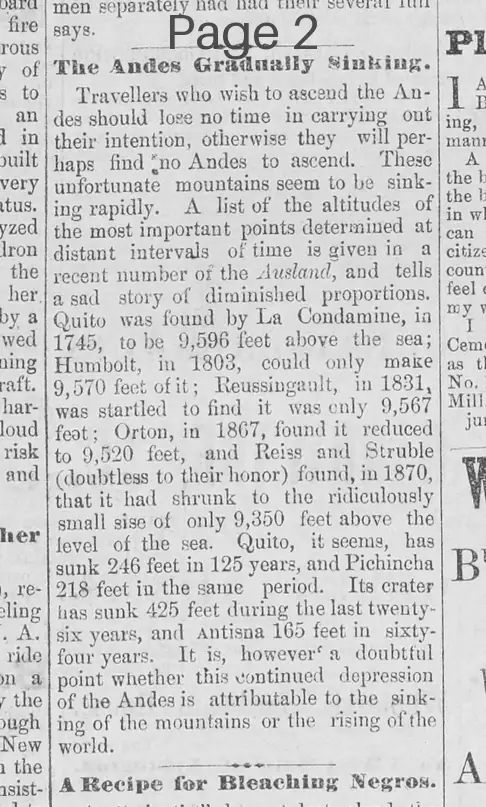
Travellers who wish to ascend the Andes should lose no time in carrying out their intention, otherwise they will perhaps find "no Andes to ascend." These unfortunate mountains seem to be sinking rapidly. A list of the altitudes of the most important points determined at distant intervals of time is given in a recent number of the Ausland, and tells a sad story of diminished proportions. Quito was found by La Condamine, in 1745. to be 9,596 feet above the sea; Humboldt, in 1803, could only make 9,570 feet of it; Boussingault, in 1831, was startled to find it was only 9,567 feet; Orton, in 1867, found it reduced to 9,520 feet, and Reiss and Stübel (doubtless to their horror) found, in 1870, that it had shrunk to the ridiculously small size of only 9,350 feet above the level of the sea. Quito, it seems, has sunk 246 feet in 125 years, and Pichincha 218 feet in the same period. Its crater has sunk 425 feet during the last twenty-six years, and Antisana 165 feet in sixty-four years. It is, however, a doubtful point whether this continued depression of the Andes is attributable to the sinking of the mountains or the rising of the world.
Travellers who wish to ascend the Andes should lose no time in carrying out their intention, otherwise they will perhaps find "no Andes to ascend." These unfortunate mountains seem to be sinking rapidly. A list of the altitudes of the most important points determined at distant intervals of time is given in a recent number of the Ausland, and tells a sad story of diminished proportions. Quito was found by La Condamine, in 1745. to be 9,596 feet above the sea; Humboldt, in 1803, could only make 9,570 feet of it; Boussingault, in 1831, was startled to find it was only 9,567 feet; Orton, in 1867, found it reduced to 9,520 feet, and Reiss and Stübel (doubtless to their horror) found, in 1870, that it had shrunk to the ridiculously small size of only 9,350 feet above the level of the sea. Quito, it seems, has sunk 246 feet in 125 years, and Pichincha 218 feet in the same period. Its crater has sunk 425 feet during the last twenty-six years, and Antisana 165 feet in sixty-four years. It is, however, a doubtful point whether this continued depression of the Andes is attributable to the sinking of the mountains or the rising of the world.
What sub-type of article is it?
Curiosity
Extraordinary Event
Historical Event
What themes does it cover?
Nature
Misfortune
What keywords are associated?
Andes Sinking
Altitude Measurements
Quito Elevation
Geological Depression
What entities or persons were involved?
La Condamine
Humboldt
Boussingault
Orton
Reiss
Stübel
Where did it happen?
Andes, Quito
Story Details
Key Persons
La Condamine
Humboldt
Boussingault
Orton
Reiss
Stübel
Location
Andes, Quito
Event Date
1745 1870
Story Details
Altitude measurements of Quito and other Andean points show progressive decline over 125 years, suggesting mountains sinking, though possibly due to rising sea levels.