Thank you for visiting SNEWPapers!
Sign up free
Literary
June 23, 1820
Richmond Enquirer
Richmond, Richmond County, Virginia
What is this article about?
Detailed report on the April 24-28 public examination at Hampden Sidney College, covering freshman to senior classes' winter and summer session studies in classics, mathematics, sciences, philosophy, and composition. Notes strong performances, especially seniors in philosophy, and praises the closing public orations.
Clipping
OCR Quality
95%
Excellent
Full Text
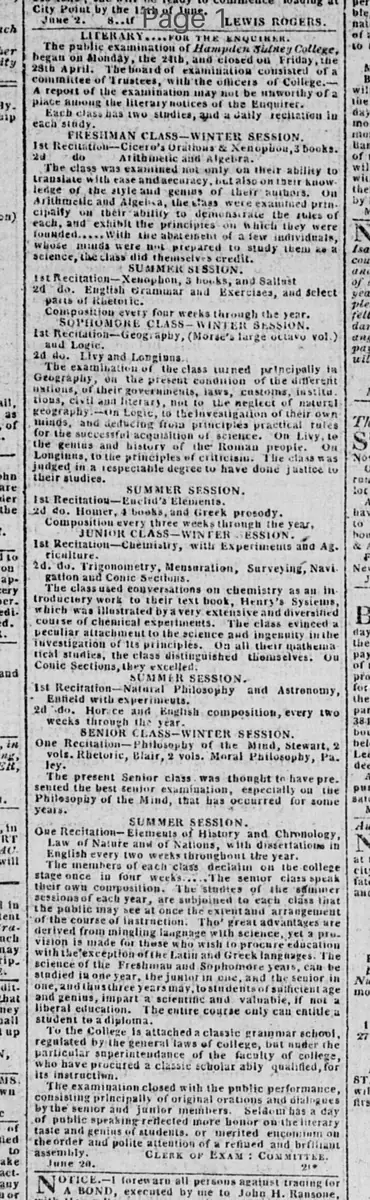
LITERARY...FOR THE ENQUIRER.
The public examination of Hampden Sidney College, began on Monday, the 24th, and closed on Friday, the 28th April. The board of examination consisted of a committee of Trustees, with the officers of College.—
A report of the examination may not be unworthy of a place among the literary notices of the Enquirer.
Each class has two studies, and a daily recitation in each study.
FRESHMAN CLASS—WINTER SESSION
1st Recitation—Cicero's Orations & Xenophon, 3 books.
2d do Arithmetic and Algebra.
The class was examined not only on their ability to translate with ease and accuracy, but also on their knowledge of the style and genius of their authors. On Arithmetic and Algebra, the class were examined principally on their ability to demonstrate the rules of each, and exhibit the principles on which they were founded..... With the abatement of a few individuals, whose minds were not prepared to study them as a science, the class did themselves credit.
SUMMER SESSION.
1st Recitation—Xenophon, 3 books, and Sallust
2d do. English Grammar and Exercises, and select parts of Rhetoric.
Composition every four weeks through the year.
SOPHOMORE CLASS—WINTER SESSION.
1st Recitation—Geography, (Morse's large octavo vol.) and Logic.
2d do. Livy and Longinus.
The examination of the class turned principally in Geography, on the present condition of the different nations, of their governments, laws, customs, institutions, civil and literary, not to the neglect of natural geography,—in Logic, to the investigation of their own minds, and deducing from principles practical rules for the successful acquisition of science. On Livy, to the genius and history of the Roman people. On Longinus, to the principles of criticism. The class was judged in a respectable degree to have done justice to their studies.
SUMMER SESSION.
1st Recitation—Euclid's Elements.
2d do. Homer, 4 books, and Greek prosody.
Composition every three weeks through the year,
JUNIOR CLASS—WINTER SESSION.
1st Recitation—Chemistry, with Experiments and Agriculture.
2d. do. Trigonometry, Mensuration, Surveying, Navigation and Conic Sections.
The class used conversations on chemistry as an introductory work to their text book, Henry's System, which was illustrated by a very extensive and diversified course of chemical experiments. The class evinced a peculiar attachment to the science and ingenuity in the investigation of its principles. On all their mathematical studies, the class distinguished themselves. On Conic Sections, they excelled.
SUMMER SESSION.
1st Recitation—Natural Philosophy and Astronomy, Enfield with experiments.
2d do. Horace and English composition, every two weeks through the year.
SENIOR CLASS—WINTER SESSION.
One Recitation—Philosophy of the Mind, Stewart, 2 vols. Rhetoric, Blair, 2 vols. Moral Philosophy, Paley.
The present Senior class. was thought to have presented the best senior examination, especially on the Philosophy of the Mind, that has occurred for some years.
SUMMER SESSION.
One Recitation—Elements of History and Chronology.
Law of Nature and of Nations, with dissertations in English every two weeks throughout the year.
The members of each class declaim on the college stage once in four weeks.....The senior class speak their own composition. The studies of the summer sessions of each year, are subjoined to each class that the public may see at once the extent and arrangement of the course of instruction. Tho' great advantages are derived from mingling language with science, yet a provision is made for those who wish to procure education within the exception of the Latin and Greek languages. The science of the Freshman and Sophomore years, can be studied in one year, the junior in one, and the senior in one, and thus three years may, to students of sufficient age and genius, impart a scientific and valuable, if not a liberal education. The entire course only can entitle a student to a diploma.
To the College is attached a classic grammar school, regulated by the general laws of college, but under the particular superintendence of the faculty of college, who have procured a classic scholar ably qualified, for its instruction.
The examination closed with the public performance, consisting principally of original orations and dialogues by the senior and junior members. Seldom has a day of public speaking reflected more honor on the literary taste and genius of students. or merited encomium on the order and polite attention of a refined and brilliant assembly.
CLERK OF EXAM. COMMITTEE.
June 20.
210
The public examination of Hampden Sidney College, began on Monday, the 24th, and closed on Friday, the 28th April. The board of examination consisted of a committee of Trustees, with the officers of College.—
A report of the examination may not be unworthy of a place among the literary notices of the Enquirer.
Each class has two studies, and a daily recitation in each study.
FRESHMAN CLASS—WINTER SESSION
1st Recitation—Cicero's Orations & Xenophon, 3 books.
2d do Arithmetic and Algebra.
The class was examined not only on their ability to translate with ease and accuracy, but also on their knowledge of the style and genius of their authors. On Arithmetic and Algebra, the class were examined principally on their ability to demonstrate the rules of each, and exhibit the principles on which they were founded..... With the abatement of a few individuals, whose minds were not prepared to study them as a science, the class did themselves credit.
SUMMER SESSION.
1st Recitation—Xenophon, 3 books, and Sallust
2d do. English Grammar and Exercises, and select parts of Rhetoric.
Composition every four weeks through the year.
SOPHOMORE CLASS—WINTER SESSION.
1st Recitation—Geography, (Morse's large octavo vol.) and Logic.
2d do. Livy and Longinus.
The examination of the class turned principally in Geography, on the present condition of the different nations, of their governments, laws, customs, institutions, civil and literary, not to the neglect of natural geography,—in Logic, to the investigation of their own minds, and deducing from principles practical rules for the successful acquisition of science. On Livy, to the genius and history of the Roman people. On Longinus, to the principles of criticism. The class was judged in a respectable degree to have done justice to their studies.
SUMMER SESSION.
1st Recitation—Euclid's Elements.
2d do. Homer, 4 books, and Greek prosody.
Composition every three weeks through the year,
JUNIOR CLASS—WINTER SESSION.
1st Recitation—Chemistry, with Experiments and Agriculture.
2d. do. Trigonometry, Mensuration, Surveying, Navigation and Conic Sections.
The class used conversations on chemistry as an introductory work to their text book, Henry's System, which was illustrated by a very extensive and diversified course of chemical experiments. The class evinced a peculiar attachment to the science and ingenuity in the investigation of its principles. On all their mathematical studies, the class distinguished themselves. On Conic Sections, they excelled.
SUMMER SESSION.
1st Recitation—Natural Philosophy and Astronomy, Enfield with experiments.
2d do. Horace and English composition, every two weeks through the year.
SENIOR CLASS—WINTER SESSION.
One Recitation—Philosophy of the Mind, Stewart, 2 vols. Rhetoric, Blair, 2 vols. Moral Philosophy, Paley.
The present Senior class. was thought to have presented the best senior examination, especially on the Philosophy of the Mind, that has occurred for some years.
SUMMER SESSION.
One Recitation—Elements of History and Chronology.
Law of Nature and of Nations, with dissertations in English every two weeks throughout the year.
The members of each class declaim on the college stage once in four weeks.....The senior class speak their own composition. The studies of the summer sessions of each year, are subjoined to each class that the public may see at once the extent and arrangement of the course of instruction. Tho' great advantages are derived from mingling language with science, yet a provision is made for those who wish to procure education within the exception of the Latin and Greek languages. The science of the Freshman and Sophomore years, can be studied in one year, the junior in one, and the senior in one, and thus three years may, to students of sufficient age and genius, impart a scientific and valuable, if not a liberal education. The entire course only can entitle a student to a diploma.
To the College is attached a classic grammar school, regulated by the general laws of college, but under the particular superintendence of the faculty of college, who have procured a classic scholar ably qualified, for its instruction.
The examination closed with the public performance, consisting principally of original orations and dialogues by the senior and junior members. Seldom has a day of public speaking reflected more honor on the literary taste and genius of students. or merited encomium on the order and polite attention of a refined and brilliant assembly.
CLERK OF EXAM. COMMITTEE.
June 20.
210
What sub-type of article is it?
Essay
What keywords are associated?
Hampden Sidney College
Public Examination
Class Recitations
Curriculum
Student Performance
What entities or persons were involved?
Clerk Of Exam. Committee.
Literary Details
Author
Clerk Of Exam. Committee.
Subject
Public Examination Of Hampden Sidney College, April 24 28
Form / Style
Prose Report On Curriculum And Student Performance