Thank you for visiting SNEWPapers!
Sign up free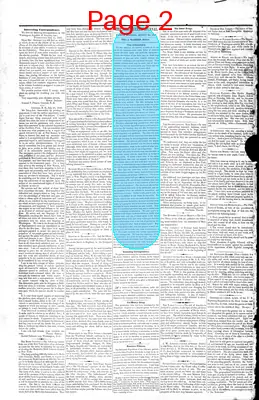
Editorial
August 20, 1852
Camden Journal
Camden, Kershaw County, South Carolina
What is this article about?
Editorial urges Missouri citizens to develop lumber resources using steam mills for profit, critiques over-reliance on cotton farming, and advocates prioritizing provision crops for self-sufficiency and economic stability.
Clipping
OCR Quality
98%
Excellent
Full Text
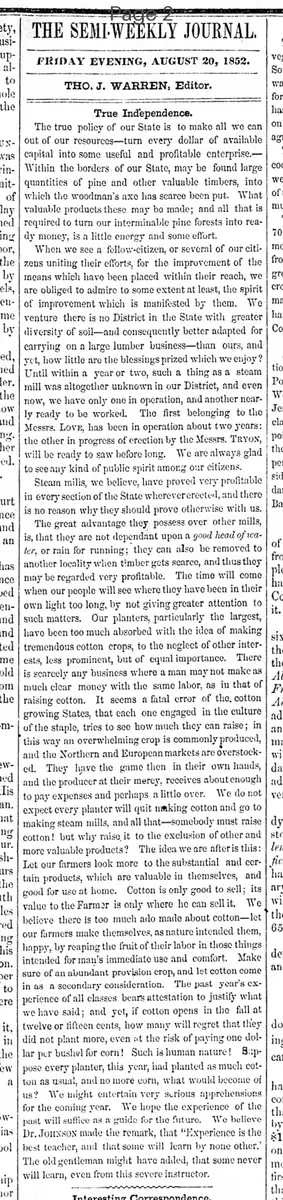
THE SEMI-WEEKLY JOURNAL
FRIDAY EVENING, AUGUST 20, 1852.
THOS. J. WARREN, Editor
True Independence.
The true policy of our State is to make all we can out of our resources—turn every dollar of available capital into some useful and profitable enterprise. Within the borders of our State, may be found large quantities of pine and other valuable timbers, into which the woodman's axe has scarce been put. What valuable products these may be made; and all that is required to turn our interminable pine forests into ready money, is a little energy and some effort.
When we see a fellow-citizen, or several of our citizens uniting their efforts, for the improvement of the means which have been placed within their reach, we are obliged to admire to some extent at least, the spirit of improvement which is manifested by them. We venture there is no District in the State with greater diversity of soil and consequently better adapted for carrying on a large lumber business—than ours, and yet, how little are the blessings prized which we enjoy? Until within a year or two, such a thing as a steam mill was altogether unknown in our District, and even now, we have only one in operation, and another nearly ready to be worked. The first belonging to the Messrs. Love, has been in operation about two years: the other in progress of erection by the Messrs. Tryon, will be ready to saw before long. We are always glad to see any kind of public spirit among our citizens.
Steam mills, we believe, have proved very profitable in every section of the State wherever erected, and there is no reason why they should prove otherwise with us. The great advantage they possess over other mills, is, that they are not dependant upon a good head of water, or rain for running; they can also be removed to another locality when timber gets scarce, and thus they may be regarded very profitable. The time will come when our people will see where they have been in their own light too long, by not giving greater attention to such matters. Our planters, particularly the largest, have been too much absorbed with the idea of making tremendous cotton crops, to the neglect of other interests, less prominent, but of equal importance. There is scarcely any business where a man may not make as much clear money with the same labor, as in that of raising cotton. It seems a fatal error of the cotton growing States, that each one engaged in the culture of the staple, tries to see how much they can raise; in this way an overwhelming crop is commonly produced, and the Northern and European markets are overstocked. They have the game then in their own hands and the producer at their mercy, receives about enough to pay expenses and perhaps a little over. We do not expect every planter will quit making cotton and go to making steam mills, and all that—somebody must raise cotton! but why raise it to the exclusion of other and more valuable products? The idea we are after is this: Let our farmers look more to the substantial and certain products, which are valuable in themselves, and good for use at home. Cotton is only good to sell; its value to the Farmer is only where he can sell it. We believe there is too much ado made about cotton—let our farmers make themselves, as nature intended them, happy, by reaping the fruit of their labor in those things intended for man's immediate use and comfort. Make sure of an abundant provision crop, and let cotton come in as a secondary consideration. The past year's experience of all classes bears attestation to justify what we have said; and yet, if cotton opens in the fall at twelve or fifteen cents, how many will regret that they did not plant more, even at the risk of paying one dollar per bushel for corn! Such is human nature! Suppose every planter, this year, had planted as much cotton as usual, and no more corn, what would become of us? We might entertain very serious apprehensions for the coming year. We hope the experience of the past will suffice as a guide for the future. We believe Dr. Johnson made the remark, that "Experience is the best teacher, and that some will learn by none other." The old gentleman might have added, that some never will learn, even from this severe instructor.
FRIDAY EVENING, AUGUST 20, 1852.
THOS. J. WARREN, Editor
True Independence.
The true policy of our State is to make all we can out of our resources—turn every dollar of available capital into some useful and profitable enterprise. Within the borders of our State, may be found large quantities of pine and other valuable timbers, into which the woodman's axe has scarce been put. What valuable products these may be made; and all that is required to turn our interminable pine forests into ready money, is a little energy and some effort.
When we see a fellow-citizen, or several of our citizens uniting their efforts, for the improvement of the means which have been placed within their reach, we are obliged to admire to some extent at least, the spirit of improvement which is manifested by them. We venture there is no District in the State with greater diversity of soil and consequently better adapted for carrying on a large lumber business—than ours, and yet, how little are the blessings prized which we enjoy? Until within a year or two, such a thing as a steam mill was altogether unknown in our District, and even now, we have only one in operation, and another nearly ready to be worked. The first belonging to the Messrs. Love, has been in operation about two years: the other in progress of erection by the Messrs. Tryon, will be ready to saw before long. We are always glad to see any kind of public spirit among our citizens.
Steam mills, we believe, have proved very profitable in every section of the State wherever erected, and there is no reason why they should prove otherwise with us. The great advantage they possess over other mills, is, that they are not dependant upon a good head of water, or rain for running; they can also be removed to another locality when timber gets scarce, and thus they may be regarded very profitable. The time will come when our people will see where they have been in their own light too long, by not giving greater attention to such matters. Our planters, particularly the largest, have been too much absorbed with the idea of making tremendous cotton crops, to the neglect of other interests, less prominent, but of equal importance. There is scarcely any business where a man may not make as much clear money with the same labor, as in that of raising cotton. It seems a fatal error of the cotton growing States, that each one engaged in the culture of the staple, tries to see how much they can raise; in this way an overwhelming crop is commonly produced, and the Northern and European markets are overstocked. They have the game then in their own hands and the producer at their mercy, receives about enough to pay expenses and perhaps a little over. We do not expect every planter will quit making cotton and go to making steam mills, and all that—somebody must raise cotton! but why raise it to the exclusion of other and more valuable products? The idea we are after is this: Let our farmers look more to the substantial and certain products, which are valuable in themselves, and good for use at home. Cotton is only good to sell; its value to the Farmer is only where he can sell it. We believe there is too much ado made about cotton—let our farmers make themselves, as nature intended them, happy, by reaping the fruit of their labor in those things intended for man's immediate use and comfort. Make sure of an abundant provision crop, and let cotton come in as a secondary consideration. The past year's experience of all classes bears attestation to justify what we have said; and yet, if cotton opens in the fall at twelve or fifteen cents, how many will regret that they did not plant more, even at the risk of paying one dollar per bushel for corn! Such is human nature! Suppose every planter, this year, had planted as much cotton as usual, and no more corn, what would become of us? We might entertain very serious apprehensions for the coming year. We hope the experience of the past will suffice as a guide for the future. We believe Dr. Johnson made the remark, that "Experience is the best teacher, and that some will learn by none other." The old gentleman might have added, that some never will learn, even from this severe instructor.
What sub-type of article is it?
Agriculture
Economic Policy
What keywords are associated?
True Independence
Lumber Business
Steam Mills
Cotton Crops
Economic Diversification
Provision Crops
Agricultural Policy
What entities or persons were involved?
Thos. J. Warren
Messrs. Love
Messrs. Tryon
Dr. Johnson
Editorial Details
Primary Topic
Promoting Lumber Development And Agricultural Diversification Over Cotton Monoculture
Stance / Tone
Advocacy For Economic Self Sufficiency And Resource Utilization
Key Figures
Thos. J. Warren
Messrs. Love
Messrs. Tryon
Dr. Johnson
Key Arguments
State Should Maximize Resources Like Pine Forests For Profit Through Energy And Effort
Local District Ideal For Lumber Business But Underutilized
Steam Mills Profitable, Independent Of Water, And Mobile
Planters Overly Focused On Cotton, Neglecting Other Interests
Overproduction Of Cotton Leads To Low Prices And Market Dependency
Prioritize Provision Crops For Home Use Over Cotton As Secondary
Past Experience Shows Risks Of Insufficient Corn Production