Thank you for visiting SNEWPapers!
Sign up free
Kentucky Gazette And General Advertiser
Lexington, Fayette County, Kentucky
What is this article about?
An anonymous citizen from St. Louis defends Governor James Wilkinson against calumnious articles signed 'An American' in the Kentucky Gazette, denying party divisions and persecutions in Louisiana Territory, and exposing the fraudulent characters of Wilkinson's opponents like Easton, Hunt, and Lucas.
Merged-components note: Continuation of the same signed letter to the editor defending Governor Wilkinson, split across pages due to parsing.
Clippings
1 of 2
OCR Quality
Full Text
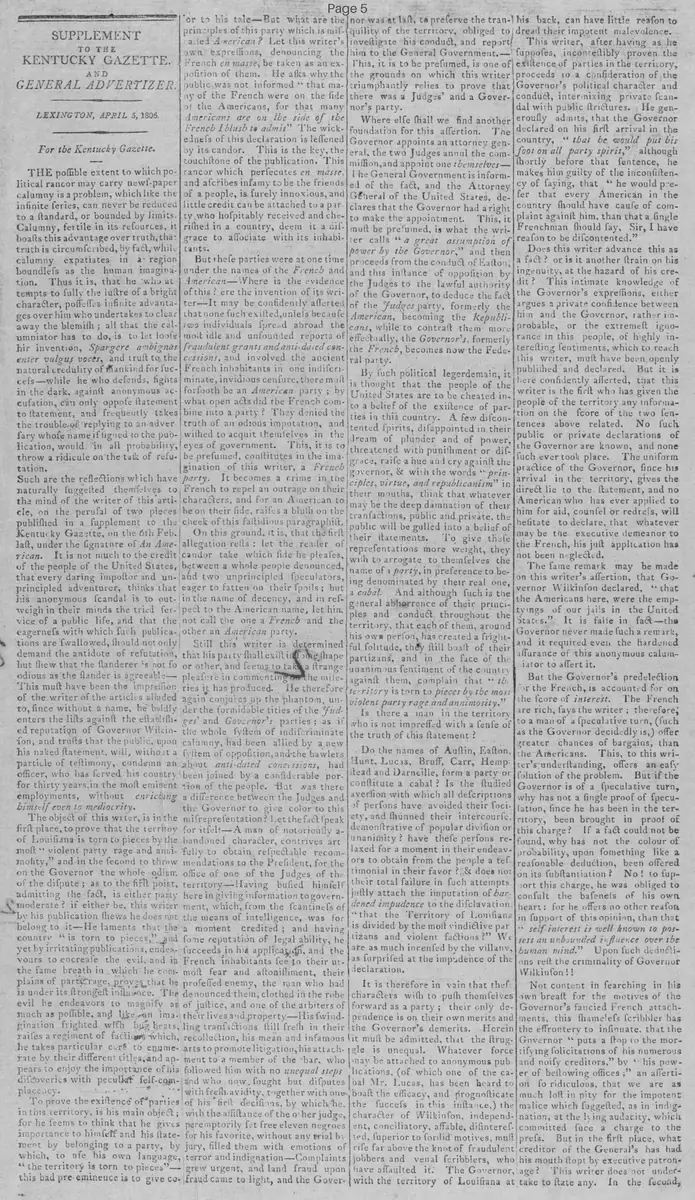
THE possible extent to which political rancor may carry newspaper calumny is a problem, which like the infinite series, can never be reduced to a standard, or bounded by limits. Calumny, fertile in its resources, it boasts this advantage over truth, that truth is circumscribed, by fact, while calumny expatiates in a region boundless as the human imagination. Thus it is, that he who attempts to sully the lustre of a bright character, possesses infinite advantages over him who undertakes to clear away the blemish; all that the calumniator has to do, is to let loose his invention, Spargere ambiguas in vulgus voces, and trust to the natural credulity of mankind for success-while he who defends, fights in the dark, against anonymous accusation, can only oppose statement to statement, and frequently takes the trouble of replying to an adversary whose name if signed to the publication, would in all probability, throw a ridicule on the task of refutation.
Such are the reflections which have naturally suggested themselves to the mind of the writer of this article, on the perusal of two pieces published in a supplement to the Kentucky Gazette, on the 6th Feb. last, under the Signature of An American. It is not much to the credit of the people of the United States, that every daring impostor and unprincipled adventurer, thinks that his anonymous scandal is to outweigh in their minds the tried service of a public life, and that the eagerness with which such publications are swallowed, should not only demand the antidote of refutation, but show that the slanderer is not so odious as the slander is agreeable-
This must have been the impression of the writer of the articles alluded to, since without a name, he boldly enters the lists against the established reputation of Governor Wilkinson, and trusts that the public, upon his naked statement, will, without a particle of testimony, condemn an officer, who has served his country for thirty years, in the most eminent employments, without enriching himself even to mediocrity.
The object of this writer, is in the first place, to prove that the territory of Louisiana is torn to pieces by the most violent party rage and animosity, and in the second to throw on the Governor the whole odium of the dispute; as to the first point, admitting the fact, is either party moderate? if either be, this writer by his publication shows he does not belong to it--He laments that the country is torn to pieces, and yet by irritating publications, endeavors to increase the evil, and in the same breath in which he complains of party rage, proves that he is under its strongest influence. The evil he endeavors to magnify as much as possible, and like an imagination frighted with bug bears, raises a regiment of factions which, he takes particular care to enumerate by their different titles, and appears to enjoy the importance of his discoveries with peculiar self-complacency.
To prove the existence of parties in this territory, is his main object; for he seems to think that he gives importance to himself and his statement by belonging to a party, by which, to use his own language, the territory is torn to pieces— this bad pre-eminence is to give co-
What appointment can the Governor give, which could put an end to the mortifying solicitations of a creditor? Is it the office of a judge of the inferior courts? The trouble is great, and no compensation is attached to it—sheriff? clerk? coroners? In this country, they will scarcely afford a bare maintenance to a single man. The charge is as absurd as it is false, and rancour seems exhausted in its invention.
Passing over the florid stuff with which the American concludes his first piece, and in which with unexampled effrontery, he entreats the government, in the name of the people of Louisiana, to remove from office the man, whom but a few days before, they had cheerfully crowded around, to support against the malice of his detractors; as well as the commencement of his second address, wherein, as if untired with falsehood, he commences anew; but disinterestedly declares, 'that nothing less urgent than the defence of the principles of republicanism, could induce him again to intrude,' passing far over to his learned discovery, that a good Monarchy is better than a bad Republic: and his ingenious explanation of Pope's maxim—
'On forms of government let fools contest
That which is best administered is best.'
A sentiment which this disinterested friend to the rights of man, seems to have made a part of his creed. I come again to his main object, his attack on the character of Governor Wilkinson.
Again, in his setting forth, he resorts to the old hackneyed story of the country 'being divided by parties.' and that the Governor is at the 'head of one, and persecuting the other with all the vengeance of power.' Again is the existence of parties in the most solemn manner denied, and the evidence, of even the subscription of thirty names, in behalf of the cabal, demanded in proof of the assertion. The Governor then, cannot be said, with the slightest foundation of probability, to 'persecute a party.' Men lost to decency, and abandoned in character, swindlers by profession, and practising the very acts, concerning which they have raised such a clamour, he has investigated, detected and disgraced. Easton in his robbery of Fine and Gerard—Hunt in his attempt to suborn Dodge, and his purchase of a concession, which he sells to Smith, and then prosecutes Smith for settling—Hempstead for receiving fees on both sides, and by a surreptitious and false affidavit, swearing that the Governor had packed a jury. Bruff as being connected with Easton, in one of his basest transactions—Carr in prevailing on a cripple of the name of Coan, ignorant of the provisions of the law in his favour, to sell his fine tract of cultivated land, on the river St. Francois, consisting of eleven hundred and fifty acres, French measure, for one hundred dollars, and with the hard-hearted coldness of avarice, refusing to yield up the prize to the prayers and entreaties of the victim of his credulity—Darnielle; but of him I need not speak, his character is too infamous and notorious to be dwelled on. What shall be said of Lucas?—Lucas whose rancour exceeds common bounds, who hates with an enmity as deadly as death, and can put on the liberal garb of moderation, while his slanders strike to the heart; him the Governor has in no instance retaliated on, although attacked by him in a thousand different forms of offence, considered as the life of the cabal, and lately detected in the most unjustifiable, and cowardly mode of aggressions, and detecting such conduct, a great part of which is levelled against himself, is called in the Governor's persecution.
Upon this ground it is, that this writer proceeds to charge the Governor with 'establishing his office into a court of inquisition,' and that he takes upon himself to investigate the private character and conduct of 'individuals.'— But of what individuals? Of those who held public employments, and who might fancy that their office was their shield—whose example was more dangerous, because more public—whom the individual trembled to expose, and whose conduct was a matter of deep interest to the general government; since the respectability of that government here, depended on the integrity of the officers it interested. Nor did the Governor take an under advantage of any man; he always gave them notice of the charge, and the time and place of substantiating it; while his unprincipled opponents, hushed up their attacks in privacy, and by their secret affidavits, meditated the blow they did not dare openly to strike; trusting that the general government would credit testimony, of which the party inculpated, had no notice; nor did the Governor, as the writer absurdly and falsely alleges, thus interfere with, or prevent the courts of justice from executing their legitimate functions. As chief Magistrate of the territory, he was bound to investigate enormities, upon complaint being made, and when investigated, to report them to the general government; but this certainly ousted no court of jurisdiction, nor prevented the due punishment of offences. It is true, that the Grand Inquest of the territory was arrested in their investigation of the frauds of Easton, then sitting on the bench, and severely reprimanded, for daring to call before them, and examine witnesses to his impositions, without the consent and approbation of the court's Attorney General. It is true,—that the judgment of the general court reduced grand juries to a form, and provided a complete legal indemnity for the frauds and misdemeanors of a judge.
After what has been said, is it to be wondered at, if the Governor felt reluctant to meet in the business of legislation; a man infamous and abandoned beyond the common measure of iniquity, associated with another, the open, sworn, and relentless enemy to himself, and of the territory? What honest man would have consented, knowing their sentiments and characters to commit the dearest interests of the territory into their hands? Among the causes of gratitude which this people are happy to acknowledge, they owe to the name of Wilkinson, that he had the fortitude to determine, that neither Lucas nor Easton should make laws for them.
I stop not for want of matter, but through weariness and disgust. Much slanderous matter remains to be refuted, much absurd and impertinent to be exposed; but it is painful to a mind possessed of the least feeling, to contemplate for a time, the dark side of the human character. Long since it was publicly boasted, that there was a member of this cabal, '*who could write letters of eight pages in length to government;' and this scribbler it is probable is the same, who has thus endeavoured to sew poison with his pen. Of him also, it was said, that the* 'news-papers would teem with his publications, on his way to the seat of government.' The last desperate hope is placed on this miserable shift, by the degraded, despised few who have lost by his departure, one of their principal supports; but this, their extreme hope and last dependence, must fail them. The people of Louisiana trust too much to the justice of government, to the good sense and plain dealing of the people of the United States, to augur consequences injurious to their interests and happiness. With a firm reliance on the providence of God, and a well-founded expectation of the justice of man, they anxiously, but confidently await the issue.
ANOTHER CITIZEN
Of St. Louis.
St. Louis, March 9th, 1806.
By Judge Lucas.
Maj. Seth Hunt
What sub-type of article is it?
What themes does it cover?
What keywords are associated?
What entities or persons were involved?
Letter to Editor Details
Author
Another Citizen Of St. Louis
Recipient
Kentucky Gazette
Main Argument
the letter defends governor wilkinson against anonymous calumnies by 'an american' in the kentucky gazette, denying party persecutions in louisiana territory and exposing the fraudulent and immoral characters of his accusers, arguing that wilkinson's investigations were justified duties as chief magistrate.
Notable Details