Thank you for visiting SNEWPapers!
Sign up free
Letter to Editor
June 8, 1812
Alexandria Daily Gazette, Commercial & Political
Alexandria, Virginia
What is this article about?
In April 1812, Congressman Edwin Gray addresses constituents on U.S. finances, opposes offensive war with Britain over neutral rights and Canada, criticizes Republican hypocrisy on taxes and loans, and condemns the unconstitutional $50,000 payment to British spy John Henry by Madison's administration.
Clipping
OCR Quality
98%
Excellent
Full Text
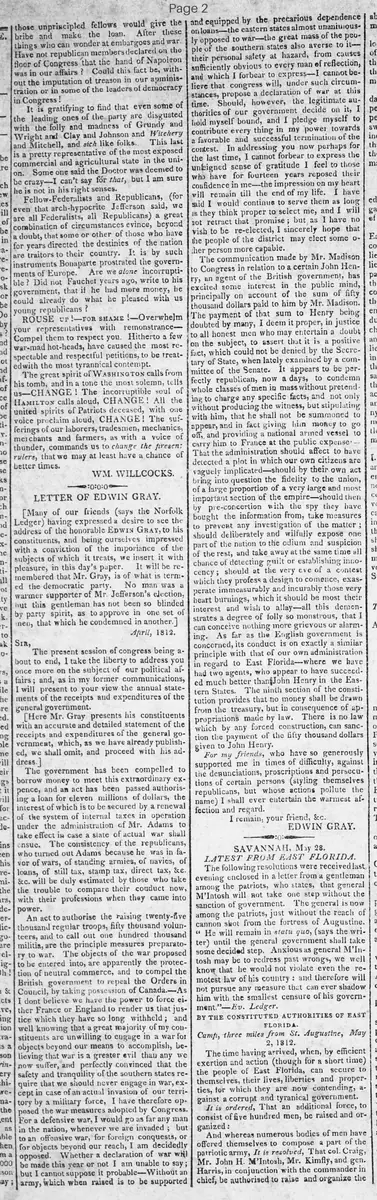
LETTER OF EDWIN GRAY.
[Many of our friends (says the Norfolk Ledger) having expressed a desire to see the address of the honorable Edwin Gray, to his constituents, and being ourselves impressed with a conviction of the importance of the subjects of which it treats, we insert it with pleasure, in this day's paper. It will be remembered that Mr. Gray, is of what is termed the democratic party. No man was a warmer supporter of Mr Jefferson's election, but this gentleman has not been so blinded by party spirit, as to approve in one set of men, that which he condemned in another.]
April, 1812.
SIR,
The present session of congress being about to end, I take the liberty to address you once more on the subject of our political affairs; and, as in my former communications, I will present to your view the annual statements of the receipts and expenditures of the general government.
[Here Mr. Gray presents his constituents with an accurate and detailed statement of the receipts and expenditures of the general government, which, as we have already published, we shall omit, and proceed with his address.]
The government has been compelled to borrow money to meet this extraordinary expense, and an act has been passed authorising a loan for eleven millions of dollars, the interest of which is to be secured by a renewal of the system of internal taxes in operation under the administration of Mr. Adams to take effect in case a state of actual war shall ensue. The consistency of the republicans, who turned out Adams because he was in favor of wars, of standing armies, of navies, of loans, of still tax, stamp tax, direct tax, &c. &c. will be duly estimated by those who take the trouble to compare their conduct now, with their professions when they came into power.
An act to authorise the raising twenty-five thousand regular troops, fifty thousand volunteers, and to call out one hundred thousand militia, are the principle measures preparatory to war. The objects of the war proposed to be entered into, are apparently the protection of neutral commerce, and to compel the British government to repeal the Orders in Council, by taking possession of Canada.—As I dont believe we have the power to force either France or England to render us that justice which they have so long withheld; and well knowing that a great majority of my constituents are unwilling to engage in a war for objects beyond our means to accomplish, believing that war is a greater evil than any we now suffer, and perfectly convinced that the safety and tranquility of the southern states require that we should never engage in war, except in case of an actual invasion of our territory by a military force, I have therefore opposed the war measures adopted by Congress.
For a defensive war, I would go as far any man in the nation, whenever we are invaded; but to an offensive war, for foreign conquests, or for objects beyond our reach, I am decidedly opposed. Whether a declaration of war will be made this year or not I am unable to say; but I cannot suppose it probable—Without an army, which when raised is to be supported and equipped by the precarious dependence on loans—the eastern states almost unanimously opposed to war—the great mass of the people of the southern states also averse to it—and which I forbear to express—I cannot believe that congress will, under such circumstances, propose a declaration of war at this time. Should, however, the legitimate authorities of our government decide on it, I hold myself bound, and I pledge myself to contribute every thing in my power towards a favorable and successful termination of the contest. In addressing you now perhaps for the last time, I cannot forbear to express the unfeigned sense of gratitude I feel to those who have for fourteen years reposed their confidence in me—the impression on my heart will remain till the end of my life. I have said I would continue to serve them as long as they think proper to select me, and I will not retract that promise; but as I have no wish to be re-elected, I sincerely hope that the people of the district may elect some other person more capable.
The communication made by Mr. Madison to Congress in relation to a certain John Henry, an agent of the British government, has excited some interest in the public mind, principally on account of the sum of fifty thousand dollars paid to him by Mr. Madison. The payment of that sum to Henry being doubted by many, I deem it proper, in justice to all honest men who may entertain a doubt on the subject, to assert that it is a positive fact, which could not be denied by the Secretary of State, when lately examined by a committee of the Senate. It appears to be perfectly republican, now a days, to condemn whole classes of men in mass without pretending to charge any specific facts, and not only without producing the witness, but stipulating with him, that he shall not be summoned to appear, and in fact giving him money to go off, and providing a national armed vessel to carry him to France at the public expense'—That the administration should affect to have detected a plot in which our own citizens are vaguely implicated—should by their own act bring into question the fidelity to the union, of a large proportion of a very large and most important section of the empire—should then by pre-concertion with the spy they have bought the information from, take measures to prevent any investigation of the matter; should deliberately and wilfully expose one part of the nation to the odium and suspicion of the rest, and take away at the same time all chance of detecting guilt or establishing innocence; should at the very eve of a contest which they profess a design to commence, exasperate immeasurably and incurably those very heart burnings, which it should be most their interest and wish to allay—all this demonstrates a degree of folly so monstrous, that I can conceive nothing more grievous or alarming. As far as the English government is concerned, its conduct is on exactly a similar principle with that of our own administration in regard to East Florida—where we have had two agents, who appear to have succeeded much better than John Henry in the Eastern States. The ninth section of the constitution provides that no money shall be drawn from the treasury, but in consequence of appropriations made by law. There is no law which by any forced construction, can sanction the payment of the fifty thousand dollars given to John Henry.
For my friends, who have so generously supported me in times of difficulty, against the denunciations, proscriptions and persecutions of certain persons (styling themselves republicans, but whose actions pollute the name) I shall ever entertain the warmest affection and regard.
I remain, your friend, &c.
EDWIN GRAY.
[Many of our friends (says the Norfolk Ledger) having expressed a desire to see the address of the honorable Edwin Gray, to his constituents, and being ourselves impressed with a conviction of the importance of the subjects of which it treats, we insert it with pleasure, in this day's paper. It will be remembered that Mr. Gray, is of what is termed the democratic party. No man was a warmer supporter of Mr Jefferson's election, but this gentleman has not been so blinded by party spirit, as to approve in one set of men, that which he condemned in another.]
April, 1812.
SIR,
The present session of congress being about to end, I take the liberty to address you once more on the subject of our political affairs; and, as in my former communications, I will present to your view the annual statements of the receipts and expenditures of the general government.
[Here Mr. Gray presents his constituents with an accurate and detailed statement of the receipts and expenditures of the general government, which, as we have already published, we shall omit, and proceed with his address.]
The government has been compelled to borrow money to meet this extraordinary expense, and an act has been passed authorising a loan for eleven millions of dollars, the interest of which is to be secured by a renewal of the system of internal taxes in operation under the administration of Mr. Adams to take effect in case a state of actual war shall ensue. The consistency of the republicans, who turned out Adams because he was in favor of wars, of standing armies, of navies, of loans, of still tax, stamp tax, direct tax, &c. &c. will be duly estimated by those who take the trouble to compare their conduct now, with their professions when they came into power.
An act to authorise the raising twenty-five thousand regular troops, fifty thousand volunteers, and to call out one hundred thousand militia, are the principle measures preparatory to war. The objects of the war proposed to be entered into, are apparently the protection of neutral commerce, and to compel the British government to repeal the Orders in Council, by taking possession of Canada.—As I dont believe we have the power to force either France or England to render us that justice which they have so long withheld; and well knowing that a great majority of my constituents are unwilling to engage in a war for objects beyond our means to accomplish, believing that war is a greater evil than any we now suffer, and perfectly convinced that the safety and tranquility of the southern states require that we should never engage in war, except in case of an actual invasion of our territory by a military force, I have therefore opposed the war measures adopted by Congress.
For a defensive war, I would go as far any man in the nation, whenever we are invaded; but to an offensive war, for foreign conquests, or for objects beyond our reach, I am decidedly opposed. Whether a declaration of war will be made this year or not I am unable to say; but I cannot suppose it probable—Without an army, which when raised is to be supported and equipped by the precarious dependence on loans—the eastern states almost unanimously opposed to war—the great mass of the people of the southern states also averse to it—and which I forbear to express—I cannot believe that congress will, under such circumstances, propose a declaration of war at this time. Should, however, the legitimate authorities of our government decide on it, I hold myself bound, and I pledge myself to contribute every thing in my power towards a favorable and successful termination of the contest. In addressing you now perhaps for the last time, I cannot forbear to express the unfeigned sense of gratitude I feel to those who have for fourteen years reposed their confidence in me—the impression on my heart will remain till the end of my life. I have said I would continue to serve them as long as they think proper to select me, and I will not retract that promise; but as I have no wish to be re-elected, I sincerely hope that the people of the district may elect some other person more capable.
The communication made by Mr. Madison to Congress in relation to a certain John Henry, an agent of the British government, has excited some interest in the public mind, principally on account of the sum of fifty thousand dollars paid to him by Mr. Madison. The payment of that sum to Henry being doubted by many, I deem it proper, in justice to all honest men who may entertain a doubt on the subject, to assert that it is a positive fact, which could not be denied by the Secretary of State, when lately examined by a committee of the Senate. It appears to be perfectly republican, now a days, to condemn whole classes of men in mass without pretending to charge any specific facts, and not only without producing the witness, but stipulating with him, that he shall not be summoned to appear, and in fact giving him money to go off, and providing a national armed vessel to carry him to France at the public expense'—That the administration should affect to have detected a plot in which our own citizens are vaguely implicated—should by their own act bring into question the fidelity to the union, of a large proportion of a very large and most important section of the empire—should then by pre-concertion with the spy they have bought the information from, take measures to prevent any investigation of the matter; should deliberately and wilfully expose one part of the nation to the odium and suspicion of the rest, and take away at the same time all chance of detecting guilt or establishing innocence; should at the very eve of a contest which they profess a design to commence, exasperate immeasurably and incurably those very heart burnings, which it should be most their interest and wish to allay—all this demonstrates a degree of folly so monstrous, that I can conceive nothing more grievous or alarming. As far as the English government is concerned, its conduct is on exactly a similar principle with that of our own administration in regard to East Florida—where we have had two agents, who appear to have succeeded much better than John Henry in the Eastern States. The ninth section of the constitution provides that no money shall be drawn from the treasury, but in consequence of appropriations made by law. There is no law which by any forced construction, can sanction the payment of the fifty thousand dollars given to John Henry.
For my friends, who have so generously supported me in times of difficulty, against the denunciations, proscriptions and persecutions of certain persons (styling themselves republicans, but whose actions pollute the name) I shall ever entertain the warmest affection and regard.
I remain, your friend, &c.
EDWIN GRAY.
What sub-type of article is it?
Political
Persuasive
Provocative
What themes does it cover?
Politics
Military War
Economic Policy
What keywords are associated?
Edwin Gray
War Opposition
John Henry
Government Finances
Republican Inconsistency
British Orders
Constitutional Violation
Military Preparations
What entities or persons were involved?
Edwin Gray
Sir
Letter to Editor Details
Author
Edwin Gray
Recipient
Sir
Main Argument
edwin gray opposes war measures against britain as beyond u.s. means and inconsistent with republican principles, criticizes the handling of the john henry affair as a violation of the constitution and an attempt to incite division, and expresses gratitude to his constituents while declining re-election.
Notable Details
Presents Receipts And Expenditures Of Government
Authorizes Loan For Eleven Millions And Internal Taxes
Raises Troops And Militia Preparatory To War
Objects Include Protection Of Neutral Commerce And Repeal Of British Orders In Council
Pledges Support If War Declared
Fifty Thousand Dollars Paid To John Henry
No Law Sanctions The Payment Per Constitution Section 9