Thank you for visiting SNEWPapers!
Sign up free
Virginia Argus
Richmond, Virginia
What is this article about?
American merchant and consul Richard Meade imprisoned in Cadiz, Spain, for refusing to refund payment on Spanish government debts he had advanced. Incident highlights Spanish financial desperation and mistreatment of US interests, prompting consular remonstrance.
Clipping
OCR Quality
Full Text
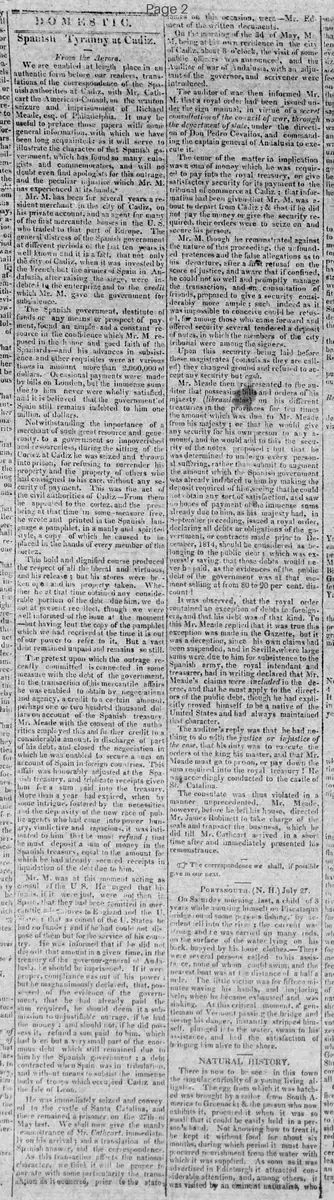
Spanish Tyranny at Cadiz
Extracted from the Jeronie.
We are enabled at length to place in an authentic form before our readers, translations of the correspondence of the Spanish authorities at Cadiz, with Mr. Cathcart the American Consul, on the wanton seizure and imprisonment of Richard Meade, esq. of Philadelphia. It may be useful to preface those papers with some general information, with which we have been long acquainted: as it will serve to illustrate the character of that Spanish government, which has found so many eulogists and commentators, and will no doubt even find apologists for this outrage, and the peculiar injustice which Mr. M. has experienced at its hands.
Mr. M. has been for several years a resident merchant in the city of Cadiz, on his private account, and an agent for many of the first mercantile houses in the U. S. who traded to that part of Europe. The general distress of the Spanish government at different periods of the last ten years is well known and it is a fact, that not only the city of Cadiz, when it was invested by the French but the armies of Spain in Andalusia, after raising the siege, were indebted to the enterprize and to the credit which Mr. M. gave the government for subsistence.
The Spanish government, destitute of funds or any means or prospect of payment, found an ample and a constant resource in the confidence which Mr. M. reposed in the honor and good faith of the Spaniards--and his advances in subsistence and other requisites were at various times in amount more than 2,000,000 of dollars. Occasional payments were made by bills on London, but the immense sums due to him never were wholly satisfied, and it is believed that the government of Spain still remains indebted to him one million of dollars.
Notwithstanding the importance of a merchant of such great resource and generosity, to a government so impoverished and resourceless, during the sitting of the Cortez at Cadiz he was seized and thrown into prison, for refusing to surrender his property and the property of others who had consigned to his care, without any security of payment. This was the act of the civil authorities of Cadiz--From them he appealed to the cortez, and the press being at that time in some measure free, he wrote and printed in the Spanish language a pamphlet, in a manly and spirited style, a copy of which he caused to be placed in the hands of every member of the cortez.
This bold and dignified course produced the respect of all the liberal and virtuous, and his release; but his stores were broken open and his property taken. Whether he at that time obtained any considerable portion of the debt due him, we do not at present recollect, though we were well informed of the issue at the moment--but having lent the copy of the pamphlet which we had received at the time it is out of our power to refer to it. But a vast debt remained unpaid and remains so still.
The pretext upon which the outrage recently committed is connected in some measure with the debt of the government. In the transaction of his mercantile affairs he was enabled to obtain by negotiations and agency, a credit to a certain amount, perhaps one or two hundred thousand dollars on account of the Spanish treasury.
Mr. Meade with the consent of the authorities employed this and further credit to a considerable amount, in discharge of part of his debt, and closed the negotiation in which he was enabled to secure a sum on account of Spain in foreign countries. This affair was honorably adjusted at the Spanish treasury, and triplicate receipts given him for a sum paid into the treasury.
More than a year had expired, when by some intrigue, fostered by the necessities and the depravity of the new race of public agents, who had come into power hungry, vindictive and rapacious, it was intimated to him that he must refund; that he must deposit a sum of money in the Spanish treasury, equal to the amount for which he had already secured receipts in liquidation of the debt due to him.
Mr. M. was at this moment acting as consul of the U S. He urged that his funds, if it were just, were not then in Spain, that they had been remitted in mercantile adventures to England and the U. States: that as consul of the U. States he had no funds; and if he had could not dispose of them but for the service of his country. He was informed that if he did not deposit that amount in a given time, in the treasury of the governor-general of Andalusia, he should be imprisoned. If it were proper, compliance was out of his power: but he magnanimously declared, that, possessed of the evidence of the government, that he had already paid the sum required, he should deem it a submission to unjustifiable outrage, if he had the money: and should not, if he did possess it, refund a sum paid to him, which had been but a very small part of the enormous debt which still remained due to him by the Spanish government: a debt contracted when Spain was in tribulation, and without means to subsist the immense body of troops which occupied Cadiz and the Isle of Leon.
He was immediately seized and conveyed to the castle of Santa Catalina, and there remained a prisoner on the 27th of May last. We shall now give the manly remonstrance of Mr. Cathcart, immediately on his arrival; and a translation of the Spanish answer, and the correspondence.
As this transaction affects the national character, we think it will be proper to state with some particularity the transaction as it occurred, prior to the statement of the correspondence we shall, if possible, give in our next.
On the morning of the 3d of May, Mr. M. being at his own residence in the city of Cadiz, about 8 o'clock, the visit of some public officers was announced, and the Auditor of war of Andalusia, with an adjutant of the governor, and scrivener were introduced.
The auditor of war then informed Mr. M. that a royal order had been issued under the sign manual, in virtue of a secret consultation of the council of war, through the department of state, under the direction of Don Pedro Cevallos, and commanding the captain general of Andalusia to execute it.
The tenor of the matter in implication was a sum of money which he was required to pay into the royal treasury, or give satisfactory security for its payment to the tribunal of commerce at Cadiz; that information had been given that Mr. M. was about to depart from Cadiz; & that if he did not pay the money or give the security required, their orders were to seize on and secure his person.
Mr. M. though he remonstrated against the nature of this proceeding, the unfounded pretences and the false allegations as to his departure, after a first refusal on the score of justice, and aware that if confined, he could not so well and promptly manage the transaction, and on consultation of friends, proposed to give a security considerably more ample; such indeed as it was impossible to conceive could be refused, for among those who came forward and offered security several tendered a deposit of notes, in which the members of the city tribunal were among the signers.
Upon this security being laid before these magistrates (consuls as they are called) they changed ground and refused to accept any security but cash.
Mr. Meade then represented to the auditor that possessing bills and orders of his majesty (libramientos) on his different treasuries in the provinces for ten times the amount which was due to Mr. Meade from his majesty; or that he would give any security for his own person to any amount, and he would add to this the security of the notes proposed: but that he was determined to undergo every personal suffering, rather than submit to augment the amount which the Spanish government was already indebted to him by making the deposit required of him, seeing that he could not obtain any sort of satisfaction, and saw no hopes of payment of the immense sums already due to him, as his majesty had, in September preceding, issued a royal order, declaring all debts or obligations of the government, or contracts made prior to December, 1814, should be considered as belonging to the public debt; which was expressly saying, that those debts would never be paid, as the evidences of the public debt of the government was at that moment selling at from 80 to 90 per cent. discount!
It was observed, that the royal order contained an exception of debts to foreigners, and that his debt was of that kind. To this Mr. Meade replied that it was true this exception was made in the Gazette, but it was a deception, since his own claims had been suspended, and in Seville, where large sums were due to him for subsistence to the Spanish army, the royal intendant and treasurer, had in writing declared that Mr. Meade's claims were included in the decree, and that he must apply to the directors of the public debt, though he had explicitly proved himself to be a native of the United States and had always maintained that character.
The auditor's reply was that he had nothing to do with the justice or injustice of the case, that his duty was to execute the orders of the king his master, and that Mr. Meade must go to prison, or pay down the sum required into the royal treasury! He was accordingly conducted to the castle of St. Catalina.
The consulate was thus violated in a manner unprecedented. Mr. Meade, however, before he left his house, directed Mr. James Robinett to take charge of the seals and transact the business, which he did till Mr. Cathcart arrived in a short time after and immediately presented his remonstrance.
What sub-type of article is it?
What keywords are associated?
What entities or persons were involved?
Where did it happen?
Foreign News Details
Primary Location
Cadiz, Spain
Event Date
3d Of May To 27th Of May Last
Key Persons
Outcome
richard meade imprisoned in the castle of santa catalina; spanish government demands refund of previously settled debt; consulate violated; ongoing unpaid debt of one million dollars to meade.
Event Details
Richard Meade, American merchant and acting US consul in Cadiz, was seized and imprisoned for refusing to refund a sum he had previously paid into the Spanish treasury toward settling government debts owed to him exceeding two million dollars. The action stemmed from a royal order demanding payment or security, despite prior receipts. Meade offered ample securities which were rejected, leading to his arrest on May 3. Mr. Cathcart, the new consul, issued a remonstrance upon arrival.