Thank you for visiting SNEWPapers!
Sign up free
Rhode Island American And Providence Gazette
Providence, Providence County, Rhode Island
What is this article about?
On January 17, in the Rhode Island Legislature, debate on a bill to establish free schools using lottery and auction duties. Mr. Tillinghast of Providence supports immediate implementation with $10,000 annual appropriation, citing financial feasibility. Mr. Waterman of Warwick opposes, proposing a substitute to create a $10,000 permanent school fund invested in bank stock, arguing for gradual approach to avoid taxes.
Merged-components note: Continuation of the Rhode-Island Legislature debate on the school bill; merged across pages into a single story. Original labels were domestic_news and story; unified as story.
Clippings
1 of 2
OCR Quality
Full Text
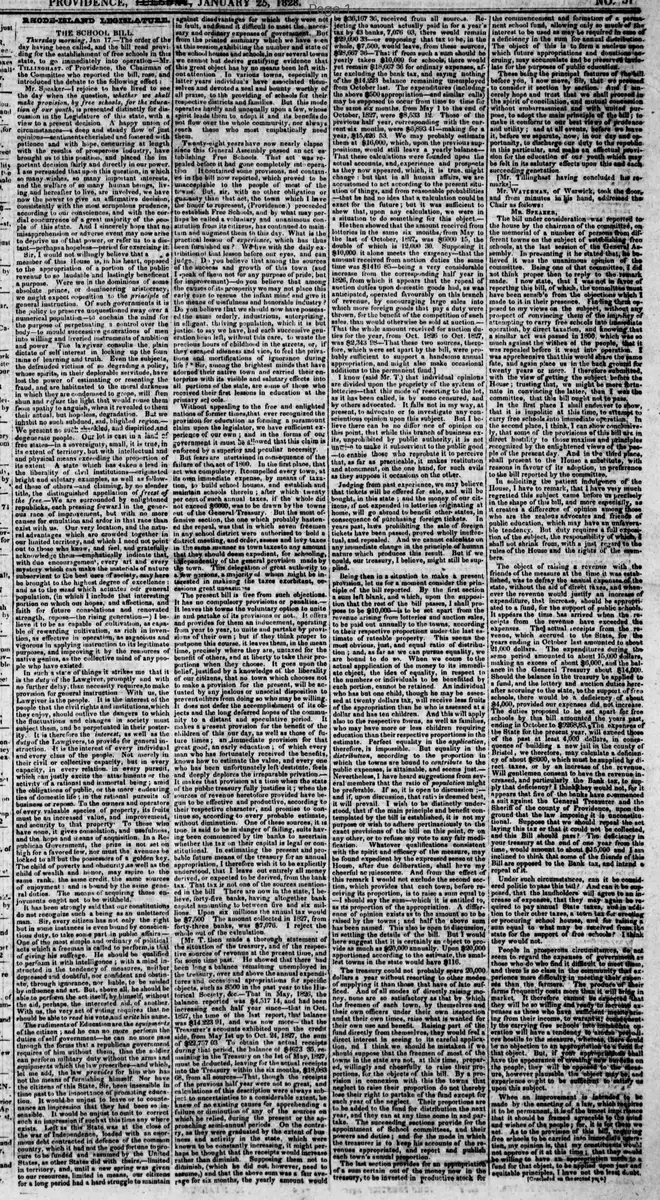
THE SCHOOL BILL.
Thursday morning, Jan 17.—The order of the day having been called, and the bill read providing for the establishment of free schools in this state, to go immediately into operation—Mr. Tillinghast, of Providence, the Chairman of the Committee who reported the bill, rose, and introduced the debate to the following effect :
Mr. Speaker—I rejoice to have lived to see the day when the question, whether we shall make provision, by free schools, for the education of our youth, is presented distinctly for discussion in the Legislature of this state, with a view to a present decision. A happy union of circumstances—a deep and steady flow of just opinions—sentiments cherished and fostered with patience and with hope, concurring at length with the results of prosperous industry, have brought us to this position, and placed the important decision fairly and directly in our power.
I am persuaded that upon this question, in which so many wishes, so many important interests, and the welfare of so many human beings, living and hereafter to live, are involved, we have now the power to give an affirmative decision, consistently with the most scrupulous prudence, according to our consciences, and with the cordial concurrence of a great majority of the people of this state. And I sincerely hope that no misapprehension or adverse event may now arise to deprive us of that power, or refer us to a distant—perhaps a hopeless—period for exercising it.
Sir, I would not willingly believe that a member of this House is, in his heart, opposed to the appropriation of a portion of the public revenue to so laudable and lastingly beneficent a purpose. Were we in the dominions of some absolute prince, or domineering aristocracy, we might expect opposition to the principle of general instruction. Of such governments it is the policy to preserve unquestioned sway over a numerical population—to enchain the mind for the purpose of perpetuating a control over the body—to mould successive generations of men into willing and liveried instruments of ambition and power. The lawgiver consults the plain dictate of self interest in locking up the fountains of learning and truth. Even the subjects, the defrauded victims of so degrading a policy, whose spirits, in their deplorable servitude, have lost the power of estimating or resenting the fraud, and are habituated to the moral darkness in which they are condemned to grope, will ten shun and refuse the light that would rouse them from apathy to anguish, when it revealed to them their actual, but hopeless, degradation. But we inhabit no such subdued, sad, blighted region.— We present no such shackled, and dispirited, and degenerate people. Our lot is cast in a land of free states—in a sovereignty, small, it is true, in its extent of territory, but with intellectual and physical means exceeding the proportion of its extent. A state which has taken a lead in the liberality of civil institutions—originated bright and salutary examples, as well as followed those of others—and claiming, by no slender title, the distinguished appellation of freest of the free.—We are surrounded by enlightened republics, each pressing forward in the generous race of improvement, but with no more causes for emulation and ardor in that race than exist with us. Our very location, and the natural advantages which are crowded together in our limited territory, and which I need not point out to those who know, and feel, and gratefully acknowledge them—emphatically indicate that, with due encouragement, every art and every mystery which can make the materials of nature subservient to the best use of society, may here be brought to the highest degree of excellence: and as to the mind which actuates our general population, (in which I include that interesting portion on which our hopes, and affections, and faith of future consolations and renovated strength, repose—the rising generation—) I believe it to be as capable of cultivation, as capable of rewarding cultivation, as rich in invention, as effective in operation, as sagacious and vigorous in applying instruction to its legitimate purposes, and improving it by the resources of native genius, as the collective mind of any people who have existed.
In such a state of things it strikes me that it is the duty of the Lawgiver, promptly and with no further delay, than necessity requires, to make provision for general instruction. With us, the Lawgiver is the people. It is the interest of the people that the civil rights and institutions, which they enjoy, should outlive the dangers to which the fluctuations and changes in society must subject them, and be perpetuated in their posterity.. It is therefore the interest, as well as the duty of the Lawgivers, to provide for general instruction. It is the interest of every individual and every class of the people. Not merely in their civil or collective capacity, but in every capacity, in every relation. in every pursuit, which can justly excite the attachments or the activity of a rational and immortal being; amid the obligations of public, or the more endearing ties of domestic life; in the rational pursuits of business or repose. To the owners and operators of every valuable species of property, its fruits must be an increased value, and improvement, and security to that property' To those who have none, it gives consolation, and usefulness, and the hope and means of acquisition. In a Republican Government, the prize is not set on high for a favored few, nor must the avenues be locked to all but the possessors of a golden key. The child of poverty and obscurity, as well as the child of wealth and honor, may aspire to the same rank, the same credit, the same sources of enjoyment : and is bound by the same general duties. The means of acquiring those enjoyments ought not to be withheld.
It has been strongly said that our constitutions do not recognize such a being as an unlettered man. Sir, every citizen has not only the right but in some instances is even bound by conscientious duty, to take some part in public affairs— One of the most simple and ordinary of political acts which a freeman is called to perform, is that of giving his suffrage. He should be qualified to perform it with intelligence ; with a mind instructed in the tendency of measures, neither depressed and doubtful, nor confident and obstinate, through ignorance, nor liable, to be misled by influence and art. But, above all, he should be able to perform the act itself, by himself, without the aid, perhaps, the interested aid. of another. With us, the very act of voting requires that he should be able to read his vote, and write his name. The rudiments of Education are the equipments of the citizen; and he can no more perform the duties of self government—he can no more pass through the forms that a republican government requires of him without them, than the soldier can perform military duty without the arms and equipments which the law prescribes—and which, not the means of furnishing himself. Nor have the citizens of this State, Sir, been insensible in time past to the importance of promoting education. It would be unjust to leave or to countenance an impression that they had been so insensible. It would be unjust to omit to correct such an impression if such at this time any where exists. Let us remember that this State was at the close of the war of Independence, loaded with an enormous debt contracted in defence of the common country, which it had not the good fortune to procure to be funded and assumed by the United States, as other States did with theirs, limited in territory, and, until a new spring was given to our resources, limited in means, our citizens for a long period had a hard struggle to maintain against disadvantages for which they were not in fault, and found it difficult to meet the necessary and ordinary expenses of government. But from the printed summary which we have seen at this session, exhibiting the number and state of the school houses and schools, in our several towns we cannot but derive gratifying evidence that this great object has by no means been left without attention . In various towns, especially in latter years individuals have associated themselves and devoted a zeal and bounty worthy of all praise, to the providing of schools for their respective districts and families. But this mode operates hardly and unequally upon a few, whose spirit leads them to adopt it and its benefits do not flow over the whole community, nor always reach those who most emphatically need them.
Twenty-eight years have now nearly elapsed since this General Assembly passed an act establishing Free Schools. That act was repealed before it had gone completely into operation It contained some provisions, not contained in the bill now reported, which proved to be unacceptable to the people of most of the towns." But, sir, with no other obligation or guarantee than that act, the town which I have the honor to represent, (Providence.) proceeded to establish Free Schools, and by what may perhaps be called a voluntary and unanimous constitution from its citizens, has continued to maintain and augment them to this day. What is the practical lesson of experience, which has thus been furnished us ? We live with the daily exhibition of that lesson before our eyes, and can judge. Do you believe that among the sources of the success and growth of this town (and I speak of them not for any purpose of pride, but for improvement)—do you believe that among the causes of its prosperity we may not place this early care to rescue the infant mind and give it the means of usefulness and honorable industry? Do you believe that we should now have possessed the same orderly, industrious, enterprising, intelligent. thriving population, which it is but justice. to say we have, had each successive generation been left, without this care, to waste the precious hours of childhood in the streets, or, if they escaped idleness and vice, to feel the privations and mortifications of ignorance during life ?
Sir, among the brightest minds that have adorned their native town and carried their enterprise with its visible and salutary effects into all portions of the state, are some of those who received their first lessons in education at the primary schools.
Without appealing to the free and enlightened nations of former times, that ever recognized the provision of education as originating a paramount claim upon the legislator, we have sufficient experience of our own ; and in the forms of our government it must be allowed that this claim is enforced by a superior and peculiar necessity. But fears are entertained in consequence of the failure of the act of 1800. In the first place, that act was compulsory. It compelled every town, at its own immediate expense, by means of taxation, to build school houses, and establish and maintain schools therein ; after which twenty per cent of such annual taxes, if the whole did not exceed $6000, was to be drawn by the towns out of the General Treasury. But the most offensive section, the one which probably hastened the repeal, was that in which seven freemen in any school district were authorised to hold a district meeting, and order, assess and levy taxes in the same manner as town taxes to any amount that they should deem expedient, for schooling, independently of the general provision made by the town. This delegation of great authority to a few persons, a majority of whom might be interested in making the taxes exorbitant, occasioned great uneasiness The present bill is free from such objections. It has no compulsory provisions or penalties.— It leaves the towns the voluntary option to unite in and partake of its provisions or not. It offers and provides for them an inducement, operating from year to year, to unite and partake by provisions of their own; but if they think proper to postpone this course, it leaves them, in the mean time, precisely where they are, untaxed for the benefit of others, and at liberty to take their proportions when they choose. It goes upon the belief, justified by a knowledge of the liberality of our citizens, that no town which chooses not to make a provision for the present, will be actuated by any jealous or unsocial disposition to prevent others from doing so who may be willing. It does not defer the accomplishment of its objects and the long deferred hopes of the community to a distant and speculative period. It makes a present provision for the benefit of the children of this our day, as well as those of future times; an immediate provision for that great good, an early education ; of which every man who has fortunately received the benefits, knows how to estimate the value, and every one who has been unfortunately left destitute. feels and deeply deplores the irreparable privation. It makes that provision at a time when the state of the public treasury fully justifies it ; when the sources of revenue heretofore provided have begun to be effective and productive, according to their respective character, and promise to continue so, according to every probable estimate, without diminution. One of these sources, it is true, is said to be in danger of failing, suits having been commenced by the banks to ascertain whether the tax on their capital is legal or constitutional. In estimating the present and probable future means of the treasury for an annual appropriation, I therefore wish it to be explicitly understood, that I leave out entirely all money derived, or expected to be derived, from the bank tax. That tax is not one of the sources mentioned in the bill There are now in the state, I believe, forty-five banks, having altogether bank capital amounting to between five and six millions. Upon six millions the annual tax would be $7,500 The amount collected in 1827, from forty-three banks, was $7,076. I reject the whole out of the calculation.
[Mr T. then made a thorough statement of the situation of the treasury, and of the respective sources of revenue at the present time, and for some time past. He showed that there had been long a balance remaining unemployed in the treasury, over and above the annual expenditures and occasional appropriations for specific objects, such as $500 in the past year to the Historical Society balance reported was $4,517 14, and had been increasing each half year since—that in Oct. 1827, the time of the last report, that balance was $14.223 91, and was now more— that the Treasurer's accounts exhibited upon the credit side, from May 1st up to Oct. 24, 1827, the sum of 22,757 03 To obtain the actual receipts during that period, the balance of $4673 35, remaining in the Treasury on the 1st of May, 1827, must be deducted, leaving for the actual receipts into the Treasury within the six months, 18,083 68, from all sources—That, though the receipts of the previous half year were not so great, and calculations of this description were always subject to uncertainties to a considerable extent, he knew of no existing causes for apprehending a failure or diminution of any of the sources on which he relied, during the present or the approaching semi-annual periods On the contrary, as they were graduated by the extent of business and activity in the state, which were known to be constantly increasing, it might perhaps be thought that the receipts would increase rather than diminish. Supposing them not to diminish, (which he did not, however, need to assume,) and that the above sum was a fair average of six months, the yearly amount would be 36,167 36, received from all sources. Rejecting the amount actually paid in for a year's tax by 43 banks, 7,076 03, there would remain 29,090 33—or supposing that tax to be, in the whole, 7,500, would leave, from those sources, 23,667 36—That if from such a sum should be yearly taken 10,000 for schools, there would yet remain 18,667 36 for ordinary expenses, after excluding the bank tax, and saying nothing of the 14,223 balance remaining unemployed from October last. The expenditures (including the above 500 appropriation—and similar calls may be supposed to occur from time to time for the same six months, from May 1 to the end of October, 1827, were $8,533 12. Those of the previous half year, corresponding with the current six months, were $6,893 41—making for a year, 15,426 53. We may probably estimate them at $16,000, which, upon the previous sup positions, would still leave a yearly balance— That these calculations were founded upon the actual accounts, and experience and prospects as they now appeared, which, it is true, might change : but that in all human affairs, we are accustomed to act according to the present situation of things, and from reasonable probabilities —that he had no idea that a calculation could be exact for the future; but it was sufficient to shew that, upon any calculation, we were in a situation to do something for this object.— He then showed that the amount received from lotteries in the same six months, from May to the last of October, 1827. was $6000 15, the double of which is 12,000 30. Supposing it $10,000. it alone meets the exigency—that the amount received from auction duties the same time was $1416 85—being a very considerable increase from the corresponding half year in 1826, from which it appears that the repeal of auction duties upon domestic goods had, as was anticipated, operated favourably on this branch of revenue, by encouraging large sales into which more foreign goods that pay a duty were thrown, for the benefit of the competition of such sales, than would otherwise be sold at auction.— That the whole amount received for auction duties for the year, from Oct. 1826 to Oct. 1827. was 2,343 98—That these two sources, therefore, which were set apart by the bill, were probably sufficient to support a handsome annual appropriation, and might also make occasional additions to the permanent fund.]
I know (said Mr. T') that individual opinions are divided upon the propriety of the system of lotteries—that this mode of resorting to the lot, as it has been called, is by some censured, and by others advocated. It falls not in my way, at present, to advocate or to investigate any conscientious opinion upon this subject. But I believe there can be no difference of opinion on this point, that while this branch of business exists, unprohibited by public authority, it is not unwise to make it subservient to the public good —to enable those who reprobate it to perceive that, as far as practicable, it makes restitution and atonement, on the one hand, for such evils as they suppose it occasions on the other.
Judging from past experience, we may believe that tickets will be offered for sale, and will be bought, in this state ; and the money of our citizens, if not expended in lotteries originating at home, will go abroad to benefit other states, in consequence of purchasing foreign tickets. In years past, laws prohibiting the sale of foreign tickets have been passed, proved wholly ineffectual, and repealed. And we cannot calculate on any immediate change in the principle of human nature which produces this result. But if we could, our treasury, I believe, might still be supplied.
Being then in a situation to make a present provision, let us for a moment consider the principle of the bill reported. By the first section a sum left blank, and which, upon the supposition that the rest of the bill passes, I shall propose to be $10,000 —is to be set apart from the revenue arising from lotteries and auction sales, to be paid out annually to the towns, according to their respective proportions under the last estimate of ratable property. This seems the most obvious, just, and equal ratio of distribution ; and, as far as we can pursue equality, we are bound to do so. When we come to the actual application of the money to its immediate object, the idea of equality, in respect to the numbers or individuals to be benefited by each portion, cannot be retained. An individual who has but one child, though he may be assessed at twenty dollars tax, will receive less fruits of the appropriation than he who is assessed at a dollar and has ten children. And this will apply also to the respective towns, as well as families, who may have more or less children requiring education than their respective proportions in the estimate. Perfect equality in the application, therefore, is impossible. But equality in the distribution, according to the proportion in which the towns are bound to contribute to the public expenses, is attainable, and seems just.— Nevertheless, I have heard suggestions from several members that the ratio of population might be preferable. If so, it is open to discussion ;— and if, upon discussion, that ratio is deemed best, it will prevail. I wish to be distinctly understood, that if the main principle and benefit contemplated by the bill is established, it is not my purpose or wish to adhere pertinaciously to the exact provisions of the bill on this point, or on any other, or to refuse my vote to any fair modification. Whatever qualifications consistent with the spirit and efficacy of the measure, may be found expedient by the expressed sense of the House, after due deliberation, shall have my cheerful acquiescence. And from the effect of this remark I would not exclude the second section, which provides that each town, before receiving its proportion, is to raise a sum equal to —I should say the sum—which it is entitled to, as its proportion of the appropriation. A difference of opinion exists as to the amount so to be raised by the towns: and half the above sum has been named. This also is open to discussion in settling the details of the bill. But I would here suggest that it is certainly an object to provide as much as $20,000 annually. Upon 20,000 apportioned according to the estimate, the smallest towns in the state would have $16. The treasury could not probably spare 20,000 dollars a year without resorting to other modes of supplying it than those that have of late sufficed. " And of all modes of directly raising money, none are so satisfactory as that by which the freemen of each town, by themselves and their own officers under their own inspection and at their own times, raise what is wanted for their own use and benefit. Raising part of the fund directly from themselves, they would feel a direct interest in seeing to its careful application, and I think we should be mistaken if we should suppose that the freemen of most of the towns in the state are not, at this time, prepared, willingly and cheerfully to raise their proportions, for the objects of this bill. By a provision in connexion with this the towns that neglect to raise their proportion do not thereby lose their right to partake of the fund except for each year of the neglect. Their proportions are to be added to the fund for distribution the next year, and they can at any time come in and partake. The succeeding sections provide for the appointment of School committees, and their powers and duties; and for the mode in which the treasurer is to keep his accounts of the revenues appropriated, and report and publish each town' annual proportion. The last section provides for an appropriation of a sum certain out of the money now in the treasury, to be invested in productive stock for the commencement and formation of a permanent school fund, allowing only so much of the interest to be used as may be required in case of a deficiency in the sum of annual distribution. The object of this is to form a nucleus upon which future appropriations and donations accruing, may accumulate and be preserved inviolate for the purposes of public education.
These being the principal features of the bill. before you, I now move, Sir, that we proceed to consider it section by section. And I sincerely hope and trust that we shall proceed in the spirit of conciliation, and mutual concession without embarrassment and with united purpose, to adopt the main principle of the bill; to make it conform to our best views of prudence and utility; and at all events, before we leave it, before we separate, now, in our day and opportunity, to discharge our duty to the republic. in this particular, and make an effectual provision for the education of our youth which may be felt in its salutary effects upon this and each succeeding generation.
[Mr. Tillinghast having concluded his remarks]—
Mr. Waterman, of Warwick, took the floor and from minutes in his hand, addressed the Chair as follows:
Mr. Speaker,
The bill under consideration was reported to the house by the chairman of the committee, on the memorial of a number of persons from different towns on the subject of establishing free schools, at the last session of the General Assembly.
In presenting it he stated that; he believed it was the unanimous opinion of the committee.
Being one of that committee, I did not think proper then to reply to the remark made. I now state, that I was not in favor of reporting this bill, of which, the committee must have been sensible from the objections which I made to it in their presence. Finding them opposed to my views on the subject, without any prospect of convincing them of the impolicy of attempting to carry free schools into immediate operation, by direct taxation, and knowing that a similar act was passed in 1800. which went so much against the wishes of the people, 'that it was repealed before it went into operation. I was apprehensive that this would share the same fate, and again place us in the back ground for twenty years or more. I therefore submitted, with the view of getting the subject before the House; trusting that, we might be more fortunate in convincing the latter, than I was the committee, that this bill ought not to pass.
In the first place I shall endeavor to show, that it is impolitic at this time, to attempt to carry free schools into immediate operation. In the second place, I think, I can show conclusively, that some of the provisions of this bill are in direct hostility to those maxims and principles recognized by the enlightened views of the people of the present day. And in the third place, shall present to the House a substitute, with reasons in favor of its adoption, in preference to the bill reported by the committee.
In soliciting the patient indulgence of the House, I have to remark, that I have very much regretted this subject came before us precisely in the shape of this bill, and more especially, as it creates a difference of opinion among those who are the zealous advocates and friends of public education, which may have an unfavorable tendency. But duty requires a full exposition of the subject, the responsibility of which, shall not shrink from, with a just regard to the rules of the House and the rights of the members.
The object of raising a revenue with the friends of the measure at the time it was established, was to defray the annual expenses of the state, without the aid of direct taxes, and whenever the revenue would justify an increase of expenditure, that increase, should be appropriated to a fund, for the support of public schools.
It appears the time, has arrived when the receipts from the revenue have exceeded the expenses. The actual receipts from the revenue, which accrued to the State, for the years ending in October last amounted to about 21,000 dollars.
The expenditures during the same period amounted to about 15,000 dollars, making an excess of about $6,000, and the balance in the General Treasury about $14,000.
Should the balance in the treasury be applied to a fund, and the lottery and auction duties hereafter accruing to the state, to the support of free schools, there would be a deficiency of about $4,000, provided our expenses did not increase.
The duties proposed to be set apart for free schools by this bill amounted the years past, ending in October to $9268,83. The expenses of the State for the present year, will exceed those of the past at least 4,000 dollars, in consequence of building. a new jail in the county of Bristol, we therefore, may calculate a deficiency of about $8000, which must be supplied by direct taxes, or by an increase of the revenue.
Will gentlemen consent to have the revenue increased, and particularly the Bank tax, to supply that deficiency? I think they would not, for it appears that five of the banks have commenced a suit against the General Treasurer and the Sheriff of the county of Providence, upon the ground that the law imposing it is unconstitutional. Suppose that we should repeal the act laying this tax or that it could not be collected, and this Bill should pass? The deficiency in your treasury at the end of one year from this time, would amount to about 15,000 and I am inclined to think that some of the friends of this Bill are opposed to the Bank tax, and intend repeal of it.
Under such circumstances, can it be considered politic to pass this bill? And can it be supposed, that the landholders: will agree to an increase of expenses, that they may again be required to pay annual State taxes, and in addition to their other taxes, a town tax for erecting or procuring school houses, and for raising a sum equal to what may be received from the state for the support of free schools? I think they would not.
People in prosperous circumstances, do not seem to regard the expenses of government as those who do who find it difficult to meet them, and there is no class in the community that experience more difficulty in meeting their expenses than the farmers. The, produce of their farms frequently costs more than it will bring in market. It therefore. cannot be expected that they will be so willing and ready to increase expenses as those who have sufficient means arising from their income, to warrant it; consequently the carrying free schools into immediate operation will have a tendency to 'arouse prejudices hostile to the measure, whereas, there could be no objection to an appropriation to a fund for that object. But, if your appropriation shall have the appearance of creating the people, they will be opposed to the measure, however plausible the object may be, and experience ought to be sufficient to satisfy us upon this subject.
When an improvement is intended to be made by the enacting of a law, which requires it to be permanent, it is of the utmost importance that it should be framed agreeable to the mind and wishes of the people; for. it is for their we act. As to the provision of this bill, requiring free schools to be carried into immediate operation, my opinion is, that my constituents would not approve of it at this time i that they would be willing to have an appropriation made to a fund for that object, to be applied upon just and equitable principles, I have not the least doubt.
[Concluded on the second page]
[Concluded from the outer page.]
Having briefly shown the impolicy of attempting to carry free schools into immediate operation, I will now proceed, in the second place, to show that in providing to establish free schools certain principles ought always to be kept in view. That every child in the state is entitled to equal rights and privileges and ought to enjoy equal benefits in all appropriations for that object, are positions I maintain to be correct, and which I think no member of this House will attempt to controvert. Then, Sir, if this be correct ground, let us examine the provisions of this bill, and see whether they accord with those principles.
The first section provides, "that from and after the passing of this act, all monies that shall be paid into the general Treasury, by managers of lotteries or their agents, and also all monies that shall be paid into said treasury by Auctioneers or duties accruing to the State, shall be set apart and paid over to the several towns in this State, in manner hereafter mentioned, in proportion to and according to the rule or ratio of taxation as established in the estimate of property at the January session last; to be by said towns appropriated to and for the exclusive purpose of keeping such schools and paying the expenses thereof, the sum, however, hereby appropriated to be paid over in any one year not to exceed one thousand dollars."
The provision of this section makes a distribution of the money to be set apart for the support of free schools to the several towns in the state, according to their wealth; it then follows, that a few of the wealthy towns are to receive a large proportion of the appropriation, whereas all the rest of the towns, who are less wealthy in proportion to their population, and having more than double the number to educate, are to receive but a trifle more than those few wealthy towns.
I shall have recourse to a calculation, showing at a single view, the extent of the several towns in the state in square miles; the number of free white inhabitants under 16 years of age, according to the census of 1820; the estimated town's proportion by population under 16 years of age; proportion of $15,000 by valuation and each town's value made in 1824; each town's proportion by population than valuation, and also of age; showing those towns which would receive less by population than valuation, and also those who would receive more.
In taking a view of the extent of territory of the several towns in the state, some idea may be formed of the number of schools which it would be necessary to have established. Excepting a few towns, the rest would, with some little deviation, require a school district to each five or six square miles, which would require say for the county of Providence, 66 school districts, Newport 21, Washington 64, Kent 32, Bristol 9, making in the whole State 200 districts; and adopting, in the absence of other data, the number of free white inhabitants under 16 years of age, as a rule of estimate, it would not make any material difference in a distribution to the several towns if made in proportion to the population to be benefitted (say between the ages of five and sixteen years) and although taken from the census of 1820. Since then the north part of the state have increased their population and wealth, whereas the south part, including the counties of Newport, Washington, and Bristol, have probably not increased in the same ratio. Yet I would not have it understood that any rule of estimate, either of population or valuation, made several years ago, ought to be adhered to, but the population or valuation, at or near the time of making the distribution, ought to be the rule established.
The population of the county of Providence under 16 years of age, was, in 1820, 14572. Newport 6134, Washington 6787, Kent 4330, Bristol 2253—total in the state 34076. Suppose $15,000 should be distributed according to the provisions of this bill, the county of Providence would receive $3258.27, Newport 2334.55, Washington 1911.75, Kent 1433.84, Bristol 1061.59—total 15,000. The proportion to each one of the population enumerated, would be about 44 cents. We shall soon see by comparing things as they are, who is to receive special benefit by the provision made in the first section of the bill.
The proportion to each one of the population enumerated in the county of Providence is about 57 cents, Newport 33, Washington 28, Kent 33, Bristol 47. It therefore appears, that the county of Providence will receive for each one of said population 13 cents more than their proportion, Newport 6 cents less, Washington 10 less, Kent 11 cents less, and Bristol 3 cents more. We will proceed a little farther. The proportion to the town of Providence is $1.05 each, and to the rest of the towns in the county but 37 cents each. The town of Foster would receive but 21 cents each. Eight towns in the state, viz. Providence, North Providence, Cranston, Johnston, Portsmouth, Middletown, Jamestown, and Bristol, would receive $3059.56 more by valuation than population, and one of those towns, with a population as enumerated, of 4167, would receive of that sum $2533.73, and the remaining seven towns together, with a population of 5059 would receive but $525.86, about one fifth as much as the town of Providence, which shows the inequality with those towns which are benefitted in a distribution by valuation. Whereas, there are 23 towns which would be benefitted by a distribution proportioned by population, and would receive more by population, than by valuation, viz. Smithfield 64.63, Foster 322.35, Scituate 114.98, Cumberland 87.92, Glocester 197.69, Burrillville 137.53, Newport 201.17, Tiverton 195.55, Little-Compton 61.75, New-Shoreham 75.11, South-Kingstown 181.69, North Kingstown 171.55, Exeter 216.41, Westerly 168.74, Hopkinton 137.04, Richmond 162.79, Charlestown 37.69, Warwick 25.45, Coventry 216.31, West-Greenwich 172.44, East-Greenwich 57.99, Warren 23.04, Barrington 25.23—making in the 23 towns $3059.56. Eight towns with a population under 16 years of age, amounting to 9221, would receive $7118.56, by this bill, should the blank in the first section be filled with $15,000, whereas twenty three towns, with a population of the same description, amounting to 24,855, would receive but $7881.44. The proportion to each one enumerated in the eight towns would be $0.77, whereas in the twenty three towns it would amount to but $0.31.
It does appear to me, Sir, that such manifest injustice and inconsistency, cannot be reconciled neither can it be countenanced or supported by any member of this House who has fully investigated the subject. For it must be recollected, that the money which is to be appropriated by this bill, arises principally from the duties on the lottery business, (by some, considered as a species of gambling, formally and legally authorized,) and the residue from sales at auction and not by direct state tax: Therefore there is nothing in reason from, which is based upon any solid foundation, to support the distribution to the several towns, as provided by the first section of the bill.
The second section of the bill provides, "that before any town shall be entitled to receive its proportion of said monies, said town shall erect or provide, or cause to be erected or provided at the expense of said town, as many suitable school houses as said town may deem necessary not less, however, than two, and shall be divided into as many school districts as there shall be school houses erected, and shall moreover, make grant out of the town Treasury, or shall make, assess and collect a tax on the rateable inhabitants thereof, in manner prescribed for making and assessing taxes, which shall be equal in amount, exclusive of expenses of collection, to that said town shall be entitled to receive from the General Treasury as aforesaid, which grant or tax shall also be appropriated to and for the purpose of keeping free schools in said town as aforesaid, and shall be placed in the hands of a committee for that purpose."
To provide school houses, and to make taxes, &c. and they must swallow it, whether they like it or not it must go down, or they will not be entitled to any benefit from the appropriation made by the state for the support of free schools. Now, Sir, can any man in his right senses (I do not appeal to any one whose senses are inflated with vanity), suppose, for a moment, that the provisions of the first and second section of this bill, are calculated to induce the people of this State to enter heart and soul into the support of free schools? I will leave the question for the advocates of this bill to answer.
The other sections of the bill may be considered as necessary, with some few exceptions, for carrying into operation the provision of the first and second. I will not, however, take up any more of the time of the House in considering this bill, but will proceed to the consideration of a substitute. I shall in due time move to amend the bill, by striking out the whole of it, after the enacting clause in the first section, with the view of substituting the following:-
Sect. 1. Be it enacted, That of the money now in the General Treasury, ten thousand dollars be set apart and exclusively appropriated, in the manner herein after mentioned, as a fund for the support of public schools, and to be denominated the school fund.
Sect. 2. That the governor and secretary for the time being, be and are hereby constituted commissioners of said fund; whose duty it shall be to invest in Bank stock of the Banks of this state, the sum hereby appropriated, together with the interest thereon as the same shall accrue, and such further appropriations as the General Assembly may hereafter make, or such donations as may be made by individuals or corporations, for the same purpose.
Sect. 3. That said commissioners shall keep a regular account, in a book to be provided for that purpose, and to remain in the secretary's office, of all monies by them received, of whom, on what account, and how invested, and report annually to the General Assembly on the first Wednesday of May, or oftener if required, a particular statement and account of said fund, and their proceedings generally in relation to the same.
Sect. 4. That the interest of said fund shall be applied to the support of public schools whenever the General Assembly shall direct the same, and shall be distributed, among the several towns in the state, in proportion to the free white population in each town, between the ages of five and sixteen years.
The substitute which I have just read, and which I intend to offer to the house in the close of my remarks, embraces all the necessary provisions for the commencement and formation of a permanent fund, for the support of public schools. The amount in the General Treasury, to be set apart for said fund, can be spared without additional burdens upon the people, which will be more likely to enlist them in favour of it, than it would if free schools were immediately established, which would require a considerable amount in taxes, to carry them into operation, without any permanent resources to maintain them, other than direct taxes, which always begets enemies, to any system of measures requiring them.
Although some may think the benefit to be derived from said fund will be too remote, to expect any themselves, yet they must recollect, that small beginnings, followed up with perseverance, will produce astonishing results: Hence we may infer, that perseverance, prudence and economy on the part of the legislature, in regard to our fiscal concerns, will enable us to improve said fund, by repeated appropriations, and to make a distribution of the interest arising therefrom, for the support of free schools, at an earlier period than some may suppose.
The revenue has exceeded the most sanguine expectations of its friends, but it has not been in operation long enough, to make calculations with any degree of certainty, of its future productiveness; but in the course of a few years, those questions which there seems a disposition to litigate, affecting materially the revenue, will be settled; and should our anticipations be realized, as regards its permanency, and productiveness, the legislature will soon be enabled, to make an appropriation annually out of the General Treasury, with the interest of the fund, sufficient for maintaining free schools four or five months in each year, provided, the money appropriated be exclusively applied to the expense of tuition: Admitting two hundred school districts to be necessary for the whole State and the expense of tuition not exceeding $30 per month, it would require annually about $12,000 to maintain those schools four months in each year. An accumulating fund, commenced with $10,000, with an annual addition of equal amount, computed at the rate of 6 per cent interest, with an annual investment of the same, would at the end of ten years amount to $139,716.42, at the end of sixteen years to about $272,000.00 at the end of twenty years to about $389,000.00 and in less than 24 years to $500,000.00. Now, Sir, we will suppose that in the year 1800, that instead of passing a school act. (which was not suffered to remain in existence long enough to go into operation,) the legislature had, at that time established a revenue, out of which an accumulating fund might have been formed, which at this time, probably would have been sufficient for the support of free schools, at least six months in the year. And suppose further, that we had in 1821 neglected to establish a revenue, and continued to this time without establishing one, what situation should we have been in, under the present depressed state of agriculture? Could any one have thought of establishing free schools, to be maintained by direct taxation, with any better prospect of success, than in 1800? I think not. The grand object in all undertakings, requiring an expenditure of money, is first to provide the ways and means, and it is immaterial, whether it be a public, or an individual undertaking, for success in either case, depends upon the ways and means necessary to commence, and to carry it on.
Sir, in concluding my remarks: I would say to those who are in favour of establishing free schools immediately, be patient a little while and you will have your wishes, whereas if you push the subject imprudently, defeat will follow as a matter of course.
What sub-type of article is it?
What themes does it cover?
What keywords are associated?
What entities or persons were involved?
Where did it happen?
Story Details
Key Persons
Location
Rhode Island Legislature
Event Date
Jan 17
Story Details
Debate on a bill to establish free schools funded by lottery and auction duties. Mr. Tillinghast advocates for immediate $10,000 annual appropriation distributed by property valuation, with towns matching funds voluntarily. Mr. Waterman criticizes the bill's inequities and fiscal risks, proposing a substitute to create a $10,000 permanent fund invested in bank stock, distributed by population when ready.