Thank you for visiting SNEWPapers!
Sign up free
Alexandria Gazette
Alexandria, Alexandria County, District Of Columbia
What is this article about?
In a congressional speech, Mr. Polk of Tennessee defends the Secretary of the Treasury's removal of public deposits from the Bank of the United States, calls for a thorough investigation into charges of bank malpractices, criticizes opponents for avoiding scrutiny, and affirms the President's constitutional power to remove cabinet officers like the Secretary.
Clipping
OCR Quality
Full Text
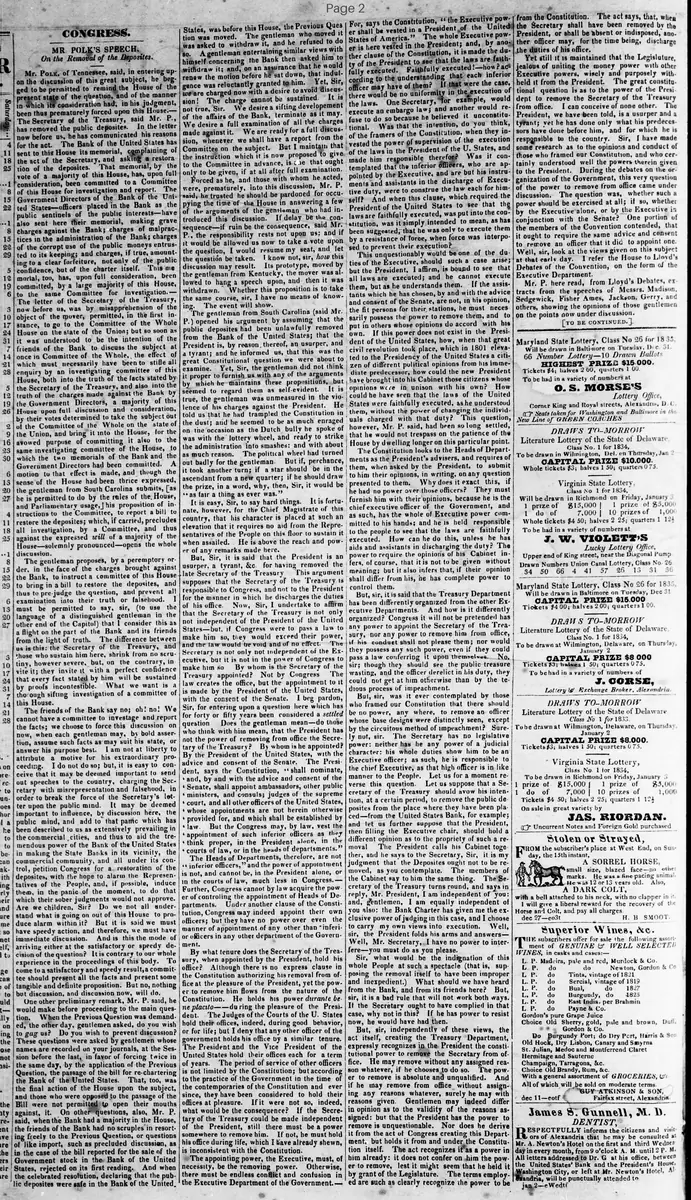
MR. POLK'S SPEECH.
On the Removal of the Deposits.
Mr. Polk, of Tennessee, said, in entering upon the discussion of this great subject, he begged to be permitted to remind the House of the present state of the question, and of the manner in which its consideration had, in his judgment, been thus prematurely forced upon this House.-- The Secretary of the Treasury, said Mr. P., has removed the public deposits. In the letter now before us, he has communicated his reasons for the act. The Bank of the United States has sent to this House its memorial, complaining of the act of the Secretary, and asking a restoration of the deposits. That memorial, by the consideration, been committed to a Committee of this House for investigation and report. The Government Directors of the Bank of the United States--officers placed in the Bank as the public sentinels of the public interests--have also sent here their memorial, making grave charges against the Bank; charges of malpractices in the administration of the Bank; charges of the corrupt use of the public moneys entrusted to its keeping; and charges, if true, amounting to a clear forfeiture, not only of the public confidence, but of the charter itself. This memorial, too, has, upon full consideration, been committed, by a large majority of this House, to the same Committee for investigation.-- The letter of the Secretary of the Treasury, now before us, was by misapprehension of the object of the mover, permitted, in the first instance, to go to the Committee of the Whole House on the state of the Union; but so soon as it was understood to be the intention of the friends of the Bank to discuss the subject at once in Committee of the Whole, the effect of which must necessarily have been to stifle all enquiry by an investigating committee of this House, both into the truth of the facts stated by the Secretary of the Treasury, and also into the truth of the charges made against the Bank by the Government Directors, a majority of this House upon full discussion and consideration, by their votes determined to take the subject out of the Committee of the Whole on the state of the Union, and bring it into the House, for the avowed purpose of committing it also to the same investigating committee of the House, to which the two memorials of the Bank and the Government Directors had been committed. A motion to that effect is made, and though the sense of the House had been thrice expressed, the gentleman from South Carolina submits, [as he is permitted to do by the rules of the House, and Parliamentary usage,] his proposition of instructions to the Committee, to report a bill to restore the deposits; which, if carried, precludes all investigation, by a Committee, and thus against the expressed will of a majority of the House--solemnly pronounced--opens the whole discussion. The gentleman proposes, by a peremptory order, in the face of the charges brought against the Bank, to instruct a committee of this House to bring in a bill to restore the deposits, and thus to pre-judge the question, and prevent all examination into their truth or falsehood. I must be permitted to say, sir, (to use the language of a distinguished gentleman in the other end of the Capitol) that I consider this as a flight on the part of the Bank and its friends from the light of truth. The difference between us is this: the Secretary of the Treasury, and those who sustain him here, shrink from no scrutiny, however severe, but, on the contrary, invite it; they invite it with a perfect confidence that every fact stated by him will be sustained by proofs incontestible. What we want is a thorough sifting investigation of a committee of this House. The friends of the Bank say no; oh! no! We cannot have a committee to investigate and report the facts; we choose to force this discussion on now, when each gentleman may, by bold assertion, assume such facts as may suit his state, or answer his purpose best. I am not at liberty to attribute a motive for his extraordinary proceeding. I do not do so; but, it is easy to conceive that it may be deemed important to send out speeches to the country, charging the Secretary with misrepresentation and falsehood, in order to break the force of the Secretary's letter upon the public mind. It may be deemed important to influence, by discussion here, the public mind, and add to that panic which has been described to us as extensively prevailing in the commercial cities, and thus to aid the tremendous power of the Bank of the United States in making the State Banks in its vicinity, the commercial community, and all under its control, petition Congress for a restoration of the deposits, with the hope to alarm the Representatives of the People, and, if possible, induce them, in the panic of the moment, to do that which their sober judgments would not approve. Are we children, Sir? Do we not all understand what is going on out of this House to produce alarm within it? But it is said we must have speedy action, and therefore, we must have immediate discussion. And is this the mode of arriving either at the satisfactory or speedy decision of the question? It is contrary to our whole experience in the proceedings of this body. To come to a satisfactory and speedy result, a committee should present all the facts and present some tangible and definite proposition. But no, nothing but discussion, and discussion now, will do. One other preliminary remark, Mr. P. said, he would make before proceeding to the main question. When the Previous Question was demanded, the other day, gentlemen asked, do you wish to gag us? Do you wish to prevent discussion? These questions were asked by gentlemen whose names are recorded on your journals, at the Session before the last, in favor of forcing twice in the same day, by the application of the Previous Question, the passage of the bill for re-chartering the Bank of the United States. That, too, was the final action of the House upon the subject, and those who were opposed to the passage of the Bill were not permitted to open their mouths against it. On other questions, also, Mr. P. said, when the Bank had a majority in the House, the friends of the Bank had no scruples in resorting freely to the Previous Question, or questions of like import, such as precluded discussion, as in the case of the bill reported for the sale of the Government stock in the Bank of the United States, rejected on its first reading. And when the celebrated resolution, declaring that the public deposits were safe in the Bank of the United States, was before this House, the Previous Question was moved.-- A gentleman entertaining similar views with the mover was asked to withdraw it, and he refused to do so. The gentleman who moved it himself concerning the Bank then asked him to withdraw it; and, on an assurance that he would renew the motion before he sat down, that indulgence was reluctantly granted to him. Yet, Sir, we are charged now with a desire to avoid discussion! The charge cannot be sustained. It is not true, Sir. We desire a sifting development of the affairs of the Bank, terminate as it may. We desire a full examination of all the charges made against it. We are ready for a full discussion, whenever we shall have a report from the Committee on the subject. But I maintain that the instruction which it is now proposed to give to the Committee in advance, is one that ought only to be given, if at all after full examination. Forced as he, and those with whom he acted, were, prematurely, into this discussion, Mr. P. said, he trusted he should be pardoned for occupying the time of the House in answering a few of the arguments of the gentleman who had introduced this discussion. If delay be the consequence--if ruin be the consequence, said Mr. P., the responsibility rests not upon us: and if it would be allowed us now to take a vote upon the question, I would resume my seat, and let the question be taken. I know not, sir, how this discussion may result. Its prototype, moved by the gentleman from Kentucky, the mover was allowed to hang a speech upon, and then it was withdrawn. Whether this proposition is to take the same course, sir, I have no means of knowing. The event will show. The gentleman from South Carolina (said Mr. P.) opened his argument by assuming that the public deposits had been unlawfully removed from the Bank of the United States; that the President is, by reason thereof, an usurper, and a tyrant; and he informed us, that this was the great Constitutional question we were about to examine. Yet, Sir, the gentleman did not think it proper to furnish us with any of the arguments by which he maintains these propositions, but seemed to regard them as self-evident. It is true, the gentleman was unmeasured in the violence of his charges against the President. He told us that he had trampled the Constitution in the dust; and he seemed to be as much enraged on the occasion as the Dutch bully he spoke of was with the lottery wheel, and ready to strike the administration into smashes: and with about as much reason. The political wheel had turned out badly for the gentleman. But if, perchance, it took another turn; if a star should be in the ascendant from a new quarter; if he should draw the prize, in a word, why, then, Sir, it would be "as fair a thing as ever was."
It is easy, Sir, to say hard things. It is fortunate, however, for the Chief Magistrate of this country, that his character is placed at such an elevation that it requires no aid from the Representatives of the People on this floor to sustain it when assailed. He is above the reach and power of any remarks made here. But, Sir, it is said that the President is an usurper, a tyrant, &c. for having removed the late Secretary of the Treasury. This argument supposes that the Secretary of the Treasury is responsible to Congress, and not to the President for the manner in which he discharges the duties of his office. Now, Sir, I undertake to affirm that the Secretary of the Treasury is not only not independent of the President of the United States--but, if Congress were to pass a law to make him so, they would exceed their power, and the law would be void and of no effect. The Secretary is not only not independent of the Executive, but it is not in the power of Congress to make him so. By whom is the Secretary of the Treasury appointed? Not by Congress. The law creates the office, but the appointment to it is made by the President of the United States, with the consent of the Senate. I beg pardon, Sir, for entering upon a question here which has for forty or fifty years been considered a settled question. Does the gentleman mean--do those who think with him mean, that the President has not the power of removing from office the Secretary of the Treasury? By whom is he appointed? By the President of the United States, with the advice and consent of the Senate. The President, says the Constitution, shall nominate, 'and, by and with the advice and consent of the Senate, shall appoint ambassadors, other public ministers, and consuls; judges of the supreme court, and all other officers of the United States, whose appointments are not herein otherwise provided for, and which shall be established by law. But the Congress may, by law, vest the appointment of such inferior officers as they think proper, in the President alone, in the courts of law, or in the heads of departments.' The Heads of Departments, therefore, are not "inferior officers," and the power of appointment is not, and cannot be, in the President alone, or in the courts of law, much less in Congress.-- Further, Congress cannot by law acquire the power of controlling the appointment of Heads of Departments. Under another clause of the Constitution, Congress may indeed appoint their own officers; but they have no power over even the manner of appointment of any other than inferior officers in any other department of the Government. By what tenure does the Secretary of the Treasury, when appointed by the President, hold his office? Although there is no express clause in the Constitution authorizing his removal from office at the pleasure of the President, yet the power to remove him flows from the nature of the Constitution. He holds his power durante bene placito--during the pleasure of the President. The Judges of the Courts of the U. States hold their offices, indeed, during good behavior, or for life; but I deny that any other officer of the government holds his office by a similar tenure. The President and the Vice President of the United States hold their offices each for a term of years. The period of service of other officers is not limited by the Constitution; but according to the practice of the Government in the time of the contemporaries of the Constitution and ever since, they have been considered to hold their offices at pleasure. If it were not so, indeed, what would be the consequence? If the Secretary of the Treasury could be made independent of the President, still there must be a power somewhere to remove him. If not, he must hold his office during life, which I have already shewn, is inconsistent with the Constitution. The appointing power, the Executive, must, of necessity, be the removing power. Otherwise, there must be endless conflict and confusion in the Executive Department of the Government.-- For, says the Constitution, "the Executive power shall be vested in a President of the United States of America." The whole Executive power is here vested in the President; and, by another clause of the Constitution, it is made the duty of the President to see that the laws are faithfully executed. Faithfully executed!--how? According to the understanding that each inferior officer may have of them? If that were the case, there would be no uniformity in the execution of the laws. One Secretary, for example, would execute an embargo law; and another would refuse to do so because he believed it unconstitutional. Was that the intention, do you think, of the framers of the Constitution, when they invested the power of supervision of the execution of the laws in the President of the U. States, and made him responsible therefor? Was it contemplated that the inferior officers, who are appointed by the Executive, and are but his instruments and assistants in the discharge of Executive duty, were to construe the law each for himself? And when this clause, which required the President of the United States to see that the laws are faithfully executed, was put into the constitution, was it simply intended to mean, as has been suggested, that he was only to execute them by a resistance of force, when force was interposed to prevent their execution? This unquestionably would be one of the duties of the Executive, should such a case arise; but the President, I affirm, is bound to see that all laws are executed; and he cannot execute them, but as he understands them. If the assistants which he has chosen, by and with the advice and consent of the Senate, are not, in his opinion, the fit persons for their stations, he must necessarily possess the power to remove them, and to put in others whose opinions do accord with his own. If this power does not exist in the President of the United States, how, when that great civil revolution took place, which in 1801 elevated to the Presidency of the United States a citizen of different political opinions from his immediate predecessor, how could the new President have brought into his Cabinet those citizens whose opinions were in unison with his own? How could he have seen that the laws of the United States were faithfully executed, as he understood them, without the power of changing the individuals charged with that duty? This question, however, Mr. P. said, had been so long settled, that he would not trespass on the patience of the House by dwelling longer on this particular point. The Constitution looks to the Heads of Departments as the President's advisers, and requires of them, when asked by the President, to submit to him their opinions, in writing, on any question presented to them. Why does it exact this, if he had no power over those officers? They must furnish him with their opinions, because he is the chief executive officer of the Government, and as such, has the whole of Executive power committed to his hands; and he is held responsible to the people to see that the laws are faithfully executed. How can he do this, unless he has aids and assistants in discharging the duty? The power to require the opinions of his Cabinet infers, of course, that it is not to be given without meaning; but it also infers that, if their opinion shall differ from his, he has complete power to control them. But, sir, it is said that the Treasury Department has been differently organized from the other Executive Departments. And how is it differently organized? Congress it will not be pretended has any power to appoint the Secretary of the Treasury, nor any power to remove him from office, if his conduct shall not please them; nor would they possess any such power, even if they could pass a law conferring it upon themselves. No, sir; though they should see the public treasure wasting, and the officer derelict in his duty, they could not get at him otherwise than by the tedious process of impeachment. But, sir, was it ever contemplated by those who framed our Constitution that there should be no power, anywhere, to remove an officer whose base designs were distinctly seen, except by the circuitous method of impeachment? Surely not, sir. The Secretary has no legislative power: neither has he any power of a judicial character: his whole duties show him to be an Executive officer; as such, he is responsible to the chief Executive, as that high officer is in like manner to the People. Let us for a moment reverse this question. Let us suppose that a Secretary of the Treasury should avow his intention, at a certain period, to remove the public deposits from the place where they have been placed--from the United States Bank, for example; and let us further suppose that the President, then filling the Executive chair, should hold a different opinion as to the propriety of such a removal. The President calls his Cabinet together, and he says to the Secretary, Sir, it is my judgment that the Deposits ought not to be removed, as you contemplate. The members of the Cabinet say to him the same thing. The Secretary of the Treasury turns round, and says in reply, Mr. President, I am independent of you: and, gentlemen, I am equally independent of you also: the Bank Charter has given me the exclusive power of judging in this case, and I choose to carry my own views into execution. Well, sir, the President folds his arms and answers-- Well, Mr. Secretary, I have no power to interfere--you must do as you please. Sir, what would be the indignation of this whole People at such a spectacle (that is, supposing the removal itself to have been improper and inexpedient.) What should we have heard from the Bank, and from its friends here? But, sir, it is a bad rule that will not work both ways. If the Secretary ought to have complied in that case, why not in this? If he has power to resist now, he would have had then. But, sir, independently of these views, the act itself, creating the Treasury Department expressly recognizes in the President the constitutional power to remove the Secretary from office. He may remove without any assigned reason whatever, if he chooses to do so. The power to remove is absolute and unqualified. And if he may remove from office without assigning any reasons whatever, surely he may with reasons given. Gentlemen may indeed differ in opinion as to the validity of the reasons assigned: but that the President has the power to remove is unquestionable. Nor does he derive it from the act of Congress creating this Department, but holds it from and under the Constitution itself. The act recognizes it as a power in him already: it does not confer on him the power to remove, lest it might seem that he held it by grant of the Legislature. The terms employed are such as clearly recognize the power to be from the Constitution. The act says, that, when the Secretary shall have been removed by the President, or shall be absent or indisposed, another officer may, for the time being, discharge the duties of his office. Yet still it is maintained that the Legislature, jealous of uniting the money power with other Executive powers, wisely and purposely withheld it from the President. The great constitutional question is as to the power of the President to remove the Secretary of the Treasury from office. I can conceive of none other. The President, we have been told, is a usurper and a tyrant; yet he has done only what his predecessors have done before him, and for which he is responsible to the country. Sir, I have made some research as to the opinions and conduct of those who framed our Constitution, and who certainly understood well the powers therein given to the President. During the debates on the organization of the Government, this very question of the power to remove from office came under discussion. The question was, whether such a power should be exercised at all; if so, whether by the Executive alone, or by the Executive in conjunction with the Senate? One portion of the members of the Convention contended, that it ought to require the same advice and consent to remove an officer that it did to appoint one. Well, sir, look at the views given on this subject at that early day. I refer the House to Lloyd's Debates of the Convention, on the form of the Executive Department. Mr. P. here read, from Lloyd's Debates, extracts from the speeches of Messrs. Madison, Sedgewick, Fisher Ames, Jackson, Gerry, and others, showing the opinions of those gentlemen on the points now under discussion.
[To be continued.]
What sub-type of article is it?
What themes does it cover?
What keywords are associated?
What entities or persons were involved?
Where did it happen?
Story Details
Key Persons
Location
House Of Representatives
Story Details
Mr. Polk argues for investigating charges against the Bank of the United States before restoring deposits, defends the Secretary's removal action, and upholds the President's constitutional authority to remove executive officers, citing historical precedents and constitutional interpretations.