Thank you for visiting SNEWPapers!
Sign up free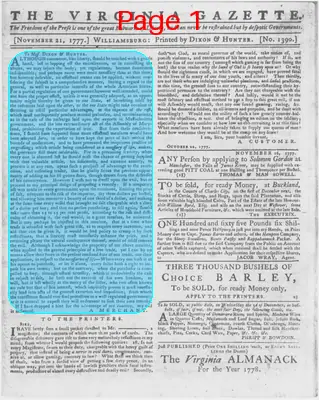
The Virginia Gazette
Richmond, Williamsburg, Richmond County, Virginia
What is this article about?
A merchant writes to printers Dixon & Hunter proposing uniform regulations across American states to control salt prices amid scarcity, including a $3/bushel limit plus bounty, duties on vessels not importing salt, and resale profit caps of 1s-2s percent, to curb engrossing and protect consumers.
Clipping
OCR Quality
Full Text
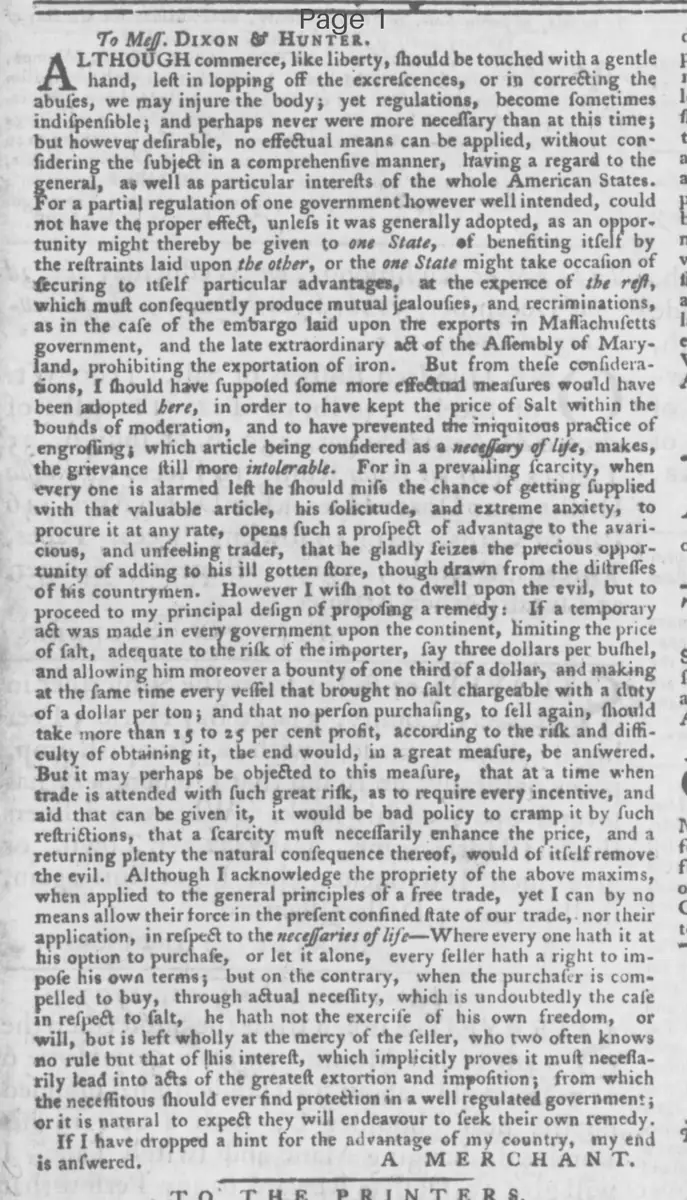
ALTHOUGH commerce, like liberty, should be touched with a gentle hand, let in lopping off the excrescences, or in correcting the abuses, we may injure the body; yet regulations I become sometimes indispensable; and perhaps never were more necessary than at this time;
but however desirable, no effectual means can be applied, without considering the subject in a comprehensive manner,
having a regard to the general, as well as particular interests of the whole American States.
For a partial regulation of one government however well intended, could not have the proper effect, unless it was generally adopted, as an opportunity might thereby be given to one State, benefiting itself by the restraints laid upon the other, or the one State might take occasion of securing to itself particular advantages, at the expense of the rest,
which must consequently produce mutual jealousies, and recriminations,
as in the case of the embargo laid upon the exports in Massachusetts government, and the late extraordinary act of the Assembly of Maryland,
prohibiting the exportation of iron.
But from these considerations, I should have supposed some more effectual measures would have been adopted here, in order to have kept the price of Salt within the bounds of moderation, and to have prevented the iniquitous practice of engrossing; which article being considered as a necessary of life, makes,
the grievance till more intolerable. For in a prevailing scarcity, when every one is alarmed lest he should miss the chance of getting supplied with that valuable article, his solicitude, and extreme anxiety, to procure it at any rate, opens such a prospect of advantage to the avaricious, and unfeeling trader, that he gladly seizes the precious opportunity of adding to his ill gotten store, though drawn from the distresses of his countrymen. However I wish not to dwell upon the evil, but to proceed to my principal design of proposing a remedy: If a temporary act was made in every government upon the continent, limiting the price of salt, adequate to the risk of the importer, say three dollars per bushel,
and allowing him moreover a bounty of one third of a dollar, and making at the same time every vessel that brought no salt chargeable with a duty of a dollar per ton; and that no person purchasing, to sell again, should take more than 1s to 2s per cent profit, according to the risk and difficulty of obtaining it, the end would, in a great measure, be answered.
But it may perhaps be objected to this measure, that at a time when trade is attended with such great risk, as to require every incentive, and aid that can be given it, it would be bad policy to cramp it by such restrictions, that a scarcity must necessarily enhance the price, and a returning plenty the natural consequence thereof, would of itself remove the evil. Although I acknowledge the propriety of the above maxims,
when applied to the general principles of a free trade, yet I can by no means allow their force in the present confined state of our trade, nor their application, in respect to the necessaries of life. Where every one hath it at his option to purchase, or let it alone, every seller hath a right to impose his own terms; but on the contrary, when the purchaser is compelled to buy, through actual necessity, which is undoubtedly the case in respect to salt, he hath not the exercise of his own freedom,
or will, but is left wholly at the mercy of the seller, who too often knows no rule but that of his interest, which implicitly proves it must necessarily lead into acts of the greatest extortion and imposition; from which the necessitous should ever find protection in a well regulated government;
or it is natural to expect they will endeavour to seek their own remedy.
If I have dropped a hint for the advantage of my country, my end is answered.
A MERCHANT.
What sub-type of article is it?
What themes does it cover?
What keywords are associated?
What entities or persons were involved?
Letter to Editor Details
Author
A Merchant.
Recipient
Messrs. Dixon & Hunter
Main Argument
propose temporary continent-wide acts to limit salt prices to three dollars per bushel plus a one-third dollar bounty for importers, impose a dollar per ton duty on vessels not bringing salt, and restrict resale profits to 1s-2s percent, to prevent engrossing and protect against scarcity-driven extortion on this necessity of life.
Notable Details