Thank you for visiting SNEWPapers!
Sign up free
Alexandria Gazette & Daily Advertiser
Alexandria, Virginia
What is this article about?
House of Representatives proceedings included committee reports on petitions and bills for lands, claims, militia, and District of Columbia. Resolutions on military, lands, navy, and other matters were tabled. Debate on partial 1822 military appropriations bill addressed funding shortages; passed provisions for Quartermaster's ($150k), army pay ($300k), and pensions ($451k), excluding Indian Department.
Merged-components note: Continuation of the congressional proceedings article across pages; relabeled from 'story' to 'domestic_news' as it fits local/national non-story news.
Clippings
1 of 2
OCR Quality
Full Text
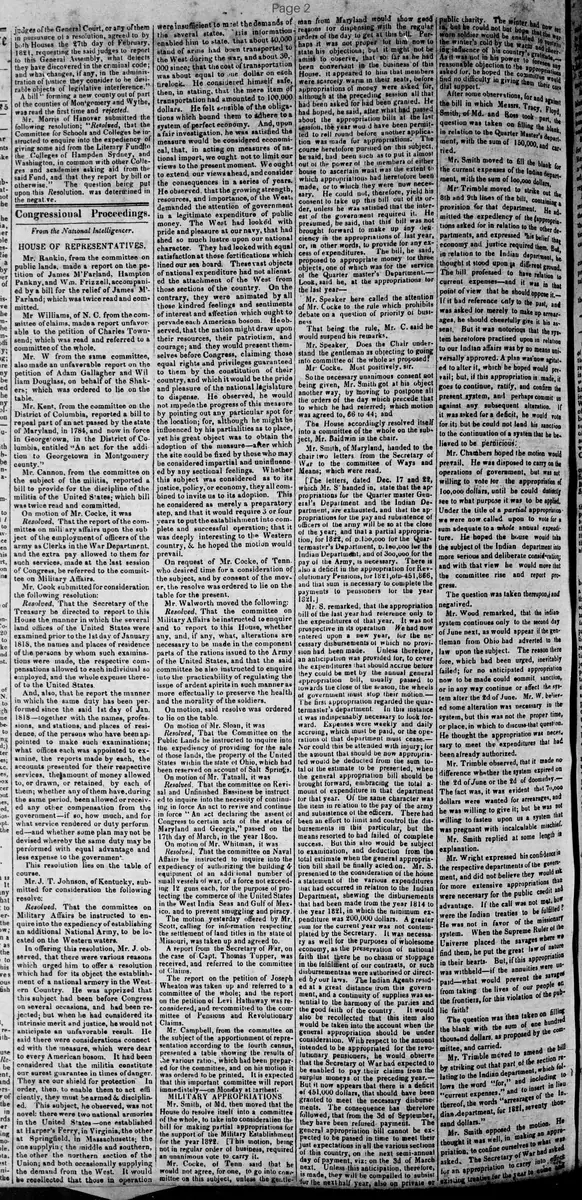
From the National Intelligencer.
HOUSE OF REPRESENTATIVES.
Mr. Rankin, from the committee on public lands, made a report on the petition of James M'Farland, Hampton Pankey, and Wm. Frizzell, accompanied by a bill for the relief of James M'Farland: which was twice read and committed.
Mr. Williams, of N. C. from the committee of claims, made a report unfavorable to the petition of Charles Townsend; which was read and referred to a committee of the whole.
Mr. W. from the same committee, also made an unfavorable report on the petition of Adam Gallagher and William Douglass, on behalf of the Shakers; which was ordered to lie on the table.
Mr. Kent, from the committee on the District of Columbia, reported a bill to repeal part of an act passed by the state of Maryland, in 1784, and now in force in Georgetown, in the District of Columbia, entitled "An act for the addition to Georgetown in Montgomery county."
Mr. Cannon, from the committee on the subject of the militia, reported a bill to provide for the discipline of the militia of the United States: which bill was twice read and committed.
On motion of Mr. Cocke, it was Resolved, That the report of the committee on military affairs upon the subject of the employment of officers of the army as Clerks in the War Department, and the extra pay allowed to them for such services, made at the last session of Congress, be referred to the committee on Military Affairs.
Mr. Cook submitted for consideration the following resolution:
Resolved, That the Secretary of the Treasury be directed to report to this House the manner in which the several land offices of the United States were examined prior to the 1st day of January 1818, the names and places of residence of the persons by whom such examinations were made, the respective compensations allowed to each individual so employed, and the whole expense thereof to the United States.
And, also, that he report the manner in which the same duty has been performed since the said 1st day of Jan. 1818—together with the names, professions, and stations, and places of residence, of the persons who have been appointed to make such examinations; what offices each was appointed to examine, the reports made by each, the accounts presented for their respective services, the amount of money allowed to, or drawn, or retained, by each of them; whether any of them have, during the same period, been allowed or received any other compensation from the government—if so, how much, and for what service rendered or duty performed—and whether some plan may not be devised whereby the same duty may be performed with equal advantage and less expense to the government.
This resolution lies on the table of course.
Mr. J. T. Johnson, of Kentucky, submitted for consideration the following resolve:
Resolved, That the committee on Military Affairs be instructed to enquire into the expediency of establishing an additional National Armory, to be located on the Western waters.
In offering this resolution, Mr. J. observed, that there were various reasons which urged him to offer a resolution which had for its object the establishment of a national armory in the Western Country. He was apprized that this subject had been before Congress on several occasions, and had been rejected; but when he had considered its intrinsic merit and justice, he would not anticipate an unfavorable result. He said there were considerations connected with the measure, which were dear to every American bosom. It had been considered that the militia constitute our surest guarantee in times of danger. They are our shield for protection. In order, then, to enable them to act efficiently, they must be armed & disciplined. This subject, he observed, was not novel: there were two national armories in the United States—one established at Harper's Ferry, in Virginia, the other at Springfield, in Massachusetts: the one supplying the middle and southern, the other the northern section of the Union; and both occasionally supplying the demand from the West. It would be recollected that those in operation were insufficient to meet the demands of the several states. This information enabled him to state, that about 40,000 stand of arms had been transported to the West during the war, and about 30,000 since; that the cost of transportation was about equal to one dollar on each firelock. He considered himself safe, then, in stating, that the mere item of transportation had amounted to 100,000 dollars. He felt sensible of the obligations which bound them to adhere to a system of perfect economy. And, upon a fair investigation, he was satisfied the measure would be considered economical, that, in acting on measures of national import, we ought not to limit our views to the present moment. We ought to extend our views ahead, and consider the consequences in a series of years. He observed, that the growing strength, resources, and importance, of the West, demanded the attention of government in a legitimate expenditure of public money. The West had looked with pride and pleasure at our navy, that had shed so much lustre upon our national character. They had looked with equal satisfaction at those fortifications which lined our sea board. These vast objects of national expenditure had not alienated the attachment of the West from those sections of the country. On the contrary, they were animated by all those kindred feelings and sentiments of interest and affection which ought to pervade each American bosom. He observed, that the nation might draw upon their resources, their patriotism, and courage; and they would present themselves before Congress, claiming those equal rights and privileges guaranteed to them by the constitution of their country, and which it would be the pride and pleasure of the national legislature to dispense. He observed, he would not impede the progress of this measure by pointing out any particular spot for the location; for, although he might be influenced by his partialities as to place, yet his great object was to obtain the adoption of the measure—after which the site could be fixed by those who may be considered impartial and uninfluenced by any sectional feelings. Whether this subject was considered as to its justice, policy, or economy, they all combined to invite us to its adoption. This he considered as merely a preparatory step, and that it would require 3 or four years to put the establishment into complete and successful operation; that it was deeply interesting to the Western country, & he hoped the motion would prevail.
On request of Mr. Cocke, of Tenn. who desired time for a consideration of the subject, and by consent of the mover, the resolve was ordered to lie on the table for the present.
Mr. Walworth moved the following:
Resolved, That the committee on Military Affairs be instructed to enquire and to report to this House, whether any, and, if any, what, alterations are necessary to be made in the component parts of the rations issued to the Army of the United States, and that the said committee be also instructed to enquire into the practicability of regulating the issue of ardent spirits in such manner as more effectually to preserve the health and the morality of the soldiers.
On motion, said resolve was ordered to lie on the table.
On motion of Mr. Sloan, it was Resolved, That the Committee on the Public Lands be instructed to inquire into the expediency of providing for the sale of those lands, the property of the United States within the state of Ohio, which had been reserved on account of Salt Springs.
On motion of Mr. Tatnall, it was Resolved, That the committee on Revision and Unfinished Business be instructed to inquire into the necessity of continuing in force "An act to revive and continue in force" An act declaring the assent of Congress to certain acts of the states of Maryland and Georgia," passed on the 17th day of March, in the year 1800.
On motion of Mr. Whitman, it was Resolved, That the committee on Naval Affairs be instructed to inquire into the expediency of authorizing the building & equipment of an additional number of small vessels of war, of a force not exceeding 12 guns each, for the purpose of protecting the commerce of the United States in the West India Seas and Gulf of Mexico, and to prevent smuggling and piracy.
The motion yesterday offered by Mr. Scott, calling for information respecting the settlement of land titles in the state of Missouri, was taken up and agreed to.
A report from the Secretary of War, on the case of Capt. Thomas Tupper, was received, and referred to the committee of Claims.
The report on the petition of Joseph Wheaton was taken up and referred to a committee of the whole; and the report on the petition of Levi Hathaway was re-considered, and re-committed to the committee of Pensions and Revolutionary Claims.
Mr. Campbell, from the committee on the subject of the apportionment of representation according to the fourth census, presented a table showing the results of the various ratios, which had been prepared for the committee, and on his motion it was ordered to be printed. It is expected that this important committee will report immediately—on Monday at farthest.
MILITARY APPROPRIATIONS
Mr. Smith, of Md. then moved that the House do resolve itself into a committee of the whole, to take into consideration the bill for making partial appropriations for the support of the Military Establishment for the year 1822. [This motion, being not in regular order of business, required an unanimous vote to carry it.
Mr. Cocke, of Tenn. said that he would not agree, for one, to go into committee on this subject, unless the gentleman from Maryland would show good reasons for dispensing with the regular orders of the day to get at this bill. Perhaps it was not proper for him now to state his objections; but it might not be amiss to observe, that so far as he had been conversant in the business of this House, it appeared to him that members were scarcely warm in their seats, before appropriations of money were asked for, although at the preceding session all that had been asked for had been granted. He had hoped, he said, after what had passed about the appropriation bills at the last session, the year would have been permitted to roll round before another application was made for appropriations. The course heretofore pursued on this subject, he said, had been such as to put it almost out of the power of the members of either house to ascertain what was the extent to which appropriations had heretofore been made, or to which they were now necessary. He could not, therefore, yield his consent to take up this bill out of its order, unless he was satisfied that the interest of the government required it. He presumed, he said, that this bill was not brought forward to make up any deficiency in the appropriations of last year, or, in other words, to provide for any excess of expenditures. The bill, he said, proposed to appropriate money for three objects, one of which was for the service of the Quarter Master's Department.— Look, said he, at the appropriations for the last year—
Mr. Speaker here called the attention of Mr. Cocke to the rule which prohibits debate on a question of priority of business.
That being the rule, Mr. C. said he would suspend his remarks.
Mr. Speaker. Does the Chair understand the gentleman as objecting to going into committee of the whole as proposed?
Mr. Cocke. Most positively, sir.
So the necessary unanimous consent not being given, Mr. Smith got at his object another way, by moving to postpone all the orders of the day which precede that to which he had referred; which motion was agreed to, 66 to 44; and
The House accordingly resolved itself into a committee of the whole on the subject, Mr. Baldwin in the chair.
Mr. Smith, of Maryland, handed to the chair two letters from the Secretary of War to the committee of Ways and Means; which were read.
[The letters, dated Dec. 17 and 22, which Mr. S. handed in, state that the appropriations for the Quarter master General's Department and the Indian Department, are exhausted, and that the appropriations for the pay and subsistence of officers of the army will be so at the close of the year; and that a partial appropriation, for 1822, of $150,000 for the Quartermaster's Department, $100,000 for the Indian Department, and of $300,000 for the pay of the Army, is necessary. There is also a deficit in the appropriation for Revolutionary Pensions, for 1821, of $451,866, and that sum is necessary to complete the payments to pensioners for the year 1821.]
Mr. S. remarked, that the appropriation bill of the last year had reference only to the expenditures of that year. It was not prospective in its operation. We had now entered upon a new year, for the necessary disbursements of which no provision had been made. Unless therefore, an anticipation was provided for, to cover the expenditures that should accrue before they could be met by the annual general appropriation bill, usually passed towards the close of the season, the wheels of government must stop their motion.— The first appropriation regarded the quartermaster's department. In this instance it was indispensably necessary to look forward. Expenses were weekly and daily accruing, which must be paid, or the operations of that department must cease.— Nor could this be attended with injury: for the amount that should be now appropriated would be deducted from the sum total of the estimate to be presented, when the general appropriation bill should be brought forward, embracing the total amount of expenditure in that department for that year. Of the same character was the item in relation to the pay of the army and subsistence of the officers. There had been an effort to limit and control the disbursements in this particular, but the means resorted to had failed of complete success. But this also would be subject to examination, and deduction from the total estimate when the general appropriation bill shall be finally acted on. Mr. S. presented to the consideration of the house a statement of the various expenditures that had occurred in relation to the Indian Department, showing the disbursements that had been made from the year 1814 to the year 1821, in which the minimum expenditure was 200,000 dollars. A greater sum for the current year was not contemplated by the Secretary. It was necessary as well for the purposes of wholesome economy, as the preservation of national faith that there be no chasm or stoppage in the fulfilment of our contracts, or such disbursements as were authorized or directed by our laws. The Indian Agents resided at a great distance from this government, and a continuity of supplies was essential to the harmony of the parties and the good faith of the country. It would also be recollected that this item also would be taken into the account when the general appropriation should be under consideration. With respect to the amount intended to be appropriated for the revolutionary pensioners, he would observe that the Secretary of War had expected to be enabled to pay their claims from the surplus moneys of the preceding year.— But it now appears that there is a deficit of 451,000 dollars, that should have been granted to meet the necessary disbursements. The consequence has therefore followed, that from the 3d of September, they have been refused payment. The general appropriation bill cannot be expected to be passed in time to meet their just expectations in all the various sections of this country, on the next semi-annual day of payment, viz: on the 3d of March next. Unless this anticipation, therefore, is made, they will be compelled to subsist for the next half year, also on private or public charity. He hoped the house would find no difficulty in giving them their cordial support.
After some observations, for and against the bill in which Messrs. Tracy, Floyd, Smith, of Md. and Rows took part, the question was taken on filling the blank in relation to the Quarter Master's department, with the sum of 150,000, and carried.
Mr. Smith moved to fill the blank for the current expenses of the Indian department, with the sum of 100,000 dollars.
Mr. Trimble moved to strike out the 8th and 9th lines of the bill, containing a provision for that department.
He admitted the expediency of the appropriations asked for in relation to the other departments, and expressed his belief that economy and justice required them. But, in relation to the Indian department, he thought it stood upon a different ground. The bill professed to have relation to current expenses—and it was in that point of view that he should oppose it.— If it had reference only to the past, and was asked for merely to make up arrearages, he should cheerfully give it his assent. But it was notorious that the system heretofore practised upon in relation to our Indian affairs was by no means universally approved. A plan was now agitated to alter it, which he hoped would prevail; but, if this appropriation is made, it goes to continue, ratify, and confirm the present system, and perhaps commit us against any subsequent alteration. If it was asked for a deficit, he would vote for it; but he could not lend his sanction to the continuation of a system that he believed to be pernicious.
Mr. Chambers hoped the motion would prevail. He was disposed to carry on the operations of government, but was not willing to vote for the appropriation of 100,000 dollars, until he could distinctly see to what purpose it was to be applied. Under the title of a partial appropriation we were now called upon to vote for a sum adequate to a whole annual expenditure. He hoped the house would take the subject of the Indian department into more serious and deliberate consideration: and with that view he would move that the committee rise and report progress.
The question was taken thereupon, and negatived.
Mr. Wood remarked, that the Indian system continues only to the second day of June next, as would appear if the gentleman from Ohio had adverted to the law upon the subject. The reason therefore, which had been urged, inevitably failed; for no anticipated appropriation now to be made could commit, sanction, or in any way continue or affect the system after the 2d of June. Mr. W. believed some alteration was necessary in the system, but this was not the proper time, or place, in which to discuss that question. He thought the appropriation was necessary to meet the expenditures that had been already authorized.
Mr. Trimble observed, that it made no difference whether the system expired on the 2d of June or the 2d of doomsday.— The fact was, it was evident that 70,000 dollars were wanted for arrearages, and he was willing to give it; but he was not willing to fasten upon us a system that was pregnant with incalculable mischief.
Mr. Smith replied at some length in explanation.
Mr. Wright expressed his confidence in the respective departments of the government, and did not believe they would ask for more extensive appropriations than were necessary for the public credit and advantage. If the call was not met, how were the Indian treaties to be fulfilled? He was not in favor of the missionary system. When the Supreme Ruler of the Universe placed the savages where we find them, he put the great law of nature in their hearts. But, if this appropriation was withheld—if the annuities were unpaid—what would prevent the savages from taking the lives of our people on the frontiers, for this violation of the public faith?
The question was then taken on filling the blank with the sum of one hundred thousand dollars, as proposed by the committee, and carried.
Mr. Trimble moved to amend the bill by striking out that part of the section relating to the Indian department, which allows the word "for," and including to "current expenses." and to insert in lieu thereof, the words "arrearages of the Indian department, for 1821, seventy thousand dollars."
Mr. Smith opposed the motion. He thought it was well, in making an appropriation, to confine ourselves to what was asked. The Secretary of War had asked for an appropriation to carry into effect existing treaties for the year to come.
is past. The gentleman from Ky. (Mr. Trimble) proposes to deny him what he asks, and to give him what he does not ask. The question was then taken, and the motion negatived. Mr. Smith then proposed to fill the blank for the pay of the army, and subsistence of the officers, with the sum of three hundred thousand dollars, which was put and carried. Mr. Smith also proposed to fill the blank for the deficit in the appropriation for Revolutionary pensions, with the sum of $451,886 57, which was put and carried; and thereupon the committee rose and reported the bill as amended to the House. In the House, the question of concurrence was taken on all the provisions of the bill (except that which provides for the Indian Department, which, on motion of Mr. Ross, was not included) and carried. Mr. Ross moved that the question of concurrence, so far as it related to the appropriation for the Indian Department, be taken by Yeas and Nays. The motion was agreed to, but, before the question was put, The House adjourned.
What sub-type of article is it?
What keywords are associated?
What entities or persons were involved?
Where did it happen?
Domestic News Details
Primary Location
Washington
Event Date
December 1821
Key Persons
Outcome
various reports committed or tabled; resolutions ordered to lie on table; motion to establish additional national armory tabled; military appropriations bill partially passed with $150,000 for quartermaster's department, $300,000 for army pay, $451,886.57 for revolutionary pensions; indian department appropriation debated and not included in final concurrence.
Event Details
The House of Representatives considered multiple committee reports on petitions and bills related to public lands, claims, District of Columbia, and militia discipline. Resolutions were submitted on military affairs, land office examinations, national armory establishment, army rations, public lands sales, revision of acts, naval vessels, and Missouri land titles. A report on apportionment was printed. Debate occurred on a bill for partial military appropriations for 1822, addressing exhausted funds in Quartermaster's, Indian, and army pay departments, plus Revolutionary pensions deficit. Amendments and objections were raised, particularly on Indian Department funding.