Thank you for visiting SNEWPapers!
Sign up free
The Hillsborough Recorder
Hillsboro, Orange County, North Carolina
What is this article about?
Circular letter from U.S. Rep. Abraham Rencher reviewing the 24th Congress's proceedings, including federal finances, surplus revenue distribution debates, executive actions under Jackson, opposition to abolitionism, and peaceful foreign relations, dated March 10, 1837, from Washington.
Merged-components note: These two components form the complete circular letter from A. Rencher reviewing congressional proceedings, finances, and policy; original labels were 'story' and 'letter_to_editor', but the content is political news summary fitting 'domestic_news'.
Clippings
1 of 2
OCR Quality
Full Text
The Proceedings of the Tenth Congress
Session
Washington
March 10th, 1837.
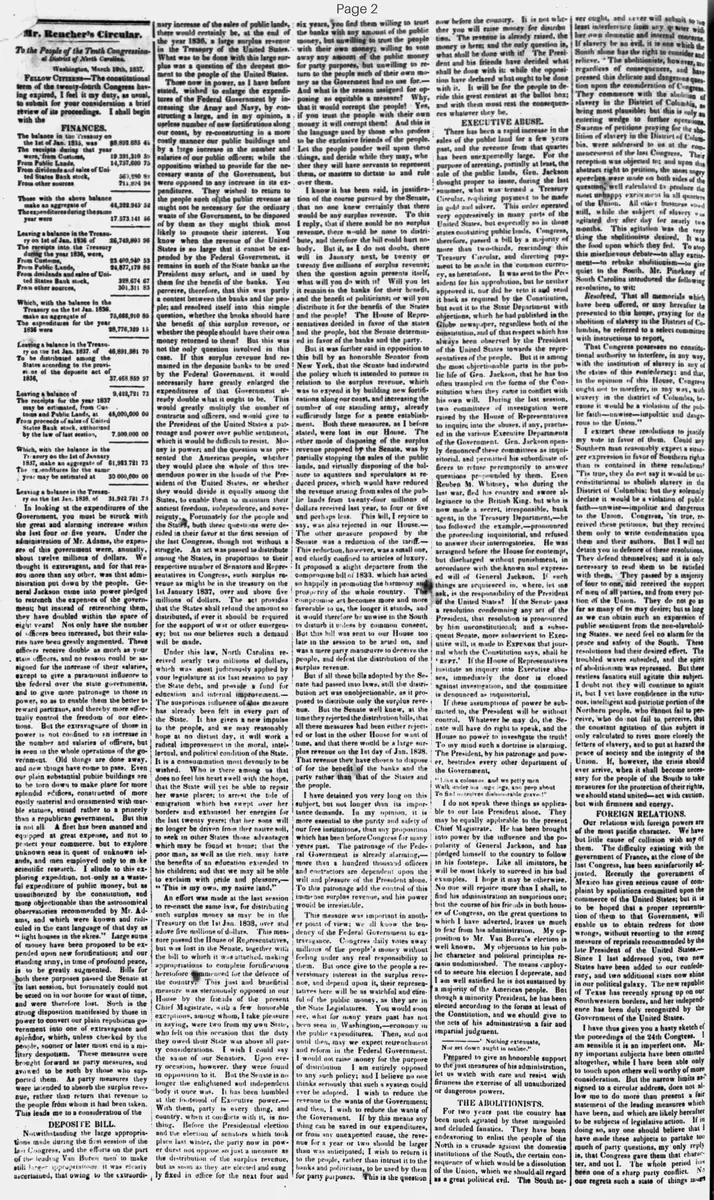
Fellow Citizens—The constitutional term during which you have been pleased to confide to me the important trust of representing you in Congress having expired, I feel it my duty, as became a faithful public servant, to submit for your consideration a brief review of its proceedings.
I shall begin
with the
FINANCES.
The balance in the Treasury on the 1st of Jan. 1835, was
$68,897,835.44
Its receipts during that year from Customs
were $39,310,919.00
From Tonnage
$16,757,600.75
From dividends and sales of U. States Bank stock
$4,100,000.00
From other sources
$1,500,000.00
Which with the above balance makes as ascertained
$130,566,355.19
The expenditures for the same period were
$17,573,141.64
Leaving a balance in the Treasury on 1st of Jan. 1836 of
$112,993,213.55
The receipts into the Treasury during the year 1836, were,
From Customs
$149,409,940.33
From Public Lands,
$25,077,179.66
From dividends and sale of United States Bank stock
$3,325,674.67
From other sources,
$1,901,311.63
Which, with the balance in the Treasury on the 1st Jan. 1836,
make an aggregate of
$293,666,910.85
The expenditures for the year 1836 were
$24,776,319.13
Leaving a balance in the Treasury on the 1st Jan. 1837, of
$268,891,581.72
To be distributed among the States according to the provisions of the deposit act of 1836,
$37,468,859.97
Leaving a balance of
$231,422,721.75
The receipts for the year 1837 may be estimated, from Customs and Public Lands, at
$45,000,000.00
From proceeds of sales of United States Bank stock, authorized by the last session,
$7,500,000.00
Which, with the balance in the Treasury on the 1st of January 1837, make an aggregate of $285,922,721.75
The expenditures for the same year may be estimated at
$30,000,000.00
Leaving a balance in the Treasury, say on the 1st Jan. 1838, of
$255,922,721.75
In looking at the expenditures of the Government, you must be struck with the great and alarming increase within the last four or five years. Under the administration of Mr. Adams, the expenses of this government were, annually, about twelve millions of dollars. We thought it extravagant, and for that reason more than any other, was that administration put down by the people. General Jackson came into power pledged to retrench the expenses of the government; but instead of retrenching them, they have doubled within the space of eight years! Not only have the number of officers been increased, but their salaries have been greatly augmented. These officers receive double as much as your State officers, and no reason could be assigned for the increase of their salaries, except to give a paramount influence to the federal over the state governments, and to give more patronage to those in power, so as to enable them the better to reward partisans, and thereby more effectually control the freedom of our elections. But the extravagance of those in power is not confined to an increase in the number and salaries of officers, but is seen in the whole operations of the government.
Old things are done away, and new things have come to pass. Even our plain substantial public buildings are to be torn down to make place for more splendid edifices, constructed of more costly material and ornamented with marble statues, suited rather to a princely than a republican government. But this is not all. A fleet has been manned and equipped at great expense, and not to protect your commerce, but to explore unknown seas in quest of unknown islands, and men employed only to make scientific research. I allude to this exploring expedition, not only as a wasteful expenditure of public money, but as unauthorized by the constitution, and more objectionable than the astronomical observatories recommended by Mr. Adams, and which were known and ridiculed in the cant language of that day as 'light houses in the skies.' Large sums of money have been proposed to be expended upon new fortifications; and our standing army, in time of profound peace, is to be greatly augmented. Bills for both these purposes passed the Senate at its last session, but fortunately could not be acted on in our house for want of time, and were therefore lost. Such is the strong disposition manifested by those in power to convert our plain republican government into one of extravagance and splendor, which, unless checked by the people, sooner or later must end in a military despotism.
These measures were brought forward as party measures, and avowed to be such by those who supported them. As party measures they were intended to absorb the surplus revenue, rather than return that revenue to the people from whom it had been taken.
This leads me to a consideration of the DEPOSITE BILL.
Notwithstanding the large appropriations made during the first session of the last Congress, and the efforts on the part of the leading Van Buren men to make still larger appropriations, it was clearly ascertained, that owing to the extraordinary increase of the sales of public lands, there would certainly be, at the end of the year 1836, a large surplus revenue in the Treasury of the United States.
What was to be done with this large surplus was a question of the deepest moment to the people of the United States. Those now in power, as I have before stated, wished to enlarge the expenditures of the Federal Government by increasing the Army and Navy, by constructing a large, and in my opinion, a useless number of new fortifications along our coast, by re-constructing in a more costly manner our public buildings and by a large increase in the number and salaries of our public officers; while the opposition wished to provide for the necessary wants of the Government, but were opposed to any increase in its expenditures. They wished to return to the people such of the public revenue as might not be necessary for the ordinary wants of the Government, to be disposed of by them as they might think most likely to promote their interest. You know when the revenue of the United States is so large that it cannot be expended by the Federal Government, it remains in such of the State banks as the President may select, and is used by them for the benefit of the banks. You perceive, therefore, that this was partly a contest between the banks and the people; and resolved itself into this simple question, whether the banks should have the benefit of this surplus revenue, or whether the people should have their own money returned to them? But this was not the only question involved in this case. If this surplus revenue had remained in the deposite banks to be used by the Federal Government, it would necessarily have greatly enlarged the expenditures of that Government already double what it ought to be. This would greatly multiply the number of contracts and officers, and would give to the President of the United States a patronage and power over public sentiment, which it would be difficult to resist. Money is power; and the question was presented the American people, whether they would place the whole of this tremendous power in the hands of the President of the United States, or whether they would divide it equally among the States, to enable them to maintain their ancient freedom, independence, and sovereignty. Fortunately for the people and the States, both these questions were decided in their favor at the first session of the last Congress, though not without a struggle. An act was passed to distribute among the States, in proportion to their respective number of Senators and Representatives in Congress, such surplus revenue as might be in the treasury on the 1st January 1837, over and above five millions of dollars. The act provides that the States shall refund the amount so distributed, if ever it should be required for the support of war or other emergency: but no one believes such a demand will be made.
Under this law, North Carolina received nearly two millions of dollars, which was most judiciously applied by your legislature at its last session to pay the State debt, and provide a fund for education and internal improvement. The auspicious influence of this measure has already been felt in every part of the State. It has given a new impulse to the people, and we may reasonably hope at no distant day, it will work a radical improvement in the moral, intellectual, and political condition of the State. It is a consummation most devoutly to be wished. Who is there among us that does not feel his heart swell with the hope, that the State will yet be able to repair her waste places; to arrest the tide of emigration which has swept over her borders and exhausted her energies for the last twenty years; that her sons will no longer be driven from their native soil, to seek in other States those advantages which may be found at home; that the poor man, as well as the rich, may have the benefits of an education extended to his children; and that we may all be able to exclaim with pride and pleasure, 'This is my own, my native land.'
An effort was made at the last session to re-enact the same law, for distributing such surplus money as may be in the Treasury on the 1st Jan. 1838, over and above five millions of dollars. This measure passed the House of Representatives, but was lost in the Senate, together with the bill to which it was attached, making appropriations to complete fortifications heretofore commenced for the defence of the country. This just and beneficial measure was strenuously opposed in our House by the friends of the present Chief Magistrate, with a few honorable exceptions, among whom, I take pleasure in saying, were two from my own State, who felt on this occasion that the duty they owed their State was above all party considerations. I wish I could say the same of our Senators. Upon every occasion, however, they were found in opposition to it. But the Senate is no longer the enlightened and independent body it once was. It has been humbled at the footstool of Executive power. With them, party is every thing, and country, when it conflicts with it, is nothing. Before the Presidential election and the election of senators which took place last winter, the party now in power durst not oppose so just a measure as the distribution of the surplus revenue, but as soon as they are elected and snugly fixed in office for the next four and six years, you find them willing to trust the banks with any amount of the public money, but unwilling to trust the people with their own money; willing to vote away any amount of the public money for party purposes, but unwilling to return to the people such of their own money as the Government had no use for.
And what is the reason assigned for opposing so equitable a measure? Why, that it would corrupt the people! Yes, if you trust the people with their own money it will corrupt them! And this is the language used by those who profess to be the exclusive friends of the people. Let the people ponder well upon these things, and decide while they may, whether they will have servants to represent them, or masters to dictate to and rule over them.
I know it has been said, in justification of the course pursued by the Senate, that no one knew certainly that there would be any surplus revenue. To this I reply, that if there should be no surplus revenue, there would be none to distribute, and therefore the bill could hurt nobody. But if, as I do not doubt, there will in January next, be twenty or twenty five millions of surplus revenue: then the question again presents itself, what will you do with it? Will you let it remain in the banks for their benefit, and the benefit of politicians; or will you distribute it for the benefit of the States and the people? The House of Representatives decided in favor of the states and the people, but the Senate determined in favor of the banks and the party.
But it was further said in opposition to this bill by an honorable Senator from New York, that the Senate had indicated the policy which it intended to pursue in relation to the surplus revenue, which was to expend it by building new fortifications along our coast, and increasing the number of our standing army, already sufficiently large for a peace establishment. Both these measures, as I before stated, were lost in our House. The other mode of disposing of the surplus revenue proposed by the Senate, was by partially stopping the sales of the public lands, and virtually disposing of the balance to squatters and speculators at reduced prices, which would have reduced the revenue arising from sales of the public lands from twenty-four millions of dollars received last year, to four or five and perhaps less. This bill, I rejoice to say, was also rejected in our House.
The other measure proposed by the Senate was a reduction of the tariff. This reduction, however, was a small one, and chiefly confined to articles of luxury. It proposed a slight departure from the Compromise bill of 1833, which has acted so happily in promoting the harmony and prosperity of the whole country. The compromise act becomes more and more favorable to us, the longer it stands, and it would therefore be unwise in the South to disturb it unless by common consent. But this bill was sent to our House too late in the session to be acted on, and was a mere party manoeuvre to deceive the people, and defeat the distribution of the surplus revenue.
But if all these bills adopted by the Senate had passed into laws, still the distribution act was unobjectionable, as it proposed to distribute only the surplus revenue. But the Senate well knew, at the time they rejected the distribution bills, that all these measures had been either rejected or lost in the other House for want of time, and that there would be a large surplus revenue on the 1st day of Jan. 1838. That revenue they have chosen to dispose of for the benefit of the banks and the party rather than that of the States and the people.
I have detained you very long on this subject, but not longer than its importance demands. In my opinion, it is more essential to the purity and safety of our free institutions, than any proposition which has been before Congress for many years past. The patronage of the Federal Government is already alarming, more than a hundred thousand officers and contractors are dependent upon the will and pleasure of the President alone. To this patronage add the control of this immense surplus revenue, and his power would be irresistible.
This measure was important in another point of view: we all know the tendency of the Federal Government to extravagance. Congress daily votes away millions of the people's money without feeling under any real responsibility to them. But once give to the people a reversionary interest in the surplus revenue, and depend upon it, their representatives here will be as watchful and careful of the public money, as they are in the State Legislatures. You would soon see, what for many years past has not been seen in Washington,—economy in the public expenditures. Then, and not until then, may we expect retrenchment and reform in the Federal Government.
I would not raise money for the purpose of distribution I am entirely opposed to any such policy; and I believe no one thinks seriously that such a system could ever be adopted. I wish to reduce the revenue to the wants of the Government; and then, I wish to reduce the wants of the Government. If by this means any thing can be saved in our expenditures, or from any unexpected cause, the revenue for a year or two should be larger than was anticipated; I wish to return it to the people, rather than intrust it to the banks and politicians, to be used by them for party purposes.
This is the question now before the country. It is not whether you will raise money for distribution. The revenue is already raised. the money is here; and the only question is, what shall be done with it! The President and his friends have decided what shall be done with it: while the opposition have declared what ought to be done with it. It will be for the people to decide this great contest at the ballot box; and with them must rest the consequences whatever they be.
EXECUTIVE ABUSE.
There has been a rapid increase in the sales of the public land for a few years past, and the revenue from that quarter has been unexpectedly large. For the purpose of arresting, partially at least, the sale of the public lands, Gen. Jackson thought proper to issue, during the last summer, what was termed a Treasury Circular, requiring payment to be made in gold and silver. This order operated very oppressively in many parts of the United States, but especially so in those states containing public lands. Congress, therefore, passed a bill by a majority of more than two-thirds, rescinding this Treasury Circular, and directing payment to be made in the "common currency, as heretofore." It was sent to the President for his approbation, but he neither approved it, nor did he veto it and send it back as required by the Constitution, but sent it to the State Department with objections, which he had published in the Globe newspaper, regardless both of the constitution, and of that respect which has always been observed by the President of the United States towards the representatives of the people. But it is among the most objectionable parts in the public life of Gen. Jackson, that he has too often trampled on the forms of the Constitution when they came in conflict with his own will. During the last session, two committees of investigation were raised by the House of Representatives to inquire into the abuses, if any, practiced in the various Executive Departments of the Government. Gen. Jackson openly denounced these committees as inquisitorial, and permitted his subordinate officers to refuse peremptorily to answer questions propounded by them. Even Reuben M. Whitney, who during the last war, fled his country and swore allegiance to the British King, but who is now made a secret, irresponsible, bank agent, in the Treasury Department,—he too followed the example,—pronounced the proceeding inquisitorial, and refused to answer their interrogatories. He was arraigned before the House for contempt, but discharged without punishment, in accordance with the known and expressed will of General Jackson. If such things are acquiesced in, where, let me ask, is the responsibility of the President of the United States? If the Senate pass a resolution condemning any act of the President, that resolution is pronounced by him unconstitutional; and a subsequent Senate, more subservient to Executive will, is made to expunge that journal which the Constitution says, shall be kept. If the House of Representatives institute an inquiry into Executive abuses, immediately the door is closed against investigation, and the committee is denounced as inquisitorial.
If these assumptions of power be submitted to, the President will be without control. Whatever he may do, the Senate will have no right to speak, and the House no power to investigate the truth! To my mind such a doctrine is alarming. The President, by his patronage and power, bestrides every other department of the Government,
"Like a colossus, and we petty men
Walk under his huge legs, and peep about
To find ourselves dishonorable graves!"
I do not speak these things as applicable to our late President alone. They may be equally applicable to the present Chief Magistrate. He has been brought into power by the influence and the popularity of General Jackson, and has pledged himself to the country to follow in his footsteps. Like all imitators, he will be most likely to succeed in his bad examples. I hope it may be otherwise. No one will rejoice more than I shall, to find his administration an auspicious one; but the course of his friends in both houses of Congress, on the great questions to which I have adverted, leaves us much to fear from his administration. My opposition to Mr. Van Buren's election is well known. My objections to his public character and political principles remain undiminished. The means employed to secure his election I deprecate, and I am well satisfied he is not sustained by a majority of the American people. But though a minority President, he has been elected according to the forms at least of the Constitution, and we should give to the acts of his administration a fair and impartial judgment.
Nothing extenuate,
Nor set down aught in malice."
Prepared to give an honorable support to the just measures of his administration, let us watch with care and resist with firmness the exercise of all unauthorized or dangerous powers.
THE ABOLITIONISTS.
For two years past the country has been much agitated by these misguided and deluded fanatics. They have been endeavoring to enlist the people of the North in a crusade against the domestic institutions of the South, the certain consequence of which would be a dissolution of the Union, which we should all regard as a great political evil. The South never ought, and never will submit to the least interference from any quarter with her own domestic and internal concerns. If slavery be an evil, it is one which the South alone has the right to consider and relieve. The abolitionists, however, are regardless of consequences, and have pressed this delicate and dangerous question upon the consideration of Congress. They commence with the abolition of slavery in the District of Columbia, as being most plausible: but this is only an entering wedge to further operations.
Swarms of petitions praying for the abolition of slavery in the District of Columbia, were addressed to us at the commencement of the last Congress. Their reception was objected to; and upon the abstract right to petition, the most angry speeches were made on both sides of the question, well calculated to produce the most unhappy excitement in all quarters of the Union. All other business stood still, while the subject of slavery was agitated day after day for nearly two months.
This agitation was the very thing the abolitionists desired. It was the food upon which they fed. To stop this mischievous debate—to allay excitement—to rebuke abolitionism—to give quiet to the South, Mr. Pinckney of South Carolina introduced the following resolution, to wit:
Resolved, That all memorials which have been offered, or may hereafter be presented to this house, praying for the abolition of slavery in the District of Columbia, be referred to a select committee with instructions to report,
That Congress possesses no constitutional authority to interfere, in any way, with the institution of slavery in any of the states of this confederacy: and that, in the opinion of this House, Congress ought not to interfere, in any way, with slavery in the district of Columbia, because it would be a violation of the public faith—unwise—impolitic and dangerous to the Union."
I extract these resolutions to justify my vote in favor of them. Could any Southern man reasonably expect a stronger expression in favor of Southern rights than is contained in these resolutions! 'Tis true, they do not say it would be unconstitutional to abolish slavery in the District of Columbia; but they solemnly declare it would be a violation of public faith—unwise—impolitic and dangerous to the Union. Congress, 'tis true, received these petitions, but they received them only to write condemnation upon them and their authors. But I will not detain you in defence of these resolutions. They defend themselves; and it is only necessary to read them to be satisfied with them. They passed by a majority of four to one, and received the support of nearly all parties, and from every portion of the Union. They do not go as far as many of us may desire; but as long as we can obtain such an expression of public sentiment from the non-slaveholding States, we need feel no alarm for the peace and safety of the South. These resolutions had their desired effect. The troubled waves subsided, and the spirit of abolitionism was repressed. But there are restless fanatics still agitate this subject. I doubt not they will continue to agitate it, but I yet have confidence in the virtuous, intelligent and patriotic portion of the Northern people, who cannot fail to perceive, who do not fail to perceive, that the constant agitation of this subject is only calculated to rivet more closely the fetters of slavery, and to put at hazard the peace of society and the integrity of the Union. If, however, the crisis should ever arrive, when it shall become necessary for the people of the South to take measures for the protection of their rights we should stand united—act with caution but with firmness and energy.
FOREIGN RELATIONS
Our relations with foreign powers are of the most pacific character. We have but little cause of collision with any of them. The difficulty existing with the government of France, at the close of the last Congress, has been satisfactorily adjusted. Recently the government of Mexico has given serious cause of complaint by spoliations committed upon the commerce of the United States: but it is to be hoped that a proper representation of them to that Government, will enable us to obtain redress for those wrongs, without resorting to the strong measure of reprisals recommended by the late President of the United States.
Since I last addressed you, two new States have been added to our confederacy, and two additional stars now shine in our political galaxy. The new republic of Texas has recently sprung up on our Southwestern borders, and her independence has been duly recognized by the Government of the United States.
I have thus given you a hasty sketch of the proceedings of the 24th Congress. I am sensible it is an imperfect one. Many important subjects have been omitted altogether, while I have been able only to touch upon others well worthy of more consideration. But the narrow limits assigned to a circular address, does not allow me to do more than present a fair statement of the leading measures which have been, and which are likely hereafter to be subjects of legislative action. If in doing so, any one should believe that I have made these subjects to partake too much of party questions, my only reply is, that Congress gave them that character, and not I. The whole period has been one of a sharp party conflict. No one regrets such a state of things more than I do.
I do, and no one contributed less to my country, my only ambition is to preserve them in their purity. Devoted to the free institutions of the country, warmly attached to the people I represent, I seek no higher reward, in my humble efforts to serve them, than their approbation. Should you think proper again to confer on me the honor of representing you, grateful for your generous and continued confidence, I shall endeavor to deserve it, by faithful and unremitting exertions to promote your interest and happiness.
With high regard, I am your fellow-citizen,
A. RENCHER.
What sub-type of article is it?
What keywords are associated?
What entities or persons were involved?
Where did it happen?
Domestic News Details
Primary Location
Washington
Event Date
March 10th, 1837
Key Persons
Outcome
surplus revenue distributed to states under 1836 deposit act; north carolina received nearly $2 million for debt, education, improvements; 1838 distribution bill passed house but failed in senate; various senate bills on fortifications, army, land sales, tariff rejected or lost; pinckney resolutions passed condemning interference with slavery; peaceful foreign relations with france adjusted, issues with mexico pending; texas independence recognized.
Event Details
U.S. Representative A. Rencher's circular reviews 24th Congress proceedings, detailing federal finances showing large surpluses, criticizing increased expenditures under Jackson administration, debating Deposit Bill for distributing surplus to states versus retaining for federal use or banks, accusing executive of constitutional abuses like pocket veto and obstructing investigations, opposing abolitionist petitions with Pinckney resolutions affirming non-interference in slavery, noting peaceful foreign relations and recognition of Texas.