Thank you for visiting SNEWPapers!
Sign up free
The Hillsborough Recorder
Hillsboro, Orange County, North Carolina
What is this article about?
Hon. A. B. Greenwood's report on Indian Affairs details annuities paid, lands acquired, and conditions of various tribes across the US, noting improvements in agriculture and civilization among many, alongside challenges like drought, intrusions, and conflicts.
Clipping
OCR Quality
Full Text
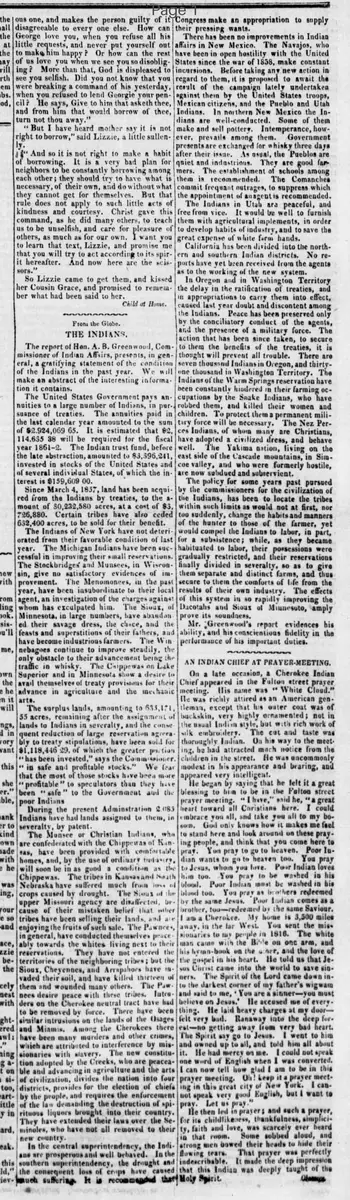
THE INDIANS.
The report of Hon. A. B. Greenwood, Commissioner of Indian Affairs, presents, in general, a gratifying statement of the condition of the Indians in the past year. We will make an abstract of the interesting information it contains.
The United States Government pays annuities to a large number of Indians, in pursuance of treaties. The annuities paid in the last calendar year amounted to the sum of $2,924,069 65. It is estimated that $2,114,655 38 will be required for the fiscal year 1861-2. The Indian trust fund, before the late abstraction, amounted to $3,596,241, invested in stocks of the United States and of several individual States, of which the interest is $159,609 00.
Since March 4, 1857, land has been acquired from the Indians by treaties, to the amount of 30,232,580 acres, at a cost of $3,726,880. Certain tribes have also ceded 632,400 acres, to be sold for their benefit.
The Indians of New York have not deteriorated from their favorable condition of last year. The Michigan Indians have been successful in improving their small reservations. The Stockbridges and Munsees, in Wisconsin, give no satisfactory evidences of improvement. The Menomonees, in the past year, have been insubordinate to their local agent, an investigation of the charges against whom has exculpated him. The Sioux, of Minnesota, in large numbers, have abandoned their savage dress, the chase, and the feasts and superstitions of their fathers, and have become industrious farmers. The Winnebagos continue to improve steadily, the only obstacle to their advancement being the traffic in whisky. The Chippewas on Lake Superior and in Minnesota show a desire to avail themselves of treaty provisions for their advance in agriculture and the mechanic arts.
The surplus lands, amounting to 638,171.55 acres, remaining after the assignment of lands to Indians in severalty, and the consequent reduction of large reservations agreeably to treaty stipulations, have been sold for $1,118,446 29, of which the greater portion "has been invested," says the Commissioner, "in safe and profitable stocks." We fear that the most of those stocks have been more "profitable" to speculators than they have been "safe" to the Government and the poor Indians.
During the present Administration 208,000 Indians have had lands assigned to them, in severalty, by patent.
The Munsee or Christian Indians, who are confederated with the Chippewas of Kansas, have been provided with comfortable homes, and, by the use of ordinary industry, will soon be in as good a condition as the Chippewas. The tribes in Kansas and South Nebraska have suffered much from loss of crops caused by drought. The Sioux of the upper Missouri agency are disaffected, because of their mistaken belief that other tribes have been selling their lands, and are enjoying the fruits of such sale. The Paws, in general, have conducted themselves peaceably towards the whites living next to their reservations. They have not entered the territories of the neighboring tribes; but the Sioux, Cheyennes, and Arapahoes have invaded their soil, and have killed thirteen of them and wounded many others. The Pawnees desire peace with these tribes. Intruders on the Cherokee neutral tract have had to be removed by force. There have been similar intrusions on the lands of the Osages and Miamis. Among the Cherokees there have been many murders and other crimes, which are attributed to interference by missionaries with slavery. The new constitution adopted by the Creeks, who are peaceable and advancing in agriculture and the arts of civilization, divides the nation into four districts, provides for the election of chief by the people, and requires the enforcement of the law demanding the destruction of spirituous liquors brought into their country.
They have extended their laws over the Seminoles, who have not all removed to their new country.
In the central superintendency, the Indians are prosperous and well behaved. In the southern superintendency, the drought and the consequent loss of crops have caused much suffering. It is recommended that Congress make an appropriation to supply their pressing wants.
There has been no improvements in Indian affairs in New Mexico. The Navajos, who have been in open hostility with the United States since the war of 1858, make constant incursions. Before taking any new action in regard to them, it is proposed to await the result of the campaign lately undertaken against them by the United States troops, Mexican citizens, and the Pueblo and Uteh Indians. In northern New Mexico the Indians are well-conducted. Some of them make and sell pottery. Intemperance, however, prevails among them. Government presents are exchanged for whisky three days after their issue. As usual, the Pueblos are quiet and industrious. They are good farmers. The establishment of schools among them is recommended. The Comanches commit frequent outrages, to suppress which the appointment of an agent is recommended.
The Indians in Utah are peaceful, and free from vice. It would be well to furnish them with agricultural implements, in order to develop habits of industry, and to save the great expense of white farm hands.
California has been divided into the northern and southern Indian districts. No reports have yet been received from the agents as to the working of the new system.
In Oregon and in Washington Territory the delay in the ratification of treaties, and in appropriations to carry them into effect, caused last year doubt and discontent among the Indians. Peace has been preserved only by the conciliatory conduct of the agents, and the presence of a military force. "The action that has been since taken, to secure to them the benefits of the treaties, it is thought will prevent all trouble. There are seven thousand Indians in Oregon, and thirty-one thousand in Washington Territory. The Indians of the Warm Springs reservation have been constantly hindered in their farming occupations by the Snake Indians, who have robbed them, and killed their women and children. To protect them a permanent military force will be necessary. The Nez Perces Indians, of whom many are Christians, have adopted a civilized dress, and behave well. The Yakima nation, living on the east side of the Cascade mountains, in Simcoe valley, and who were formerly hostile, are now subdued and subservient.
The policy for some years past pursued by the commissioners for the civilization of the Indians, has been to locate the tribes within such limits as would not at first, nor too suddenly, change the habits and manners of the hunter to those of the farmer, yet would compel the Indians to labor, in part, for a subsistence; while, as they became habituated to labor, their possessions were gradually restricted, and their reservations finally divided in severalty, so as to give them separate and distinct farms, and thus secure to them the comforts of life from the results of their own industry. The effects of this system in so rapidly improving the Dacotahs and Sioux of Minnesota, amply prove its soundness.
Mr. Greenwood's report evidences his ability, and his conscientious fidelity in the performance of his important duties.
What sub-type of article is it?
What keywords are associated?
What entities or persons were involved?
Where did it happen?
Domestic News Details
Primary Location
United States
Event Date
Last Calendar Year
Key Persons
Outcome
annuities paid $2,924,069.65; lands acquired 30,232,580 acres for $3,726,880; improvements in farming and civilization among sioux, winnebagos, chippewas; thirteen pawnees killed and many wounded by sioux, cheyennes, arapahoes; many murders among cherokees; drought causing crop losses and suffering in kansas, south nebraska, southern superintendency; navajo incursions; snake indians robbing and killing warm springs indians.
Event Details
Report by Commissioner Greenwood summarizes Indian conditions: annuities and trust funds managed; lands ceded and sold; various tribes showing progress in agriculture and civilization, facing issues like whisky traffic, insubordination, disaffection, intrusions, crimes, drought, hostilities, and delays in treaties.