Thank you for visiting SNEWPapers!
Sign up free
Richmond Enquirer
Richmond, Richmond County, Virginia
What is this article about?
A traveler's letter from Milledgeville, Georgia, dated June 7-8, describes conditions in southern states: Savannah's health improvement plan by shifting from rice to dry crops; wet season impacts on rice planters in Burke and Liberty counties; coastal planters' summer migrations to pine barrens; effective slave management systems; thriving Darien as a depot; sparse travel to St. Mary's; past prosperity from smuggling on Amelia Island; anticipation of East Florida's cession to the U.S. for prosperity.
Clipping
OCR Quality
Full Text
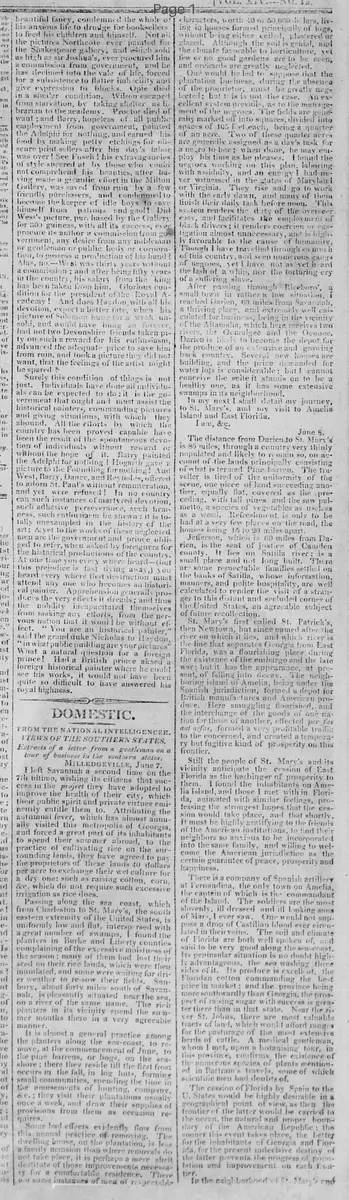
FROM THE NATIONAL INTELLIGENCER.
VIEWS OF THE SOUTHERN STATES.
Extracts of a letter from a gentleman on a tour of business in the southern states.
MILLEDGEVILLE, June 7.
I left Savannah a second time on the 7th ultimo, wishing its citizens that success in the project they have adopted to improve the health of their city, which their public spirit and private virtues eminently entitle them to. Attributing the autumual fever, which has almost annually visited this metropolis of Georgia, and forced a great part of its inhabitants to spend their summer abroad, to the practice of cultivating rice on the surrounding lands, they have agreed to pay the proprietors of these lands 40 dollars per acre to exchange their wet culture for a dry one: such as raising cotton, corn, &c. which do not require such excessive irrigation as rice does.
Passing along the sea coast, which from Charleston to St. Mary's, the south eastern extremity of the United States, is uniformly low and flat, interspersed with a great number of swamps, I found the planters in Burke and Liberty counties complaining of the excessive moistness of the season; many of them had lost their seed on their rice lands, which were then inundated, and some were waiting for drier weather to re-sow their fields. Sunbury, about forty miles south of Savannah, is pleasantly situated near the sea, on a river of the same name. The rich planters in its vicinity spend the summer months there in a very agreeable manner.
It is almost a general practice among the planters along the sea-coast, to remove, at the commencement of June, to the pine barrens, or hogs, on the sea-shore; there they reside till the first frost occurs in the fall, in log huts, forming small communities, spending the time in the amusements of hunting, company, &c.; they visit their plantations usually once a week, and draw their supplies of provisions from them as occasion requires.
Some bad effects evidently flow from this annual practice of removing. The dwelling house, on the plantation, is less a family mansion than where removals do not take place, it is perhaps a mere shell destitute of those improvements necessary for a comfortable residence. There are some instances of men of respectable characters, worth 40 or 50 thousand dollars, living in houses formed principally of logs, without being either ceiled, plastered or glazed. Although the soil is genial, and the climate favorable to horticulture, yet few or no good gardens are to be seen, and orchards are greatly neglected.
One would be led to suppose that the plantation business, during the absence of the proprietor, must be greatly neglected: but this is not the case. An excellent system prevails, as to the management of the negroes. The fields are generally marked off into squares, divided into spaces of 105 feet each, being a quarter of an acre. Two of these quarter acres are generally assigned as a day's task for a negro to hoe: when done, he may employ his time as he pleases. I found the negroes working on this plan, laboring with assiduity, and an energy I had never witnessed in the states of Maryland or Virginia. They rise and go to work with the early dawn, and many of them finish their daily task before noon. This system renders the duty of the overseer easy, and facilitates the employment of black drivers; it renders coercion or castigation almost unnecessary, and is highly favorable to the cause of humanity.
Though I have travelled through so much of this country, and seen numerous gangs of negroes, yet I have not as yet heard the lash of a whip, nor the torturing cry of a suffering slave.
After passing through Riceborough, a small town in rather a low situation, I reached Darien, 63 miles from Savannah, a thriving place, and extremely well calculated for business, being in the vicinity of the Altamaha, which here receives two rivers, the Ocmulgee and the Oconee.
Darien is likely to become the depot for the produce of an extensive and growing back country. Several new houses are building, and the price demanded for water lots is considerable: but I cannot conceive the site it stands on to be a healthy one, as it has some extensive swamps in its neighborhood.
In my next I shall detail my journey to St. Mary's, and my visit to Amelia Island and East Florida.
I am, &c.
June 8.
The distance from Darien to St. Mary's is 35 miles, through a country very thinly populated and likely to remain so, on account of the lands principally consisting of what is termed Pine barren. The traveller is tired of the uniformity of the scene, one piece of land succeeding another, equally flat, covered as the preceding, with tall pines and the saw palmetto, a species of vegetable as useless as a weed. Refreshment is only to be had at a very few places on the road, the houses being 16 to 20 miles apart.
Jefferson, which is 20 miles from Darien, is the seat of justice of Camden county. It lies on Satilla river: is a small place and not long built. There are some respectable families settled on the banks of Satilla, whose information, manners, and polite hospitality, are well calculated to render the visit of a stranger to this distant and secluded corner of the United States, an agreeable subject of future recollection.
St. Mary's first called St. Patrick's, then Newtown, but since named after the river on which it lies, and which river is the line that separates Georgia from East Florida, was a flourishing place during the existence of the embargo and the late war; but it has the appearance, at present, of falling into decay. The neighboring island of Amelia, being under the Spanish jurisdiction, formed a depot for British manufactures and American produce. Here smuggling flourished, and the interchange of the goods of one nation for those of another, effected per fas et nefas, formed a very profitable trade to the concerned, and created a temporary but fugitive kind of prosperity on this frontier.
Still the people of St. Mary's and its vicinity anticipate the cession of East Florida as the harbinger of prosperity to them. I found the inhabitants on Amelia island, and those I met with in Florida, animated with similar feelings, professing the strongest hopes that the cession would take place, and that shortly.
It must be highly gratifying to the friends of the American institutions, to find their neighbors so anxious to be incorporated into the same family, and willing to welcome the American jurisdiction as the certain guarantee of peace, prosperity and happiness.
There is a company of Spanish artillery at Fernandina, the only town on Amelia, the captain of which is the commandant of the Island. The soldiers are the most slovenly, ill dressed and ill looking sons of Mars, I ever saw. One would not suppose a drop of Castilian blood ever circulated in their veins. The soil and climate of Florida are both well spoken of, and said to be very good along the sea-coast. Its peninsular situation is no doubt highly advantageous, the sea washing three sides of it. Its produce is excellent, the Floridan cotton commanding the best price in market: and the province being more southwardly than Georgia, the prospect of raising sugar with success is greater there than in that state. Near the river St. Johns, there are most valuable tracts of land, which would afford ranges for the pasturage of the most extensive herds of cattle. A medical gentleman, whom I met, upon a Botanising tour, in this province, confirms the existence of the numerous species of plants mentioned in Bartram's travels, some of which scientific men had doubts of.
The cession of Florida by Spain to the U. States would be highly desirable in a geographical point of view, as then the frontier of the latter would be carried to the ocean, the natural and proper boundary of the American Republic: the sooner this event takes place, the better for the inhabitants of Georgia and Florida, for the present undecided destiny of the latter prevents the progress of population and improvement on each frontier.
In the neighbourhood of St. Mary's and
What sub-type of article is it?
What keywords are associated?
What entities or persons were involved?
Where did it happen?
Domestic News Details
Primary Location
Southern States (Georgia And Florida)
Event Date
June 7 And 8
Key Persons
Outcome
anticipation of east florida cession to u.s. for prosperity; past smuggling prosperity on amelia island now in decay; effective slave management reducing coercion; savannah's plan to pay $40 per acre to shift from rice to dry crops for health improvement.
Event Details
Traveler describes leaving Savannah on May 7, health project against autumnal fever by changing rice cultivation; wet season losses for rice planters in Burke and Liberty counties; coastal planters' June migration to pine barrens in log huts; neglect of plantation homes and gardens due to absences; task-based system for negroes leading to diligent work without observed whipping; thriving Darien as depot near Altamaha; sparse pine barren travel to St. Mary's; St. Mary's decay post-embargo and war; Amelia Island's past smuggling depot role; hopes for Florida cession; Spanish artillery at Fernandina; Florida's soil, climate, cotton, sugar prospects, cattle lands, and confirmed plants from Bartram's travels.