Thank you for visiting SNEWPapers!
Sign up free
Story
December 4, 1805
Norfolk Gazette And Publick Ledger
Norfolk, Virginia
What is this article about?
A shopkeeper sues a theater manager in the Court of Pie Poudre for seducing his daughter into joining a troupe at Bartholomew Fair. The manager claims she came with a supposed husband, but the court awards damages and orders her return.
Clipping
OCR Quality
95%
Excellent
Full Text
From a Scotch paper.
LAW REPORT EXTRAORDINARY.
COURT OF PIE POUDRE, SEPT 6.—CIVIL SIDE.
Baker, v. am Seduction.
We purposely omit the name of the defendant, as the publication of it might be detrimental to him at the ensuing Edmonton statute, and it appeared that he was more unfortunate than guilty.
Fortuna crimen in illo
Non scelus invenies.
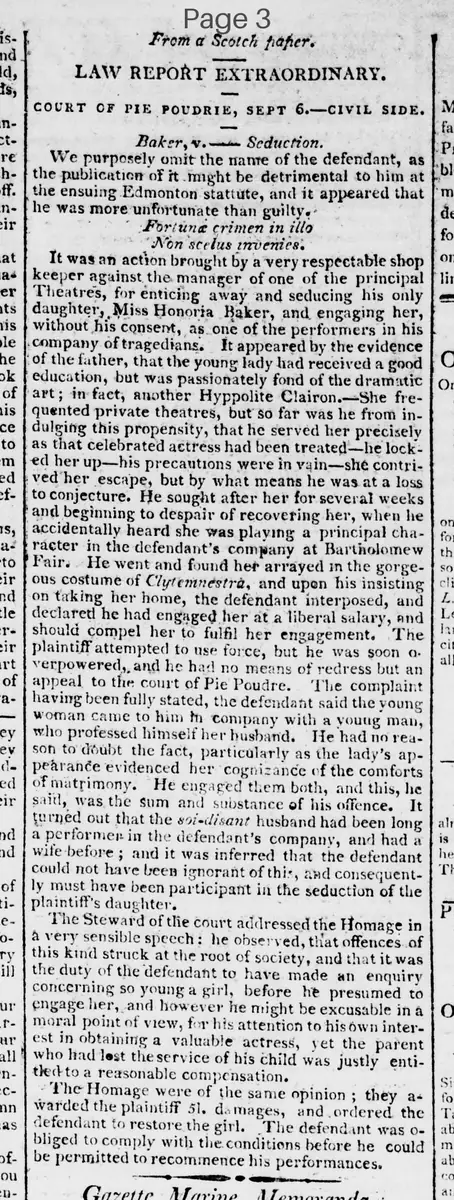
It was an action brought by a very respectable shop keeper against the manager of one of the principal Theatres, for enticing away and seducing his only daughter, Miss Honoria Baker, and engaging her, without his consent, as one of the performers in his company of tragedians. It appeared by the evidence of the father, that the young lady had received a good education, but was passionately fond of the dramatic art; in fact, another Hyppolite Clairon. She frequented private theatres, but so far was he from indulging this propensity, that he served her precisely as that celebrated actress had been treated—he locked her up—his precautions were in vain—she contrived her escape, but by what means he was at a loss to conjecture. He sought after her for several weeks and beginning to despair of recovering her, when he accidentally heard she was playing a principal character in the defendant's company at Bartholomew Fair. He went and found her arrayed in the gorgeous costume of Clytemnestra, and upon his insisting on taking her home, the defendant interposed, and declared he had engaged her at a liberal salary, and should compel her to fulfil her engagement. The plaintiff attempted to use force, but he was soon overpowered, and he had no means of redress but an appeal to the court of Pie Poudre. The complaint having been fully stated, the defendant said the young woman came to him in company with a young man, who professed himself her husband. He had no reason to doubt the fact, particularly as the lady's appearance evidenced her cognizance of the comforts of matrimony. He engaged them both, and this, he said, was the sum and substance of his offence. It turned out that the soi-disant husband had been long a performer in the defendant's company, and had a wife before; and it was inferred that the defendant could not have been ignorant of this, and consequently must have been participant in the seduction of the plaintiff's daughter.
The Steward of the court addressed the Homage in a very sensible speech: he observed, that offences of this kind struck at the root of society, and that it was the duty of the defendant to have made an enquiry concerning so young a girl, before he presumed to engage her, and however he might be excusable in a moral point of view, for his attention to his own interest in obtaining a valuable actress, yet the parent who had lost the service of his child was justly entitled to a reasonable compensation.
The Homage were of the same opinion; they awarded the plaintiff 5l. damages, and ordered the defendant to restore the girl. The defendant was obliged to comply with the conditions before he could be permitted to recommence his performances.
LAW REPORT EXTRAORDINARY.
COURT OF PIE POUDRE, SEPT 6.—CIVIL SIDE.
Baker, v. am Seduction.
We purposely omit the name of the defendant, as the publication of it might be detrimental to him at the ensuing Edmonton statute, and it appeared that he was more unfortunate than guilty.
Fortuna crimen in illo
Non scelus invenies.
It was an action brought by a very respectable shop keeper against the manager of one of the principal Theatres, for enticing away and seducing his only daughter, Miss Honoria Baker, and engaging her, without his consent, as one of the performers in his company of tragedians. It appeared by the evidence of the father, that the young lady had received a good education, but was passionately fond of the dramatic art; in fact, another Hyppolite Clairon. She frequented private theatres, but so far was he from indulging this propensity, that he served her precisely as that celebrated actress had been treated—he locked her up—his precautions were in vain—she contrived her escape, but by what means he was at a loss to conjecture. He sought after her for several weeks and beginning to despair of recovering her, when he accidentally heard she was playing a principal character in the defendant's company at Bartholomew Fair. He went and found her arrayed in the gorgeous costume of Clytemnestra, and upon his insisting on taking her home, the defendant interposed, and declared he had engaged her at a liberal salary, and should compel her to fulfil her engagement. The plaintiff attempted to use force, but he was soon overpowered, and he had no means of redress but an appeal to the court of Pie Poudre. The complaint having been fully stated, the defendant said the young woman came to him in company with a young man, who professed himself her husband. He had no reason to doubt the fact, particularly as the lady's appearance evidenced her cognizance of the comforts of matrimony. He engaged them both, and this, he said, was the sum and substance of his offence. It turned out that the soi-disant husband had been long a performer in the defendant's company, and had a wife before; and it was inferred that the defendant could not have been ignorant of this, and consequently must have been participant in the seduction of the plaintiff's daughter.
The Steward of the court addressed the Homage in a very sensible speech: he observed, that offences of this kind struck at the root of society, and that it was the duty of the defendant to have made an enquiry concerning so young a girl, before he presumed to engage her, and however he might be excusable in a moral point of view, for his attention to his own interest in obtaining a valuable actress, yet the parent who had lost the service of his child was justly entitled to a reasonable compensation.
The Homage were of the same opinion; they awarded the plaintiff 5l. damages, and ordered the defendant to restore the girl. The defendant was obliged to comply with the conditions before he could be permitted to recommence his performances.
What sub-type of article is it?
Crime Story
Family Drama
Deception Fraud
What themes does it cover?
Family
Deception
Justice
What keywords are associated?
Seduction
Theater
Court Case
Pie Poudre
Bartholomew Fair
Fake Husband
What entities or persons were involved?
Baker
Miss Honoria Baker
Defendant
Where did it happen?
Court Of Pie Poudre, Bartholomew Fair
Story Details
Key Persons
Baker
Miss Honoria Baker
Defendant
Location
Court Of Pie Poudre, Bartholomew Fair
Event Date
Sept 6
Story Details
Shopkeeper Baker sues theater manager for seducing daughter Honoria into acting troupe via fake husband; court awards 5l damages and orders her return.