Thank you for visiting SNEWPapers!
Sign up free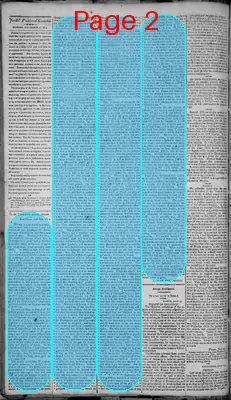
Letter to Editor
September 27, 1802
Jenks' Portland Gazette. Maine Advertiser
Portland, Cumberland County, Maine
What is this article about?
A satirical letter to the Portland Gazette editor criticizes Thomas Jefferson's hypocrisy in defending rights of conscience while making corrupt appointments favoring the base and ignorant, references specific cases like Sargent, Goodridge, and Bishop, and draws biblical parallels to Jeroboam.
Clipping
OCR Quality
95%
Excellent
Full Text
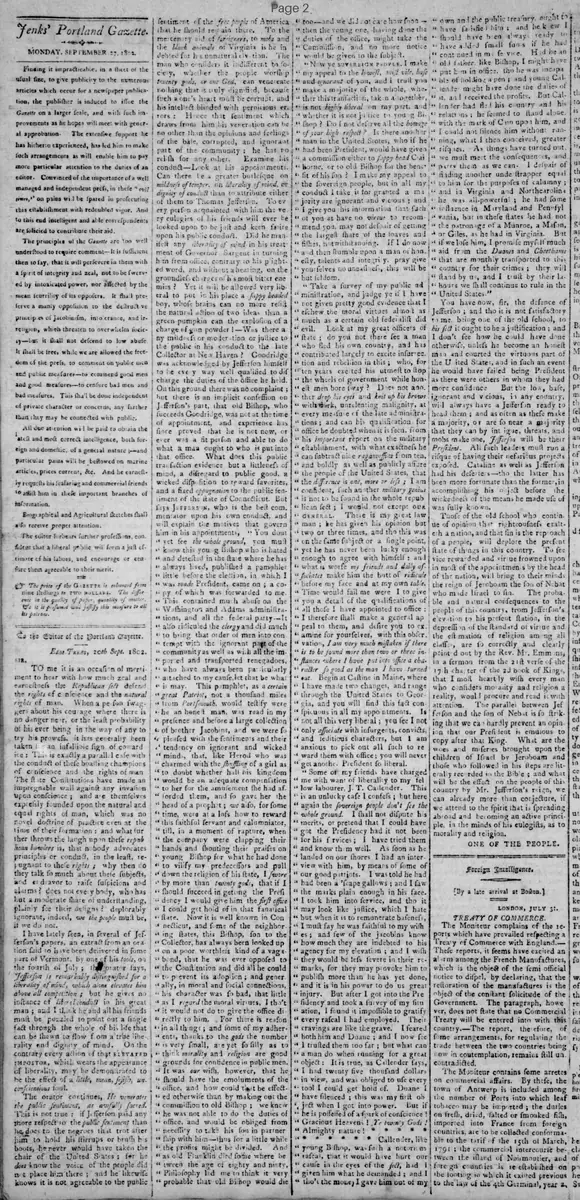
To the Editor of the Portland Gazette.
Elm Trees, 20th Sept. 1802.
SIR,
Sometimes it is an occasion of merriment to hear with how much zeal and earnestness these Republican sect defend the rights of conscience and the natural rights of man. When a person brags about his courage where there is no danger near, or the least probability of his ever being in the way of any to try his prowess, it has generally been taken for an infallible sign of cowardice: This is exactly a parallel case with the conduct of these boasting champions of conscience and the rights of man. The late Constitutions have made an impregnable wall against any invasion upon conscience: and are themselves expressly founded upon the natural and equal rights of man, which was no novel doctrine or practice even at the time of their formation: and what further throws the laugh upon these republican bawlers is, that nobody advocates principles or conduct, in the least, repugnant to these rights; why then do they talk so much about these subjects, and endeavor to raise suspicions and alarms? does not every body, who has but a moderate share of understanding, plainly see their designs? deplorably ignorant, indeed, we the people must be, if we do not.
I have lately seen, in several of Jefferson's papers, an extract from an oration said to have been delivered in some part of Vermont, by one of his tools, on the fourth of July; the orator says, Jefferson is remarkably distinguished for a liberality of mind, which alone elevates him above all comparison: but he gives no instance of his liberal conduct in his great man; and I think he and all his friends must be puzzled to point out a single fact through the whole of his life that can be shewn to flow from a true liberality and dignity of mind. On the contrary every action of that arch demagogue Impostor, which wears the appearance of liberality, may be demonstrated to be the effect of a little, mean, selfish, un-conscientious soul.
The orator continues, He venerates the public sentiment, as artfully sacred. This is not true: if Jefferson paid any more respect to the public sentiment than he does to the negroes that trot after him to hold his stirrups or brush his boots, he never would have taken the chair of the United States: or he does know the voice of the people did not place him there; and he likewise knows it is not agreeable to the public sentiment of the free people of America that he should remain there. To the mercenary aid of foreigners, to mobs and the black animals of Virginia is he indebted for his unnatural elevation. The man who considers it indifferent to society, whether the people worship twenty gods or one God, can venerate nothing that is truly dignified, because such a one's heart must be corrupted, and his intellect blinded with pernicious errors: Hence that sentiment which draws from him his veneration can be no other than the opinions and feelings of the base, corrupted, and ignorant part of the community: he has no relish for any other. Examine his conduct—Look at his appointments. Can there be a greater burlesque on mildness of temper, on liberality of mind, or dignity of conduct than to attribute either of them to Thomas Jefferson. To every person acquainted with him the very eulogies of his friends will ever be looked upon to be just and keen satire upon his public conduct. Did he manifest any liberality of mind in his treatment of Governor Sargent in turning him from office, contrary to his plighted word, and without a hearing, on the groundless charges of his most bitter enemies? Yet it will be allowed very liberal to put in his place a sappy headed boy, whose brains can no more resist the natural union of two ideas than a green pumpkin can the explosion of a charge of gun powder!—Was there any mildness or moderation or justice to the public in his conduct to the late Collector at New Haven? Goodridge was acknowledged by Jefferson himself to be every way well qualified to discharge the duties of the office he held. On this ground there was no complaint; but there is an implicit confession on Jefferson's part, that old Bishop, who succeeds Goodridge, was not at the time of appointment, and experience has since proved that he is not now, or ever was a fit person and able to do what a man ought to who is put into that office. What does this public transaction evidence but a littleness of mind, a disregard to public good, a wicked disposition to reward favorites, and a fixed oppugnation to the public sentiment of the state of Connecticut. But says Jefferson, who is the best commentator upon his own conduct, and will explain the motives that govern him in his appointments, "You don't yet see the whole ground, you must know this young Bishop who is hated and detested in the state where he has always lived, published a pamphlet little before the election, in which I was made President, came on; a copy of which was forwarded to me. This contained much abuse on the Washington and Adams administrations, and all the federal party—It also ridiculed the clergy and did much to bring that order of men into contempt with the ignorant part of the community as well as with all the imported and transported renegadoes, who have always been particularly attached to my cause, let that be what it may. This pamphlet, as a certain great Patriot, not a thousand miles from Portsmouth, would testify were he an honest man, was read in my presence and before a large collection of brother Jacobins, and we were so pleased with the sentiments and their tendency on ignorant and wicked minds, that, like Herod who was charmed with the dancing of a girl as to doubt whether half his kingdom would be an adequate compensation to her for the amusement she had afforded them, and so gave her the head of a prophet; we also, for some time, were at a loss how to reward this faithful servant and calumniator, till, in a moment of rapture, when the company were clapping their hands and shouting their praises on young Bishop for what he had done to vilify my predecessors and pull down the religion of his state, I swore by more than twenty gods, that if I should succeed in getting the Presidency I would give him the first office I could get hold of in that fanatical state. Now it is well known in Connecticut, and some of the neighboring states, this Bishop, on to the Collector, has always been looked upon as a poor, worthless kind of a vagabond, that he was ever opposed to the Constitution and did all he could to prevent its adoption; and generally, in moral and social connections, his character was so bad, that little as I regard the moral virtues, I thought it would not do to give the office directly to him. For there is reason in all things; and some of my adherents, thanks to the gods the number is very small, are yet so silly as to think morality and religion are good grounds for confidence in public men. It was our wish, however, that he should have the emoluments of the office, and how could that be effected other wise than by making out the commission to old Bishop; we knew he was not able to do the duties of office, and would be obliged from necessity to take his son in partnership with him—thus for a little while the profits might be divided. And as old Franklin died somewhere between the age of eighty and ninety, Philosophy led me to think it very probable that old Bishop would die too—and we did not care how soon—then the young one, having done the duties of the office, might take the Commission, and no more notice would be given to the subject.
NOW ye sovereign People. I make my appeal to the lowest, mean, vile, base and ignorant of you, and I trust you make a majority of the whole, whether this transaction, taken altogether, is not highly liberal on my part, and whether it is not justice to you young Bishop? Do I not deserve all the homage of your high respect? Is there another man in the United States, who if he had been President, would have given a commission either to Cappy head Claiborne, or to old Bishop for the benefit of his son? I make my appeal to the sovereign people, but in all my conduct I take it for granted a majority are ignorant and vicious; and I give you this information that such of you as have no virtue to recommend you, may not despair of getting the largest share of the loaves and fishes, notwithstanding. If I do now and then stumble upon a man of honesty, talents and integrity, pray give yourselves no uneasiness, this will be but seldom.
Take a survey of my public administration, and judge ye if I have not given pretty good evidence that I eschew the moral virtues almost as much as a certain old federalist did evil. Look at my great officers of state: do you not there see a man who fled his own country, and has contributed largely to excite insurrection and rebellion in this: who, for ten years exerted his utmost to stop the wheels of government while honest men bore sway? Does not another drop his eyes and knit up his brows with dark, unrelenting malignity, at every measure of the late administrations: and can his qualification for office be doubted when it is seen, from his important report on the military establishment, with what exactness he can subtract nine ragamuffins from ten, and boldly, as well as publicly assure the people of the United States, that the difference is one, more or less; I am confident, such another military genius is not to be found in the whole republican list; I would not except our General. There is my great law man: he has given his opinion but two or three times, and tho this was on the same subject or a single point, yet he has never been lucky enough to agree with himself: and what is worse my friends and daily associates make him the butt of ridicule before my face and at my own table. Time would fail me were I to give you a detail of the qualifications of all those I have appointed to office: I therefore shall make a general appeal to them, and desire you to examine for yourselves, with this observation, I am very much mistaken if there is to be found more than two or three instances where I have put into office a character so good as the man I have turned out. Begin at Castine in Maine, where I have made two changes, and range through the United States to Georgia, and you will find this fact conspicuous in all my appointments. Is not all this very liberal; you see I not only associate with insurgents, convicts, and seditious characters, but I am anxious to pick out all such to reward them with office; you will never get another President so liberal.
Some of my friends have charged me with want of liberality to my fellow labourer. J. T. Callender. This is an unlucky case I confess; but here again the sovereign people don't see the whole ground. I shall not dispute his merits, or pretend that I could have got the Presidency had it not been for his services: I have tried them and know them well. As soon as he landed on our shores I had an interview with him, by means of some of our good patriots. I was told he had been a 'scape gallows; and I saw the marks plain enough in his face. I took him into service, and tho it may look like justice, which I hate but when it is to remunerate baseness, I must say he was faithful to my wishes; and few of the jacobins know how much they are indebted to his agency for my elevation; and I wish they would be less severe in their remarks, for they may provoke him to publish more than he has yet done, and it is in his power to do us great injury. But after I got into the Presidency and took a survey of my situation, I found it impossible to gratify every rascal I had employed. Their cravings are like the grave. I feared both him and Duane; and I now see I trusted them too far: but what can a man do when running for a great object: It is true, as Callender says, I had twenty five thousand dollars in view, and was obliged to use every tool I could get hold of. Duane I have silenced; this was my first object when I got into power. But if he is possessed of a spark of conscience! Gracious Heaven! Ye twenty Gods! Almighty nature! * * *
* * Callender, like young Bishop, was such a notorious rascal, that it would have hurt our cause in the eyes of the sect, had I given him what he demanded; and I thought the money I gave him out of my own and the public treasury, ought to have satisfied him: and he knew I should have been always ready to have aided small sums if he had continued in my service. Had he an old father, like Bishop, I might have put him in office, tho he was incapable of holding a pen; and young Callender might have done the duties of it, and received the profits. But Callender had fled his country and his relations: he seemed to stand alone, with the mark of Cain upon him, and I could not silence him without running, what I then conceived, greater risks. As things have turned out, we must meet the consequences, and parry them as we can. I despair of finding another understrapper equal to him for the purpose of calumny; and in Virginia and North Carolina he was all-powerful; he had some influence in Maryland and Pennsylvania, but in these states he had not the patronage of a Munroe, a Mason or Giles, as he had in Virginia. But if we lose him, I promise myself much aid from the Duanes and Cheethams that are monthly transported to this country for their crimes: they will stand by us, and I trust by their labours we shall continue to rule in the United States."
You have now, sir, the defence of Jefferson; and tho it is not satisfactory to me, being one of the old school, to his sect it ought to be a justification; and I don't see how he could have done otherwise, unless he become an honest man and courted the virtuous part of the United States, and in such an event he would have failed being President as there were others in whom they had more confidence. But the low, base, ignorant and vicious, in any country, will always have a Jefferson ready to head them: and as often as these make a majority, or are so near a majority that they can by intrigue, threats, and mobs make one, Jefferson will be their President. All such leaders must run a risque of having their nefarious projects exposed. Catiline as well as Jefferson had his deserters—tho the latter has been more fortunate than the former in accomplishing his object before the wickedness of the means he made use of was fully known.
Those of the old school who continue of opinion that righteousness exalteth a nation, and that sin is the reproach of a people, will deplore the present state of things in this country. To see vice rewarded and virtue frowned upon in most of the appointments by the head of the nation, will bring to their minds the reign of Jeroboam the son of Nebat who made Israel to sin. The probable and natural consequences to the people of this country, from Jefferson's elevation to his present station, in the depression of the standard of virtue and the estimation of religion among all classes, are so correctly and clearly pointed out by the Rev. Mr. Emmons, in a sermon from the 26th verse of the 17th chapter of the 2d book of Kings, that I most heartily wish every man who considers morality and religion a reality, would procure and read it with attention. The parallel between Jefferson and the son of Nebat is so striking that we can hardly prevent an opinion that our President is emulous to copy after that King. What are the woes and miseries brought upon the children of Israel by Jeroboam and those who followed in his steps are literally recorded in the Bible; and what will be the effect on the people of this country by Mr. Jefferson's reign, we can already more than conjecture, if we attend to the spirit that is spreading abroad and becoming an active principle, in the minds of his eulogists, as to morality and religion.
ONE OF THE PEOPLE.
Elm Trees, 20th Sept. 1802.
SIR,
Sometimes it is an occasion of merriment to hear with how much zeal and earnestness these Republican sect defend the rights of conscience and the natural rights of man. When a person brags about his courage where there is no danger near, or the least probability of his ever being in the way of any to try his prowess, it has generally been taken for an infallible sign of cowardice: This is exactly a parallel case with the conduct of these boasting champions of conscience and the rights of man. The late Constitutions have made an impregnable wall against any invasion upon conscience: and are themselves expressly founded upon the natural and equal rights of man, which was no novel doctrine or practice even at the time of their formation: and what further throws the laugh upon these republican bawlers is, that nobody advocates principles or conduct, in the least, repugnant to these rights; why then do they talk so much about these subjects, and endeavor to raise suspicions and alarms? does not every body, who has but a moderate share of understanding, plainly see their designs? deplorably ignorant, indeed, we the people must be, if we do not.
I have lately seen, in several of Jefferson's papers, an extract from an oration said to have been delivered in some part of Vermont, by one of his tools, on the fourth of July; the orator says, Jefferson is remarkably distinguished for a liberality of mind, which alone elevates him above all comparison: but he gives no instance of his liberal conduct in his great man; and I think he and all his friends must be puzzled to point out a single fact through the whole of his life that can be shewn to flow from a true liberality and dignity of mind. On the contrary every action of that arch demagogue Impostor, which wears the appearance of liberality, may be demonstrated to be the effect of a little, mean, selfish, un-conscientious soul.
The orator continues, He venerates the public sentiment, as artfully sacred. This is not true: if Jefferson paid any more respect to the public sentiment than he does to the negroes that trot after him to hold his stirrups or brush his boots, he never would have taken the chair of the United States: or he does know the voice of the people did not place him there; and he likewise knows it is not agreeable to the public sentiment of the free people of America that he should remain there. To the mercenary aid of foreigners, to mobs and the black animals of Virginia is he indebted for his unnatural elevation. The man who considers it indifferent to society, whether the people worship twenty gods or one God, can venerate nothing that is truly dignified, because such a one's heart must be corrupted, and his intellect blinded with pernicious errors: Hence that sentiment which draws from him his veneration can be no other than the opinions and feelings of the base, corrupted, and ignorant part of the community: he has no relish for any other. Examine his conduct—Look at his appointments. Can there be a greater burlesque on mildness of temper, on liberality of mind, or dignity of conduct than to attribute either of them to Thomas Jefferson. To every person acquainted with him the very eulogies of his friends will ever be looked upon to be just and keen satire upon his public conduct. Did he manifest any liberality of mind in his treatment of Governor Sargent in turning him from office, contrary to his plighted word, and without a hearing, on the groundless charges of his most bitter enemies? Yet it will be allowed very liberal to put in his place a sappy headed boy, whose brains can no more resist the natural union of two ideas than a green pumpkin can the explosion of a charge of gun powder!—Was there any mildness or moderation or justice to the public in his conduct to the late Collector at New Haven? Goodridge was acknowledged by Jefferson himself to be every way well qualified to discharge the duties of the office he held. On this ground there was no complaint; but there is an implicit confession on Jefferson's part, that old Bishop, who succeeds Goodridge, was not at the time of appointment, and experience has since proved that he is not now, or ever was a fit person and able to do what a man ought to who is put into that office. What does this public transaction evidence but a littleness of mind, a disregard to public good, a wicked disposition to reward favorites, and a fixed oppugnation to the public sentiment of the state of Connecticut. But says Jefferson, who is the best commentator upon his own conduct, and will explain the motives that govern him in his appointments, "You don't yet see the whole ground, you must know this young Bishop who is hated and detested in the state where he has always lived, published a pamphlet little before the election, in which I was made President, came on; a copy of which was forwarded to me. This contained much abuse on the Washington and Adams administrations, and all the federal party—It also ridiculed the clergy and did much to bring that order of men into contempt with the ignorant part of the community as well as with all the imported and transported renegadoes, who have always been particularly attached to my cause, let that be what it may. This pamphlet, as a certain great Patriot, not a thousand miles from Portsmouth, would testify were he an honest man, was read in my presence and before a large collection of brother Jacobins, and we were so pleased with the sentiments and their tendency on ignorant and wicked minds, that, like Herod who was charmed with the dancing of a girl as to doubt whether half his kingdom would be an adequate compensation to her for the amusement she had afforded them, and so gave her the head of a prophet; we also, for some time, were at a loss how to reward this faithful servant and calumniator, till, in a moment of rapture, when the company were clapping their hands and shouting their praises on young Bishop for what he had done to vilify my predecessors and pull down the religion of his state, I swore by more than twenty gods, that if I should succeed in getting the Presidency I would give him the first office I could get hold of in that fanatical state. Now it is well known in Connecticut, and some of the neighboring states, this Bishop, on to the Collector, has always been looked upon as a poor, worthless kind of a vagabond, that he was ever opposed to the Constitution and did all he could to prevent its adoption; and generally, in moral and social connections, his character was so bad, that little as I regard the moral virtues, I thought it would not do to give the office directly to him. For there is reason in all things; and some of my adherents, thanks to the gods the number is very small, are yet so silly as to think morality and religion are good grounds for confidence in public men. It was our wish, however, that he should have the emoluments of the office, and how could that be effected other wise than by making out the commission to old Bishop; we knew he was not able to do the duties of office, and would be obliged from necessity to take his son in partnership with him—thus for a little while the profits might be divided. And as old Franklin died somewhere between the age of eighty and ninety, Philosophy led me to think it very probable that old Bishop would die too—and we did not care how soon—then the young one, having done the duties of the office, might take the Commission, and no more notice would be given to the subject.
NOW ye sovereign People. I make my appeal to the lowest, mean, vile, base and ignorant of you, and I trust you make a majority of the whole, whether this transaction, taken altogether, is not highly liberal on my part, and whether it is not justice to you young Bishop? Do I not deserve all the homage of your high respect? Is there another man in the United States, who if he had been President, would have given a commission either to Cappy head Claiborne, or to old Bishop for the benefit of his son? I make my appeal to the sovereign people, but in all my conduct I take it for granted a majority are ignorant and vicious; and I give you this information that such of you as have no virtue to recommend you, may not despair of getting the largest share of the loaves and fishes, notwithstanding. If I do now and then stumble upon a man of honesty, talents and integrity, pray give yourselves no uneasiness, this will be but seldom.
Take a survey of my public administration, and judge ye if I have not given pretty good evidence that I eschew the moral virtues almost as much as a certain old federalist did evil. Look at my great officers of state: do you not there see a man who fled his own country, and has contributed largely to excite insurrection and rebellion in this: who, for ten years exerted his utmost to stop the wheels of government while honest men bore sway? Does not another drop his eyes and knit up his brows with dark, unrelenting malignity, at every measure of the late administrations: and can his qualification for office be doubted when it is seen, from his important report on the military establishment, with what exactness he can subtract nine ragamuffins from ten, and boldly, as well as publicly assure the people of the United States, that the difference is one, more or less; I am confident, such another military genius is not to be found in the whole republican list; I would not except our General. There is my great law man: he has given his opinion but two or three times, and tho this was on the same subject or a single point, yet he has never been lucky enough to agree with himself: and what is worse my friends and daily associates make him the butt of ridicule before my face and at my own table. Time would fail me were I to give you a detail of the qualifications of all those I have appointed to office: I therefore shall make a general appeal to them, and desire you to examine for yourselves, with this observation, I am very much mistaken if there is to be found more than two or three instances where I have put into office a character so good as the man I have turned out. Begin at Castine in Maine, where I have made two changes, and range through the United States to Georgia, and you will find this fact conspicuous in all my appointments. Is not all this very liberal; you see I not only associate with insurgents, convicts, and seditious characters, but I am anxious to pick out all such to reward them with office; you will never get another President so liberal.
Some of my friends have charged me with want of liberality to my fellow labourer. J. T. Callender. This is an unlucky case I confess; but here again the sovereign people don't see the whole ground. I shall not dispute his merits, or pretend that I could have got the Presidency had it not been for his services: I have tried them and know them well. As soon as he landed on our shores I had an interview with him, by means of some of our good patriots. I was told he had been a 'scape gallows; and I saw the marks plain enough in his face. I took him into service, and tho it may look like justice, which I hate but when it is to remunerate baseness, I must say he was faithful to my wishes; and few of the jacobins know how much they are indebted to his agency for my elevation; and I wish they would be less severe in their remarks, for they may provoke him to publish more than he has yet done, and it is in his power to do us great injury. But after I got into the Presidency and took a survey of my situation, I found it impossible to gratify every rascal I had employed. Their cravings are like the grave. I feared both him and Duane; and I now see I trusted them too far: but what can a man do when running for a great object: It is true, as Callender says, I had twenty five thousand dollars in view, and was obliged to use every tool I could get hold of. Duane I have silenced; this was my first object when I got into power. But if he is possessed of a spark of conscience! Gracious Heaven! Ye twenty Gods! Almighty nature! * * *
* * Callender, like young Bishop, was such a notorious rascal, that it would have hurt our cause in the eyes of the sect, had I given him what he demanded; and I thought the money I gave him out of my own and the public treasury, ought to have satisfied him: and he knew I should have been always ready to have aided small sums if he had continued in my service. Had he an old father, like Bishop, I might have put him in office, tho he was incapable of holding a pen; and young Callender might have done the duties of it, and received the profits. But Callender had fled his country and his relations: he seemed to stand alone, with the mark of Cain upon him, and I could not silence him without running, what I then conceived, greater risks. As things have turned out, we must meet the consequences, and parry them as we can. I despair of finding another understrapper equal to him for the purpose of calumny; and in Virginia and North Carolina he was all-powerful; he had some influence in Maryland and Pennsylvania, but in these states he had not the patronage of a Munroe, a Mason or Giles, as he had in Virginia. But if we lose him, I promise myself much aid from the Duanes and Cheethams that are monthly transported to this country for their crimes: they will stand by us, and I trust by their labours we shall continue to rule in the United States."
You have now, sir, the defence of Jefferson; and tho it is not satisfactory to me, being one of the old school, to his sect it ought to be a justification; and I don't see how he could have done otherwise, unless he become an honest man and courted the virtuous part of the United States, and in such an event he would have failed being President as there were others in whom they had more confidence. But the low, base, ignorant and vicious, in any country, will always have a Jefferson ready to head them: and as often as these make a majority, or are so near a majority that they can by intrigue, threats, and mobs make one, Jefferson will be their President. All such leaders must run a risque of having their nefarious projects exposed. Catiline as well as Jefferson had his deserters—tho the latter has been more fortunate than the former in accomplishing his object before the wickedness of the means he made use of was fully known.
Those of the old school who continue of opinion that righteousness exalteth a nation, and that sin is the reproach of a people, will deplore the present state of things in this country. To see vice rewarded and virtue frowned upon in most of the appointments by the head of the nation, will bring to their minds the reign of Jeroboam the son of Nebat who made Israel to sin. The probable and natural consequences to the people of this country, from Jefferson's elevation to his present station, in the depression of the standard of virtue and the estimation of religion among all classes, are so correctly and clearly pointed out by the Rev. Mr. Emmons, in a sermon from the 26th verse of the 17th chapter of the 2d book of Kings, that I most heartily wish every man who considers morality and religion a reality, would procure and read it with attention. The parallel between Jefferson and the son of Nebat is so striking that we can hardly prevent an opinion that our President is emulous to copy after that King. What are the woes and miseries brought upon the children of Israel by Jeroboam and those who followed in his steps are literally recorded in the Bible; and what will be the effect on the people of this country by Mr. Jefferson's reign, we can already more than conjecture, if we attend to the spirit that is spreading abroad and becoming an active principle, in the minds of his eulogists, as to morality and religion.
ONE OF THE PEOPLE.
What sub-type of article is it?
Political
Persuasive
Satirical
What themes does it cover?
Politics
Morality
Religion
What keywords are associated?
Jefferson Criticism
Political Appointments
Republican Hypocrisy
Moral Corruption
Religious Decline
What entities or persons were involved?
One Of The People
To The Editor Of The Portland Gazette
Letter to Editor Details
Author
One Of The People
Recipient
To The Editor Of The Portland Gazette
Main Argument
the letter satirically criticizes thomas jefferson's hypocrisy in championing rights of conscience and natural rights while his actions, especially corrupt appointments, reveal a mean, selfish character favoring the ignorant and vicious over the virtuous.
Notable Details
Imagined Defense In Jefferson's Voice
Criticism Of Appointments: Governor Sargent, Goodridge And Bishop At New Haven
Reference To J.T. Callender
Biblical Parallel To Jeroboam Son Of Nebat
Sermon By Rev. Mr. Emmons