Thank you for visiting SNEWPapers!
Sign up free
The Savannah Tribune
Savannah, Chatham County, Georgia
What is this article about?
The eighth quadrennial session of the African Methodist Episcopal church in Chicago features opening sermons by bishops emphasizing church priorities, debates on laymen representation in the Episcopal Committee led by Ira T. Bryant and supported by Bishop Ransom, opposition from other bishops, and the episcopal address addressing church issues including criticism, marriage, and discrimination.
Merged-components note: This is a continuation of the A.M.E. church conference story from page 1 (reading order 5) to page 4, as indicated by '(Continued from Page One)' in the text.
Clippings
1 of 2
OCR Quality
Full Text
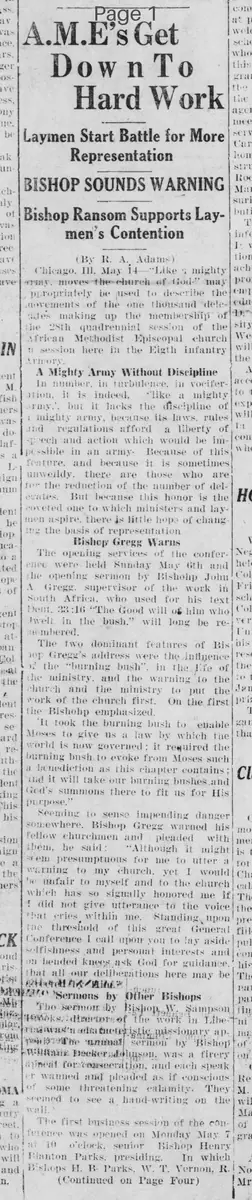
Laymen Start Battle for More Representation
BISHOP SOUNDS WARNING
Bishop Ransom Supports Laymen's Contention
(By R. A. Adams)
Chicago, Ill., May 14—"Like a mighty army, moves the church of God" may appropriately be used to describe the movements of the one thousand delegates making up the membership of the eighth quadrennial session of the African Methodist Episcopal church in session here in the Eighth Infantry Armory.
A Mighty Army Without Discipline
In number, in turbulence, in vociferation, it is indeed like a mighty army, but it lacks the discipline of mighty army, because its laws, rules and regulations afford a liberty of speech and action which would be impossible in an army. Because of this feature, and because it is sometimes unwieldy, there are those who are for the reduction of the number of delegates. But because this honor is the coveted one to which ministers and laymen aspire, there is little hope of changing the basis of representation.
Bishop Gregg Warns
The opening services of the conference were held Sunday May 6th and the opening sermon by Bishop John A. Gregg, supervisor of the work in South Africa, who used for his text Deut. 33:16 "The Good will of him who dwelt in the bush," will long be remembered.
The two dominant features of Bishop Gregg's address were the influence the "burning bush", in the life of the ministry, and the warning to the church and the ministry to put the work of the church first. On the first the Bishop emphasized "It took the burning bush to enable Moses to give us a law by which the world is now governed; it required the burning bush to evoke from Moses such a benediction as this chapter contains; and it will take our burning bushes and God's summons there to fit us for His purpose."
Seeming to sense impending danger somewhere, Bishop Gregg warned his fellow churchmen and pleaded with them, he said: "Although it might seem presumptuous for me to utter a warning to my church, yet I would be unfair to myself and to the church which has so signally honored me if I did not give utterance to the voice that cries within me. Standing upon the threshold of this great General Conference I call upon you to lay aside selfishness and personal interests and on bended knees ask God for guidance, that all our deliberations here may be celestial wine."
Sermons by Other Bishops
The sermons by Bishop J. S. Sampson, director of the work in Liberia as a distinctistic missionary appointee to the annual sermon by Bishop W. A. Decker's admonition, was a fiery appeal for consecration, and each speaker warned and pleaded as if conscious of some threatening calamity. They seemed to see a hand-writing on the wall.
The first business session of the conference was opened on Monday May 7 at 10 o'clock, senior Bishop Henry M. Parks, presiding. In which Bishops H. B. Parks, W. T. Vernon, R. C. ...
A. M. E.'s GET DOWN
TO HARD WORK
(Continued from Page One)
C. Ransom, A. J. Carey, Wm. A. Foun-
tain, Joshua H. Jones, J. S. Flipper, J.
Albert Johnson, W. Sampson Brooks
John A. Gregg, and W. H. Heard pre-
sided.
Conference Officers
Officers elected were: secretaries R.
S. Jenkins, W. B. Lawrence, J. A. Wil-
liams, John Adams, M. W. Frazier, A.
Wayman Ward, Carl S. Flipper, S. E.
C. Jordon, Eugene Thompson: marshals,
T. W. Lewis, W. H. Thogood, H. L.
Hughes, A. D. Coston, J. E. McLean, W.
C. Crawford, J. E. Brown, J. S. Hick-
W. B. White, H. R. Baranco, J. B.
man, G. W. Morgan, R. D. Lemmons.
Foxall, Henry P. Talbert, W. H. Kit-
tle, S. J. Mobote and J. S. Smith.
Ira T. Bryant Stirs Conference
As was predicted, the greatest sen-
sation of the session to date was caused
by the fiery contention of Ira T. Bry-
ant, secretary Sunday School Depart-
ment, that laymen should have repre-
sentation on the Episcopal Committee
Mr. Bryant's contention was that the
law of the church says the committee
shall be elected: that laymen, as mem-
bers of the General Conference, are
entitled to representation : that the Ten-
nessee annual conference had elect-
ed him positively to the leadership
of his delegation, and it would be in
keeping with the custom for him to be
accorded this place
Supported By Atty. Brown of Va.
Attorney W. H. Brown of Norfolk
Va., made a fiery speech favored the
contention of Mr. Bryant, and conclud-
ing warned the delegates that laymen
will never be satisfied with being de-
nied their legal and moral rights. Both
Bryant and Mr. Brown warned against
what they termed "episcopal usurpa-
tion," and Mr. Bryant was bold to de-
clare, "No man, however good, should.
he trusted with unlimited power with-
out being amenable to some one."
Bishops Jones, Heard and Flipper
Fight Back
Bishop Joseph S. Flipper, of Geor-
gia, argued that it is unMethodistic to have
laymen on this committee by which
bishops are to be tried, and, using
Mr. Bryant's criticism of him in the
public press, as a sample of the spirit
of the laymen, declared that such a
departure as demanded would wreck
the church.
Bishop Joseph S. Flipper, of Geor-
gia, forcefully denounced the effort as
contrary to Methodist law and polity
and indignantly declared, "Justice re-
quires that a man be tried by his peers:
a bishop is an elder, according to rank
and a layman is not his peer; whatever
you do or say, no layman will ever try
me!"
Bishop William H. Heard, of Phila-
delphia, supported Bishops Jones and
Flipper in their contentions and brand-
ed it as "unheard-of unreasonable and
destructive, that such a thing should be
urged."
Jones Criticises Ransom
In his address Bishop Jones criti-
cised Bishop Ransom for his supposed
action in allowing the Tennessee an-
nual conference to elect Mr. Bryant
leader of the delegation. He affirmed
"The conference was wrong in trying
to dictate to the General Conference,
and the Bishop was wrong when he
permitted such to be done."
Ransom Supports Laymen
Bishop Ransom said that Bishop
Jones' criticism was the reason he had
for speaking on the subject, yet he
joined Mr. Bryant and Mr. Brown in
their interpretation of the law and in
their demand for recognition on this
committee. He argued that since they
are members, they are entitled to sit
on any committee; that, so far as try-
ing bishops is concerned, they do try
bishops, for they vote on the report of
the Episcopal committee which does
try bishops. Answering Bishop Jones,
Bishop Ransom denied that the con-
ference took such action, and that he
had any knowledge of what the delega-
tion intended to do until they had acted.
"Church Belongs to Laymen"—Ransom
Pointing his finger and speaking in
most solemn tones, Bishop Ransom
declared: "The church belongs to the
laymen, and not to the bishops, nor
to the preachers: since the church is
theirs shall we deny them a part in
its government of their own church?"
He then warned, This thing will not
be settled until it is settled right: and
these laymen will have what is justly
theirs!"
Episcopal Address
The next "high-light" was the Epis-
copal Address, prepared by Bishop Jos-
hua H. Jones, and read by him, asso-
ciated with Bishops J. Albert Johnson,
W. Decker Johnson, A. J. Carey, Wm.
A. Fountain and W. T. Vernon. The
address dealt with Methodism, African
Methodism, church departments, after
war problems, uniformity of worship,
soul saving, the episcopacy, construe-
tive criticism, destructive criticism,
evangelization, marriage and divorce,
religious education, superannuated min-
isters and prohibition.
Perhaps the strongest passages in
the report were those which dealt with
Ira T. Bryant and his severe criticism
of the bishops. It did not mention Mr.
Bryant's name, but it did condemn the
use of the Allenite, the paper through
which Mr. Bryant has made these al-
legations.
The address read:
Questions S. S. Department
"Is the Sunday School Union filling
its mission in the A. M. E. church? Is
it performing the functions for which
it was created? Is it attending faith-
fully to its duty? Does the Sunday
School Union create the proper en-
vironment for our children? Does it
feed their minds on clean church ideals
and literature? Can we have a church
department, a Sunday School Union
that is daily trying to unchurch the
Sunday School children? Can we
have a Sunday School department and
permit it to print the Allenite? Does
the Sunday School Union print the
Allenite as the Union's mouth-piece
and message to the church?"
Marriage and Divorce
On marriage and divorce the epis-
copal address said :
The most sacred relation in life is
that of a man and a woman in holy
wedlock. The means by which in these
modern times the members of society
obtain release from this vow, is one
of the greatest blights to our civiliza-
tion.
Nothing injures society more
than our easy divorce system. Our
pulpits should insist on the sacredness
of marriage and the keeping of mar-
riage vows.
Growing out of this folly of easy
divorce comes that equally bad thing
of companionate marriage, which, if
anything, is worse than divorce. It
is about as near an approach to the
prostitution of the marriage altar as
imagined. It is absolutely he-
nious to think about. Let us pray
God that young people of our race, in
this degradation will not copy in this
respect, the action of the so-called su-
perior races."
Lynching and Discriminations
The address condemned lynching and
discriminations and recommended that
the presidents of the two women's mis-
sionary societies become members of
the General Conference, by virtue of
their positions.
The remainder of the week will be
taken with and devoted to reports and
bishops and general officers, and the
election of bishops and general officers
will follow, in order.
What sub-type of article is it?
What themes does it cover?
What keywords are associated?
What entities or persons were involved?
Where did it happen?
Story Details
Key Persons
Location
Chicago, Ill., Eighth Infantry Armory
Event Date
May 6 14
Story Details
The eighth quadrennial session of the A.M.E. church opens with sermons warning of church priorities and dangers; layman Ira T. Bryant demands representation on the Episcopal Committee, supported by Bishop Ransom against opposition from Bishops Flipper, Heard, and Jones; the episcopal address critiques church departments, marriage, divorce, lynching, and discrimination.