Thank you for visiting SNEWPapers!
Sign up free
Editorial
May 21, 1824
Constitutional Whig
Richmond, Virginia
What is this article about?
William B. Giles criticizes the 1824 Tariff Bill as a scheme to benefit manufacturers at farmers' expense, advocating state-imposed counter-duties to protect state rights and southern interests against federal overreach.
Clipping
OCR Quality
95%
Excellent
Full Text
FROM THE ENQUIRER.
POLITICAL SCHEMERS—HARD TIMES.
Tariff—Plot, and Counter-Plot.
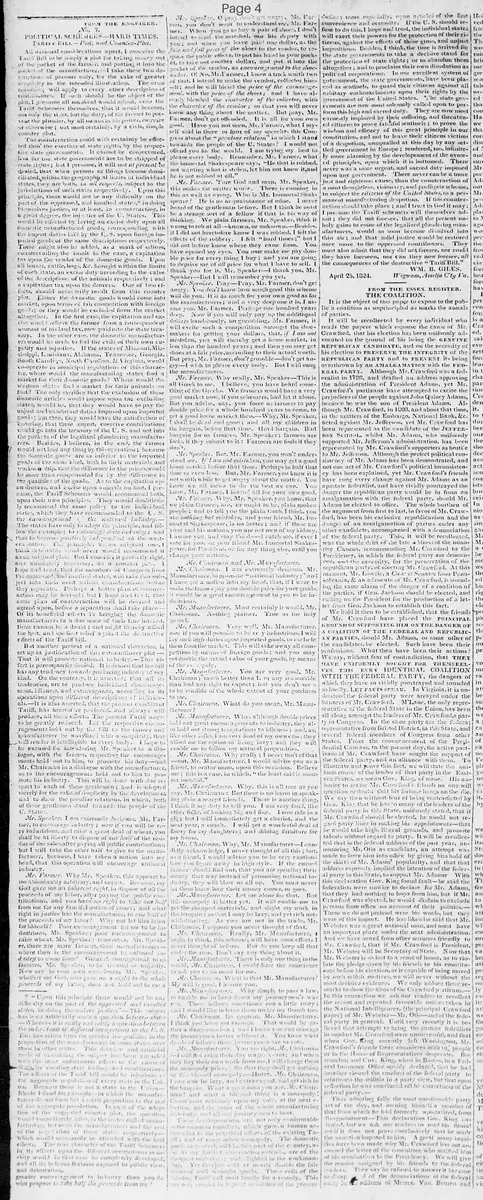
All rational considerations apart, I conceive the Tariff Bill to be simply a plot for taking money out of the pocket of the farmer, and putting it into the pocket of the manufacturer.—I take these two descriptions of persons only, for the sake of greater simplicity in the intended illustration. The same reasoning will apply to every other description of contributors. If such should be the object of the plot, I presume all mankind would admit, even the Tariff Schemers themselves, that it would become, not only the right, but the duty, of the farmer to prevent the plunder, by all means in his power, coercive or otherwise; but most certainly, by a civil, simple counter-plot.
The counteraction could with certainty be effected thro' the exertion of state rights, by the respective state governments. It cannot be conjectured, how far the state governments are to be stripped of state rights; but I presume, it will not at present be denied, that when persons or things become domiciliated, within the geographical limits of individual states, they are both, in all respects, subject to the jurisdictions of such states respectively. "Upon this principle, there would not be any difficulty on the part of the oppressed, and insulted states,* in doing themselves justice, or at least, in counteracting, in a great degree, the injustice of the U. States. This would be effected by laying an excise duty upon all domestic manufactured goods, corresponding with the impost duties laid by the U.S. upon foreign imported goods of the same descriptions respectively. There might also be added, as a mark of odium, countervailing the insult in the case, a capitation tax upon the vendor of the domestic goods. Upon all horses, cattle, hogs, &c. brought within the limits of each state, an excise duty according to the value of the descriptions of the animals respectively; and a capitation tax upon the drovers. One of two effects, should necessarily result from this counter-plot. Either the domestic goods would come into market, upon terms of fair competition with foreign goods; or they would be excluded from the market altogether. In the first case, the capitation and excise would relieve the farmer from a corresponding amount of his land tax, now paid into the state treasury. In the other case, the domestic manufacturers would be made to feel the evils of their own cupidity and injustice. If the states of Missouri, Mississippi, Louisiana, Alabama, Tennessee, Georgia, South Carolina, North Carolina, & Virginia, would co-operate in municipal regulations of this character, where would the manufacturing states find a market for their domestic goods? Where would the western states find a market for their animals on foot? The only sacrifice that the exclusion of these domestic articles would impose upon the excluding states, would be, that they would have to pay the unjust and exorbitant duties imposed upon imported goods; but then, they would have the satisfaction of knowing, that these unjust, coercive contributions would go into the treasury of the U. S. and not into the pockets of the legalized plundering manufacturers. Besides, I believe, in the end, the farmer would not lose any thing by this operation; because the domestic goods are so inferior to the imported goods of the same kind, both in their materials and workmanship, that the difference in the prices, would be more than compensated for by the difference in the qualities of the goods. As to the capitation upon drovers, and excise upon animals on foot, I presume, the Tariff Schemers would recommend both, upon their own principles. They would doubtless recommend the same policy to the individual states, which they have recommended to the U. S. the encouragement of the national industry.—The states have only to adopt the principle, and follow the example; to encourage state industry: and thus to become speedily independent of the western states. The principle, as an original one, I think detestable—and never would recommend it as an original plot. But I consider it good as a counter-plot. I hope and trust, that the members of Congress from the oppressed, and insulted states, will take this subject into their most serious considerations before they separate. Perhaps a better plan of counter-action may be devised; but I hope and trust, that some plan of counteraction will be devised and agreed upon, before a separation shall take place—Of its beneficial effects in bringing the domestic manufacturers to a due sense of their true interest, there cannot be a doubt; and might thereby afford the best, and speediest relief against the destructive effects of the Tariff bill.
But another pretext of a national character, is set up in justification of this extraordinary plot—That it will promote national industry.—This effect is peremptorily denied. It is denied that the bill has any tendency towards producing industry of any kind. On the contrary, it is asserted, that all its tendencies, are to produce individual discouragement, idleness, and extravagance, according to its operations upon different descriptions of individuals.—It is also asserted, that the present exorbitant Tariff, has heretofore produced, and always will produce, all these effects. The present Tariff ought to be greatly reduced. Let the respective encouragements held out by the bill to the farmer and manufacturer be analyzed with a simplicity, that shall render it intelligible to every body. I hope to be excused for introducing Mr. Speaker in a dialogue, with the farmer, respecting the encouragements held out to him, to promote his industry—and Mr. Chairman in a dialogue with the manufacturer, as to the encouragements held out to him to promote his industry. This will be done with due respect to each of these gentlemen; and is adopted merely for the sake of simplicity in the development and to shew the peculiar relations, in which, both of those gentlemen stand towards the people of the U. State.
Mr. Speaker. I am extremely desirous, Mr. Farmer, to encourage industry; now if you will be very industrious, and raise a great deal of wheat, you shall be at liberty to dispose of one half of the residue of the sales, after paying all public contributions; but I will take the other half to give to the manufacturer, because, I have taken a notion into my head, that this operation will encourage national industry.
Mr. Farmer. Why Mr. Speaker, this appears to me abominably arbitrary, and unjust. Because, my God gave me an inherent right, to dispose of all the proceeds of my labor, after paying the public contributions, and you have no right to take one half from me for any fanciful notion of yours; and what right in justice has the manufacturer, to one half of the proceeds of my labor? Why not let him labor for himself? Poor encouragement for me to be industrious, Mr. Speaker; poor encouragement to raise wheat, Mr. Speaker: remember, Mr. Speaker, there are more farmers, than manufacturers—where then is the encouragement to rational industry to come from? Great discouragement to us farmers, Mr. Speaker, to be treated so unjustly. Now say in your own conscience, Mr. Speaker, whether my God, who gave me a right to the whole proceeds of my labor, does not hold out to me a greater encouragement to industry than you do who propose to take half the proceeds from me.
Mr. Speaker. Pray—pray, Mr. Farmer, don't get angry. You don't know how much good this scheme will do you. It is as much for your own good as for the manufacturers; and a very deep one it is, I assure you, Mr. Farmer. Perhaps one hundred years deep. Now if you will only pay up the additional dollars handsomely, no grumbling, Mr. Farmer, it will excite such a competition amongst the shoe-makers for getting your dollars, that, if I am not mistaken, you will thereby get a home market, in less than the hundred years; and then you may get shoes at a fair price, according to their actual worth. But pray, Mr. Farmer, don't grumble—don't get angry—I wish to please every body. But I will snug the manufacturers.
Mr. Farmer. Why really, Mr. Speaker, this is all Greek to me. I believe, you have heard something of the Greeks. We farmers would have a very good market now, if you schemers, had let it alone. But you advise, nay, you force us farmers to pay double price for a whole hundred years to come, to get a good home market then,—Why, Mr. Speaker, I shall be dead and gone; and all my children in the bargain, before that time. Hard bargain. Bad bargain for us farmers, Mr. Speaker; farmers are fools, if they submit to it: Farmers are fools if they don't.
Mr. Speaker. But, Mr. Farmer, you don't understand me. If I am not mistaken, you may get a good home market before that time. Perhaps in half that time or even less. But, Mr. Farmer, you know it is not worth while to get angry about the matter. You know we all mean to do the best we can. You know, Mr. Farmer, I intend all for your own good.
Mr. Farmer. Why, Mr. Speaker, you know, that we plain farmers, are, or ought to be, plain spoken people; and to tell you the plain truth, I think, you are nothing but mistakes, and your friend, Mr. Immortal Shakespeare, is no better; and if these are your and his notions, you are not men of my kidney. I assure you and may the d—l catch me, if ever I vote for you, or your friend Mr. Immortal Shakespeare, for President, or for any thing else, until you change your notions.
Mr. Chairman and Mr. Manufacturer.
Mr. Chairman. I am extremely desirous, Mr. Manufacturer, to promote "national industry;" and I have got a notion into my head, that, if I were to make the farmer pay you double price for your goods, it would be a great encouragement to you to be industrious.
Mr. Manufacturer. Most certainly it would, Mr. Chairman. Nothing plainer. True as the holy gospel.
Mr. Chairman. Very well, Mr. Manufacturer, now if you will promise to be very industrious, I will lay such high duties upon imported goods, to exclude them from the market. This will take away all competition by means of foreign goods; and you may set double the actual value of your goods, by means of the monopoly.
Mr. Manufacturer. You are very good, Mr. Chairman; much better than I, or any reasonable man had any right to expect; but you don't seem to be sensible of the whole extent of your goodness to me.
Mr. Chairman. What do you mean, Mr. Manufacturer?
Mr. Manufacturer. Why, although double prices hold out great encouragements to industry, they also hold out strong temptations to idleness; and, as, like other folks, I am very fond of my own ease, they afford me the option of being lazy; and they will enable me to follow my natural propensities.
Mr. Chairman. Why really: I never tho't of that—but, Mr. Manufacturer, I would advise you as a friend, to keep mum, upon this occasion. Believe me; this is a case, in which, "the least said is soonest mended."
Mr. Manufacturer. Why, this is all true as you say, Mr. Chairman: But there is no harm in speaking plain amongst friends. There is another thing, I think it my duty to tell you. I am very fond, like other folks, of looking big and fine. I now ride in a gig; but I will immediately get a chariot, and the next year, a coach. I will get a wonderful deal of finery for my daughters; and shining furniture for my house.
Mr. Chairman. Why, Mr. Manufacturer—I candidly acknowledge, I never thought of all this; but, as a friend, I would advise you to be very cautious how you figure away in high style. If the cursed farmers should find out, that you are spending their money that way instead of promoting national industry, they will blow us all up. You must never let them know how their money comes, or goes.
Mr. Manufacturer. Let me alone for that. But this monopoly is better yet. It will enable me to get the cheapest materials, and slight my work in the bargain; so that I may be lazy, and yet rich notwithstanding. As you are not in the trade, Mr. Chairman, I suppose you never thought of that.
Mr. Chairman. Really, Mr. Manufacturer, I begin to think, this scheme, will have some effects I never thought of before. But do you keep all that under the rose. Don't say any thing about it.
Mr. Manufacturer. There is only one thing in the world, Mr. Chairman, I could have the conscience to ask you to do more for me.
Mr. Chairman. What is that Mr. Manufacturer? My will is good, I assure you.
Mr. Manufacturer. Why simply to pass a law, to enable me to keep down my journeymen's wages. These fellows sometimes run a little rusty; and I should like to have them under my thumb too.
Mr. Chairman. Be content, Mr. Manufacturer. I think you have got enough. That would be rather a dangerous law; and I know you can manage the journeymen better without it. You know what bad sorts of fellows these journeymen are to vote.
Mr. Manufacturer. You are right, Mr. Chairman—I will not raise their day wages one cent; and when they buy their own work from me, I will charge them the monopoly price. So that they shall get nothing by this blessed monopoly—Hurrah. Mr. Chairman, I can now be lazy, and extravagant, and get rich in the bargain. What a statesman you are, Mr. Chairman! and what a blessed thing is a monopoly! Count most certainly upon my vote, at the next election, and the votes of the whole manufacturing interest, and all our journeymen to boot.
These developments, are not only conformable with the common cupidity, which governs human actions, but to the practical effect, of the existing Tariff: and of every other monopoly. The domestic goods here to general, so far as my observation extend, are of the greatest mediocrity: and slovenly in the workmanship. Yet they are sold at nearly double the fair prices of well wrought goods. The southern States feel most ludicrously for a remedy. This only consists in a great reduction of the present duties; more especially, upon articles of the first convenience and necessity. If the U. S. should refuse to do this, I hope and trust, the individual states will exert their powers for the protection of their citizens, against the effects of these gross, and unjust impositions. Besides, I think, the time is arrived for the state governments to take a decisive stand for the protection of state rights; or to abandon them altogether; and to proclaim their own dissolution as political corporations. In our excellent system of government, the state governments, have been placed as sentinels, to guard their citizens against all arbitrary encroachments upon their rights by the government of the United States. The state governments are now most solemnly called upon to perform this high and sacred duty. They are now most carnestly implored by their suffering, and threatened citizens to prove faithful sentinels; to prove the wisdom and efficacy of this great principle in our constitution, and not to leave their citizens victims of a despotism, unequalled at this day by any settled government in Europe; rendered, too, infinitely more alarming by the development of the avowed principles, upon which it is bottomed. There never was a more urgent, and sacred duty imposed upon any government. There never can be a more just and righteous cause, than the counteraction of a most thoughtless, visionary, and profligate scheme, to subject the citizens of the United States, to a permanent manufacturing despotism. If this counter-action should take place; and I trust in God it may: I presume the Tariff schemers will themselves admit: they did not foresee, that all the present unholy gains to come of the legalized plundering manufacturers, would so soon become dissolved into thin air; and that solid justice would be restored once more to the oppressed contributors. They must also admit that they did not foresee, nor could they have foreseen, nor can they now foresee, all the consequences of the destructive "Tariff Bill."
WM. B. GILES.
April 25, 1824.
Wigwam, Amelia Cty Va.
* "Upon this principle there would not be any difficulty on the part of the oppressed and insulted states, in doing themselves justice,"—This subject has been artificially made a question between states—Whereas it is really and solely a question between the individuals of different occupations in the U. S. This has arisen from the greater irregularities in the proportion of the manufacturers in some states over those in other states. This deceptive and artificial style of viewing the subject has been attended with the most unfortunate effect to the cause of truth, by creating state feeling and combinations. The effects of the Tariff bill would be injurious to the aggregate population of every state in the Union. Because there is not a state in the Union—Rhode Island for example—in which the manufacturers do not form but a small proportion to the rest of the aggregate population. In case of the adoption of the suggested counter-plot, the question would immediately arise, in the states called manufacturing, between the manufacturers and the rest of the population of those states respectively—which would necessarily be attended with the best effects. The true character of the Tariff Schemer in its effects upon the different occupations in society would in that case be completely developed, and all its hideous features exposed to public view, and detestation.
Mr. Speaker, Opera: don't get angry, Mr. Farmer. Wouldn't you see to understand me, Mr. Farmer. When you go to buy a pair of shoes, I don't intend to send the marshal, nor his deputy with you; and when you have paid one dollar, as the fair and full price of the shoes to the vendor, to requie the public officer, to put his hand in your pocket, to take out another dollar, and put it into the pocket of the vendor, as encouragement to the shoe-maker. O! No, Mr. Farmer, I know a trick worth two of that, I intend to make the vendor, collector himself; and he will blend the price of the encouragement, with the price of the shoes; and I have already blended the character of the collector, with the character of the vendor; so that you will never know any thing about the matter. But pray, Mr. Farmer, don't get offended. It is all for your own good. Have you not seen, Mr. Farmer, what I myself said in three or four of my speeches this Congress about the "peculiar relation" in which I stand towards the people of the U. States? I would not offend you for the world. I am trying my best to please every body. Remember, Mr. Farmer, what the immortal Shakespeare says, "He that is robbed, not wanting what is stolen, let him not know it, and he is not robbed at all."
Mr. Farmer. For God and man, Mr. Speaker, this makes the matter worse. There is cunning in this as well as wrong. Who is Mr. Immortal Shakespeare? He is no acquaintance of mine. I never heard of the gentleman before. But I think he must be a strange sort of a fellow if that is his way of thinking. We plain farmers, Mr. Speaker, think it wrong to rob at all—known, or unknown.—Besides, if I did not heretofore know I was robbed, I felt the effects of the robbery. I felt "hard times;" but I did not before know where they came from. You have opened my eyes. You now make me pay double price for every thing I buy; and you are going to deprive me of all price for what I have to sell. I thank you for it. Mr. Speaker—I thank you, Mr. Speaker—But I will remember you yet.
Mr. Speaker. Pray—Pray, Mr. Farmer, don't get angry. You don't know how much good this scheme will do you. It is as much for your own good as for the manufacturers; and a very deep one it is, I assure you, Mr. Farmer. Perhaps one hundred years deep. Now if you will only pay up the additional dollars handsomely, no grumbling, Mr. Farmer, it will excite such a competition amongst the shoe-makers for getting your dollars, that, if I am not mistaken, you will thereby get a home market, in less than the hundred years; and then you may get shoes at a fair price, according to their actual worth. But pray, Mr. Farmer, don't grumble—don't get angry—I wish to please every body. But I will snug the manufacturers.
Mr. Farmer. Why really, Mr. Speaker, this is all Greek to me. I believe, you have heard something of the Greeks. We farmers would have a very good market now, if you schemers, had let it alone. But you advise, nay, you force us farmers to pay double price for a whole hundred years to come, to get a good home market then,—Why, Mr. Speaker, I shall be dead and gone; and all my children in the bargain, before that time. Hard bargain. Bad bargain for us farmers, Mr. Speaker; farmers are fools, if they submit to it: Farmers are fools if they don't.
Mr. Speaker. But, Mr. Farmer, you don't understand me. If I am not mistaken, you may get a good home market before that time. Perhaps in half that time or even less. But, Mr. Farmer, you know it is not worth while to get angry about the matter. You know we all mean to do the best we can. You know, Mr. Farmer, I intend all for your own good.
Mr. Farmer. Why, Mr. Speaker, you know, that we plain farmers, are, or ought to be, plain spoken people; and to tell you the plain truth, I think, you are nothing but mistakes, and your friend, Mr. Immortal Shakespeare, is no better; and if these are your and his notions, you are not men of my kidney. I assure you and may the d—l catch me, if ever I vote for you, or your friend Mr. Immortal Shakespeare, for President, or for any thing else, until you change your notions.
Mr. Chairman and Mr. Manufacturer.
Mr. Chairman. I am extremely desirous, Mr. Manufacturer, to promote "national industry;" and I have got a notion into my head, that, if I were to make the farmer pay you double price for your goods, it would be a great encouragement to you to be industrious.
Mr. Manufacturer. Most certainly it would, Mr. Chairman. Nothing plainer. True as the holy gospel.
Mr. Chairman. Very well, Mr. Manufacturer, now if you will promise to be very industrious, I will lay such high duties upon imported goods, to exclude them from the market. This will take away all competition by means of foreign goods; and you may set double the actual value of your goods, by means of the monopoly.
Mr. Manufacturer. You are very good, Mr. Chairman; much better than I, or any reasonable man had any right to expect; but you don't seem to be sensible of the whole extent of your goodness to me.
Mr. Chairman. What do you mean, Mr. Manufacturer?
Mr. Manufacturer. Why, although double prices hold out great encouragements to industry, they also hold out strong temptations to idleness; and, as, like other folks, I am very fond of my own ease, they afford me the option of being lazy; and they will enable me to follow my natural propensities.
Mr. Chairman. Why really: I never tho't of that—but, Mr. Manufacturer, I would advise you as a friend, to keep mum, upon this occasion. Believe me; this is a case, in which, "the least said is soonest mended."
Mr. Manufacturer. Why, this is all true as you say, Mr. Chairman: But there is no harm in speaking plain amongst friends. There is another thing, I think it my duty to tell you. I am very fond, like other folks, of looking big and fine. I now ride in a gig; but I will immediately get a chariot, and the next year, a coach. I will get a wonderful deal of finery for my daughters; and shining furniture for my house.
Mr. Chairman. Why, Mr. Manufacturer—I candidly acknowledge, I never thought of all this; but, as a friend, I would advise you to be very cautious how you figure away in high style. If the cursed farmers should find out, that you are spending their money that way instead of promoting national industry, they will blow us all up. You must never let them know how their money comes, or goes.
Mr. Manufacturer. Let me alone for that. But this monopoly is better yet. It will enable me to get the cheapest materials, and slight my work in the bargain; so that I may be lazy, and yet rich notwithstanding. As you are not in the trade, Mr. Chairman, I suppose you never thought of that.
Mr. Chairman. Really, Mr. Manufacturer, I begin to think, this scheme, will have some effects I never thought of before. But do you keep all that under the rose. Don't say any thing about it.
Mr. Manufacturer. There is only one thing in the world, Mr. Chairman, I could have the conscience to ask you to do more for me.
Mr. Chairman. What is that Mr. Manufacturer? My will is good, I assure you.
Mr. Manufacturer. Why simply to pass a law, to enable me to keep down my journeymen's wages. These fellows sometimes run a little rusty; and I should like to have them under my thumb too.
Mr. Chairman. Be content, Mr. Manufacturer. I think you have got enough. That would be rather a dangerous law; and I know you can manage the journeymen better without it. You know what bad sorts of fellows these journeymen are to vote.
Mr. Manufacturer. You are right, Mr. Chairman—I will not raise their day wages one cent; and when they buy their own work from me, I will charge them the monopoly price. So that they shall get nothing by this blessed monopoly—Hurrah. Mr. Chairman, I can now be lazy, and extravagant, and get rich in the bargain. What a statesman you are, Mr. Chairman! and what a blessed thing is a monopoly! Count most certainly upon my vote, at the next election, and the votes of the whole manufacturing interest, and all our journeymen to boot.
These developments, are not only conformable with the common cupidity, which governs human actions, but to the practical effect, of the existing Tariff: and of every other monopoly. The domestic goods here to general, so far as my observation extend, are of the greatest mediocrity: and slovenly in the workmanship. Yet they are sold at nearly double the fair prices of well wrought goods. The southern States feel most ludicrously for a remedy. This only consists in a great reduction of the present duties; more especially, upon articles of the first convenience and necessity. If the U. S. should refuse to do this, I hope and trust, the individual states will exert their powers for the protection of their citizens, against the effects of these gross, and unjust impositions. Besides, I think, the time is arrived for the state governments to take a decisive stand for the protection of state rights; or to abandon them altogether; and to proclaim their own dissolution as political corporations. In our excellent system of government, the state governments, have been placed as sentinels, to guard their citizens against all arbitrary encroachments upon their rights by the government of the United States. The state governments are now most solemnly called upon to perform this high and sacred duty. They are now most carnestly implored by their suffering, and threatened citizens to prove faithful sentinels; to prove the wisdom and efficacy of this great principle in our constitution, and not to leave their citizens victims of a despotism, unequalled at this day by any settled government in Europe; rendered, too, infinitely more alarming by the development of the avowed principles, upon which it is bottomed. There never was a more urgent, and sacred duty imposed upon any government. There never can be a more just and righteous cause, than the counteraction of a most thoughtless, visionary, and profligate scheme, to subject the citizens of the United States, to a permanent manufacturing despotism. If this counter-action should take place; and I trust in God it may: I presume the Tariff schemers will themselves admit: they did not foresee, that all the present unholy gains to come of the legalized plundering manufacturers, would so soon become dissolved into thin air; and that solid justice would be restored once more to the oppressed contributors. They must also admit that they did not foresee, nor could they have foreseen, nor can they now foresee, all the consequences of the destructive "Tariff Bill."
WM. B. GILES.
April 25, 1824.
Wigwam, Amelia Cty Va.
POLITICAL SCHEMERS—HARD TIMES.
Tariff—Plot, and Counter-Plot.
All rational considerations apart, I conceive the Tariff Bill to be simply a plot for taking money out of the pocket of the farmer, and putting it into the pocket of the manufacturer.—I take these two descriptions of persons only, for the sake of greater simplicity in the intended illustration. The same reasoning will apply to every other description of contributors. If such should be the object of the plot, I presume all mankind would admit, even the Tariff Schemers themselves, that it would become, not only the right, but the duty, of the farmer to prevent the plunder, by all means in his power, coercive or otherwise; but most certainly, by a civil, simple counter-plot.
The counteraction could with certainty be effected thro' the exertion of state rights, by the respective state governments. It cannot be conjectured, how far the state governments are to be stripped of state rights; but I presume, it will not at present be denied, that when persons or things become domiciliated, within the geographical limits of individual states, they are both, in all respects, subject to the jurisdictions of such states respectively. "Upon this principle, there would not be any difficulty on the part of the oppressed, and insulted states,* in doing themselves justice, or at least, in counteracting, in a great degree, the injustice of the U. States. This would be effected by laying an excise duty upon all domestic manufactured goods, corresponding with the impost duties laid by the U.S. upon foreign imported goods of the same descriptions respectively. There might also be added, as a mark of odium, countervailing the insult in the case, a capitation tax upon the vendor of the domestic goods. Upon all horses, cattle, hogs, &c. brought within the limits of each state, an excise duty according to the value of the descriptions of the animals respectively; and a capitation tax upon the drovers. One of two effects, should necessarily result from this counter-plot. Either the domestic goods would come into market, upon terms of fair competition with foreign goods; or they would be excluded from the market altogether. In the first case, the capitation and excise would relieve the farmer from a corresponding amount of his land tax, now paid into the state treasury. In the other case, the domestic manufacturers would be made to feel the evils of their own cupidity and injustice. If the states of Missouri, Mississippi, Louisiana, Alabama, Tennessee, Georgia, South Carolina, North Carolina, & Virginia, would co-operate in municipal regulations of this character, where would the manufacturing states find a market for their domestic goods? Where would the western states find a market for their animals on foot? The only sacrifice that the exclusion of these domestic articles would impose upon the excluding states, would be, that they would have to pay the unjust and exorbitant duties imposed upon imported goods; but then, they would have the satisfaction of knowing, that these unjust, coercive contributions would go into the treasury of the U. S. and not into the pockets of the legalized plundering manufacturers. Besides, I believe, in the end, the farmer would not lose any thing by this operation; because the domestic goods are so inferior to the imported goods of the same kind, both in their materials and workmanship, that the difference in the prices, would be more than compensated for by the difference in the qualities of the goods. As to the capitation upon drovers, and excise upon animals on foot, I presume, the Tariff Schemers would recommend both, upon their own principles. They would doubtless recommend the same policy to the individual states, which they have recommended to the U. S. the encouragement of the national industry.—The states have only to adopt the principle, and follow the example; to encourage state industry: and thus to become speedily independent of the western states. The principle, as an original one, I think detestable—and never would recommend it as an original plot. But I consider it good as a counter-plot. I hope and trust, that the members of Congress from the oppressed, and insulted states, will take this subject into their most serious considerations before they separate. Perhaps a better plan of counter-action may be devised; but I hope and trust, that some plan of counteraction will be devised and agreed upon, before a separation shall take place—Of its beneficial effects in bringing the domestic manufacturers to a due sense of their true interest, there cannot be a doubt; and might thereby afford the best, and speediest relief against the destructive effects of the Tariff bill.
But another pretext of a national character, is set up in justification of this extraordinary plot—That it will promote national industry.—This effect is peremptorily denied. It is denied that the bill has any tendency towards producing industry of any kind. On the contrary, it is asserted, that all its tendencies, are to produce individual discouragement, idleness, and extravagance, according to its operations upon different descriptions of individuals.—It is also asserted, that the present exorbitant Tariff, has heretofore produced, and always will produce, all these effects. The present Tariff ought to be greatly reduced. Let the respective encouragements held out by the bill to the farmer and manufacturer be analyzed with a simplicity, that shall render it intelligible to every body. I hope to be excused for introducing Mr. Speaker in a dialogue, with the farmer, respecting the encouragements held out to him, to promote his industry—and Mr. Chairman in a dialogue with the manufacturer, as to the encouragements held out to him to promote his industry. This will be done with due respect to each of these gentlemen; and is adopted merely for the sake of simplicity in the development and to shew the peculiar relations, in which, both of those gentlemen stand towards the people of the U. State.
Mr. Speaker. I am extremely desirous, Mr. Farmer, to encourage industry; now if you will be very industrious, and raise a great deal of wheat, you shall be at liberty to dispose of one half of the residue of the sales, after paying all public contributions; but I will take the other half to give to the manufacturer, because, I have taken a notion into my head, that this operation will encourage national industry.
Mr. Farmer. Why Mr. Speaker, this appears to me abominably arbitrary, and unjust. Because, my God gave me an inherent right, to dispose of all the proceeds of my labor, after paying the public contributions, and you have no right to take one half from me for any fanciful notion of yours; and what right in justice has the manufacturer, to one half of the proceeds of my labor? Why not let him labor for himself? Poor encouragement for me to be industrious, Mr. Speaker; poor encouragement to raise wheat, Mr. Speaker: remember, Mr. Speaker, there are more farmers, than manufacturers—where then is the encouragement to rational industry to come from? Great discouragement to us farmers, Mr. Speaker, to be treated so unjustly. Now say in your own conscience, Mr. Speaker, whether my God, who gave me a right to the whole proceeds of my labor, does not hold out to me a greater encouragement to industry than you do who propose to take half the proceeds from me.
Mr. Speaker. Pray—pray, Mr. Farmer, don't get angry. You don't know how much good this scheme will do you. It is as much for your own good as for the manufacturers; and a very deep one it is, I assure you, Mr. Farmer. Perhaps one hundred years deep. Now if you will only pay up the additional dollars handsomely, no grumbling, Mr. Farmer, it will excite such a competition amongst the shoe-makers for getting your dollars, that, if I am not mistaken, you will thereby get a home market, in less than the hundred years; and then you may get shoes at a fair price, according to their actual worth. But pray, Mr. Farmer, don't grumble—don't get angry—I wish to please every body. But I will snug the manufacturers.
Mr. Farmer. Why really, Mr. Speaker, this is all Greek to me. I believe, you have heard something of the Greeks. We farmers would have a very good market now, if you schemers, had let it alone. But you advise, nay, you force us farmers to pay double price for a whole hundred years to come, to get a good home market then,—Why, Mr. Speaker, I shall be dead and gone; and all my children in the bargain, before that time. Hard bargain. Bad bargain for us farmers, Mr. Speaker; farmers are fools, if they submit to it: Farmers are fools if they don't.
Mr. Speaker. But, Mr. Farmer, you don't understand me. If I am not mistaken, you may get a good home market before that time. Perhaps in half that time or even less. But, Mr. Farmer, you know it is not worth while to get angry about the matter. You know we all mean to do the best we can. You know, Mr. Farmer, I intend all for your own good.
Mr. Farmer. Why, Mr. Speaker, you know, that we plain farmers, are, or ought to be, plain spoken people; and to tell you the plain truth, I think, you are nothing but mistakes, and your friend, Mr. Immortal Shakespeare, is no better; and if these are your and his notions, you are not men of my kidney. I assure you and may the d—l catch me, if ever I vote for you, or your friend Mr. Immortal Shakespeare, for President, or for any thing else, until you change your notions.
Mr. Chairman and Mr. Manufacturer.
Mr. Chairman. I am extremely desirous, Mr. Manufacturer, to promote "national industry;" and I have got a notion into my head, that, if I were to make the farmer pay you double price for your goods, it would be a great encouragement to you to be industrious.
Mr. Manufacturer. Most certainly it would, Mr. Chairman. Nothing plainer. True as the holy gospel.
Mr. Chairman. Very well, Mr. Manufacturer, now if you will promise to be very industrious, I will lay such high duties upon imported goods, to exclude them from the market. This will take away all competition by means of foreign goods; and you may set double the actual value of your goods, by means of the monopoly.
Mr. Manufacturer. You are very good, Mr. Chairman; much better than I, or any reasonable man had any right to expect; but you don't seem to be sensible of the whole extent of your goodness to me.
Mr. Chairman. What do you mean, Mr. Manufacturer?
Mr. Manufacturer. Why, although double prices hold out great encouragements to industry, they also hold out strong temptations to idleness; and, as, like other folks, I am very fond of my own ease, they afford me the option of being lazy; and they will enable me to follow my natural propensities.
Mr. Chairman. Why really: I never tho't of that—but, Mr. Manufacturer, I would advise you as a friend, to keep mum, upon this occasion. Believe me; this is a case, in which, "the least said is soonest mended."
Mr. Manufacturer. Why, this is all true as you say, Mr. Chairman: But there is no harm in speaking plain amongst friends. There is another thing, I think it my duty to tell you. I am very fond, like other folks, of looking big and fine. I now ride in a gig; but I will immediately get a chariot, and the next year, a coach. I will get a wonderful deal of finery for my daughters; and shining furniture for my house.
Mr. Chairman. Why, Mr. Manufacturer—I candidly acknowledge, I never thought of all this; but, as a friend, I would advise you to be very cautious how you figure away in high style. If the cursed farmers should find out, that you are spending their money that way instead of promoting national industry, they will blow us all up. You must never let them know how their money comes, or goes.
Mr. Manufacturer. Let me alone for that. But this monopoly is better yet. It will enable me to get the cheapest materials, and slight my work in the bargain; so that I may be lazy, and yet rich notwithstanding. As you are not in the trade, Mr. Chairman, I suppose you never thought of that.
Mr. Chairman. Really, Mr. Manufacturer, I begin to think, this scheme, will have some effects I never thought of before. But do you keep all that under the rose. Don't say any thing about it.
Mr. Manufacturer. There is only one thing in the world, Mr. Chairman, I could have the conscience to ask you to do more for me.
Mr. Chairman. What is that Mr. Manufacturer? My will is good, I assure you.
Mr. Manufacturer. Why simply to pass a law, to enable me to keep down my journeymen's wages. These fellows sometimes run a little rusty; and I should like to have them under my thumb too.
Mr. Chairman. Be content, Mr. Manufacturer. I think you have got enough. That would be rather a dangerous law; and I know you can manage the journeymen better without it. You know what bad sorts of fellows these journeymen are to vote.
Mr. Manufacturer. You are right, Mr. Chairman—I will not raise their day wages one cent; and when they buy their own work from me, I will charge them the monopoly price. So that they shall get nothing by this blessed monopoly—Hurrah. Mr. Chairman, I can now be lazy, and extravagant, and get rich in the bargain. What a statesman you are, Mr. Chairman! and what a blessed thing is a monopoly! Count most certainly upon my vote, at the next election, and the votes of the whole manufacturing interest, and all our journeymen to boot.
These developments, are not only conformable with the common cupidity, which governs human actions, but to the practical effect, of the existing Tariff: and of every other monopoly. The domestic goods here to general, so far as my observation extend, are of the greatest mediocrity: and slovenly in the workmanship. Yet they are sold at nearly double the fair prices of well wrought goods. The southern States feel most ludicrously for a remedy. This only consists in a great reduction of the present duties; more especially, upon articles of the first convenience and necessity. If the U. S. should refuse to do this, I hope and trust, the individual states will exert their powers for the protection of their citizens, against the effects of these gross, and unjust impositions. Besides, I think, the time is arrived for the state governments to take a decisive stand for the protection of state rights; or to abandon them altogether; and to proclaim their own dissolution as political corporations. In our excellent system of government, the state governments, have been placed as sentinels, to guard their citizens against all arbitrary encroachments upon their rights by the government of the United States. The state governments are now most solemnly called upon to perform this high and sacred duty. They are now most carnestly implored by their suffering, and threatened citizens to prove faithful sentinels; to prove the wisdom and efficacy of this great principle in our constitution, and not to leave their citizens victims of a despotism, unequalled at this day by any settled government in Europe; rendered, too, infinitely more alarming by the development of the avowed principles, upon which it is bottomed. There never was a more urgent, and sacred duty imposed upon any government. There never can be a more just and righteous cause, than the counteraction of a most thoughtless, visionary, and profligate scheme, to subject the citizens of the United States, to a permanent manufacturing despotism. If this counter-action should take place; and I trust in God it may: I presume the Tariff schemers will themselves admit: they did not foresee, that all the present unholy gains to come of the legalized plundering manufacturers, would so soon become dissolved into thin air; and that solid justice would be restored once more to the oppressed contributors. They must also admit that they did not foresee, nor could they have foreseen, nor can they now foresee, all the consequences of the destructive "Tariff Bill."
WM. B. GILES.
April 25, 1824.
Wigwam, Amelia Cty Va.
* "Upon this principle there would not be any difficulty on the part of the oppressed and insulted states, in doing themselves justice,"—This subject has been artificially made a question between states—Whereas it is really and solely a question between the individuals of different occupations in the U. S. This has arisen from the greater irregularities in the proportion of the manufacturers in some states over those in other states. This deceptive and artificial style of viewing the subject has been attended with the most unfortunate effect to the cause of truth, by creating state feeling and combinations. The effects of the Tariff bill would be injurious to the aggregate population of every state in the Union. Because there is not a state in the Union—Rhode Island for example—in which the manufacturers do not form but a small proportion to the rest of the aggregate population. In case of the adoption of the suggested counter-plot, the question would immediately arise, in the states called manufacturing, between the manufacturers and the rest of the population of those states respectively—which would necessarily be attended with the best effects. The true character of the Tariff Schemer in its effects upon the different occupations in society would in that case be completely developed, and all its hideous features exposed to public view, and detestation.
Mr. Speaker, Opera: don't get angry, Mr. Farmer. Wouldn't you see to understand me, Mr. Farmer. When you go to buy a pair of shoes, I don't intend to send the marshal, nor his deputy with you; and when you have paid one dollar, as the fair and full price of the shoes to the vendor, to requie the public officer, to put his hand in your pocket, to take out another dollar, and put it into the pocket of the vendor, as encouragement to the shoe-maker. O! No, Mr. Farmer, I know a trick worth two of that, I intend to make the vendor, collector himself; and he will blend the price of the encouragement, with the price of the shoes; and I have already blended the character of the collector, with the character of the vendor; so that you will never know any thing about the matter. But pray, Mr. Farmer, don't get offended. It is all for your own good. Have you not seen, Mr. Farmer, what I myself said in three or four of my speeches this Congress about the "peculiar relation" in which I stand towards the people of the U. States? I would not offend you for the world. I am trying my best to please every body. Remember, Mr. Farmer, what the immortal Shakespeare says, "He that is robbed, not wanting what is stolen, let him not know it, and he is not robbed at all."
Mr. Farmer. For God and man, Mr. Speaker, this makes the matter worse. There is cunning in this as well as wrong. Who is Mr. Immortal Shakespeare? He is no acquaintance of mine. I never heard of the gentleman before. But I think he must be a strange sort of a fellow if that is his way of thinking. We plain farmers, Mr. Speaker, think it wrong to rob at all—known, or unknown.—Besides, if I did not heretofore know I was robbed, I felt the effects of the robbery. I felt "hard times;" but I did not before know where they came from. You have opened my eyes. You now make me pay double price for every thing I buy; and you are going to deprive me of all price for what I have to sell. I thank you for it. Mr. Speaker—I thank you, Mr. Speaker—But I will remember you yet.
Mr. Speaker. Pray—Pray, Mr. Farmer, don't get angry. You don't know how much good this scheme will do you. It is as much for your own good as for the manufacturers; and a very deep one it is, I assure you, Mr. Farmer. Perhaps one hundred years deep. Now if you will only pay up the additional dollars handsomely, no grumbling, Mr. Farmer, it will excite such a competition amongst the shoe-makers for getting your dollars, that, if I am not mistaken, you will thereby get a home market, in less than the hundred years; and then you may get shoes at a fair price, according to their actual worth. But pray, Mr. Farmer, don't grumble—don't get angry—I wish to please every body. But I will snug the manufacturers.
Mr. Farmer. Why really, Mr. Speaker, this is all Greek to me. I believe, you have heard something of the Greeks. We farmers would have a very good market now, if you schemers, had let it alone. But you advise, nay, you force us farmers to pay double price for a whole hundred years to come, to get a good home market then,—Why, Mr. Speaker, I shall be dead and gone; and all my children in the bargain, before that time. Hard bargain. Bad bargain for us farmers, Mr. Speaker; farmers are fools, if they submit to it: Farmers are fools if they don't.
Mr. Speaker. But, Mr. Farmer, you don't understand me. If I am not mistaken, you may get a good home market before that time. Perhaps in half that time or even less. But, Mr. Farmer, you know it is not worth while to get angry about the matter. You know we all mean to do the best we can. You know, Mr. Farmer, I intend all for your own good.
Mr. Farmer. Why, Mr. Speaker, you know, that we plain farmers, are, or ought to be, plain spoken people; and to tell you the plain truth, I think, you are nothing but mistakes, and your friend, Mr. Immortal Shakespeare, is no better; and if these are your and his notions, you are not men of my kidney. I assure you and may the d—l catch me, if ever I vote for you, or your friend Mr. Immortal Shakespeare, for President, or for any thing else, until you change your notions.
Mr. Chairman and Mr. Manufacturer.
Mr. Chairman. I am extremely desirous, Mr. Manufacturer, to promote "national industry;" and I have got a notion into my head, that, if I were to make the farmer pay you double price for your goods, it would be a great encouragement to you to be industrious.
Mr. Manufacturer. Most certainly it would, Mr. Chairman. Nothing plainer. True as the holy gospel.
Mr. Chairman. Very well, Mr. Manufacturer, now if you will promise to be very industrious, I will lay such high duties upon imported goods, to exclude them from the market. This will take away all competition by means of foreign goods; and you may set double the actual value of your goods, by means of the monopoly.
Mr. Manufacturer. You are very good, Mr. Chairman; much better than I, or any reasonable man had any right to expect; but you don't seem to be sensible of the whole extent of your goodness to me.
Mr. Chairman. What do you mean, Mr. Manufacturer?
Mr. Manufacturer. Why, although double prices hold out great encouragements to industry, they also hold out strong temptations to idleness; and, as, like other folks, I am very fond of my own ease, they afford me the option of being lazy; and they will enable me to follow my natural propensities.
Mr. Chairman. Why really: I never tho't of that—but, Mr. Manufacturer, I would advise you as a friend, to keep mum, upon this occasion. Believe me; this is a case, in which, "the least said is soonest mended."
Mr. Manufacturer. Why, this is all true as you say, Mr. Chairman: But there is no harm in speaking plain amongst friends. There is another thing, I think it my duty to tell you. I am very fond, like other folks, of looking big and fine. I now ride in a gig; but I will immediately get a chariot, and the next year, a coach. I will get a wonderful deal of finery for my daughters; and shining furniture for my house.
Mr. Chairman. Why, Mr. Manufacturer—I candidly acknowledge, I never thought of all this; but, as a friend, I would advise you to be very cautious how you figure away in high style. If the cursed farmers should find out, that you are spending their money that way instead of promoting national industry, they will blow us all up. You must never let them know how their money comes, or goes.
Mr. Manufacturer. Let me alone for that. But this monopoly is better yet. It will enable me to get the cheapest materials, and slight my work in the bargain; so that I may be lazy, and yet rich notwithstanding. As you are not in the trade, Mr. Chairman, I suppose you never thought of that.
Mr. Chairman. Really, Mr. Manufacturer, I begin to think, this scheme, will have some effects I never thought of before. But do you keep all that under the rose. Don't say any thing about it.
Mr. Manufacturer. There is only one thing in the world, Mr. Chairman, I could have the conscience to ask you to do more for me.
Mr. Chairman. What is that Mr. Manufacturer? My will is good, I assure you.
Mr. Manufacturer. Why simply to pass a law, to enable me to keep down my journeymen's wages. These fellows sometimes run a little rusty; and I should like to have them under my thumb too.
Mr. Chairman. Be content, Mr. Manufacturer. I think you have got enough. That would be rather a dangerous law; and I know you can manage the journeymen better without it. You know what bad sorts of fellows these journeymen are to vote.
Mr. Manufacturer. You are right, Mr. Chairman—I will not raise their day wages one cent; and when they buy their own work from me, I will charge them the monopoly price. So that they shall get nothing by this blessed monopoly—Hurrah. Mr. Chairman, I can now be lazy, and extravagant, and get rich in the bargain. What a statesman you are, Mr. Chairman! and what a blessed thing is a monopoly! Count most certainly upon my vote, at the next election, and the votes of the whole manufacturing interest, and all our journeymen to boot.
These developments, are not only conformable with the common cupidity, which governs human actions, but to the practical effect, of the existing Tariff: and of every other monopoly. The domestic goods here to general, so far as my observation extend, are of the greatest mediocrity: and slovenly in the workmanship. Yet they are sold at nearly double the fair prices of well wrought goods. The southern States feel most ludicrously for a remedy. This only consists in a great reduction of the present duties; more especially, upon articles of the first convenience and necessity. If the U. S. should refuse to do this, I hope and trust, the individual states will exert their powers for the protection of their citizens, against the effects of these gross, and unjust impositions. Besides, I think, the time is arrived for the state governments to take a decisive stand for the protection of state rights; or to abandon them altogether; and to proclaim their own dissolution as political corporations. In our excellent system of government, the state governments, have been placed as sentinels, to guard their citizens against all arbitrary encroachments upon their rights by the government of the United States. The state governments are now most solemnly called upon to perform this high and sacred duty. They are now most carnestly implored by their suffering, and threatened citizens to prove faithful sentinels; to prove the wisdom and efficacy of this great principle in our constitution, and not to leave their citizens victims of a despotism, unequalled at this day by any settled government in Europe; rendered, too, infinitely more alarming by the development of the avowed principles, upon which it is bottomed. There never was a more urgent, and sacred duty imposed upon any government. There never can be a more just and righteous cause, than the counteraction of a most thoughtless, visionary, and profligate scheme, to subject the citizens of the United States, to a permanent manufacturing despotism. If this counter-action should take place; and I trust in God it may: I presume the Tariff schemers will themselves admit: they did not foresee, that all the present unholy gains to come of the legalized plundering manufacturers, would so soon become dissolved into thin air; and that solid justice would be restored once more to the oppressed contributors. They must also admit that they did not foresee, nor could they have foreseen, nor can they now foresee, all the consequences of the destructive "Tariff Bill."
WM. B. GILES.
April 25, 1824.
Wigwam, Amelia Cty Va.
What sub-type of article is it?
Economic Policy
Constitutional
Partisan Politics
What keywords are associated?
Tariff Bill
State Rights
Economic Policy
Manufacturers
Farmers
National Industry
Counter Plot
Hard Times
What entities or persons were involved?
Wm. B. Giles
Tariff Schemers
Farmers
Manufacturers
State Governments
U. States
Missouri
Mississippi
Louisiana
Alabama
Tennessee
Georgia
South Carolina
North Carolina
Virginia
Mr. Speaker
Mr. Chairman
Mr. Immortal Shakespeare
Editorial Details
Primary Topic
Opposition To The Tariff Bill And State Counteraction
Stance / Tone
Strongly Anti Tariff, Pro States' Rights
Key Figures
Wm. B. Giles
Tariff Schemers
Farmers
Manufacturers
State Governments
U. States
Missouri
Mississippi
Louisiana
Alabama
Tennessee
Georgia
South Carolina
North Carolina
Virginia
Mr. Speaker
Mr. Chairman
Mr. Immortal Shakespeare
Key Arguments
Tariff Bill Is A Plot To Transfer Wealth From Farmers To Manufacturers
States Should Impose Excise Duties On Domestic Goods To Counter Federal Tariffs
Tariff Discourages Industry In Farmers And Encourages Idleness In Manufacturers
Southern And Western States Should Cooperate To Exclude Domestic Manufactured Goods
Reduction Of Tariffs Needed For Justice And Protection Of State Rights
Federal Tariff Leads To Manufacturing Despotism And Hard Times For Consumers