Thank you for visiting SNEWPapers!
Sign up free
Editorial
February 12, 1925
The Wrangell Sentinel
Wrangell, Alaska
What is this article about?
Editorial defends Alaska's salmon canning industry against generalizations, emphasizing local variations in labor practices, benefits to Alaskans (35% wages, ~$3.5M annually), and calls for factual, sincere discussion over political rhetoric. Quotes Herbert Hoover on practical solutions.
Clipping
OCR Quality
98%
Excellent
Full Text
Generalities
Versus
Facts
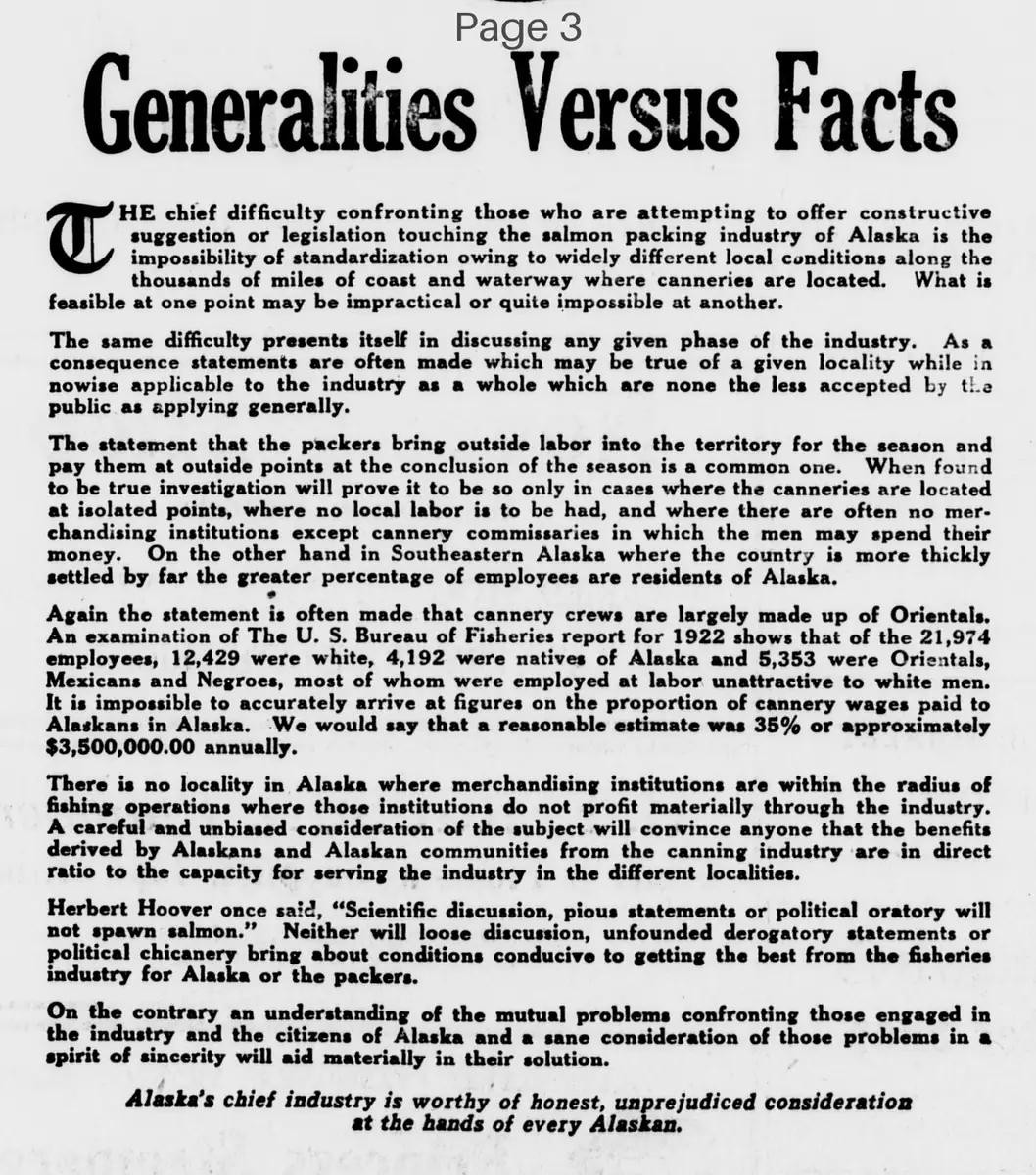
The chief difficulty confronting those who are attempting to offer constructive suggestion or legislation touching the salmon packing industry of Alaska is the impossibility of standardization owing to widely different local conditions along the thousands of miles of coast and waterway where canneries are located. What is feasible at one point may be impractical or quite impossible at another.
The same difficulty presents itself in discussing any given phase of the industry. As a consequence statements are often made which may be true of a given locality while in nowise applicable to the industry as a whole which are none the less accepted by the public as applying generally.
The statement that the packers bring outside labor into the territory for the season and pay them at outside points at the conclusion of the season is a common one. When found to be true investigation will prove it to be so only in cases where the canneries are located at isolated points, where no local labor is to be had, and where there are often no merchandising institutions except cannery commissaries in which the men may spend their money. On the other hand in Southeastern Alaska where the country is more thickly settled by far the greater percentage of employees are residents of Alaska.
Again the statement is often made that cannery crews are largely made up of Orientals. An examination of The U. S. Bureau of Fisheries report for 1922 shows that of the 21,974 employees, 12,429 were white, 4,192 were natives of Alaska and 5,353 were Orientals, Mexicans and Negroes, most of whom were employed at labor unattractive to white men.
It is impossible to accurately arrive at figures on the proportion of cannery wages paid to Alaskans in Alaska. We would say that a reasonable estimate was 35% or approximately $3,500,000.00 annually.
There is no locality in Alaska where merchandising institutions are within the radius of fishing operations where those institutions do not profit materially through the industry. A careful and unbiased consideration of the subject will convince anyone that the benefits derived by Alaskans and Alaskan communities from the canning industry are in direct ratio to the capacity for serving the industry in the different localities.
Herbert Hoover once said, "Scientific discussion, pious statements or political oratory will not spawn salmon." Neither will loose discussion, unfounded derogatory statements or political chicanery bring about conditions conducive to getting the best from the fisheries industry for Alaska or the packers.
On the contrary an understanding of the mutual problems confronting those engaged in the industry and the citizens of Alaska and a sane consideration of those problems in a spirit of sincerity will aid materially in their solution.
Alaska's chief industry is worthy of honest, unprejudiced consideration at the hands of every Alaskan.
Versus
Facts
The chief difficulty confronting those who are attempting to offer constructive suggestion or legislation touching the salmon packing industry of Alaska is the impossibility of standardization owing to widely different local conditions along the thousands of miles of coast and waterway where canneries are located. What is feasible at one point may be impractical or quite impossible at another.
The same difficulty presents itself in discussing any given phase of the industry. As a consequence statements are often made which may be true of a given locality while in nowise applicable to the industry as a whole which are none the less accepted by the public as applying generally.
The statement that the packers bring outside labor into the territory for the season and pay them at outside points at the conclusion of the season is a common one. When found to be true investigation will prove it to be so only in cases where the canneries are located at isolated points, where no local labor is to be had, and where there are often no merchandising institutions except cannery commissaries in which the men may spend their money. On the other hand in Southeastern Alaska where the country is more thickly settled by far the greater percentage of employees are residents of Alaska.
Again the statement is often made that cannery crews are largely made up of Orientals. An examination of The U. S. Bureau of Fisheries report for 1922 shows that of the 21,974 employees, 12,429 were white, 4,192 were natives of Alaska and 5,353 were Orientals, Mexicans and Negroes, most of whom were employed at labor unattractive to white men.
It is impossible to accurately arrive at figures on the proportion of cannery wages paid to Alaskans in Alaska. We would say that a reasonable estimate was 35% or approximately $3,500,000.00 annually.
There is no locality in Alaska where merchandising institutions are within the radius of fishing operations where those institutions do not profit materially through the industry. A careful and unbiased consideration of the subject will convince anyone that the benefits derived by Alaskans and Alaskan communities from the canning industry are in direct ratio to the capacity for serving the industry in the different localities.
Herbert Hoover once said, "Scientific discussion, pious statements or political oratory will not spawn salmon." Neither will loose discussion, unfounded derogatory statements or political chicanery bring about conditions conducive to getting the best from the fisheries industry for Alaska or the packers.
On the contrary an understanding of the mutual problems confronting those engaged in the industry and the citizens of Alaska and a sane consideration of those problems in a spirit of sincerity will aid materially in their solution.
Alaska's chief industry is worthy of honest, unprejudiced consideration at the hands of every Alaskan.
What sub-type of article is it?
Trade Or Commerce
Labor
Economic Policy
What keywords are associated?
Salmon Canning
Alaska Industry
Labor Practices
Employee Demographics
Economic Benefits
Fisheries Wages
Local Employment
What entities or persons were involved?
Herbert Hoover
U. S. Bureau Of Fisheries
Packers
Alaskans
Editorial Details
Primary Topic
Fair Assessment Of Alaska's Salmon Canning Industry
Stance / Tone
Advocacy For Factual And Unprejudiced Consideration
Key Figures
Herbert Hoover
U. S. Bureau Of Fisheries
Packers
Alaskans
Key Arguments
Impossibility Of Standardizing Salmon Industry Due To Diverse Local Conditions
Labor Statements Often True Only In Isolated Areas, Not Generally
In Southeastern Alaska, Most Employees Are Local Residents
1922 Data: 12,429 White, 4,192 Alaska Natives, 5,353 Others Out Of 21,974 Employees
Estimate: 35% Of Cannery Wages (~$3,500,000 Annually) Paid To Alaskans
Local Merchandising Benefits From Industry Where Accessible
Benefits To Alaskans Proportional To Local Capacity To Serve Industry
Scientific Discussion Needed Over Oratory; Quote From Herbert Hoover
Mutual Understanding And Sincerity Aid In Solving Problems