Thank you for visiting SNEWPapers!
Sign up free
Editorial
August 4, 1903
The Semi Weekly Messenger
Wilmington, New Hanover County, North Carolina
What is this article about?
The editorial critiques the fading enthusiasm for Judge Parker as a Democratic leader after his Georgia speech, doubts the viability of Hon. George Gray's candidacy, and urges the party to nominate a candidate with strong organizational and commanding abilities for the 1904 election to have a chance at victory.
Clipping
OCR Quality
95%
Excellent
Full Text
Readers in Texas.
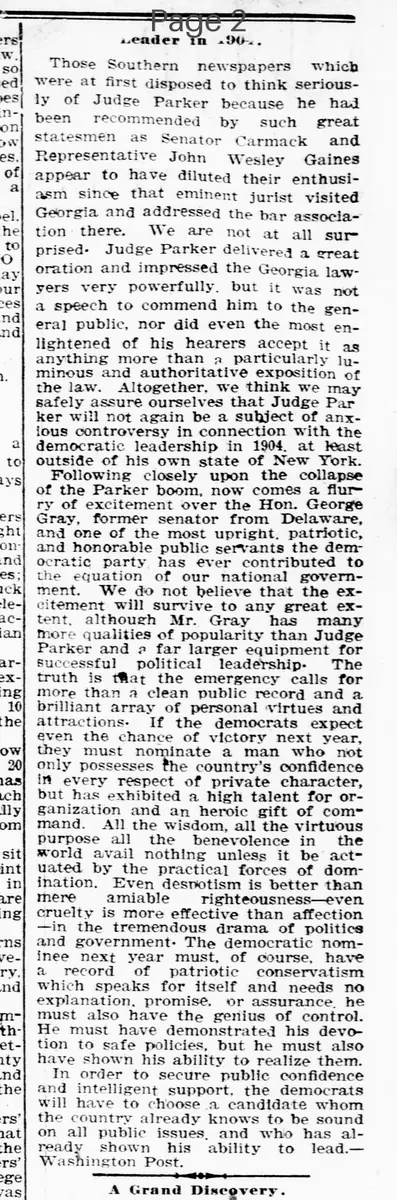
Those Southern newspapers which were at first disposed to think seriously of Judge Parker because he had been recommended by such great statesmen as Senator Carmack and Representative John Wesley Gaines appear to have diluted their enthusiasm since that eminent jurist visited Georgia and addressed the bar association there. We are not at all surprised. Judge Parker delivered a great oration and impressed the Georgia lawyers very powerfully, but it was not a speech to commend him to the general public, nor did even the most enlightened of his hearers accept it as anything more than a particularly luminous and authoritative exposition of the law. Altogether, we think we may safely assure ourselves that Judge Parker will not again be a subject of anxious controversy in connection with the democratic leadership in 1904, at least outside of his own state of New York.
Following closely upon the collapse of the Parker boom, now comes a flurry of excitement over the Hon. George Gray, former senator from Delaware, and one of the most upright, patriotic, and honorable public servants the democratic party has ever contributed to the administration of our national government. We do not believe that the excitement will survive to any great extent, although Mr. Gray has many more qualities of popularity than Judge Parker and a far larger equipment for successful political leadership. The truth is that the emergency calls for more than a clean public record and a brilliant array of personal virtues and attractions. If the democrats expect even the chance of victory next year, they must nominate a man who not only possesses the country's confidence in every respect of private character, but has exhibited a high talent for organization and an heroic gift of command. All the wisdom, all the virtuous purpose all the benevolence in the world avail nothing unless it be actuated by the practical forces of domination. Even despotism is better than mere amiable righteousness—even cruelty is more effective than affection -in the tremendous drama of politics and government. The democratic nominee next year must, of course, have a record of patriotic conservatism which speaks for itself and needs no explanation, promise, or assurance. he must also have the genius of control. He must have demonstrated his devotion to safe policies, but he must also have shown his ability to realize them. In order to secure public confidence and intelligent support, the democrats will have to choose a candidate whom the country already knows to be sound on all public issues, and who has already shown his ability to lead.—Washington Post.
Those Southern newspapers which were at first disposed to think seriously of Judge Parker because he had been recommended by such great statesmen as Senator Carmack and Representative John Wesley Gaines appear to have diluted their enthusiasm since that eminent jurist visited Georgia and addressed the bar association there. We are not at all surprised. Judge Parker delivered a great oration and impressed the Georgia lawyers very powerfully, but it was not a speech to commend him to the general public, nor did even the most enlightened of his hearers accept it as anything more than a particularly luminous and authoritative exposition of the law. Altogether, we think we may safely assure ourselves that Judge Parker will not again be a subject of anxious controversy in connection with the democratic leadership in 1904, at least outside of his own state of New York.
Following closely upon the collapse of the Parker boom, now comes a flurry of excitement over the Hon. George Gray, former senator from Delaware, and one of the most upright, patriotic, and honorable public servants the democratic party has ever contributed to the administration of our national government. We do not believe that the excitement will survive to any great extent, although Mr. Gray has many more qualities of popularity than Judge Parker and a far larger equipment for successful political leadership. The truth is that the emergency calls for more than a clean public record and a brilliant array of personal virtues and attractions. If the democrats expect even the chance of victory next year, they must nominate a man who not only possesses the country's confidence in every respect of private character, but has exhibited a high talent for organization and an heroic gift of command. All the wisdom, all the virtuous purpose all the benevolence in the world avail nothing unless it be actuated by the practical forces of domination. Even despotism is better than mere amiable righteousness—even cruelty is more effective than affection -in the tremendous drama of politics and government. The democratic nominee next year must, of course, have a record of patriotic conservatism which speaks for itself and needs no explanation, promise, or assurance. he must also have the genius of control. He must have demonstrated his devotion to safe policies, but he must also have shown his ability to realize them. In order to secure public confidence and intelligent support, the democrats will have to choose a candidate whom the country already knows to be sound on all public issues, and who has already shown his ability to lead.—Washington Post.
What sub-type of article is it?
Partisan Politics
What keywords are associated?
Democratic Nomination
1904 Election
Judge Parker
George Gray
Political Leadership
Party Strategy
What entities or persons were involved?
Judge Parker
Senator Carmack
Representative John Wesley Gaines
Hon. George Gray
Democratic Party
Georgia Bar Association
Editorial Details
Primary Topic
Democratic Leadership For 1904 Election
Stance / Tone
Critical Of Weak Candidates, Advocating For Strong Leadership
Key Figures
Judge Parker
Senator Carmack
Representative John Wesley Gaines
Hon. George Gray
Democratic Party
Georgia Bar Association
Key Arguments
Parker's Speech Impressed Lawyers But Not The Public
Parker's Boom Has Collapsed Outside New York
Gray Has Strong Qualities But Excitement Will Fade
Democrats Need A Nominee With Organization And Command Talents
Patriotic Conservatism And Genius Of Control Are Essential
Amiable Righteousness Is Insufficient For Political Victory