Thank you for visiting SNEWPapers!
Sign up free
Alexandria Daily Gazette, Commercial & Political
Alexandria, Virginia
What is this article about?
Reports from U.S. House of Representatives sessions on January 8 and 9, covering resolutions on elections, petitions, court times, naval communications, a duty bill passage, and debates on commercial intercourse with Britain and France.
Clipping
OCR Quality
Full Text
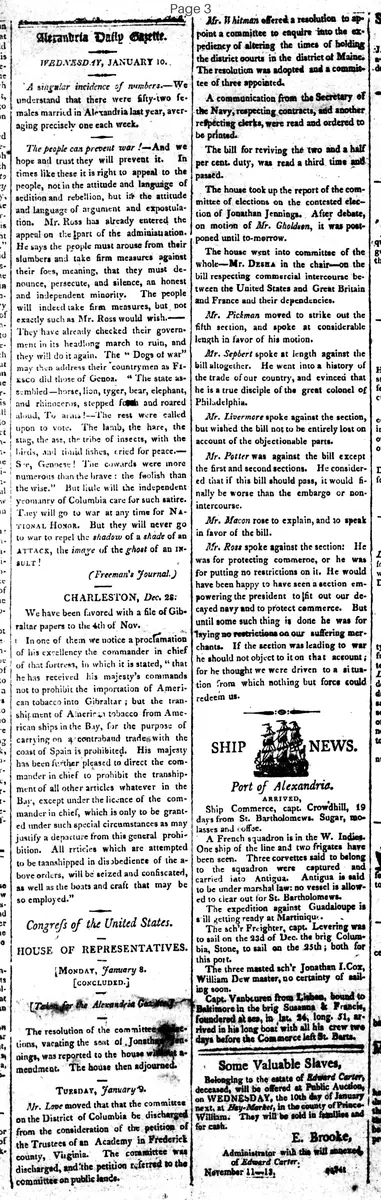
HOUSE OF REPRESENTATIVES.
(Monday, January 8.
[Concluded.]
(Taken for the Alexandria
The resolution of the committee on elections, vacating the seat of Jonathan Jennings, was reported to the house without amendment. The house then adjourned.
Tuesday, January 9.
Mr. Love moved that the committee on the District of Columbia be discharged from the consideration of the petition of the Trustees of an Academy in Frederick county, Virginia. The committee was discharged, and the petition referred to the committee on public lands.
Mr. Whitman offered a resolution to appoint a committee to enquire into the expediency of altering the times of holding the district courts in the district of Maine. The resolution was adopted and a committee of three appointed.
A communication from the Secretary of the Navy, respecting contracts, and another respecting clerks, were read and ordered to be printed.
The bill for reviving the two and a half per cent. duty, was read a third time and passed.
The house took up the report of the committee of elections on the contested election of Jonathan Jennings. After debate, on motion of Mr. Goldson, it was postponed until to-morrow.
The house went into committee of the whole Mr. Dana in the chair on the bill respecting commercial intercourse between the United States and Great Britain and France and their dependencies.
Mr. Pickman moved to strike out the fifth section, and spoke at considerable length in favor of his motion.
Mr. Sergeant spoke at length against the bill altogether. He went into a history of the trade of our country, and evinced that he is a true disciple of the great colonel of Philadelphia.
Mr. Livermore spoke against the section, but wished the bill not to be entirely lost on account of the objectionable parts.
Mr. Potter was against the bill except the first and second sections. He considered that if this bill should pass, it would finally be worse than the embargo or non-intercourse.
Mr. Macon rose to explain, and to speak in favor of the bill.
Mr. Ross spoke against the section: He was for protecting commerce, or he was for putting no restrictions on it. He would have been happy to have seen a section empowering the president to fit out our decayed navy and to protect commerce. But until some such thing is done he was for laying no restrictions on our suffering merchants. If the section was leading to war he should not object to it on that account; for he thought we were driven to a situation from which nothing but force could redeem us.
What sub-type of article is it?
What keywords are associated?
What entities or persons were involved?
Where did it happen?
Domestic News Details
Primary Location
United States House Of Representatives
Event Date
Monday, January 8; Tuesday, January 9
Key Persons
Outcome
resolution vacating jonathan jennings' seat reported without amendment; committee discharged on academy petition and referred to public lands; resolution adopted for committee on maine district courts; navy communications ordered printed; two and a half per cent duty bill passed; elections report postponed; debates on commercial intercourse bill with motions to strike sections and varied opinions expressed.
Event Details
The House concluded proceedings on January 8 with a report on vacating Jonathan Jennings' seat. On January 9, actions included discharging a committee on a Virginia academy petition, adopting a resolution for inquiring into Maine court times, reading and printing Navy communications, passing a duty revival bill, postponing an elections report, and entering committee of the whole for debates on a commercial intercourse bill where members like Pickman, Sergeant, Livermore, Potter, Macon, and Ross spoke for and against sections.