Thank you for visiting SNEWPapers!
Sign up free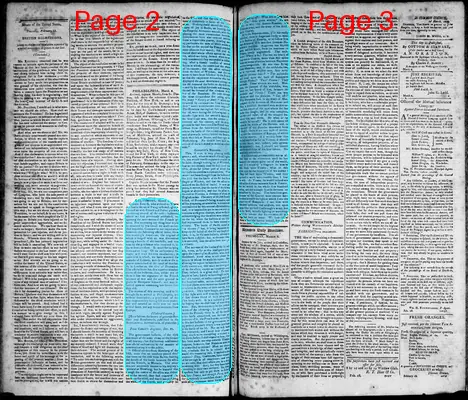
Alexandria Daily Advertiser
Alexandria, Virginia
What is this article about?
Baltimore report on delayed European war bulletins describing battles in Moravia on December 2-4, 1805, between French forces under Bonaparte and allied Russian-Austrian troops under Emperor Alexander; allies reportedly turned initial defeat into victory, recovering lost ground per British accounts, though commentator Cobbett expresses skepticism.
Merged-components note: Continuation of the foreign news article quoting Cobbett's remarks on the Napoleonic wars from page 2 to page 3.
Clippings
1 of 2
OCR Quality
Full Text
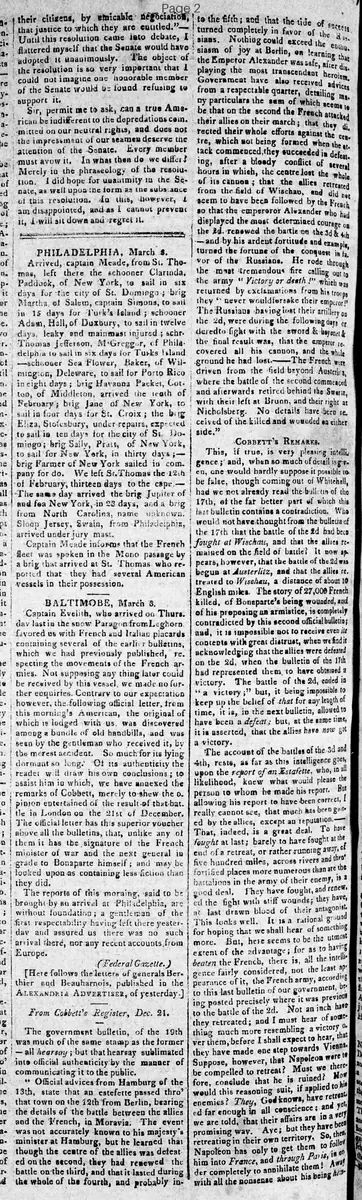
Captain Evelith, who arrived on Thursday last in the sloop Paragon from Leghorn favored us with French and Italian placards containing several of the earlier bulletins, which we had previously published, respecting the movements of the French armies. Not supposing any thing later could be received by this vessel, we made no further enquiries. Contrary to our expectation however, the following official letter, from this morning's American, the original of which is lodged with us, was discovered among a bundle of old handbills, and was seen by the gentleman who received it, by the merest accident. So much for its lying dormant so long. Of its authenticity the reader will draw his own conclusions; to assist him in which, we have annexed the remarks of Cobbett, merely to shew the opinion entertained of the result of that battle in London on the 21st of December. The official letter has this superior voucher above all the bulletins, that, unlike any of them it has the signature of the French minister of war and the next general in grade to Bonaparte himself; and may be looked upon as containing less fiction than they did.
The reports of this morning, said to be brought by an arrival at Philadelphia, are without foundation; a gentleman of the first respectability having left there yesterday and assured us there was no such arrival there, nor any recent accounts from Europe.
(Federal Gazette.)
[Here follows the letters of generals Berthier and Beauharnais, published in the ALEXANDRIA ADVERTISER, of yesterday.]
From Cobbett's Register, Dec. 21.
The government bulletin, of the 19th was much of the same stamp as the former—all hearsay; but that hearsay sublimated into official authenticity by the manner of communicating it to the public.
"Official advices from Hamburg of the 13th, state that an estafette passed through that town on the 12th from Berlin, bearing the details of the battle between the allies and the French, in Moravia. The event was not accurately known to his majesty's minister at Hamburg, but he learned that though the centre of the allies was defeated on the second, they had renewed the battle on the third, and that it lasted during the whole of the fourth, and probably into the fifth; and that the tide of success turned completely in favor of the Russians. Nothing could exceed the enthusiasm of joy at Berlin, on learning that the Emperor Alexander was safe, after displaying the most transcendent heroism. Government have also received advices from a respectable quarter, detailing many particulars the sum of which seems to be that on the second the French attacked their allies on their march; that they directed their whole efforts against the centre, which not being formed when the attack commenced, they succeeded in defeating, after a bloody conflict of several hours in which, the centre lost the whole of its cannon; that the allies retreated from the field of Wischau, and did not seem to have been followed by the French so that the emperor Alexander who had displayed the most determined courage on the 2d. renewed the battle on the 3d & 4th—and by his ardent fortitude and example, turned the fortune of the contest in favor of the Russians. He rode through the most tremendous fire calling out to the army "Victory or death!" which was returned by exclamations from his troops they "never would forsake their emperor!" The Russians having lost their artillery on the 2d, were during the following days ordered to fight with the sword & bayonet & the final result was, that the emperor recovered all his cannon, and the whole ground he had lost.—The French were driven from the field beyond Austerlitz, where the battle of the second commenced and afterwards retired behind the Swariz, with their left at Brunn, and their right at Nicholsberg. No details have been received of the killed and wounded on either side."
Cobbett's Remarks.
This, if true, is very pleasing intelligence; and, when so much of detail is given, one would hardly suppose it possible to be false, though coming out of Whitehall, had we not already read the bulletin of the 17th, of the far better part of which this last bulletin contains a contradiction. Who would not have thought from the bulletin of the 17th that the battle of the 2d had been fought at Wischau, and that the allies remained on the field of battle? It now appears, however, that the battle of the 2d was begun at Austerlitz, and that the allies retreated to Wischau, a distance of about 10 English miles. The story of 27,000 French killed, of Bonaparte's being wounded, and of his proposing an armistice, is completely contradicted by this second official bulletin; and, it is impossible not to receive even its contents with great distrust, when we find it acknowledging that the allies were defeated on the 2d, when the bulletin of the 17th had represented them to have obtained a victory. The battle of the 2d, ended in "a victory;" but, it being impossible to keep up the belief of that for any length of time, it is, in the next bulletin, allowed to have been a defeat; but, at the same time, it is asserted, that the allies have now got a victory. The account of the battles of the 3d and 4th, rests, as far as this intelligence goes, upon the report of an Estafette, who, in all likelihood, knew what would please the person to whom he made his report. But allowing his report to have been correct, I really cannot see, that much has been gained by the allies, except in reputation.—That, indeed, is a great deal. To have five hundred miles, across rivers and through end of a retreat, or rather running away, of fortified places more numerous than are the battalions in the army of their enemy, is a good deal. They have fought, and renewed the fight with stiff wounds: they have, at last drawn blood of their antagonist. This looks well. It is a rational ground for hoping that we shall hear of something more. But, here seems to be the utmost extent of the advantage: for as to having beaten the French, there is, all the intelligence fairly considered, not the least appearance of it, the French army, according to this last bulletin of our government, being posted precisely where it was previous to the battle of the 2d. Not an inch have they retreated; and I must hear of something much more resembling a victory over them, before I shall expect to hear, that they have made one step towards Vienna. Suppose, however, that Napoleon were to be compelled to retreat? Must we therefore, conclude that he is ruined? How would this reasoning suit, if applied to his enemies? They, God knows, have retreated far enough in all conscience: and yet, we are told, that their affairs are in a very promising way. Aye; but they have been retreating in their own territory. So, then, Napoleon has only to get them to follow him into France, and through Paris, in order completely to annihilate them! Awa! with all the nonsense about his being hemmed in.
Who is to hem him in and cut off? Who are to hem him to wit: the Austro-Russian, the Prussian army, and the army of the Archduke Charles. In Suabia or Bavaria, or to follow him marched, there is Augereau ready to meet. As to the Prussian army, if it has really into Bohemia, if it marches towards Napoleon, and his army, from its nearness to Napoleon's position. Augereau has 60,000 him was in Croatia, more than 200 miles from the scene of action between Napoleon and his antagonists. He was chon fying es is reported, 90,000 men, how many must his pursuer have? The archduke will come upon the back of Bonaparte through Vienna. Through Vienna! They are mad. These writers are mad. Massena, the pursuer of the archduke, was, when we last heard of him, between the archduke and Vienna! There too was Why Bonaparte had, in the army of Massena and in the division of Marmont and Ney, a hundred thousand men within seven days march of the spot where the last battle was fought, and he was complete, pay the civil ruler, of all the country be- tween him and them. By what or by whom is he cut off? He is only about 50 miles to the north of the Danube, and, to the south of the Danube westward from Hungary, there is not one inch of territory upon the continent of Europe, of which he is not master. If I were to hear that he had recoiled as far as Vienna, I should be very much, and, indeed, very agreeably surprised: but, I should not thence derive much hope of his final failure. He must stop somewhere. It is ridiculously unreasonable not to allow him to be victorious until he has haunted the enemy quite out of the world. and if it would be a disgrace to him to fall back upon Vienna; what at this time must be the reputation of his enemy! They fell back upon Vienna, and they quitted it much more readily than, I fear he will. At Vienna - he would indeed see 500 miles distance between him & France. but he would in the whole five hundred miles, see not a single hostile fortress or battalion in his way. The ferocious gentleman of the Courier must excuse me-: for this is really the light in which I see the situation of Bonaparte. I see him with 500,000 soldiers, real soldiers, not upon paper like my lord Castlereagh's army, but in the field, actually fighting or marching, and I do not see that his enemies all put together have so many. We hear talk of them before the battles indeed, but we do not see them in the battles.
What sub-type of article is it?
What keywords are associated?
What entities or persons were involved?
Where did it happen?
Foreign News Details
Primary Location
Moravia
Event Date
2nd, 3rd, And 4th December
Key Persons
Outcome
allies' center defeated on the 2nd, lost all cannon; renewed battle on 3rd and 4th, recovered all cannon and ground; french driven beyond austerlitz, retired behind swariz with left at brunn and right at nicholsberg; no details on killed and wounded.
Event Details
French attacked allied forces on march in Moravia on December 2nd, defeating their unformed center after bloody conflict and capturing cannon; allies retreated to Wischau; Emperor Alexander renewed battle on 3rd and 4th, inspiring troops to fight with sword and bayonet, turning tide in Russians' favor and recovering losses; French retreated to positions behind Swariz.