Thank you for visiting SNEWPapers!
Sign up free
Virginia Argus
Richmond, Virginia
What is this article about?
Detailed account of French invasion of Switzerland in early 1798, highlighting Bernese government's irresolution, French intrigues, key battles near Fribourg and Berne leading to Swiss defeats, government subversion, and ongoing resistance in mountainous cantons.
Clipping
OCR Quality
Full Text
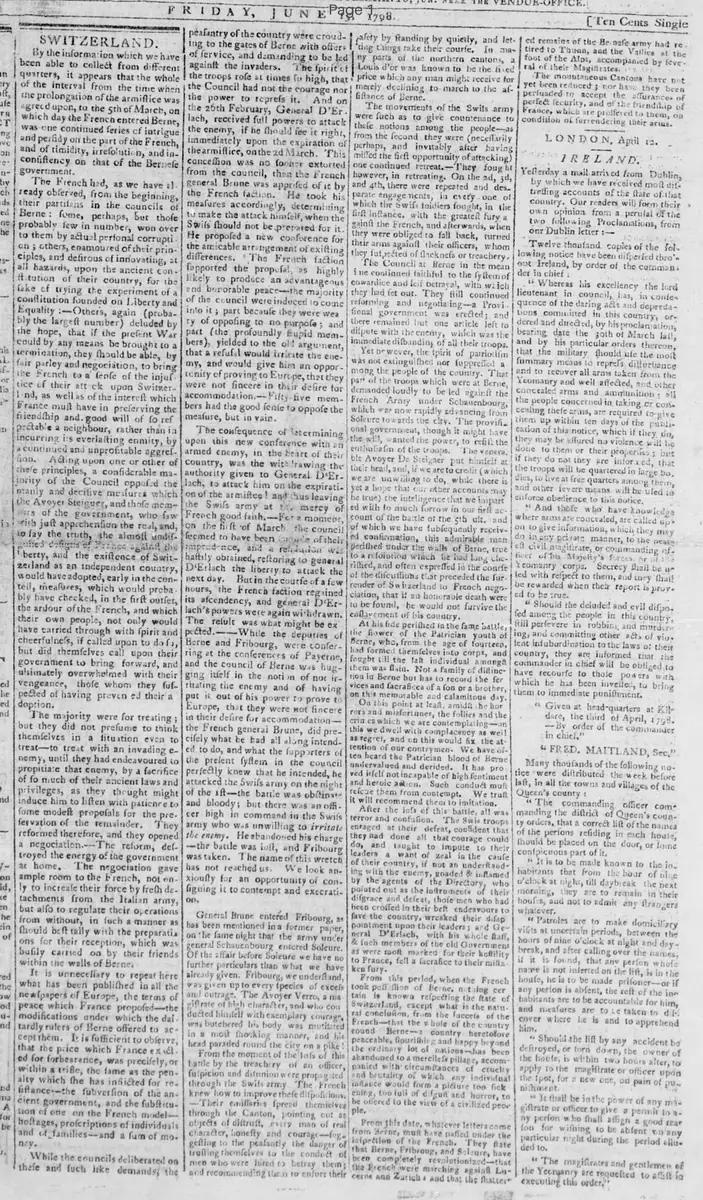
By the information which we have been able to collect from different quarters, it appears that the whole of the interval from the time when the prolongation of the armistice was agreed upon, to the 5th of March, on which day the French entered Berne, was one continued series of intrigue and perfidy on the part of the French, and of timidity, irresolution, and inconsistency on that of the Bernese government.
The French had, as we have already observed, from the beginning, their partisans in the councils of Berne: some, perhaps, but those probably few in number, won over to them by actual personal corruption; others, enamoured of their principles, and desirous of innovating, at all hazards, upon the ancient constitution of their country, for the sake of trying the experiment of a constitution founded on Liberty and Equality:—Others, again (probably the largest number) deluded by the hope, that if the present War could by any means be brought to a termination, they should be able, by fair parley and negotiation, to bring the French to a sense of the injustice of their attack upon Switzerland, as well as of the interest which France must have in preserving the friendship and good will of so respectable a neighbour, rather than in incurring its everlasting enmity, by a continued and unprofitable aggression. Acting upon one or other of these principles, a considerable majority of the Council opposed the manly and decisive measures which the Avoyer Steiger, and those members of the government, who saw with just apprehension the real, and, to say the truth, almost undisguised designs of France against the liberty, and the existence of Switzerland as an independent country, would have adopted, early in the contest, measures, which would probably have checked, in the first outset, the ardour of the French, and which their own people, not only would have carried through with spirit and cheerfulness, if called upon to do so, but did themselves call upon their government to bring forward, and ultimately overwhelmed with their vengeance, those whom they suspected of having prevented their adoption.
The majority were for treating; but they did not presume to think themselves in a situation even to treat with an invading enemy, until they had endeavoured to propitiate that enemy, by a sacrifice of so much of their ancient laws and privileges, as they thought might induce him to listen with patience to some modest proposals for the preservation of the remainder. They reformed therefore, and they opened a negotiation.—The reform, destroyed the energy of the government at home. The negotiation gave ample room to the French, not only to increase their force by fresh detachments from the Italian army, but also to regulate their operations from without, in such a manner as should best tally with the preparations for their reception, which was busily carried on by their friends within the walls of Berne.
It is unnecessary to repeat here what has been published in all the newspapers of Europe, the terms of peace which France proposed—the modifications under which the dastardly rulers of Berne offered to accept them. It is sufficient to observe, that the price which France exacted for forbearance, was precisely, or within a trifle, the same as the penalty which she has inflicted for resistance—the subversion of the ancient government, and the substitution of one on the French model—hostages, proscriptions of individuals and of families—and a sum of money.
While the councils deliberated on these and suchlike demands the peasantry of the country were crowding to the gates of Berne with offers of service, and demanding to be led against the invaders. The spirit of the troops rose at times so high, that the Council had not the courage nor the power to suppress it. And on the 26th February. General D' Erlach, received full powers to attack the enemy, if he should see it right, immediately upon the expiration of the armistice, on the 2d March. This concession was no sooner extorted from the council, than the French general Brune was apprised of it by the French faction. He took his measures accordingly, determining to make the attack himself, when the Swiss should not be prepared for it. He proposed a new conference for the amicable arrangement of existing differences. The French faction supported the proposal, as highly likely to produce an advantageous and honorable peace—the majority of the council were induced to come into it; part because they were weary of opposing to no purpose; and part (the profoundly stupid members) yielded to the old argument, that a refusal would irritate the enemy, and would give him an opportunity of proving to Europe, that they were not sincere in their desire for accommodation.—Fifty-five members had the good sense to oppose the measure, but in vain.
The consequence of determining upon this new conference with an armed enemy, in the heart of their country, was the withdrawing the authority given to General D' Erlach, to attack him on the expiration of the armistice! and thus leaving the Swiss army at the mercy of French good faith.—For a moment, on the 1st of March the council seemed to have been aware of their imprudence, and a resolution was hastily obtained, restoring to general D' Erlach the liberty to attack the next day. But in the course of a few hours, the French faction regained its ascendency, and general D' Erlach' s powers were again withdrawn.
The result was what might be expected.—While the deputies of Berne and Fribourg, were conferring at the conferences of Payerne, and the council of Berne was hugging itself in the notion of not irritating the enemy and of having put it out of his power to prove to Europe, that they were most insincere in their desire for accommodation— the French general Brune, did precisely what he had all along intended to do, and what the supporters of the present system in the council perfectly knew that he intended, he attacked the Swiss army on the night of the 1st—the battle was obstinate and bloody; but there was an officer high in command in the Swiss army who was unwilling to irritate the enemy. He abandoned his charge—the battle was lost, and Fribourg was taken. The name of this wretch has not reached us. We look anxiously for an opportunity of consigning it to contempt and execration.
General Brune entered Fribourg, as has been mentioned in a former paper, on the same night that the army under general Schauenbourg entered Soleure. Of the affair before Soleure we have no further particulars than what we have already given. Fribourg, we understand, was given up to every species of excess and outrage. The Avoyer Verro, a magistrate of high character, and who conducted himself with exemplary courage, was butchered his body was mutilated in a most shocking manner, and his head paraded round the city on a pike!
From the moment of the loss of this battle by the treachery of an officer, suspicion and dissension were propagated through the Swiss army The French knew how to improve these dispositions. Their emissaries spread themselves through the Canton, pointing out as objects of distrust, every man of real character, honesty and courage—suggesting to the peasantry the danger of trusting themselves to the conduct of men who were likely to betray them: and recommending them to ensure their safety by standing by quietly, and letting things take their course. In many parts of the northern cantons, a Louis d' or was known to be the fixed price which any man might receive for merely declining to march to the assistance of Berne.
The movements of the Swiss army were such as to give countenance to these notions among the people—as from the second they were (necessarily perhaps, and inevitably after having missed the first opportunity of attacking) one continued retreat.—They fought however, in retreating. On the 2d, 3d, and 4th, there were repeated and desperate engagements, in every one of which the Swiss soldiers fought, in the first instance, with the greatest fury against the French. and afterwards, when they were obliged to fall back, turned their arms against their officers, whom they suspected of slackness or treachery.
The Council at Berne in the mean time continued faithful to the system of cowardice and self betrayal, with which they had set out. They still continued reforming and negotiating—a Provisional government was erected; and there remained but one article left to dispute with the enemy, which was the immediate disbanding of all their troops. Yet however, the spirit of patriotism was not extinguished nor suppressed among the people of the country. That part of the troops which were at Berne, demanded loudly to be led against the French Army under Schauenbourg, which was now rapidly advancing from Soleure towards the city. The provisional government, though it might have the will, wanted the power, to resist the enthusiasm of the troops. The venerable Avoyer De Steiger put himself at their head, and, if we are to credit (which we are unwilling to do, while there is yet a hope that our other accounts may be true) the intelligence that we imparted with so much sorrow in our first account of the battle of the 5th ult. and of which we have subsequently received confirmation, this admirable man perished under the walls of Berne, true to a resolution which he had long cherished, and often expressed in the course of the discussions that preceded the surrender of Switzerland to French negotiation, that if an honorable death were to be found. he would not survive the enslavement of his country.
At his side perished in the same battle, the flower of the Patrician youth of Berne, who, from the age of fourteen, had formed themselves into corps, and fought till the last individual among them was slain. Not a family of distinction in Berne but has to record the services and sacrifices of a son or a brother, on this memorable and calamitous day.
On this point at least, amidst the horrors and misfortunes, the follies and the crimes which we are contemplating—on this we dwell with complacency as well as regret, and on this would fix the attention of our countrymen. We have often heard the Patrician blood of Berne undervalued and derided. It has proved itself not incapable of high sentiment and heroic action. Such conduct must rescue them from contempt. We trust it will recommend them to imitation.
After the loss of this battle, all was terror and confusion. The Swiss troops enraged at their defeat, confident that they had done all that courage could do, and loath to impute to their leaders a want of zeal in the cause of their country, if not an understanding with the enemy, goaded and inflamed by the agents of the Directory, who pointed out as the instruments of their disgrace and defeat, those men who had been crossed in their best endeavours to save the country, wreaked their disappointment upon their leaders: and General D' Erlach, with his whole Staff, & such members of the old Government as were most marked for their hostility to France, fell a sacrifice to their mistaken fury.
From this period, when the French took possession of Berne. but little is known respecting the state of Switzerland, except what is the natural conclusion, from the success of the French—that the whole of the country round Berne—a country heretofore peaceable, flourishing and happy beyond the ordinary lot of nations—has been abandoned to a merciless pillage, accompanied with circumstances of cruelty and brutality of which any individual instance would form a picture too sickening, too full of disgust and horror, to be offered to the view of a civilized people.
From this date, whatever letters come from Berne, must have passed under the inspection of the French. They state that Berne, Fribourg, and Soleure, have been completely revolutionized—that the French were marching against Lucerne and Zurich: and that the latter—
Ten Cents Single
ed remains of the Berne army had retired to Thun, and the Valais at the foot of the Alps, accompanied by several of their Magistrates.
The mountainous Cantons have not yet been reduced; nor have they been persuaded to accept the offers of perfect security, and of the friendship of France, which are proffered to them, on condition of surrendering their arms.
What sub-type of article is it?
What keywords are associated?
What entities or persons were involved?
Where did it happen?
Foreign News Details
Primary Location
Berne, Switzerland
Event Date
From Prolongation Of Armistice To 5th Of March
Key Persons
Outcome
swiss defeats in battles near fribourg and berne; capture of fribourg, soleure, and berne; subversion of ancient government for french model; hostages, proscriptions, monetary penalties; deaths of avoyer steiger, avoyer verro, and many patrician youth; pillage and outrages; revolution in berne, fribourg, soleure; french advances on lucerne and zurich; remnants retire to thun and valais; mountainous cantons resist
Event Details
French intrigues and Bernese government irresolution led to failed negotiations and armistice extensions. French forces under Brune attacked Swiss army on night of 1st March, winning bloody battle near Fribourg due to treachery; Fribourg captured with outrages including murder of Avoyer Verro. Schauenbourg took Soleure. Swiss retreated fighting on 2d-4th March, suspecting officers. Provisional government formed; Steiger led defense of Berne on 5th March, perishing with patrician youth. Post-battle, troops killed D' Erlach and anti-French leaders. French occupied Berne, revolutionized cantons, pillaged region; advancing on others while mountainous cantons hold out.