Thank you for visiting SNEWPapers!
Sign up free
The Daily Alaska Empire
Juneau, Juneau County, Alaska
What is this article about?
The U.S. government sold mineral rights on Depression-era bankrupt farms without notifying owners, allowing speculators and insiders to profit from oil and uranium. Senator John Williams investigated, leading to policy reversal giving farmers first rights. Examples include Michigan farmers Elmer Johnson and Paul Weiner losing out on discoveries.
Clipping
OCR Quality
Full Text
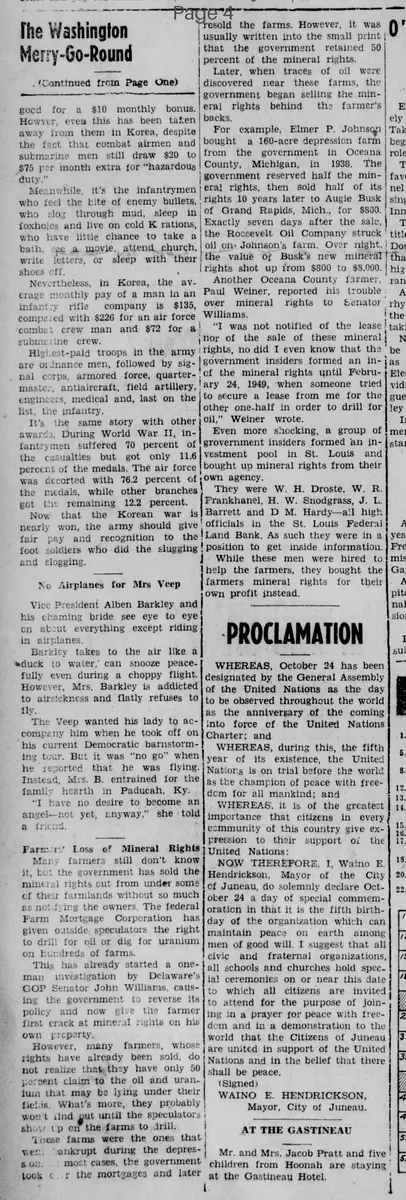
Many farmers still don't know it, but the government has sold the mineral rights out from under some of their farmlands without so much as notifying the owners. The federal Farm Mortgage Corporation has given outside speculators the right to drill for oil or dig for uranium on hundreds of farms.
This has already started a one-man investigation by Delaware's GOP Senator John Williams, causing the government to reverse its policy and now give the farmer first crack at mineral rights on his own property.
However, many farmers, whose rights have already been sold, do not realize that they have only 50 percent claim to the oil and uranium that may be lying under their fields. What's more, they probably won't find out until the speculators show up on the farms to drill.
These farms were the ones that went bankrupt during the depression. In most cases, the government took over the mortgages and later resold the farms. However, it was usually written into the small print that the government retained 50 percent of the mineral rights.
Later, when traces of oil were discovered near these farms, the government began selling the mineral rights behind the farmer's backs.
For example, Elmer P. Johnson bought a 160-acre depression farm from the government in Oceana County, Michigan, in 1938. The government reserved half the mineral rights, then sold half of its rights 10 years later to Augie Busk of Grand Rapids, Mich., for $800. Exactly seven days after the sale, the Roosevelt Oil Company struck oil on Johnson's farm. Over night, the value of Busk's new mineral rights shot up from $800 to $8,000.
Another Oceana County farmer, Paul Weiner, reported his trouble over mineral rights to Senator Williams.
"I was not notified of the lease nor of the sale of these mineral rights, nor did I even know that the government insiders formed an investment pool in St. Louis and bought up mineral rights from their own agency.
They were W. H. Droste, W. R. Frankhanel, H. W. Snodgrass, J. L Barrett and D. M. Hardy-all high officials in the St. Louis Federal Land Bank. As such they were in a position to get inside information.
While these men were hired to help the farmers, they bought the farmers' mineral rights for their own profit instead."
What sub-type of article is it?
What themes does it cover?
What keywords are associated?
What entities or persons were involved?
Where did it happen?
Story Details
Key Persons
Location
Oceana County, Michigan; St. Louis
Event Date
1930s 1949
Story Details
Government retained and sold 50% mineral rights on Depression-bankrupt farms without notice, profiting speculators and insiders after oil discoveries. Senator Williams' investigation reversed policy, but affected farmers like Johnson and Weiner lost potential wealth.