Thank you for visiting SNEWPapers!
Sign up free
Phenix Gazette
Alexandria, Virginia
What is this article about?
Extract of a 1826 letter from Paros, Greece, detailing the island's ancient history, marble quarries, partial cultivation, and a monastery visit. The traveler then sails to Smyrna (Asia Minor), describing its historical foundations, bustling bazaars, luxury goods, Turkish bath experience, and city divisions into Turk and Frank Towns.
Clipping
OCR Quality
Full Text
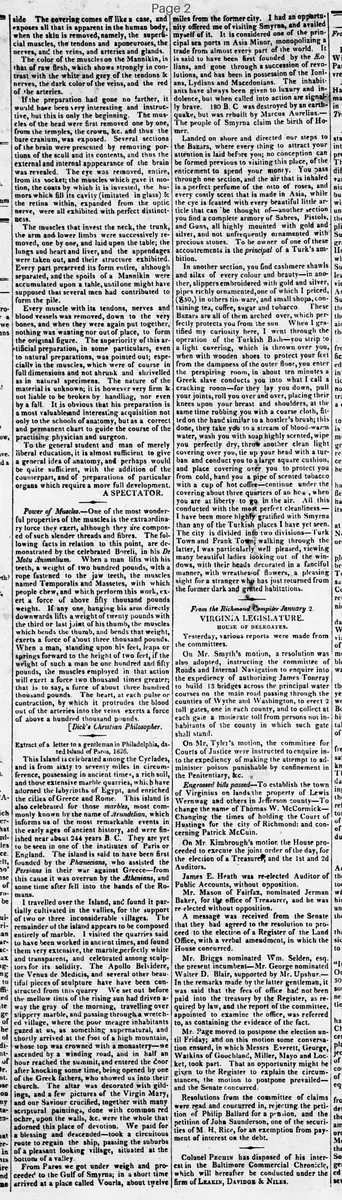
This Island is celebrated among the Cyclades, and is from sixty to seventy miles in circumference, possessing in ancient times, a rich soil, and those extensive marble quarries, which have adorned the labyrinths of Egypt, and enriched the cities of Greece and Rome. This island is also celebrated for those marbles, most commonly known by the name of Arundelian, which informs us of the most remarkable events in the early ages of ancient history, and were finished near about 244 years B. C. They are yet to be seen in one of the institutes of Paris or England. The island is said to have been first founded by the Phœnecians, who assisted the Persians in their war against Greece—from this cause it was overrun by the Athenians, and some time after fell into the hands of the Romans.
I travelled over the Island, and found it partially cultivated in the vallies, for the support of two or three inconsiderable villages. The remainder of the island appears to be composed entirely of marble. I visited the quarries said to have been worked in ancient times, and found them very extensive, the marble perfectly white and transparent, and celebrated among sculptors for its solidity. The Apollo Belvidere, the Venus de Medicis, and several other beautiful pieces of sculpture have been constructed from this quarry. We set out before the mellow tints of the rising sun had driven away the gray of the morning, travelling over slippery marble, and passing through a wretched village, where the poor meagre inhabitants gazed at us, as something supernatural, and shortly arrived at the foot of a high mountain, whose top was crowned with a monastery—we ascended by a winding road, and in half an hour reached the summit, and entered the door after knocking some time, being opened by one of the Greek fathers, who showed us into their church. The altar was decorated with gildings, and a few pictures of the Virgin Mary, and our Saviour crucified, together with many scriptural paintings, done with common red ochre, upon the walls, &c. were the whole that adorned this place of devotion. We paid for a blessing and descended—took a circuitous route to regain the ship, passing the suburbs of a pleasant looking village, situated at the bottom of a valley.
From Paros we got under weigh and proceeded to the Gulf of Smyrna; in a short time arrived at a place called Vourla, about twelve miles from the former city. I had an opportunity offered me of visiting Smyrna, and availed myself of it. It is considered one of the principal sea ports in Asia Minor, monopolizing a trade from almost every part of the world. It is said to have been first founded by the Æolians, and gone through a succession of revolutions, and has been in possession of the Ionians, Lydians and Macedonians. The inhabitants have always been given to luxury and indolence, but when called into action are signally brave. 180 B. C was destroyed by an earthquake, but was rebuilt by Marcus Aurelius.—The people of Smyrna claim the birth of Homer.
Landed on shore and directed our steps to the Bazars, where every thing to attract your attention is laid before you; no conception can be formed previous to visiting this place, of the enticement to spend your money. You pass through one section, and the air that is inhaled is a perfect perfume of the otto of roses, and every costly scent that is made in Asia, while the eye is feasted with every beautiful little article that can be thought of—another section you find a complete armory of Sabres, Pistols, and Guns, all highly mounted with gold and silver, and not unfrequently ornamented with precious stones. To be owner of one of these accoutrements is the principal of a Turk's ambition.
In another section, you find cashmere shawls and silks of every colour and beauty—in another, slippers embroidered with gold and silver, pipes richly ornamented, one of which I priced, ($50,) in others tin-ware, and small shops, containing tea, coffee, sugar and tobacco. These Bazars are all of them arched over, which perfectly protects you from the sun. When I gratified my curiosity here, I went through the operation of the Turkish Bath—you strip to a light covering, which is thrown over you, when with wooden shoes to protect your feet from the dampness of the outer floor, you enter the perspiring room, in about ten minutes a Greek slave conducts you into what I call a cracking room—for they lay you down, pull your joints, roll you over and over, placing their knees upon your breast and shoulders, at the same time rubbing you with a coarse cloth, fitted on the hand similar to a hostler's brush; this done, they take you to a stream of blood-warm water, wash you with soap highly scented, wipe you perfectly dry, throw another clean light covering over you, tie up your head with a turban and conduct you to a large square cushion, and place covering over you to protect you from cold, hand you a pipe of scented tobacco with a cup of hot coffee—continue under the covering about three quarters of an hour, when you are at liberty to go in the air. All this conducted with the most perfect cleanliness.—I have been more highly gratified with Smyrna than any of the Turkish places I have yet seen.
The city is divided into two divisions—Turk Town and Frank Town: walking through the latter, I was particularly well pleased, viewing many beautiful ladies looking out of the windows, with their heads decorated in a fanciful manner, with wreathes of flowers, a pleasing sight for a stranger who has just returned from the former dark and grated habitations.
What sub-type of article is it?
What keywords are associated?
Where did it happen?
Foreign News Details
Primary Location
Island Of Paros
Event Date
1826
Event Details
The letter describes the Island of Paros in the Cyclades, its ancient history, marble quarries used for famous sculptures, partial cultivation, and a visit to a mountaintop monastery with simple decorations. The travelers then proceed by ship to the Gulf of Smyrna, landing near Vourla and visiting Smyrna, a major port in Asia Minor with a history of revolutions and an earthquake in 180 B.C., rebuilt by Marcus Aurelius. The account details the vibrant bazaars selling perfumes, weapons, shawls, silks, and other goods; the experience of a Turkish bath; and the city's division into Turk Town and Frank Town, noting the pleasing sight of ladies in the latter.