Thank you for visiting SNEWPapers!
Sign up free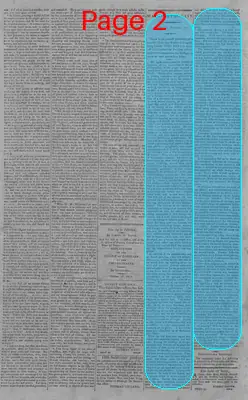
Editorial
October 17, 1803
The National Intelligencer And Washington Advertiser
Washington, District Of Columbia
What is this article about?
This editorial marks the anticipated opening of the 8th Congress on October 17, reflecting on U.S. history from independence through Constitution formation, praising republican self-government, critiquing Federalist policies, and celebrating Jefferson's Republican administration's achievements in peace, economy, and reduced taxes.
Clipping
OCR Quality
98%
Excellent
Full Text
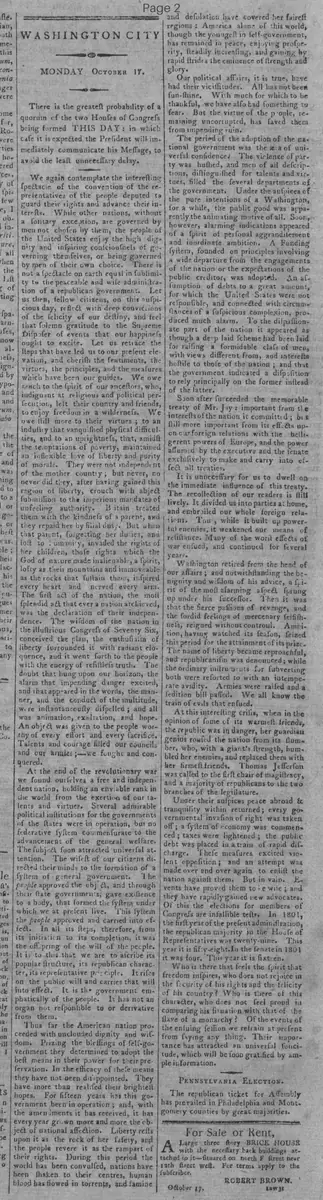
WASHINGTON CITY
MONDAY OCTOBER 17.
There is the greatest probability of a quorum of the two Houses of Congress being formed THIS DAY: in which case it is expected the President will immediately communicate his Message, to avoid the least unnecessary delay.
We again contemplate the interesting spectacle of the convention of the representatives of the people deputed to guard their rights and advance their interests. While other nations, without a solitary exception, are governed by men not chosen by them, the people of the United States enjoy the high dignity and inspiring consciousness of governing themselves, or being governed by men of their own choice. There is not a spectacle on earth equal in sublimity to the peaceable and wise administration of a republican government. Let us then, fellow citizens, on this auspicious day, reflect with deep convictions of the felicity of our destiny, and feel that solemn gratitude to the Supreme Disposer of events that our happiness ought to excite. Let us retrace the steps that have led us to our present elevation, and cherish the sentiments, the virtues, the principles, and the measures which have been our guides. We owe much to the spirit of our ancestors, who, indignant at religious and political persecution, left their country and friends to enjoy freedom in a wilderness. We owe still more to their virtues; to an industry that vanquished physical difficulties, and to an uprightness, that, amidst the temptations of poverty, maintained an inflexible love of liberty and purity of morals. They were not independent of the mother country; but never, no never did they, after having gained this region of liberty, crouch with abject submission to the imperious mandates of unfeeling authority. Britain treated them with the kindness of a parent, and they repaid her by filial duty. But when that parent, forgetting her duties, and lost to humanity, invaded the rights of her children, those rights which the God of nature made inalienable, a spirit, lofty as their mountains and immovable as the rocks that attain them, inspired every heart and nerved every arm. The first act of the nation, the most splendid act that ever a nation achieved, was the declaration of their independence. The wisdom of the nation in the illustrious Congress of Seventy Six, conceived the plan, the enthusiasm of liberty surrounded it with radiant eloquence, and it went forth to the people with the energy of restless truth. The doubt that hung upon our horizon, the alarm that impending danger excited, and that appeared in the words, the manner, and the conduct of the multitude, were instantaneously dispelled; and all was animation, exultation, and hope. An object was given to the people worthy of every effort and every sacrifice. Talents and courage filled our councils and our armies;—we fought and conquered.
At the end of the revolutionary war we found ourselves a free and independent nation, holding an enviable rank in the world from the exertion of our talents and virtues. Several admirable political institutions for the governments of the states were in operation, but no federative system commensurate to the advancement of the general welfare. The subject soon attracted universal attention. The wisest of our citizens directed their minds to the formation of a system of general government. The people approved the object, and through their state governments, gave existence to a body, that formed the system under which we at present live. This system the people approved and carried into effect. In all its steps, therefore, from its initiation to its completion, it was the offspring of the will of the people. It is to this that we are to ascribe its popular structure, its republican character, its representative principle. It rises on the public will and carries that will into effect. It is the government emphatically of the people. It has not an organ not responsible to or derivative from them.
Thus far the American nation proceeded with unclouded dignity and wisdom. Prizing the blessings of self-government they determined to adopt the best means in their power for their preservation. In the efficacy of these means they have not been disappointed. They have more than realized their brightest hopes. For fifteen years has this government been in operation; and, with the amendments it has received, it has every year grown more and more the object of national affection. Liberty rests upon it as the rock of her safety, and the people revere it as the rampart of their rights. During this period the world has been convulsed, nations have been shaken to their centres, human blood has flowed in torrents, and famine and desolation have covered her fairest regions: America alone of this world, though the youngest in self-government, has remained in peace, enjoying prosperity, steadily increasing, and gaining by rapid strides the eminence of strength and glory.
Our political affairs, it is true, have had their vicissitudes. All has not been sunshine. With much for which to be thankful, we have also had something to fear. But the virtue of the people, remaining uncorrupted, has saved them from impending ruin.
The period of the adoption of the national government was the era of universal confidence. The violence of party was hushed, and men of all descriptions, distinguished for talents and virtues, filled the several departments of the government. Under the auspices of the pure intentions of a Washington, for a while, the public good was apparently the animating motive of all. Soon, however, alarming indications appeared of a spirit of personal aggrandizement and inordinate ambition. A Funding system, founded on principles involving a wide departure from the engagements of the nation or the expectations of the public creditor, was adopted. An assumption of debts to a great amount, for which the United States were not responsible, and connected with circumstances of a suspicious complexion, produced much alarm. To the dispassionate part of the nation it appeared as though a deep laid scheme had been laid for raising a formidable class of men, with views different from, and interests hostile to those of the nation; and that the government indicated a disposition to rely principally on the former instead of the latter.
Soon after succeeded the memorable treaty of Mr. Jay: important from the interests of the nation it committed; but still more important from its effects upon our foreign relations with the belligerent powers of Europe, and the power assumed by the executive and the senate exclusively to make and carry into effect all treaties.
It is unnecessary for us to dwell on the immediate influence of this treaty. The recollection of our readers is still lively. It divided us into parties at home, and embroiled our whole foreign relations. Too, while it built up powerful enemies, it weakened our means of resistance. Many of the worst effects of war ensued, and continued for several years.
Washington retired from the head of our affairs: and notwithstanding the benignity and wisdom of his advice, a spirit of the most alarming aspect sprung up under his successor. Then it was that the fierce passions of revenge, and the sordid feelings of mercenary selfishness, reigned without control. Ambition, having watched its season, seized this period for the attainment of its prize. The name of liberty became reproachful, and republicanism was denounced; while the ordinary instruments for subverting both were resorted to with an intemperate avidity. Armies were raised and a sedition bill passed. We all know the train of evils that ensued.
At this interesting crisis, when in the opinion of some of its warmest friends, the republic was in danger, her guardian genius roused the nation from its slumber, who, with a giant's strength, humbled her enemies, and replaced them with her firmest friends. Thomas Jefferson was called to the first chair of magistracy, and a majority of republicans to the two branches of the legislature.
Under their auspices peace abroad & tranquility within returned; every governmental invasion of right was taken off; a system of economy was commenced; taxes were lightened; the public debt was placed in a train of rapid discharge. These measures excited violent opposition; and an attempt was made over and over again to enlist the nation against them. But in vain. Events have proved them to be wise; and they have rapidly gained new advocates. Of this the elections for members of Congress are infallible tests. In 1801, the first year of the present administration, the republican majority in the House of Representatives was twenty-nine. This year it is fifty-eight. In the senate in 1801 it was four, This year it is sixteen.
Who is there that feels the spirit that freedom inspires, who does not rejoice in the security of his rights and the felicity of his country? Who is there of this character, who does not feel proud in comparing his situation with that of the slave of a monarchy? Of the events of the ensuing session we refrain at present from saying any thing. Their importance has attracted an universal solicitude, which will be soon gratified by ample information.
MONDAY OCTOBER 17.
There is the greatest probability of a quorum of the two Houses of Congress being formed THIS DAY: in which case it is expected the President will immediately communicate his Message, to avoid the least unnecessary delay.
We again contemplate the interesting spectacle of the convention of the representatives of the people deputed to guard their rights and advance their interests. While other nations, without a solitary exception, are governed by men not chosen by them, the people of the United States enjoy the high dignity and inspiring consciousness of governing themselves, or being governed by men of their own choice. There is not a spectacle on earth equal in sublimity to the peaceable and wise administration of a republican government. Let us then, fellow citizens, on this auspicious day, reflect with deep convictions of the felicity of our destiny, and feel that solemn gratitude to the Supreme Disposer of events that our happiness ought to excite. Let us retrace the steps that have led us to our present elevation, and cherish the sentiments, the virtues, the principles, and the measures which have been our guides. We owe much to the spirit of our ancestors, who, indignant at religious and political persecution, left their country and friends to enjoy freedom in a wilderness. We owe still more to their virtues; to an industry that vanquished physical difficulties, and to an uprightness, that, amidst the temptations of poverty, maintained an inflexible love of liberty and purity of morals. They were not independent of the mother country; but never, no never did they, after having gained this region of liberty, crouch with abject submission to the imperious mandates of unfeeling authority. Britain treated them with the kindness of a parent, and they repaid her by filial duty. But when that parent, forgetting her duties, and lost to humanity, invaded the rights of her children, those rights which the God of nature made inalienable, a spirit, lofty as their mountains and immovable as the rocks that attain them, inspired every heart and nerved every arm. The first act of the nation, the most splendid act that ever a nation achieved, was the declaration of their independence. The wisdom of the nation in the illustrious Congress of Seventy Six, conceived the plan, the enthusiasm of liberty surrounded it with radiant eloquence, and it went forth to the people with the energy of restless truth. The doubt that hung upon our horizon, the alarm that impending danger excited, and that appeared in the words, the manner, and the conduct of the multitude, were instantaneously dispelled; and all was animation, exultation, and hope. An object was given to the people worthy of every effort and every sacrifice. Talents and courage filled our councils and our armies;—we fought and conquered.
At the end of the revolutionary war we found ourselves a free and independent nation, holding an enviable rank in the world from the exertion of our talents and virtues. Several admirable political institutions for the governments of the states were in operation, but no federative system commensurate to the advancement of the general welfare. The subject soon attracted universal attention. The wisest of our citizens directed their minds to the formation of a system of general government. The people approved the object, and through their state governments, gave existence to a body, that formed the system under which we at present live. This system the people approved and carried into effect. In all its steps, therefore, from its initiation to its completion, it was the offspring of the will of the people. It is to this that we are to ascribe its popular structure, its republican character, its representative principle. It rises on the public will and carries that will into effect. It is the government emphatically of the people. It has not an organ not responsible to or derivative from them.
Thus far the American nation proceeded with unclouded dignity and wisdom. Prizing the blessings of self-government they determined to adopt the best means in their power for their preservation. In the efficacy of these means they have not been disappointed. They have more than realized their brightest hopes. For fifteen years has this government been in operation; and, with the amendments it has received, it has every year grown more and more the object of national affection. Liberty rests upon it as the rock of her safety, and the people revere it as the rampart of their rights. During this period the world has been convulsed, nations have been shaken to their centres, human blood has flowed in torrents, and famine and desolation have covered her fairest regions: America alone of this world, though the youngest in self-government, has remained in peace, enjoying prosperity, steadily increasing, and gaining by rapid strides the eminence of strength and glory.
Our political affairs, it is true, have had their vicissitudes. All has not been sunshine. With much for which to be thankful, we have also had something to fear. But the virtue of the people, remaining uncorrupted, has saved them from impending ruin.
The period of the adoption of the national government was the era of universal confidence. The violence of party was hushed, and men of all descriptions, distinguished for talents and virtues, filled the several departments of the government. Under the auspices of the pure intentions of a Washington, for a while, the public good was apparently the animating motive of all. Soon, however, alarming indications appeared of a spirit of personal aggrandizement and inordinate ambition. A Funding system, founded on principles involving a wide departure from the engagements of the nation or the expectations of the public creditor, was adopted. An assumption of debts to a great amount, for which the United States were not responsible, and connected with circumstances of a suspicious complexion, produced much alarm. To the dispassionate part of the nation it appeared as though a deep laid scheme had been laid for raising a formidable class of men, with views different from, and interests hostile to those of the nation; and that the government indicated a disposition to rely principally on the former instead of the latter.
Soon after succeeded the memorable treaty of Mr. Jay: important from the interests of the nation it committed; but still more important from its effects upon our foreign relations with the belligerent powers of Europe, and the power assumed by the executive and the senate exclusively to make and carry into effect all treaties.
It is unnecessary for us to dwell on the immediate influence of this treaty. The recollection of our readers is still lively. It divided us into parties at home, and embroiled our whole foreign relations. Too, while it built up powerful enemies, it weakened our means of resistance. Many of the worst effects of war ensued, and continued for several years.
Washington retired from the head of our affairs: and notwithstanding the benignity and wisdom of his advice, a spirit of the most alarming aspect sprung up under his successor. Then it was that the fierce passions of revenge, and the sordid feelings of mercenary selfishness, reigned without control. Ambition, having watched its season, seized this period for the attainment of its prize. The name of liberty became reproachful, and republicanism was denounced; while the ordinary instruments for subverting both were resorted to with an intemperate avidity. Armies were raised and a sedition bill passed. We all know the train of evils that ensued.
At this interesting crisis, when in the opinion of some of its warmest friends, the republic was in danger, her guardian genius roused the nation from its slumber, who, with a giant's strength, humbled her enemies, and replaced them with her firmest friends. Thomas Jefferson was called to the first chair of magistracy, and a majority of republicans to the two branches of the legislature.
Under their auspices peace abroad & tranquility within returned; every governmental invasion of right was taken off; a system of economy was commenced; taxes were lightened; the public debt was placed in a train of rapid discharge. These measures excited violent opposition; and an attempt was made over and over again to enlist the nation against them. But in vain. Events have proved them to be wise; and they have rapidly gained new advocates. Of this the elections for members of Congress are infallible tests. In 1801, the first year of the present administration, the republican majority in the House of Representatives was twenty-nine. This year it is fifty-eight. In the senate in 1801 it was four, This year it is sixteen.
Who is there that feels the spirit that freedom inspires, who does not rejoice in the security of his rights and the felicity of his country? Who is there of this character, who does not feel proud in comparing his situation with that of the slave of a monarchy? Of the events of the ensuing session we refrain at present from saying any thing. Their importance has attracted an universal solicitude, which will be soon gratified by ample information.
What sub-type of article is it?
Constitutional
Partisan Politics
Moral Or Religious
What keywords are associated?
Republican Government
Self Government
American Independence
Jefferson Administration
Constitutional Formation
Partisan Elections
Federalist Policies
National Prosperity
What entities or persons were involved?
Congress
President
Washington
Thomas Jefferson
Congress Of Seventy Six
Mr. Jay
Republicans
Federalists
Editorial Details
Primary Topic
Celebration Of Republican Self Government And Jefferson's Administration
Stance / Tone
Patriotic Exaltation And Pro Republican Advocacy
Key Figures
Congress
President
Washington
Thomas Jefferson
Congress Of Seventy Six
Mr. Jay
Republicans
Federalists
Key Arguments
American Independence Was A Splendid Act Achieved Through Wisdom And Enthusiasm.
The Constitution Was Formed By The Will Of The People, Embodying Republican Principles.
The U.S. Government Has Succeeded For Fifteen Years, Maintaining Peace Amid Global Turmoil.
Federalist Policies Like The Funding System And Jay Treaty Led To Division And Alarm.
Under Jefferson, Peace Returned, Taxes Lightened, And Debt Reduced, Gaining Public Support.
Republican Majorities In Congress Have Grown From 1801 To The Present Year.