Thank you for visiting SNEWPapers!
Sign up free
Story
February 22, 1832
Republican Herald
Providence, Providence County, Rhode Island
What is this article about?
Report from 1830 on the ferocious Fer de lance viper in the West Indies, detailing its aggressive behavior and an incident where Mr. Moreau de Joanes encounters one, and a bitten negro captures it for superstitious cure.
Clipping
OCR Quality
98%
Excellent
Full Text
THE HORSE AND VIPER.
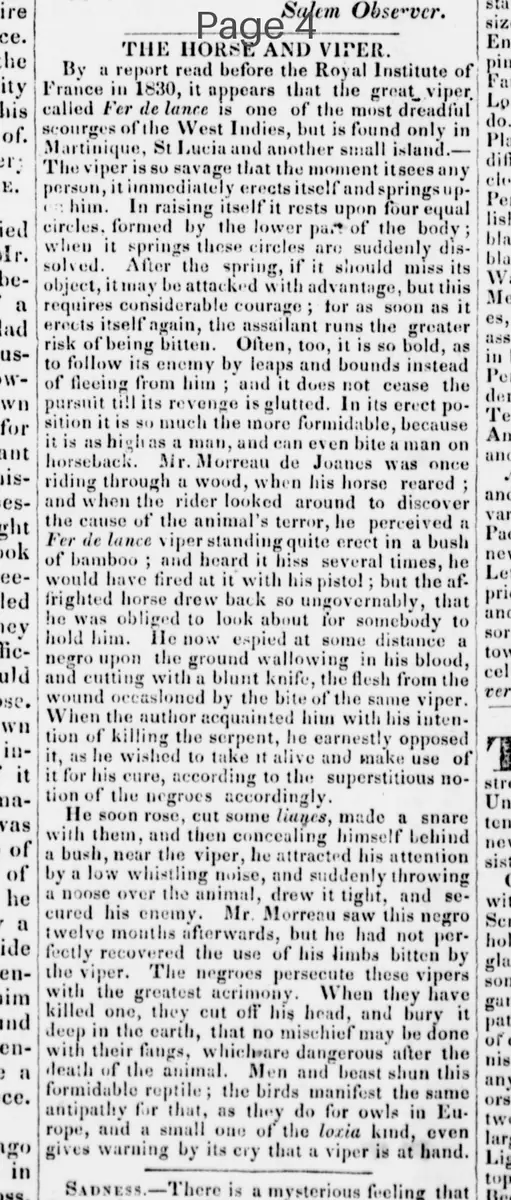
By a report read before the Royal Institute of France in 1830, it appears that the great viper called Fer de lance is one of the most dreadful scourges of the West Indies, but is found only in Martinique, St Lucia and another small island.— The viper is so savage that the moment it sees any person, it immediately erects itself and springs upon him. In raising itself it rests upon four equal circles, formed by the lower part of the body: when it springs these circles are suddenly dissolved. After the spring, if it should miss its object, it may be attacked with advantage, but this requires considerable courage; for as soon as it erects itself again, the assailant runs the greater risk of being bitten. Often, too, it is so bold, as to follow its enemy by leaps and bounds instead of fleeing from him; and it does not cease the pursuit till its revenge is glutted. In its erect position it is so much the more formidable, because it is as high as a man, and can even bite a man on horseback. Mr. Moreau de Joanes was once riding through a wood, when his horse reared: and when the rider looked around to discover the cause of the animal's terror, he perceived a Fer de lance viper standing quite erect in a bush of bamboo; and heard it hiss several times, he would have fired at it with his pistol; but the affrighted horse drew back so ungovernably, that he was obliged to look about for somebody to hold him. It now espied at some distance a negro upon the ground wallowing in his blood. and cutting with a blunt knife, the flesh from the wound occasioned by the bite of the same viper. When the author acquainted him with his intention of killing the serpent, he earnestly opposed it, as he wished to take it alive and make use of it for his cure, according to the superstitious notion of the negroes accordingly. He soon rose, cut some lianes, made a snare with them, and then concealing himself behind a bush, near the viper, he attracted his attention by a low whistling noise, and suddenly throwing a noose over the animal, drew it tight. and secured his enemy. Mr. Moreau saw this negro twelve months afterwards, but he had not perfectly recovered the use of his limbs bitten by the viper. The negroes persecute these vipers with the greatest acrimony. When they have killed one, they cut off his head, and bury it deep in the earth, that no mischief may be done with their fangs, which are dangerous after the death of the animal. Men and beast shun this formidable reptile: the birds manifest the same antipathy for that, as they do for owls in Europe, and a small one of the loxia kind, even gives warning by its cry that a viper is at hand.
By a report read before the Royal Institute of France in 1830, it appears that the great viper called Fer de lance is one of the most dreadful scourges of the West Indies, but is found only in Martinique, St Lucia and another small island.— The viper is so savage that the moment it sees any person, it immediately erects itself and springs upon him. In raising itself it rests upon four equal circles, formed by the lower part of the body: when it springs these circles are suddenly dissolved. After the spring, if it should miss its object, it may be attacked with advantage, but this requires considerable courage; for as soon as it erects itself again, the assailant runs the greater risk of being bitten. Often, too, it is so bold, as to follow its enemy by leaps and bounds instead of fleeing from him; and it does not cease the pursuit till its revenge is glutted. In its erect position it is so much the more formidable, because it is as high as a man, and can even bite a man on horseback. Mr. Moreau de Joanes was once riding through a wood, when his horse reared: and when the rider looked around to discover the cause of the animal's terror, he perceived a Fer de lance viper standing quite erect in a bush of bamboo; and heard it hiss several times, he would have fired at it with his pistol; but the affrighted horse drew back so ungovernably, that he was obliged to look about for somebody to hold him. It now espied at some distance a negro upon the ground wallowing in his blood. and cutting with a blunt knife, the flesh from the wound occasioned by the bite of the same viper. When the author acquainted him with his intention of killing the serpent, he earnestly opposed it, as he wished to take it alive and make use of it for his cure, according to the superstitious notion of the negroes accordingly. He soon rose, cut some lianes, made a snare with them, and then concealing himself behind a bush, near the viper, he attracted his attention by a low whistling noise, and suddenly throwing a noose over the animal, drew it tight. and secured his enemy. Mr. Moreau saw this negro twelve months afterwards, but he had not perfectly recovered the use of his limbs bitten by the viper. The negroes persecute these vipers with the greatest acrimony. When they have killed one, they cut off his head, and bury it deep in the earth, that no mischief may be done with their fangs, which are dangerous after the death of the animal. Men and beast shun this formidable reptile: the birds manifest the same antipathy for that, as they do for owls in Europe, and a small one of the loxia kind, even gives warning by its cry that a viper is at hand.
What sub-type of article is it?
Animal Story
Curiosity
Extraordinary Event
What themes does it cover?
Nature
Survival
Bravery Heroism
What keywords are associated?
Fer De Lance Viper
West Indies
Snake Attack
Negro Capture
Superstitious Cure
Animal Behavior
What entities or persons were involved?
Mr. Moreau De Joanes
Negro
Where did it happen?
West Indies (Martinique, St Lucia, Another Small Island); Wood With Bamboo Bush
Story Details
Key Persons
Mr. Moreau De Joanes
Negro
Location
West Indies (Martinique, St Lucia, Another Small Island); Wood With Bamboo Bush
Event Date
1830
Story Details
Description of the savage Fer de lance viper's behavior and habitat; Mr. Moreau's horse startles at viper, nearby negro bitten by it captures viper alive for cure using snare despite injury; negroes' practices against vipers.