Thank you for visiting SNEWPapers!
Sign up free
Letter to Editor
September 11, 1844
The North Carolina Standard
Raleigh, Wake County, North Carolina
What is this article about?
Letter to the North Carolina Standard editor criticizing Mr. Loring of 'The Independent' for shifting from Democratic to Whig politics without explanation, highlighting contradictions in his past attacks on William A. Graham and support for a National Bank versus his current endorsements.
Clipping
OCR Quality
98%
Excellent
Full Text
For the North Carolina Standard.
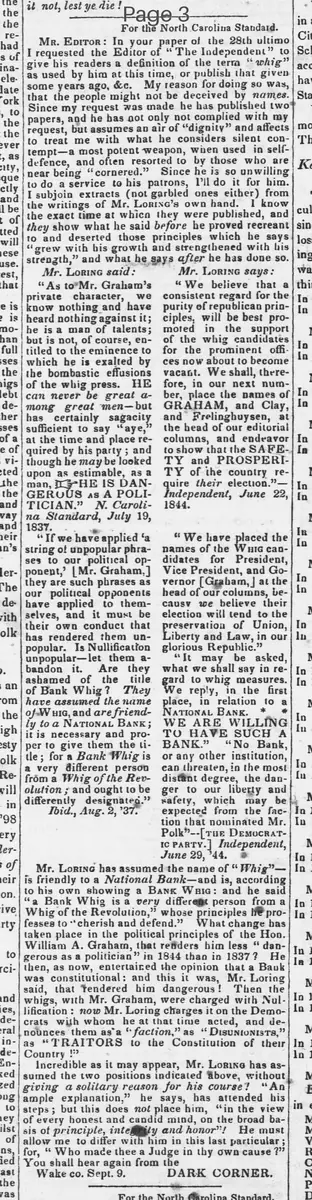
Mr. Editor: In your paper of the 28th ultimo I requested the Editor of "The Independent" to give his readers a definition of the term "whig" as used by him at this time, or publish that given some years ago, &c. My reason for doing so was, that the people might not be deceived by names. Since my request was made he has published two papers, and he has not only not complied with my request, but assumes an air of "dignity" and affects to treat me with what he considers silent contempt—a most potent weapon, when used in self-defence, and often resorted to by those who are near being "cornered." Since he is so unwilling to do a service to his patrons, I'll do it for him. I subjoin extracts (not garbled ones either) from the writings of Mr. Loring's own hand. I know the exact time at which they were published, and they show what he said before he proved recreant to and deserted those principles which he says "grew with his growth and strengthened with his strength," and what he says after he has done so.
"As to Mr. Graham's private character, we know nothing and have heard nothing against it; he is a man of talents; but is not, of course, entitled to the eminence to which he is exalted by the bombastic effusions of the whig press. HE can never be great among great men—but has certainly sagacity sufficient to say "aye," at the time and place required by his party; and though he may be looked upon as estimable, as a man, HE IS DANGEROUS AS A POLITICIAN." N. Carolina Standard, July 19, 1837.
"If we have applied 'a string of unpopular phrases to our political opponent, Mr. Graham,' they are such phrases as our political opponents have applied to themselves, and it must be their own conduct that has rendered them unpopular. Is Nullification unpopular—let them abandon it. Are they ashamed of the title of Bank Whig? They have assumed the name of Whig, and are friendly to a National Bank; it is necessary and proper to give them the title; for a Bank Whig is a very different person from a Whig of the Revolution; and ought to be differently designated." Ibid., Aug. 2. '37.
"We believe that a consistent regard for the purity of republican principles, will be best promoted in the support of the whig candidates for the prominent offices now about to become vacant. We shall, therefore, in our next number, place the names of GRAHAM, and Clay, and Frelinghuysen, at the head of our editorial columns, and endeavor to show that the SAFETY and PROSPERITY of the country require their election." Independent, June 22, 1844.
"We have placed the names of the Whig candidates for President, Vice President, and Governor [Graham], at the head of our columns, because we believe their election will tend to the preservation of Union, Liberty and Law, in our glorious Republic."
"It may be asked, what we shall say in regard to whig measures. We reply, in the first place, in relation to a NATIONAL BANK. WE ARE WILLING TO HAVE SUCH A BANK."
"No Bank, or any other institution, can threaten, in the most distant degree, the danger to our liberty and safety, which may be expected from the faction that nominated Mr. Polk"—[The Democratic Party.] Independent, June 29, '44.
Mr. Loring has assumed the name of "Whig"—is friendly to a National Bank—and is, according to his own showing a Bank Whig: and he said "a Bank Whig is a very different person from a Whig of the Revolution," whose principles he professes to "cherish and defend." What change has taken place in the political principles of the Hon. William A. Graham, that renders him less "dangerous as a politician" in 1844 than in 1837? He then, as now, entertained the opinion that a Bank was constitutional: and this it was, Mr. Loring said, that rendered him dangerous! Then the whigs, with Mr. Graham, were charged with Nullification: now Mr. Loring charges it on the Democrats with whom he at that time acted, and denounces them as a "faction," as Disunionists, as "TRAITORS to the Constitution of their Country."
Incredible as it may appear, Mr. Loring has assumed the two positions indicated above, without giving a solitary reason for his course? "An ample explanation," he says, has attended his steps; but this does not place him, "in the view of every honest and candid mind, on the broad basis of principle, integrity and honor":! He must allow me to differ with him in this last particular: for, "Who made thee a Judge in thy own cause?"
You shall hear again from the Wake Co. Sept. 9.
DARK CORNER.
Mr. Editor: In your paper of the 28th ultimo I requested the Editor of "The Independent" to give his readers a definition of the term "whig" as used by him at this time, or publish that given some years ago, &c. My reason for doing so was, that the people might not be deceived by names. Since my request was made he has published two papers, and he has not only not complied with my request, but assumes an air of "dignity" and affects to treat me with what he considers silent contempt—a most potent weapon, when used in self-defence, and often resorted to by those who are near being "cornered." Since he is so unwilling to do a service to his patrons, I'll do it for him. I subjoin extracts (not garbled ones either) from the writings of Mr. Loring's own hand. I know the exact time at which they were published, and they show what he said before he proved recreant to and deserted those principles which he says "grew with his growth and strengthened with his strength," and what he says after he has done so.
"As to Mr. Graham's private character, we know nothing and have heard nothing against it; he is a man of talents; but is not, of course, entitled to the eminence to which he is exalted by the bombastic effusions of the whig press. HE can never be great among great men—but has certainly sagacity sufficient to say "aye," at the time and place required by his party; and though he may be looked upon as estimable, as a man, HE IS DANGEROUS AS A POLITICIAN." N. Carolina Standard, July 19, 1837.
"If we have applied 'a string of unpopular phrases to our political opponent, Mr. Graham,' they are such phrases as our political opponents have applied to themselves, and it must be their own conduct that has rendered them unpopular. Is Nullification unpopular—let them abandon it. Are they ashamed of the title of Bank Whig? They have assumed the name of Whig, and are friendly to a National Bank; it is necessary and proper to give them the title; for a Bank Whig is a very different person from a Whig of the Revolution; and ought to be differently designated." Ibid., Aug. 2. '37.
"We believe that a consistent regard for the purity of republican principles, will be best promoted in the support of the whig candidates for the prominent offices now about to become vacant. We shall, therefore, in our next number, place the names of GRAHAM, and Clay, and Frelinghuysen, at the head of our editorial columns, and endeavor to show that the SAFETY and PROSPERITY of the country require their election." Independent, June 22, 1844.
"We have placed the names of the Whig candidates for President, Vice President, and Governor [Graham], at the head of our columns, because we believe their election will tend to the preservation of Union, Liberty and Law, in our glorious Republic."
"It may be asked, what we shall say in regard to whig measures. We reply, in the first place, in relation to a NATIONAL BANK. WE ARE WILLING TO HAVE SUCH A BANK."
"No Bank, or any other institution, can threaten, in the most distant degree, the danger to our liberty and safety, which may be expected from the faction that nominated Mr. Polk"—[The Democratic Party.] Independent, June 29, '44.
Mr. Loring has assumed the name of "Whig"—is friendly to a National Bank—and is, according to his own showing a Bank Whig: and he said "a Bank Whig is a very different person from a Whig of the Revolution," whose principles he professes to "cherish and defend." What change has taken place in the political principles of the Hon. William A. Graham, that renders him less "dangerous as a politician" in 1844 than in 1837? He then, as now, entertained the opinion that a Bank was constitutional: and this it was, Mr. Loring said, that rendered him dangerous! Then the whigs, with Mr. Graham, were charged with Nullification: now Mr. Loring charges it on the Democrats with whom he at that time acted, and denounces them as a "faction," as Disunionists, as "TRAITORS to the Constitution of their Country."
Incredible as it may appear, Mr. Loring has assumed the two positions indicated above, without giving a solitary reason for his course? "An ample explanation," he says, has attended his steps; but this does not place him, "in the view of every honest and candid mind, on the broad basis of principle, integrity and honor":! He must allow me to differ with him in this last particular: for, "Who made thee a Judge in thy own cause?"
You shall hear again from the Wake Co. Sept. 9.
DARK CORNER.
What sub-type of article is it?
Persuasive
Political
Provocative
What themes does it cover?
Politics
Economic Policy
Constitutional Rights
What keywords are associated?
Whig Principles
National Bank
William A Graham
Political Hypocrisy
Nullification
Party Switch
Loring Editor
What entities or persons were involved?
Dark Corner.
Mr. Editor
Letter to Editor Details
Author
Dark Corner.
Recipient
Mr. Editor
Main Argument
mr. loring hypocritically switched from democratic to whig allegiance without justification, contradicting his earlier condemnations of william a. graham as a dangerous bank whig and now endorsing him and a national bank while accusing democrats of nullification and disunion.
Notable Details
Extracts From Loring's 1837 Writings In N. Carolina Standard Criticizing Graham And Whigs
Loring's 1844 Endorsements In Independent Supporting Graham, Clay, Frelinghuysen, And A National Bank
Contrast Between 'Bank Whig' And 'Whig Of The Revolution'
Accusations Of Silent Contempt And Self Justification