Thank you for visiting SNEWPapers!
Sign up free
Story
December 5, 1877
The Central Presbyterian
Richmond, Virginia
What is this article about?
A church address urges renewed support for foreign missions amid financial shortages and labor needs. Highlights past successes, conversions in eight languages, and calls for $75,000 to sustain work in India, China, Africa, and beyond, emphasizing divine approval and moral duty.
Clipping
OCR Quality
98%
Excellent
Full Text
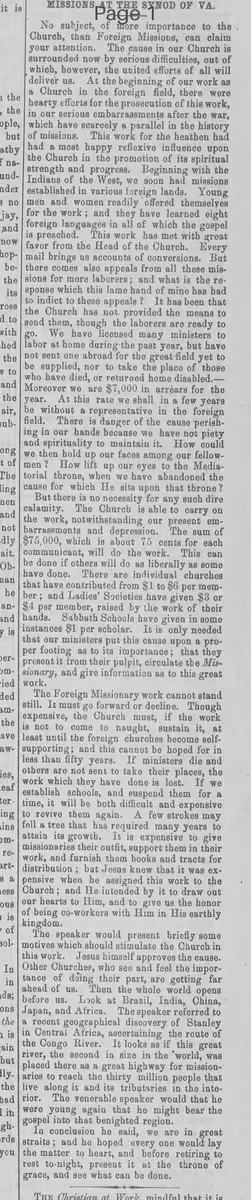
No subject, of more importance to the Church, than Foreign Missions, can claim your attention. The cause in our Church is surrounded now by serious difficulties, out of which, however, the united efforts of all will deliver us. At the beginning of our work as a Church in the foreign field, there were hearty efforts for the prosecution of this work, in our serious embarrassments after the war, which have scarcely a parallel in the history of missions. This work for the heathen had had a most happy reflexive influence upon the Church in the promotion of its spiritual strength and progress. Beginning with the Indians of the West, we soon had missions established in various foreign lands. Young men and women readily offered themselves for the work; and they have learned eight foreign languages in all of which the gospel is preached. This work has met with great favor from the Head of the Church. Every mail brings us accounts of conversions. But there comes also appeals from all these missions for more laborers: and what is the response which this lame hand of mine has had to indite to these appeals? It has been that the Church has not provided the means to send them, though the laborers are ready to go. We have licensed many ministers to labor at home during the past year, but have not sent one abroad for the great field yet to be supplied, nor to take the place of those who have died, or returned home disabled.— Moreover we are $7,000 in arrears for the year. At this rate we shall in a few years be without a representative in the foreign field. There is danger of the cause perishing in our hands because we have not piety and spirituality to maintain it. How could we then hold up our faces among our fellow-men? How lift up our eyes to the Mediatorial throne, when we have abandoned the cause for which He sits upon that throne?
But there is no necessity for any such dire calamity. The Church is able to carry on the work, notwithstanding our present embarrassments and depression. The sum of $75,000, which is about 75 cents for each communicant, will do the work. This can be done if others will do as liberally as some have done. There are individual churches that have contributed from $1 to $6 per member: and Ladies' Societies have given $3 or $4 per member, raised by the work of their hands. Sabbath Schools have given in some instances $1 per scholar. It is only needed that our ministers put this cause upon a proper footing as to its importance; that they present it from their pulpit, circulate the Missionary, and give information as to this great work.
The Foreign Missionary work cannot stand still. It must go forward or decline. Though expensive, the Church must, if the work is not to come to naught, sustain it, at least until the foreign churches become self-supporting; and this cannot be hoped for in less than fifty years. If ministers die and others are not sent to take their places, the work which they have done is lost. If we establish schools, and suspend them for a time, it will be both difficult and expensive to revive them again. A few strokes may fell a tree that has required many years to attain its growth. It is expensive to give missionaries their outfit, support them in their work, and furnish them books and tracts for distribution; but Jesus knew that it was expensive when he assigned this work to the Church; and He intended by it to draw out our hearts to Him, and to give us the honor of being co-workers with Him in His earthly kingdom.
The speaker would present briefly some motives which should stimulate the Church in this work. Jesus himself approves the cause. Other Churches, who see and feel the importance of doing their part, are getting far ahead of us. Then the whole world opens before us. Look at Brazil, India, China, Japan, and Africa. The speaker referred to a recent geographical discovery of Stanley in Central Africa, ascertaining the route of the Congo River. It looks as if this great river, the second in size in the world, was placed there as a great highway for missionaries to reach the thirty million people that live along it and its tributaries in the interior. The venerable speaker wished that he were young again that he might bear the gospel into that benighted region.
In conclusion he said, we are in great straits; and he hoped every one would lay the matter to heart, and before retiring to rest to-night, present it at the throne of grace, and see what can be done.
But there is no necessity for any such dire calamity. The Church is able to carry on the work, notwithstanding our present embarrassments and depression. The sum of $75,000, which is about 75 cents for each communicant, will do the work. This can be done if others will do as liberally as some have done. There are individual churches that have contributed from $1 to $6 per member: and Ladies' Societies have given $3 or $4 per member, raised by the work of their hands. Sabbath Schools have given in some instances $1 per scholar. It is only needed that our ministers put this cause upon a proper footing as to its importance; that they present it from their pulpit, circulate the Missionary, and give information as to this great work.
The Foreign Missionary work cannot stand still. It must go forward or decline. Though expensive, the Church must, if the work is not to come to naught, sustain it, at least until the foreign churches become self-supporting; and this cannot be hoped for in less than fifty years. If ministers die and others are not sent to take their places, the work which they have done is lost. If we establish schools, and suspend them for a time, it will be both difficult and expensive to revive them again. A few strokes may fell a tree that has required many years to attain its growth. It is expensive to give missionaries their outfit, support them in their work, and furnish them books and tracts for distribution; but Jesus knew that it was expensive when he assigned this work to the Church; and He intended by it to draw out our hearts to Him, and to give us the honor of being co-workers with Him in His earthly kingdom.
The speaker would present briefly some motives which should stimulate the Church in this work. Jesus himself approves the cause. Other Churches, who see and feel the importance of doing their part, are getting far ahead of us. Then the whole world opens before us. Look at Brazil, India, China, Japan, and Africa. The speaker referred to a recent geographical discovery of Stanley in Central Africa, ascertaining the route of the Congo River. It looks as if this great river, the second in size in the world, was placed there as a great highway for missionaries to reach the thirty million people that live along it and its tributaries in the interior. The venerable speaker wished that he were young again that he might bear the gospel into that benighted region.
In conclusion he said, we are in great straits; and he hoped every one would lay the matter to heart, and before retiring to rest to-night, present it at the throne of grace, and see what can be done.
What sub-type of article is it?
Historical Event
Journey
What themes does it cover?
Providence Divine
Moral Virtue
Exploration
What keywords are associated?
Foreign Missions
Church Finances
Missionary Laborers
Conversions
Central Africa
Congo River
Spiritual Duty
What entities or persons were involved?
Jesus
Stanley
The Speaker
Where did it happen?
Brazil, India, China, Japan, Africa, Central Africa
Story Details
Key Persons
Jesus
Stanley
The Speaker
Location
Brazil, India, China, Japan, Africa, Central Africa
Story Details
A church speaker addresses the crisis in foreign missions, noting past successes starting with Western Indians, conversions in eight languages, but current $7,000 arrears and lack of new laborers. Urges $75,000 funding and highlights opportunities in newly discovered Congo River region.