Thank you for visiting SNEWPapers!
Sign up free
The Hillsborough Recorder
Hillsboro, Orange County, North Carolina
What is this article about?
Biographical sketch of Andrew Jackson, born 1767 in South Carolina to Irish farmers. Orphaned young, fought in Revolutionary War, studied law in Tennessee, rose to Major General, defeated Creeks and British at New Orleans in 1815, governed Florida, served as U.S. President 1829-1837, died at the Hermitage.
Clipping
OCR Quality
Full Text
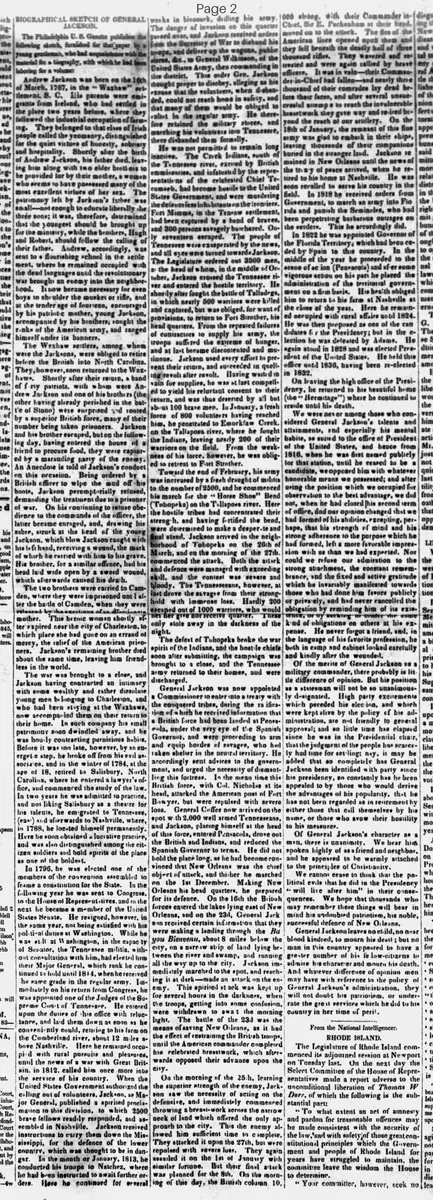
The Philadelphia U. S. Gazette publishes the following sketch, furnished for that paper by a young gentleman, who had acquaintance with the material facts of a biography, with which he had been laboring for a volume:
Andrew Jackson was born on the 15th of March, 1767, in the "Waxhaw" settlement, S. C. His parents were emigrants from Ireland, who had settled in the place two years before, where they followed the industrious occupation of farming. They belonged to that class of Irish people called the yeomanry, distinguished for the quiet virtues of honesty, sobriety and hospitality. Shortly after the birth of Andrew Jackson, his father died, leaving him along with two elder brothers to be provided for by their mother, a woman who seems to have possessed many of the most excellent virtues of her sex. The patrimony left by Jackson's father was small—not enough to educate liberally the three sons; it was, therefore, determined that the youngest should be brought up for the ministry, while the brothers, Hugh and Robert, should follow the calling of their father. Andrew, accordingly, was sent to a flourishing school in the settlement, where he remained occupied with the dead languages until the revolutionary war brought an enemy into the neighborhood. It now became necessary for even boys to shoulder the musket or rifle, and at the tender age of thirteen, encouraged by his patriotic mother, young Jackson, accompanied by his brothers, fought the ranks of the American army, and ranged himself under its banners.
The Waxhaw settlers, among whom were the Jacksons, were obliged to retire before the British into North Carolina. They, however, soon returned to the Waxhaw. Shortly after their return, a band of fiery patriots, with whom were Andrew Jackson and one of his brothers (the other having already perished in the battle of Stono) were surprised and routed by a superior British force, many of their number being taken prisoners. Jackson and his brother escaped, but on the following day, having entered the house of a friend to procure food, they were captured by a marauding party of the enemy.
An Anecdote is told of Jackson's conduct on this occasion. Being ordered by a British officer to wipe the mud off his boots, Jackson peremptorily refused, demanding the treatment due to a prisoner of war. On his continuing to refuse obedience to the commands of the officer, the latter became enraged, and, drawing his sabre, struck at the head of the young Jackson, which blow Jackson caught with his left hand, receiving a wound, the mark of which he carried with him to his grave. His brother, for a similar offence, had his head laid wide open by a sword wound, which afterwards caused his death.
The two brothers were carried to Camden, where they were imprisoned until after the battle of Camden, when they were released by the exertions of a purchasing mother. This heroic woman shortly after expired near the city of Charleston, to which place she had gone on an errand of mercy, the relief of the American prisoners. Jackson's remaining brother died about the same time, leaving him friendless in the world.
The war was brought to a close, and Jackson having contracted an intimacy with some wealthy and rather dissolute young men belonging to Charleston, and who had been staying at the Waxhaw, now accompanied them on their return to their home. In such company his small patrimony soon dwindled away, and he was hourly contracting pernicious habits. Before it was too late, however, by an energetic step, he broke off from his evil associates, and in the winter of 1784, at the age of 17, retired to Salisbury, North Carolina, where he entered a lawyer's office, and commenced the study of the law. In two years he was admitted to practice, and not liking Salisbury as a theatre for his talents, he emigrated to Tennessee, (east) and afterwards to Nashville, where, in 1788, he located himself permanently.
Here he soon obtained a lucrative practice, and was also distinguished among the citizen soldiers and bold spirits of the place as one of the boldest. In 1796, he was elected one of the members of the convention assembled to frame a constitution for the State. In the following year he was sent to Congress, to the House of Representatives, and in the next he became a member of the United States Senate. He resigned, however, in the same year, not being satisfied with his political duties at Washington. While he was still at Washington, in the capacity of Senator, the Tennessee militia, without consultation with him, had elected him their Major General, which rank he continued to hold until 1814, when he received the same grade in the regular army.
Immediately on his return from Congress, he was appointed one of the Judges of the Supreme Court of Tennessee. He entered upon the duties of his office with reluctance, and laid them down as soon as he conveniently could, retiring to his farm on the Cumberland river, about 12 miles above Nashville. Here he remained occupied with rural pursuits and pleasures, until the news of a war with Great Britain, in 1812, called him once more into the service of his country. When the United States Government authorized the calling out of volunteers, Jackson, as Major General, published a spirited proclamation to his division, to which 2500 brave fellows readily responded, and assembled in Nashville. Jackson received instructions to carry them down the Mississippi, for the defence of the lower country, which was thought to be in danger. In the month of January, 1813, he conducted his troops to Natchez, where he had been instructed to await further orders. Here he continued for several weeks in bivouack, drilling his army. The danger of invasion on this quarter passed over, and Jackson received orders from the Secretary of War to disband his troops, and deliver up the wagons, public stores, &c., to General Wilkinson, of the United States Army, then commanding in this district. This order Gen. Jackson thought proper to disobey, alleging as his excuse that the volunteers, when disbanded, could not reach home in safety, and that many of them would be obliged to enlist in the regular army. He therefore retained the military stores, and marching his volunteers into Tennessee, there disbanded them formally.
He was not permitted to remain long inactive. The Creek Indians, south of the Tennessee river, excited by British emissaries, and infatuated by the representations of the celebrated Chief Tecumseh, had become hostile to the United States Government, and were murdering the defenceless inhabitants on the frontier. Fort Mims, in the Tensaw settlement, had been captured by a band of braves, and 300 persons savagely butchered. Only seventeen escaped. The people of Tennessee were exasperated by the news, and all eyes were turned towards Jackson. The Legislature ordered out 3500 men, at the head of whom, in the middle of October, Jackson crossed the Tennessee river and entered the hostile territory. He shortly after fought the battle of Talladega, in which nearly 500 warriors were killed and captured, but was obliged, for want of provisions, to return to Fort Strother, his head quarters. From the repeated failures of contractors to supply his army, the troops suffered the extreme of hunger, and at last became discontented and mutinous. Jackson used every effort to prevent their return, and succeeded in quelling revolt after revolt. Having waited in vain for supplies, he was at last compelled to yield his reluctant consent to their return, and was thus deserted by all but about 100 brave men. In January, a fresh force of 800 volunteers having reached him, he penetrated to Emuckfaw Creek, on the Tallapoosa river, where he fought the Indians, leaving nearly 200 of their warriors on the field. From the weakness of his force, however, he was obliged to retreat to Fort Strother.
Toward the end of February, his army was increased by a fresh draught of militia to the number of 2500, and he commenced his march for the "Horse Shoe" Bend (Tohopeka) on the Tallapoosa river. Here the hostile tribes had concentrated their strength, and having fortified the bend, were determined to make a desperate and final stand. Jackson arrived in the neighborhood of Tohopeka on the 26th of March, and on the morning of the 27th commenced the attack. Both the attack and defence were managed with exceeding skill, and the contest was severe and bloody. The Tennesseeans, however, at last drove the savages from their strong hold with immense loss. Hardly 200 escaped out of 1000 warriors, who would neither give nor receive quarter. These only stole away in the darkness of the night.
The defeat of Tohopeka broke the war spirit of the Indians, and the hostile chiefs soon after submitting, the campaign was brought to a close, and the Tennessee army returned to their homes, and were discharged.
General Jackson was now appointed a Commissioner to enter into a treaty with the conquered tribes, during the ratification of which he received information that a British force had been landed at Pensacola, under the very eye of the Spanish Governor, and were proceeding to arm and equip hordes of savages, who had taken shelter in the neutral territory. He accordingly sent advices to the government, and urged the necessity of dismantling this fortress. In the mean time the British force, with Col. Nicholls at its head, attacked the American post of Fort Bowyer, but were repulsed with severe loss. General Coffee now arrived on the spot with 2,000 well armed Tennesseans, and Jackson, placing himself at the head of this force, entered Pensacola, drove out the British and Indians, and reduced the Spanish Governor to terms. He did not hold the place long, as he had become convinced that New Orleans was the chief object of attack, and thither he marched on the 1st December. Making New Orleans his head quarters, he prepared for its defence. On the 16th the British forces entered the lakes lying east of New Orleans, and on the 23d, General Jackson received certain information that they were making a landing through the Bayou Bienvenu, about 8 miles below the city, on a narrow strip of land lying between the river and swamp, and running all the way up to the city. Jackson immediately marched to the spot, and reaching it at dark—made an attack on the enemy. This spirited attack was kept up for several hours in the darkness, when the troops, getting into some confusion, were withdrawn to await the morning light. The battle of the 23d was the means of saving New Orleans, as it had the effect of restraining the British troops, until the American commander completed his celebrated breastwork, which afterwards opposed their advance upon the city.
On the morning of the 25th, learning the superior strength of the enemy, Jackson saw the necessity of acting on the defensive, and immediately commenced throwing a breast-work across the narrow neck of land which offered the only approach to the city. This the enemy allowed him sufficient time to complete. They attacked it upon the 27th, but were repulsed with severe loss. They again assailed it on the 1st of January with similar fortune. But their final attack was planned for the 8th. On the morning of this day, the British column, 10,000 strong, with their Commander-in-Chief, Sir E. Pakenham at their head, moved on to the attack. The fire of the American line poured upon them and they fell beneath the deadly hail of three thousand rifles. They wavered and retreated and were again rallied by brave officers. It was in vain—their Commander-in-Chief had fallen—and nearly three thousand of their comrades lay dead before their faces, and after several unsuccessful attempts to reach the invulnerable breastwork they gave way and retired beyond the reach of our artillery. On the 18th of January, the remnant of this fine army was glad to embark in their ships, leaving thousands of their companions buried in the strange land. Jackson remained in New Orleans until the news of the treaty of peace arrived, when he retired to his home at Nashville. He was soon recalled to serve his country in the field. In 1818 he received orders from Government, to march an army into Florida and punish the Seminoles, who had been perpetrating barbarous outrages on the settlers. This he accordingly did.
In 1821 he was appointed Governor of the Florida Territory, which had been ceded by Spain to this country. In the middle of the year he proceeded to the scene of action (Pensacola) and after some vigorous action on his part he placed the administration of the territorial government on a firm basis. His health obliged him to return to his farm at Nashville at the close of the year. Here he remained occupied with rural affairs until 1824. He was then proposed as one of the candidates for the Presidency: but in the election he was defeated by Adams. He again stood in 1828 and was elected President of the United States. He held this office until 1836, having been re-elected in 1832.
On leaving the high office of the Presidency, he returned to his beautiful home (the "Hermitage") where he continued to reside until his death.
We were never among those who considered General Jackson's talents and attainments, and especially his mental habits, so suited to the office of President of the United States, and hence from 1824, when he was first named publicly for that station, until he ceased to be a candidate, we opposed him with whatever honorable means we possessed; and after using the position which we occupied for observation to the best advantage, we did not, when he had closed his second term of office, find our opinion changed that we had formed of his abilities, excepting, perhaps, that his strength of mind and his strong adherence to the purpose which he had formed, left a more favorable impression with us than we had expected. Nor could we refuse our admiration to the strong attachment, the constant remembrance, and the fixed and active gratitude which he invariably manifested toward those who had done him favors publicly or privately, and had never cancelled the obligation by reminding him of its existence or kind of obligations on others at his expense. He never forgot a friend, and, in the language of his favorite profession, he both in camp and cabinet looked carefully and kindly after the wounded.
Of the merits of General Jackson as a military commander, there probably is little difference of opinion. But his position as a statesman will not be so unanimously designated. High party excitements which preceded his election, and which were kept alive by the policy of his administration, are not friendly to general approval; and so little time has elapsed since he was in the Presidential chair, that the judgment of the people has scarcely had time for settling; nay, it may be added that so completely has General Jackson been identified with party since his presidency, so constantly has he been appealed to by those who would derive the advantages of his popularity, that he has not been regarded as in retirement by either those that call themselves by his name, or those who avow their hostility to his measures.
Of General Jackson's character as a man, there is unanimity. We hear him spoken highly of as a friend and neighbor, and he appeared to be warmly attached to the principles of Christianity.
We cannot cease to think that the political evils that he did in the Presidency "will live after him" in their consequences. We hope that thousands who may remember these things will bear in mind his undoubted patriotism, his noble, successful defence of New Orleans.
General Jackson leaves no child, no near blood kindred, to mourn his death; but no man in this country appeared to have a greater number of his fellow-citizens to admire his character and mourn his death. And whatever difference of opinion men may have with reference to the policy of General Jackson's administration, they will not doubt his patriotism, or underrate the great services which he did to his Country in her time of peril.
What sub-type of article is it?
What themes does it cover?
What keywords are associated?
What entities or persons were involved?
Where did it happen?
Story Details
Key Persons
Location
Waxhaw Settlement S. C., North Carolina, Tennessee, Nashville, New Orleans, Florida
Event Date
1767 To 1836
Story Details
Born 1767 in South Carolina to Irish immigrants, orphaned young after Revolutionary War service where captured and wounded; studied law, settled in Tennessee 1788, became lawyer, judge, senator; Major General in War of 1812, defeated Creeks at Horseshoe Bend 1814, British at New Orleans 1815; Governor of Florida 1821, U.S. President 1829-1837; retired to Hermitage until death.