Thank you for visiting SNEWPapers!
Sign up free
The Nome Nugget
Nome, Nome County, Alaska
What is this article about?
In a Tokyo interview, WWII Japanese submarine commander Meiji Tagami recounts plane-carrying subs raiding US West Coast from Alaska to California, including forest fire bombs in Oregon as Doolittle raid retaliation and shelling Fort Stevens. Claims sinking a cruiser; historian Morison contextualizes limited impact and later supply role. (248 characters)
Merged-components note: Merged continuation of Japanese submarines story
Clippings
1 of 2
OCR Quality
Full Text
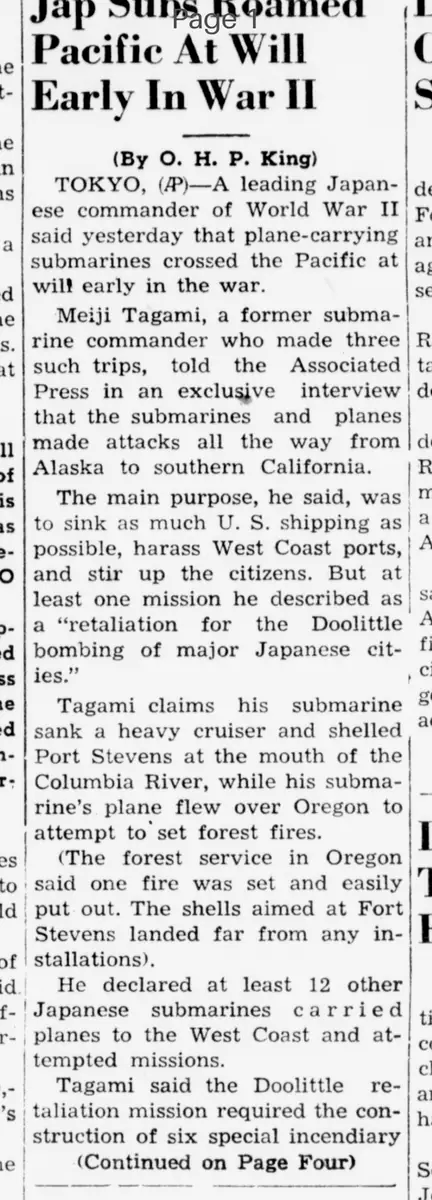
(By O. H. P. King)
TOKYO, (AP)-A leading Japanese commander of World War II said yesterday that plane-carrying submarines crossed the Pacific at will early in the war.
Meiji Tagami, a former submarine commander who made three such trips, told the Associated Press in an exclusive interview that the submarines and planes made attacks all the way from Alaska to southern California.
The main purpose, he said, was to sink as much U. S. shipping as possible, harass West Coast ports, and stir up the citizens. But at least one mission he described as a "retaliation for the Doolittle bombing of major Japanese cities."
Tagami claims his submarine sank a heavy cruiser and shelled Fort Stevens at the mouth of the Columbia River, while his submarine's plane flew over Oregon to attempt to set forest fires.
(The forest service in Oregon said one fire was set and easily put out. The shells aimed at Fort Stevens landed far from any installations).
He declared at least 12 other Japanese submarines carried planes to the West Coast and attempted missions.
Tagami said the Doolittle retaliation mission required the construction of six special incendiary bombs.
(Continued on Page Four)
Jap Subs Roamed
Pacific At Will
(Continued from Page One)
Rear Adm. Fumio Shimizu then chief of naval ordnance who acted as interpreter at the interview, said the bombs were made at his order.
On Aug. 15, 1942, four months after the Doolittle raid, Tagami's I-25 submarine left Yokohama on its third mission to the United States.
The submarine surfaced seven miles from the Oregon coast Sept. 15 and catapulted a plane piloted by Sgt. Nobuo Fujita. Fujita reported he dropped four of the six bombs and was sure two started fires.
Tagami said on the return voyage an American submarine was torpedoed and sunk in the Aleutians. Another submarine sighted him and fired on the I-25 with machinegun bullets. He said it was the only time in six crossings that enemy warcraft were encountered.
Tagami related that the cruiser which he says he sank was encountered later between the Japanese naval base of Truk and the New Hebrides.
Tagami did not say why Japanese submarine activity on the West Coast dwindled less than a year after war began, but navy historian Samuel Eliot Morison did.
Morison, now in Japan, told the Associated Press the Japanese army insisted the submarines be brought closer home to supply island outposts as the United States began its Pacific comeback.
"As our island-hopping campaign advanced more and more Morison said, "Japanese submarines became mere provisions carriers."
Morison showed interest in Tagami's story and related two incidents which the Japanese did not mention or was unaware of.
Morison said a plane from a Japanese submarine scouted Puget Sound and flew over Seattle about May 28, 1942. Another submarine-launched plane scouted Pearl Harbor in October of 1943.
Tagami said his and four other submarines were outside Pearl Harbor the morning of the attack on Dec. 7, 1941, that plunged the United States into war.
Morison discounted the value of the plane-carrying submarines as a military weapon.
He said the cumbersome, cylindrical hangar on the deck hindered the submarine's maneuverability.
The Japanese, however, had a program for building 18 huge submarines each capable of carrying three planes, and had three finished when the war ended.
What sub-type of article is it?
What themes does it cover?
What keywords are associated?
What entities or persons were involved?
Where did it happen?
Story Details
Key Persons
Location
Pacific Ocean, Us West Coast, Oregon, Tokyo
Event Date
World War Ii, 1941 1943
Story Details
Japanese submarine commander Meiji Tagami describes plane-carrying submarines crossing the Pacific to attack US shipping and ports from Alaska to California, including retaliation for the Doolittle raid by dropping incendiary bombs over Oregon forests and shelling Fort Stevens. He claims sinking a US cruiser and other missions, though some effects were minimal. Historian Morison notes Japanese submarines later used for supply and discounts their military value.