Thank you for visiting SNEWPapers!
Sign up free
Editorial
December 10, 1861
Newbern Weekly Progress
New Bern, Craven County, North Carolina
What is this article about?
An 1861 editorial harshly criticizes President Lincoln for violating his oath and international law by ordering the capture of Confederate envoys Mason and Slidell from a British ship, quoting Northern Democratic and Republican papers urging the U.S. to disavow the act and release them to avert war with Britain.
Clipping
OCR Quality
95%
Excellent
Full Text
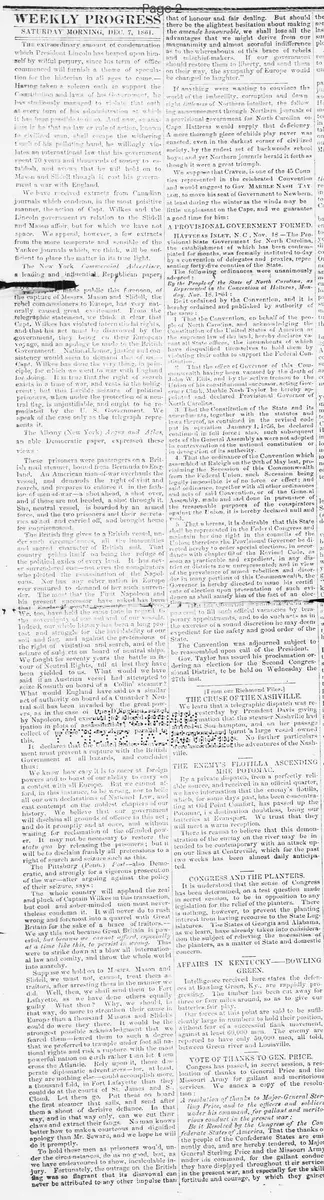
WEEKLY PROGRESS
SATURDAY MORNING, DEC. 7, 1861.
The extraordinary amount of condemnation which President Lincoln has heaped upon himself by wilful perjury, since his term of office commenced, will furnish a theme of speculation for the historian in all ages to come. Having taken a solemn oath to support the Constitution and laws of his Government, he has studiously managed to violate that oath at every turn of his administration at which it has been possible to do so. And now, so anxious is he that no law or rule of action, known to civilized men, shall escape the withering touch of his polluting hand, he willingly violates an international law that his government spent 70 years and thousands of money to establish, and avows that he will hold on to Mason and Slidell though it cost his government a war with England.
We have received extracts from Canadian journals which condemn, in the most positive manner, the action of Capt. Wilkes and the Lincoln government in relation to the Slidell and Mason affair, but for which we have not space.
We append, however, a few extracts from the more temperate and sensible of the Yankee journals which, we think, will be sufficient to place the matter in its true light.
The New York Commercial Advertiser, a leading and influential Republican paper, reports made public this forenoon, of the capture of Messrs. Mason and Slidell, the rebel commissioners to Europe, has very naturally caused great excitement. From the telegraphic statement, we think it clear that Capt. Wilkes has violated international rights, and that his act must be disavowed by the government, they being on their European voyage, and an apology be made to the British Government. National honor, justice and consistency would seem to demand this of us.
Capt. Wilkes has done the very thing, in principle, for which we went to war with England for doing. It is true that the right of search exists in a time of war, and vests in the belligerent; but this forcible seizure of political prisoners, when under the protection of a neutral flag, is unjustifiable, and ought to be repudiated by the U. S. Government. We speak of the case only as the telegraph represents it.
The Albany (New York) Argus and Atlas, an able Democratic paper, expressed these views:
These prisoners were passengers on a British mail steamer, bound from Bermuda to England. An American man-of-war overhauls the vessel, and demands the right of visit and search, and prepares to enforce it in the fashion of men-of-war—a shot ahead, a shot over, and if those are not heeded, a shot through it. She, neutral vessel, is boarded by an armed force, and the two prisoners and their secretaries seized and carried off, and brought home for imprisonment.
The British flag gives to a British vessel, under such circumstances, all the immunities and sacred character of British soil. That country prides itself on being the refuge of the political exiles of every land. It has never surrendered one—not even the conspirators who plotted the assassination of the Napoleons. Nor has any other nation in Europe ever ventured to demand of her such surrender. The most that the First Napoleon and his present successor have asked has been
We, too, have held the same tone in regard to the sovereignty of our soil and of our vessels. Indeed, our whole history has been a long protest and struggle for the inviolability of our soil and flag, and against the pretensions of the right of visitation and search, and of the seizure of subjects on board of neutral ships. We fought for seventy years the battle in favour of Neutral Rights, till at last they have been yielded to us. What would we have said if an Austrian vessel had attempted to seize Kossuth on board of a Collins steamer? What would England have said to a similar act of authority on board of a Cunarder? Neutral soil has been invaded by the great powers, as in the case of the Duke of Enghien seized by Napoleon, and executed for alleged participation in plots of assassination; but we recollect of no case in any degree parallel to this.
It declares that the United States Government must prevent a rupture with the British Government at all hazards, and concludes thus:
We know how easy it is to sneer at foreign powers and to boast of our ability to carry on a contest with all Europe. But we cannot afford, in this instance, to be wrong, nor to belie all our own declarations of National Law, and history. We believe that our government will disclaim all grounds of offence in this act; and do it promptly and at once, and without waiting for reclamation of the offended power.
It may not be necessary to restore the status quo by releasing the prisoners; but it will be to disclaim frankly all pretensions to a right of search and seizure such as this.
The Pittsburg (Penn.) Post—also Democratic, and strongly for a vigorous prosecution of the war—after arguing against the policy of their seizure, says:
The whole country will applaud the zeal and pluck of Captain Wilkes in this transaction, but cool and sober-minded men must nevertheless condemn it. It will never do to rush wrong and foremost into a quarrel with Great Britain for the sake of a brace of traitors.
We say this not because Great Britain is powerful, but because we cannot afford, especially at a time like this, to persist in wrong. This were to strike down at a blow all international law and comity, and throw the whole world into anarchy.
Suppose we hold on to Messrs. Mason and Slidell, we must not, cannot, treat them as traitors, after arresting them in the manner we did. Well, then, we shall send them to Fort Lafayette, as we have done others equally guilty. What then? Why, we should, it that way, do more to strengthen their cause in Europe than a thousand Masons and Slidells could accomplish more, a thousand fold, in Fort Lafayette than they could do at the courts of St. James and St. Cloud. Let them go. Put them on board the first steamer that sails, and send after them a shout of derisive defiance. In that way, and in that way only, can we cut their claws and extract their fangs. No man knows better how to make a courteous and dignified apology than Mr. Seward, and we hope he will do it promptly.
To hold these men as prisoners would, under the circumstances, do us no good, but, as we have endeavoured to show, incalculable injury. Fortunately, the outrage on the British flag was so flagrant that its disavowal can never be attributed to any other impulse than that of honour and fair dealing. But should there be the slightest hesitation about making the amende honourable, we shall lose all the advantages that we might derive from our magnanimity and almost scornful indifference as to the whereabouts of this brace of rebels and mischief-makers.
If our government should restore them to liberty, and send them on their way, the sympathy of Europe would be changed to laughter.
SATURDAY MORNING, DEC. 7, 1861.
The extraordinary amount of condemnation which President Lincoln has heaped upon himself by wilful perjury, since his term of office commenced, will furnish a theme of speculation for the historian in all ages to come. Having taken a solemn oath to support the Constitution and laws of his Government, he has studiously managed to violate that oath at every turn of his administration at which it has been possible to do so. And now, so anxious is he that no law or rule of action, known to civilized men, shall escape the withering touch of his polluting hand, he willingly violates an international law that his government spent 70 years and thousands of money to establish, and avows that he will hold on to Mason and Slidell though it cost his government a war with England.
We have received extracts from Canadian journals which condemn, in the most positive manner, the action of Capt. Wilkes and the Lincoln government in relation to the Slidell and Mason affair, but for which we have not space.
We append, however, a few extracts from the more temperate and sensible of the Yankee journals which, we think, will be sufficient to place the matter in its true light.
The New York Commercial Advertiser, a leading and influential Republican paper, reports made public this forenoon, of the capture of Messrs. Mason and Slidell, the rebel commissioners to Europe, has very naturally caused great excitement. From the telegraphic statement, we think it clear that Capt. Wilkes has violated international rights, and that his act must be disavowed by the government, they being on their European voyage, and an apology be made to the British Government. National honor, justice and consistency would seem to demand this of us.
Capt. Wilkes has done the very thing, in principle, for which we went to war with England for doing. It is true that the right of search exists in a time of war, and vests in the belligerent; but this forcible seizure of political prisoners, when under the protection of a neutral flag, is unjustifiable, and ought to be repudiated by the U. S. Government. We speak of the case only as the telegraph represents it.
The Albany (New York) Argus and Atlas, an able Democratic paper, expressed these views:
These prisoners were passengers on a British mail steamer, bound from Bermuda to England. An American man-of-war overhauls the vessel, and demands the right of visit and search, and prepares to enforce it in the fashion of men-of-war—a shot ahead, a shot over, and if those are not heeded, a shot through it. She, neutral vessel, is boarded by an armed force, and the two prisoners and their secretaries seized and carried off, and brought home for imprisonment.
The British flag gives to a British vessel, under such circumstances, all the immunities and sacred character of British soil. That country prides itself on being the refuge of the political exiles of every land. It has never surrendered one—not even the conspirators who plotted the assassination of the Napoleons. Nor has any other nation in Europe ever ventured to demand of her such surrender. The most that the First Napoleon and his present successor have asked has been
We, too, have held the same tone in regard to the sovereignty of our soil and of our vessels. Indeed, our whole history has been a long protest and struggle for the inviolability of our soil and flag, and against the pretensions of the right of visitation and search, and of the seizure of subjects on board of neutral ships. We fought for seventy years the battle in favour of Neutral Rights, till at last they have been yielded to us. What would we have said if an Austrian vessel had attempted to seize Kossuth on board of a Collins steamer? What would England have said to a similar act of authority on board of a Cunarder? Neutral soil has been invaded by the great powers, as in the case of the Duke of Enghien seized by Napoleon, and executed for alleged participation in plots of assassination; but we recollect of no case in any degree parallel to this.
It declares that the United States Government must prevent a rupture with the British Government at all hazards, and concludes thus:
We know how easy it is to sneer at foreign powers and to boast of our ability to carry on a contest with all Europe. But we cannot afford, in this instance, to be wrong, nor to belie all our own declarations of National Law, and history. We believe that our government will disclaim all grounds of offence in this act; and do it promptly and at once, and without waiting for reclamation of the offended power.
It may not be necessary to restore the status quo by releasing the prisoners; but it will be to disclaim frankly all pretensions to a right of search and seizure such as this.
The Pittsburg (Penn.) Post—also Democratic, and strongly for a vigorous prosecution of the war—after arguing against the policy of their seizure, says:
The whole country will applaud the zeal and pluck of Captain Wilkes in this transaction, but cool and sober-minded men must nevertheless condemn it. It will never do to rush wrong and foremost into a quarrel with Great Britain for the sake of a brace of traitors.
We say this not because Great Britain is powerful, but because we cannot afford, especially at a time like this, to persist in wrong. This were to strike down at a blow all international law and comity, and throw the whole world into anarchy.
Suppose we hold on to Messrs. Mason and Slidell, we must not, cannot, treat them as traitors, after arresting them in the manner we did. Well, then, we shall send them to Fort Lafayette, as we have done others equally guilty. What then? Why, we should, it that way, do more to strengthen their cause in Europe than a thousand Masons and Slidells could accomplish more, a thousand fold, in Fort Lafayette than they could do at the courts of St. James and St. Cloud. Let them go. Put them on board the first steamer that sails, and send after them a shout of derisive defiance. In that way, and in that way only, can we cut their claws and extract their fangs. No man knows better how to make a courteous and dignified apology than Mr. Seward, and we hope he will do it promptly.
To hold these men as prisoners would, under the circumstances, do us no good, but, as we have endeavoured to show, incalculable injury. Fortunately, the outrage on the British flag was so flagrant that its disavowal can never be attributed to any other impulse than that of honour and fair dealing. But should there be the slightest hesitation about making the amende honourable, we shall lose all the advantages that we might derive from our magnanimity and almost scornful indifference as to the whereabouts of this brace of rebels and mischief-makers.
If our government should restore them to liberty, and send them on their way, the sympathy of Europe would be changed to laughter.
What sub-type of article is it?
Foreign Affairs
War Or Peace
Partisan Politics
What keywords are associated?
Trent Affair
Mason Slidell
Neutral Rights
International Law
Lincoln Criticism
British Flag
War With England
Capt Wilkes
What entities or persons were involved?
President Lincoln
Capt. Wilkes
Mason And Slidell
British Government
England
New York Commercial Advertiser
Albany Argus And Atlas
Pittsburg Post
Mr. Seward
Editorial Details
Primary Topic
Criticism Of The Capture Of Mason And Slidell Violating Neutral Rights And Risking War With Britain
Stance / Tone
Strongly Critical Of Lincoln Administration, Urging Disavowal And Release Of Prisoners
Key Figures
President Lincoln
Capt. Wilkes
Mason And Slidell
British Government
England
New York Commercial Advertiser
Albany Argus And Atlas
Pittsburg Post
Mr. Seward
Key Arguments
Lincoln Has Violated His Oath And International Law Repeatedly
Capture Of Mason And Slidell From British Ship Violates Neutral Rights Established After 70 Years Of U.S. Struggle
Act Must Be Disavowed And Apology Made To Britain To Avoid War
Holding Prisoners Would Strengthen Confederate Cause In Europe
U.S. Should Release Them With Derisive Defiance Rather Than Imprisonment
Northern Papers, Even Republican, Condemn The Action As Unjustifiable