Thank you for visiting SNEWPapers!
Sign up free
Story
February 26, 1857
Alexandria Gazette
Alexandria, Alexandria County, District Of Columbia
What is this article about?
Anecdote of a 1850 meeting with Henry Clay in Washington, where he discusses the Compromise Bill, warns of Union dissolution starting from the Methodist Church split, and affirms his indifference to public opinion, highlighting his moral integrity.
Clipping
OCR Quality
95%
Excellent
Full Text
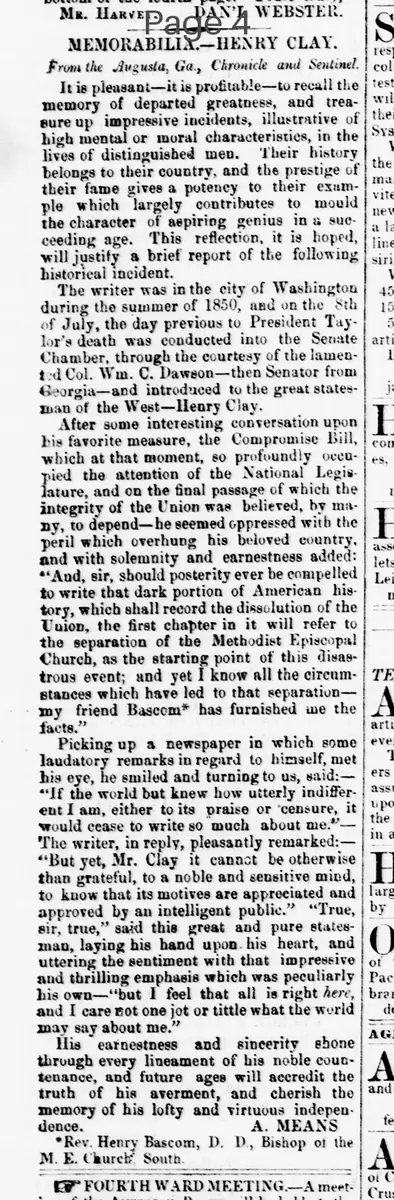
MEMORABILIA.-HENRY CLAY.
From the Augusta, Ga., Chronicle and Sentinel.
It is pleasant—it is profitable—to recall the memory of departed greatness, and treasure up impressive incidents, illustrative of high mental or moral characteristics, in the lives of distinguished men. Their history belongs to their country, and the prestige of their fame gives a potency to their example which largely contributes to mould the character of aspiring genius in succeeding age. This reflection, it is hoped, will justify a brief report of the following historical incident.
The writer was in the city of Washington during the summer of 1850, and on the 8th of July, the day previous to President Taylor's death was conducted into the Senate Chamber, through the courtesy of the lamented Col. Wm. C. Dawson—then Senator from Georgia—and introduced to the great statesman of the West—Henry Clay.
After some interesting conversation upon his favorite measure, the Compromise Bill, which at that moment, so profoundly occupied the attention of the National Legislature, and on the final passage of which the integrity of the Union was believed, by many, to depend—he seemed oppressed with the peril which overhung his beloved country, and with solemnity and earnestness added:
"And, sir, should posterity ever be compelled to write that dark portion of American history, which shall record the dissolution of the Union, the first chapter in it will refer to the separation of the Methodist Episcopal Church, as the starting point of this disastrous event; and yet I know all the circumstances which have led to that separation—my friend Bascom* has furnished me the facts."
Picking up a newspaper in which some laudatory remarks in regard to himself, met his eye, he smiled and turning to us, said: "If the world but knew how utterly indifferent I am, either to its praise or censure, it would cease to write so much about me."
The writer, in reply, pleasantly remarked: "But yet, Mr. Clay it cannot be otherwise than grateful, to a noble and sensitive mind, to know that its motives are appreciated and approved by an intelligent public." "True, sir, true," said this great and pure statesman, laying his hand upon his heart, and uttering the sentiment with that impressive and thrilling emphasis which was peculiarly his own—“but I feel that all is right here, and I care not one jot or tittle what the world may say about me."
His earnestness and sincerity shone through every lineament of his noble countenance, and future ages will accredit the truth of his averment, and cherish the memory of his lofty and virtuous independence.
*A. MEANS
Rev. Henry Bascom, D. D., Bishop of the M. E. Church South.
From the Augusta, Ga., Chronicle and Sentinel.
It is pleasant—it is profitable—to recall the memory of departed greatness, and treasure up impressive incidents, illustrative of high mental or moral characteristics, in the lives of distinguished men. Their history belongs to their country, and the prestige of their fame gives a potency to their example which largely contributes to mould the character of aspiring genius in succeeding age. This reflection, it is hoped, will justify a brief report of the following historical incident.
The writer was in the city of Washington during the summer of 1850, and on the 8th of July, the day previous to President Taylor's death was conducted into the Senate Chamber, through the courtesy of the lamented Col. Wm. C. Dawson—then Senator from Georgia—and introduced to the great statesman of the West—Henry Clay.
After some interesting conversation upon his favorite measure, the Compromise Bill, which at that moment, so profoundly occupied the attention of the National Legislature, and on the final passage of which the integrity of the Union was believed, by many, to depend—he seemed oppressed with the peril which overhung his beloved country, and with solemnity and earnestness added:
"And, sir, should posterity ever be compelled to write that dark portion of American history, which shall record the dissolution of the Union, the first chapter in it will refer to the separation of the Methodist Episcopal Church, as the starting point of this disastrous event; and yet I know all the circumstances which have led to that separation—my friend Bascom* has furnished me the facts."
Picking up a newspaper in which some laudatory remarks in regard to himself, met his eye, he smiled and turning to us, said: "If the world but knew how utterly indifferent I am, either to its praise or censure, it would cease to write so much about me."
The writer, in reply, pleasantly remarked: "But yet, Mr. Clay it cannot be otherwise than grateful, to a noble and sensitive mind, to know that its motives are appreciated and approved by an intelligent public." "True, sir, true," said this great and pure statesman, laying his hand upon his heart, and uttering the sentiment with that impressive and thrilling emphasis which was peculiarly his own—“but I feel that all is right here, and I care not one jot or tittle what the world may say about me."
His earnestness and sincerity shone through every lineament of his noble countenance, and future ages will accredit the truth of his averment, and cherish the memory of his lofty and virtuous independence.
*A. MEANS
Rev. Henry Bascom, D. D., Bishop of the M. E. Church South.
What sub-type of article is it?
Biography
Historical Event
What themes does it cover?
Moral Virtue
Fate Providence
What keywords are associated?
Henry Clay
Compromise Bill
Union Dissolution
Methodist Church Split
Moral Independence
What entities or persons were involved?
Henry Clay
Wm. C. Dawson
Henry Bascom
President Taylor
Where did it happen?
City Of Washington, Senate Chamber
Story Details
Key Persons
Henry Clay
Wm. C. Dawson
Henry Bascom
President Taylor
Location
City Of Washington, Senate Chamber
Event Date
8th Of July 1850
Story Details
The writer meets Henry Clay in the Senate Chamber on July 8, 1850, discusses the Compromise Bill and the Union's peril, Clay links the Methodist Episcopal Church separation to potential dissolution, and expresses indifference to public praise, emphasizing his inner moral conviction.