Thank you for visiting SNEWPapers!
Sign up free
The National Intelligencer And Washington Advertiser
Washington, District Of Columbia
What is this article about?
In the Virginia General Assembly, Mr. A. S. Hooe proposed a resolution declaring that Brigadier General James Wilkinson lacks public confidence and should not command the U.S. army due to suspicions of treason. Debate ensued with motions to postpone or deem action inexpedient, amendments, and votes, ultimately laying the matter on the table.
Merged-components note: Continuation of the discussion in the Virginia House of Delegates on a resolution regarding General James Wilkinson.
Clipping
OCR Quality
Full Text
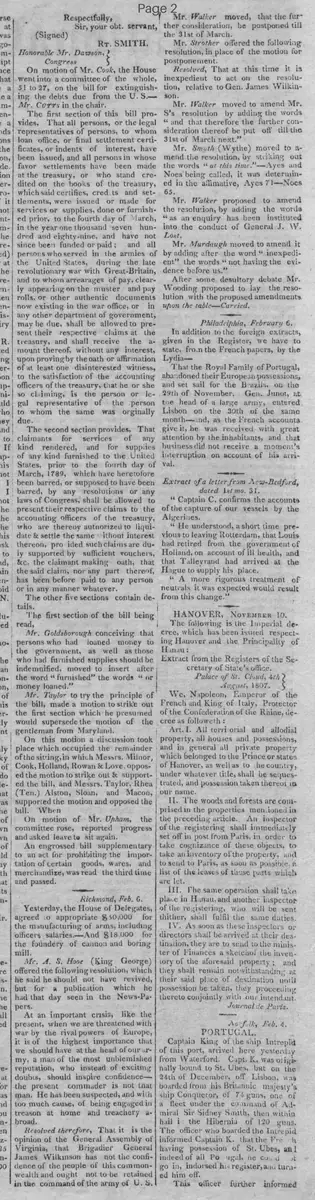
At an important crisis, like the present, when we are threatened with war by the rival powers of Europe, it is of the highest importance that we should have at the head of our army, a man of the most unblemished reputation, who instead of exciting doubts, should inspire confidence—the present commander is not that man. He has been suspected, and with too much cause, of being engaged in treason at home and treachery abroad.
Resolved therefore, That it is the opinion of the General Assembly of Virginia, that Brigadier General James Wilkinson has not the confidence of the people of this commonwealth and ought not to be retained in the command of the army of U. S.
Mr. Walker moved, that the further consideration, be postponed till the 31st of March.
Mr. Strother offered the following resolution, in place of the motion for postponement.
Resolved, That at this time it is inexpedient to act on the resolution, relative to Gen. James Wilkinson.
Mr. Walker moved to amend Mr. S's resolution by adding the words "and that therefore the further consideration thereof be put off till the 31st of March next."
Mr. Smyth (Wythe) moved to amend the resolution, by striking out the words "at this time."—Ayes and Noes being called, it was determined in the affirmative, Ayes 71—Noes 65.
Mr. Walker proposed to amend the resolution, by adding the words "as an enquiry has been instituted into the conduct of General J. W."
Lost.
Mr. Murdaugh moved to amend it by adding after the word "inexpedient" the words "not having the evidence before us."
After some desultory debate Mr. Wooding proposed to lay the resolution with the proposed amendments upon the table—Carried.
What sub-type of article is it?
What keywords are associated?
What entities or persons were involved?
Where did it happen?
Domestic News Details
Primary Location
Virginia
Key Persons
Outcome
resolution laid on the table after debate and failed amendments; one amendment passed 71-65.
Event Details
Mr. A. S. Hooe revived a resolution criticizing Brigadier General James Wilkinson for suspected treason and treachery, recommending his removal from U.S. army command. Mr. Walker moved postponement to March 31. Mr. Strother proposed deeming action inexpedient. Amendments were debated: Mr. Walker added postponement clause; Mr. Smyth struck 'at this time' (passed 71-65); Mr. Walker's inquiry amendment lost; Mr. Murdaugh's evidence amendment debated. Mr. Wooding's motion to table carried.