Thank you for visiting SNEWPapers!
Sign up free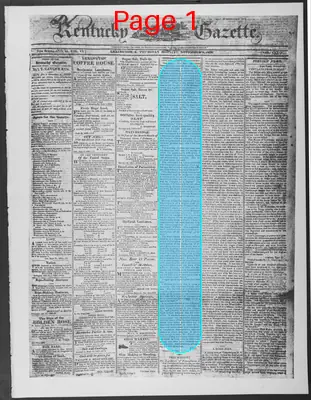
Letter to Editor
November 9, 1820
Kentucky Gazette
Lexington, Fayette County, Kentucky
What is this article about?
A letter signed 'PAUL' defends the established astronomical theory that the Earth is an oblate spheroid against doubts raised by 'Pierre' in the Utica Gazette, citing measurements by Maupertuis, Condamine, and authorities like La Lande, Newton, and others, including comparisons to Jupiter.
Clipping

OCR Quality
95%
Excellent
Full Text
To the National Intelligencer.
Gentlemen: You have republished from the Utica Gazette, in your paper of the 7th of October, a piece under the signature of Pierre, in which the writer has stated doubts upon the theory of the figure of the earth that was supposed to be the best established; even more solidly so, if possible, than the earth's rotation itself. What seems strange in the case is that the results of the admeasurements of a degree of the meridian in very different latitudes, which have led all the astronomers to the conclusion that the earth is flattened towards the poles, are the facts which create the difficulties to this gentleman's mind; or rather, if I understand him correctly, he draws opposite conclusions from the same facts. He sets out with saying: "Since the days of the immortal Newton, it has been the received opinion of the academicians and collegians, and the literati generally that the form or figure of the globe is that of a oblate spheroid." To this theory the gentleman sees "insurmountable barriers;" firstly, it has been demonstrated actual measurement, by the most able scientific men that Europe could afford, that a degree of latitude near the equator is 67 1/4 fathoms less than a degree at the polar circle. To reconcile this fact with the principle of the earth being flattened at the poles, requires more genuine logic than I am possessed of.'
Not knowing whether any more able mathematician will take the trouble to notice the gentleman's difficulties, I shall submit the following points, from high astronomical authority. The logic must speak for itself.
The celebrated La Lande, admitted to be the greatest astronomer of the present age, and who died only a few years ago, thus defines a degree of the earth. "The degree of the terrestrial spheroid (whatsoever may be its figure) is the space that must be passed through upon the earth, in order that the vertical line may be changed by a degree." He continues: "It follows from this definition, that, in the most flattened places of the earth, the degrees must be longer; and it sufficed to measure the extent of a degree at different distances from the poles, in order to judge if the earth was round."
He then relates the results of the admeasurements of a degree upon the earth in Lapland, under Messrs. Maupertius and others, in 1737: and of a degree at the equator, under Monsieur Condamine and others, in 1741. In this first case he remarks: "In this we see that the degree of the meridian which cuts the polar circle is 57,422 toises, (a measure somewhat more than our English fathom)—greater by 123 toises than degree of Paris. This augmentation fixed from this time a complete demonstration of the flattening of the earth."
The academics who went to Peru, found the fifth degree of the meridian to be only 56,730 toises." This was a new conformation of the diminution of degrees going towards the south, and of Maupertius in going towards the north.—This flattening of the earth is also confirmed by the diminution of the pendulum, and by the figure of Jupiter, whose disk is sensibly flattened. It is, moreover, a consequence of the motion of the earth upon its axis, and of the centrifugal force which tends the parts of the equator. Newton, and after him Maclaurin and Clairaut, have demonstrated that, in supposing the earth homogeneous and fluid, it must necessarily take a figure elliptical and flattened."
In again speaking of Jupiter, La Lande says: "We see distinctly that it turns on its axis in nine hours and fifty-six minutes. The flattening of Jupiter is very sensible; his axis is shorter than the diameter of his equator, by one fourteenth part, and this is a natural consequence of the centrifugal force arising out of a rotation so rapid."
It is evident that the writer, "Pierre" has a full and complete knowledge of every thing contained in the foregoing; and probably is much more profound in such subjects than the writer of this. It seems, however, to be somewhat singular that his doubts about the received theory of the figure of the earth should have arisen principally out of those very facts which so many of our illustrious astronomers have considered as completely demonstrative that our globe is an oblate spheroid. It will be time enough to notice Mr. Pierre's objections, arising out of other circumstances stated as facts, when he shall have proved that what have hitherto been considered as demonstrations, are nothing else than illusions.
PAUL.
October 15, 1820.
Gentlemen: You have republished from the Utica Gazette, in your paper of the 7th of October, a piece under the signature of Pierre, in which the writer has stated doubts upon the theory of the figure of the earth that was supposed to be the best established; even more solidly so, if possible, than the earth's rotation itself. What seems strange in the case is that the results of the admeasurements of a degree of the meridian in very different latitudes, which have led all the astronomers to the conclusion that the earth is flattened towards the poles, are the facts which create the difficulties to this gentleman's mind; or rather, if I understand him correctly, he draws opposite conclusions from the same facts. He sets out with saying: "Since the days of the immortal Newton, it has been the received opinion of the academicians and collegians, and the literati generally that the form or figure of the globe is that of a oblate spheroid." To this theory the gentleman sees "insurmountable barriers;" firstly, it has been demonstrated actual measurement, by the most able scientific men that Europe could afford, that a degree of latitude near the equator is 67 1/4 fathoms less than a degree at the polar circle. To reconcile this fact with the principle of the earth being flattened at the poles, requires more genuine logic than I am possessed of.'
Not knowing whether any more able mathematician will take the trouble to notice the gentleman's difficulties, I shall submit the following points, from high astronomical authority. The logic must speak for itself.
The celebrated La Lande, admitted to be the greatest astronomer of the present age, and who died only a few years ago, thus defines a degree of the earth. "The degree of the terrestrial spheroid (whatsoever may be its figure) is the space that must be passed through upon the earth, in order that the vertical line may be changed by a degree." He continues: "It follows from this definition, that, in the most flattened places of the earth, the degrees must be longer; and it sufficed to measure the extent of a degree at different distances from the poles, in order to judge if the earth was round."
He then relates the results of the admeasurements of a degree upon the earth in Lapland, under Messrs. Maupertius and others, in 1737: and of a degree at the equator, under Monsieur Condamine and others, in 1741. In this first case he remarks: "In this we see that the degree of the meridian which cuts the polar circle is 57,422 toises, (a measure somewhat more than our English fathom)—greater by 123 toises than degree of Paris. This augmentation fixed from this time a complete demonstration of the flattening of the earth."
The academics who went to Peru, found the fifth degree of the meridian to be only 56,730 toises." This was a new conformation of the diminution of degrees going towards the south, and of Maupertius in going towards the north.—This flattening of the earth is also confirmed by the diminution of the pendulum, and by the figure of Jupiter, whose disk is sensibly flattened. It is, moreover, a consequence of the motion of the earth upon its axis, and of the centrifugal force which tends the parts of the equator. Newton, and after him Maclaurin and Clairaut, have demonstrated that, in supposing the earth homogeneous and fluid, it must necessarily take a figure elliptical and flattened."
In again speaking of Jupiter, La Lande says: "We see distinctly that it turns on its axis in nine hours and fifty-six minutes. The flattening of Jupiter is very sensible; his axis is shorter than the diameter of his equator, by one fourteenth part, and this is a natural consequence of the centrifugal force arising out of a rotation so rapid."
It is evident that the writer, "Pierre" has a full and complete knowledge of every thing contained in the foregoing; and probably is much more profound in such subjects than the writer of this. It seems, however, to be somewhat singular that his doubts about the received theory of the figure of the earth should have arisen principally out of those very facts which so many of our illustrious astronomers have considered as completely demonstrative that our globe is an oblate spheroid. It will be time enough to notice Mr. Pierre's objections, arising out of other circumstances stated as facts, when he shall have proved that what have hitherto been considered as demonstrations, are nothing else than illusions.
PAUL.
October 15, 1820.
What sub-type of article is it?
Informative
Persuasive
Historical
What themes does it cover?
Science Nature
What keywords are associated?
Oblate Spheroid
Earth Flattening
Meridian Measurements
Astronomical Authority
Pierre Doubts
La Lande
Newton
What entities or persons were involved?
Paul
National Intelligencer
Letter to Editor Details
Author
Paul
Recipient
National Intelligencer
Main Argument
the theory of the earth as an oblate spheroid is well-established by measurements of meridian degrees in different latitudes and supported by astronomers like la lande, newton, and others; pierre's doubts misinterpret these demonstrative facts.
Notable Details
Cites La Lande's Definition Of A Degree
References 1737 Lapland Measurement By Maupertuis (57,422 Toises)
References 1741 Equator Measurement By Condamine
Peru Measurement (56,730 Toises)
Confirms Via Pendulum, Jupiter's Figure, Centrifugal Force
Mentions Newton, Maclaurin, Clairaut Demonstrations