Thank you for visiting SNEWPapers!
Sign up free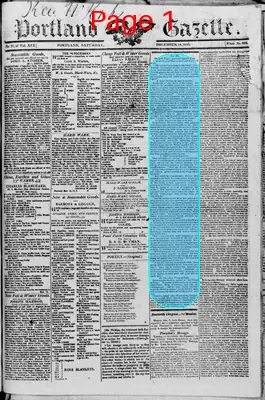
Editorial
December 14, 1816
Portland Gazette, And Maine Advertiser
Portland, Cumberland County, Maine
What is this article about?
This editorial reviews the first number of 'The Friend of Peace,' summarizing letters from Omar to the U.S. President on Christian pacifism, redefining patriotism as preserving peace, critiquing rulers' war powers, and reflections against war, ending with praise for an ancient peace treaty abolishing human sacrifices.
Clipping
OCR Quality
95%
Excellent
Full Text
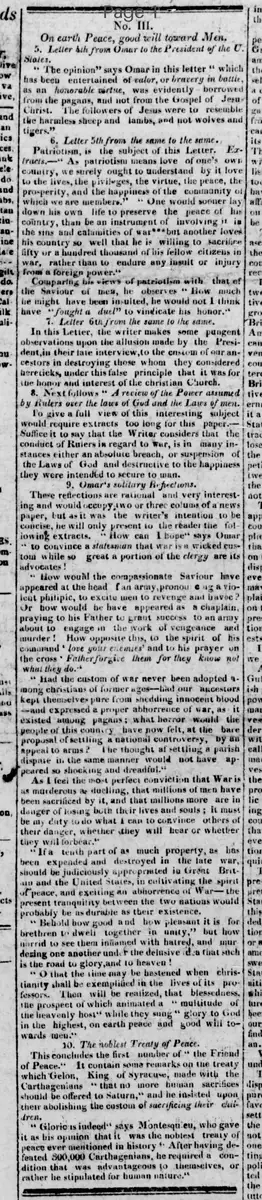
No. III.
On earth Peace, good will toward Men,
5. Letter 4th from Omar to the President of the U.
States.
" The opinion" says Omar in this letter " which
has been entertained of valor, or bravery in battle,
as an honorable virtue, was evidently borrowed
from the pagans, and not from the Gospel of Jesus
Christ. The followers of Jesus were to resemble
the harmless sheep and lambs, and not wolves and
tigers."
6. Letter 5th from the same to the same.
Patriotism, is the subject of this Letter. Ex-
tracts.—" As patriotism means love of one's own
country, we surely ought to understand by it love
to the lives, the privileges, the virtue, the peace, the
prosperity, and the happiness of the community of
which we are members." " One would sooner lay
down his own life to preserve the peace of his
country, than be an instrument of involving it in
the sins and calamities of war; but another loves
his country so well that he is willing to sacrifice
fifty or a hundred thousand of his fellow citizens in
war, rather than to endure any insult or injury
from a foreign power."
Comparing his views of patriotism with that of
the Saviour of men, he observes " How much
he might have been insulted, he would not I think
have "fought a duel" to vindicate his honor."
7. Letter 6th from the same to the same.
In this Letter, the writer makes some pungent
observations upon the allusion made by the Presi-
dent, in their late interview, to the custom of our an-
cestors in destroying those whom they considered
heretics, under this false principle that it was for
the honor and interest of the christian Church.
8. Next follows " A review of the Power assumed
by Rulers over the laws of God and the Laws of men.
To give a full view of this interesting subject
would require extracts too long for this paper.—
Suffice it to say that the Writer considers that the
conduct of Rulers in regard to war, is in many in-
stances either an absolute breach, or suspension of
the Laws of God and destructive to the happiness
they were intended to secure to man.
9. Omar's solitary Reflections.
These reflections are rational and very interest-
ing and would occupy two or three columns of a news-
paper, but as it was the writer's intention to be
concise, he will only present to the reader the fol-
lowing extracts. " How can I hope" says Omar
" to convince a statesman that war is a wicked cus-
tom while so great a portion of the clergy are its
advocates!
" How would the compassionate Saviour have
appeared at the head of an army, pronouncing a vio-
lent philippic, to excite men to revenge and havoc?
Or how would he have appeared as a chaplain,
praying to his Father to grant success to an army
about to engage in the work of vengeance and
murder! How opposite this, to the spirit of his
command 'love your enemies' and to his prayer on
the cross 'Father forgive them for they know not
what they do.'
"Had the custom of war never been adopted a-
mong christians of former ages—had our ancestors
kept themselves pure from shedding innocent blood
—and expressed a proper abhorrence of war, as it
existed among pagans; what horror would the
people of this country have now felt, at the bare
proposal of settling a national controversy, by an ap-
peal to arms? The thought of settling a parish
dispute in the same manner would not have ap-
peared so shocking and dreadful."
As I feel the most perfect conviction that War is
as murderous a dueling, that millions of men have
been sacrificed by it, and that millions more are in
danger of losing both their lives and souls; it must
be my duty to do what I can to convince others of
their danger, whether they will hear or whether
they will forbear."
"If a tenth part of as much property, as has
been expended and destroyed in the late war,
should be judiciously appropriated in Great Brit-
ain and the United States, in cultivating the spirit
of peace, and exciting an abhorrence of War—the
present tranquillity between the two nations would
probably be as durable as their existence.
"Behold how good and how pleasant it is for
brethren to dwell together in unity," but how
horrid to see them inflamed with hatred, and mur-
dering one another under the delusive idea that such
is the road to glory, and to heaven!
" O that the time may be hastened when chris-
tianity shall be exemplified in the lives of its pro-
fessors. Then will be realized, that blessedness,
the prospect of which animated a " multitude of
the heavenly host" while they sung "glory to God
in the highest, on earth peace and good will to-
wards men."
10. The noblest Treaty of Peace.
This concludes the first number of " the Friend
of Peace." It contain some remarks on the treaty
which Gelon, King of Syracuse, made with the
Carthagenians " that no more human sacrifices
should be offered to Saturn," and he insisted upon
their abolishing the custom of sacrificing their chil-
dren,
" Glorious indeed" says Montesquieu, who gave
it as his opinion that it was the noblest treaty of
peace ever mentioned in history ' After having de-
feated 500,000 Carthagenians, he required a con-
dition that was advantageous to themselves, or
rather he stipulated for human nature."
On earth Peace, good will toward Men,
5. Letter 4th from Omar to the President of the U.
States.
" The opinion" says Omar in this letter " which
has been entertained of valor, or bravery in battle,
as an honorable virtue, was evidently borrowed
from the pagans, and not from the Gospel of Jesus
Christ. The followers of Jesus were to resemble
the harmless sheep and lambs, and not wolves and
tigers."
6. Letter 5th from the same to the same.
Patriotism, is the subject of this Letter. Ex-
tracts.—" As patriotism means love of one's own
country, we surely ought to understand by it love
to the lives, the privileges, the virtue, the peace, the
prosperity, and the happiness of the community of
which we are members." " One would sooner lay
down his own life to preserve the peace of his
country, than be an instrument of involving it in
the sins and calamities of war; but another loves
his country so well that he is willing to sacrifice
fifty or a hundred thousand of his fellow citizens in
war, rather than to endure any insult or injury
from a foreign power."
Comparing his views of patriotism with that of
the Saviour of men, he observes " How much
he might have been insulted, he would not I think
have "fought a duel" to vindicate his honor."
7. Letter 6th from the same to the same.
In this Letter, the writer makes some pungent
observations upon the allusion made by the Presi-
dent, in their late interview, to the custom of our an-
cestors in destroying those whom they considered
heretics, under this false principle that it was for
the honor and interest of the christian Church.
8. Next follows " A review of the Power assumed
by Rulers over the laws of God and the Laws of men.
To give a full view of this interesting subject
would require extracts too long for this paper.—
Suffice it to say that the Writer considers that the
conduct of Rulers in regard to war, is in many in-
stances either an absolute breach, or suspension of
the Laws of God and destructive to the happiness
they were intended to secure to man.
9. Omar's solitary Reflections.
These reflections are rational and very interest-
ing and would occupy two or three columns of a news-
paper, but as it was the writer's intention to be
concise, he will only present to the reader the fol-
lowing extracts. " How can I hope" says Omar
" to convince a statesman that war is a wicked cus-
tom while so great a portion of the clergy are its
advocates!
" How would the compassionate Saviour have
appeared at the head of an army, pronouncing a vio-
lent philippic, to excite men to revenge and havoc?
Or how would he have appeared as a chaplain,
praying to his Father to grant success to an army
about to engage in the work of vengeance and
murder! How opposite this, to the spirit of his
command 'love your enemies' and to his prayer on
the cross 'Father forgive them for they know not
what they do.'
"Had the custom of war never been adopted a-
mong christians of former ages—had our ancestors
kept themselves pure from shedding innocent blood
—and expressed a proper abhorrence of war, as it
existed among pagans; what horror would the
people of this country have now felt, at the bare
proposal of settling a national controversy, by an ap-
peal to arms? The thought of settling a parish
dispute in the same manner would not have ap-
peared so shocking and dreadful."
As I feel the most perfect conviction that War is
as murderous a dueling, that millions of men have
been sacrificed by it, and that millions more are in
danger of losing both their lives and souls; it must
be my duty to do what I can to convince others of
their danger, whether they will hear or whether
they will forbear."
"If a tenth part of as much property, as has
been expended and destroyed in the late war,
should be judiciously appropriated in Great Brit-
ain and the United States, in cultivating the spirit
of peace, and exciting an abhorrence of War—the
present tranquillity between the two nations would
probably be as durable as their existence.
"Behold how good and how pleasant it is for
brethren to dwell together in unity," but how
horrid to see them inflamed with hatred, and mur-
dering one another under the delusive idea that such
is the road to glory, and to heaven!
" O that the time may be hastened when chris-
tianity shall be exemplified in the lives of its pro-
fessors. Then will be realized, that blessedness,
the prospect of which animated a " multitude of
the heavenly host" while they sung "glory to God
in the highest, on earth peace and good will to-
wards men."
10. The noblest Treaty of Peace.
This concludes the first number of " the Friend
of Peace." It contain some remarks on the treaty
which Gelon, King of Syracuse, made with the
Carthagenians " that no more human sacrifices
should be offered to Saturn," and he insisted upon
their abolishing the custom of sacrificing their chil-
dren,
" Glorious indeed" says Montesquieu, who gave
it as his opinion that it was the noblest treaty of
peace ever mentioned in history ' After having de-
feated 500,000 Carthagenians, he required a con-
dition that was advantageous to themselves, or
rather he stipulated for human nature."
What sub-type of article is it?
War Or Peace
Moral Or Religious
Social Reform
What keywords are associated?
Anti War
Christian Pacifism
True Patriotism
Rulers And War
Peace Reflections
Friend Of Peace
Noble Treaty
What entities or persons were involved?
Omar
President Of The United States
Saviour Of Men
Gelon King Of Syracuse
Montesquieu
Carthagenians
Editorial Details
Primary Topic
Advocacy For Christian Pacifism And Anti War Sentiments In 'The Friend Of Peace'
Stance / Tone
Strongly Anti War And Pro Peace, Grounded In Christian Teachings
Key Figures
Omar
President Of The United States
Saviour Of Men
Gelon King Of Syracuse
Montesquieu
Carthagenians
Key Arguments
Valor In Battle Is Pagan, Not Christian; Followers Of Jesus Should Be Harmless Like Sheep.
True Patriotism Preserves Peace And Happiness, Not Sacrifices Lives In War.
Rulers' Conduct In War Breaches God's Laws And Destroys Human Happiness.
War Is Wicked; Clergy Should Not Advocate It; Jesus Would Not Lead Armies Or Pray For Vengeance.
If Christians Had Abhorred War Historically, People Would Now Recoil At Appeals To Arms.
Investing In Peace Could Ensure Lasting Tranquility Between Britain And The Us.
Christianity Should Be Lived To Realize 'Peace On Earth, Good Will Toward Men.'
Gelon's Treaty Abolishing Human Sacrifices Is The Noblest In History, Stipulating For Human Nature.