Thank you for visiting SNEWPapers!
Sign up free
Letter to Editor
March 31, 1870
The Working Christian
York, Charleston, Columbia, York County, Charleston County, Richland County, South Carolina
What is this article about?
A Baptist contributor to the Working Christian responds to a Methodist's article on Christian union, arguing that baptism is an essential divinely instituted ordinance, not non-essential, as classifying it so undermines Christ's authority and wisdom. Signed T. W. S. from Union, S.C.
Clipping
OCR Quality
98%
Excellent
Full Text
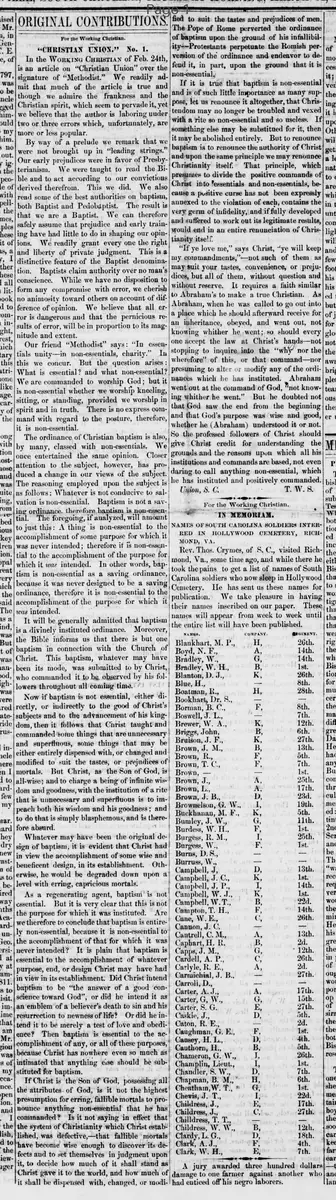
ORIGINAL CONTRIBUTIONS
For the Working Christian.
"CHRISTIAN UNION." No. 1.
In the WORKING CHRISTIAN of Feb. 24th is an article on "Christian Union" over the signature of "Methodist." We readily admit that much of the article is true and though we admire the frankness and the Christian spirit, which seem to pervade it, yet we believe that the author is laboring under two or three errors which, unfortunately, are more or less popular.
By way of a prelude we remark that we were not brought up in leading strings. Our early prejudices were in favor of Presbyterianism. We were taught to read the Bible and to act according to our convictions derived therefrom. This we did. We also read some of the best authorities on baptism, both Baptist and Pedobaptist. The result is that we are a Baptist. We can therefore safely assume that prejudice and early training have had little to do in shaping our opinions. We readily grant every one the right and liberty of private judgment. This is a distinctive feature of the Baptist denomination. Baptists claim authority over no man's conscience. While we have no disposition to form any compromise with error, we cherish no animosity toward others on account of difference of opinion. We believe that all error is dangerous and that the pernicious results of error, will be in proportion to its magnitude and extent.
Our friend "Methodist" says: "In essentials unity--in non-essentials, charity." In this we concur. But the question arises: What is essential? and what non-essential? We are commanded to worship God; but it is non-essential whether we worship kneeling, sitting, or standing, provided we worship in spirit and in truth. There is no express command with regard to the posture, therefore, it is non-essential.
The ordinance of Christian baptism is also, by many, classed with non-essentials. We once entertained the same opinion. Closer attention to the subject, however, has produced a change in our views of the subject. The reasoning employed upon the subject is as follows: Whatever is not conducive to salvation is non-essential. Baptism is not a saving ordinance, therefore baptism is non-essential. The foregoing, if analyzed, will amount to just this: A thing is non-essential to the accomplishment of some purpose for which it was never intended; therefore it is non-essential to the accomplishment of the purpose for which it was intended. In other words, baptism is non-essential as a saving ordinance, because it was never designed to be a saving ordinance, therefore it is non-essential to the accomplishment of the purpose for which it was intended.
It will be generally admitted that baptism is a divinely instituted ordinance. Moreover, the Bible informs us that there is but one baptism in connection with the Church of Christ. This baptism, whatever may have been its mode, was submitted to by Christ, who commanded it to be observed by his followers throughout all coming time.
Now if baptism is not essential, either directly, or indirectly to the good of Christ's subjects and to the advancement of his kingdom, then it follows that Christ taught and commanded some things that are unnecessary and superfluous, some things that may be either entirely dispensed with, or changed and modified to suit the tastes, or prejudices of mortals. But Christ, as the Son of God, is all-wise; and to charge a being of infinite wisdom and goodness, with the institution of a rite that is unnecessary and superfluous is to impeach both his wisdom and his goodness; and to do that is simply blasphemous, and is therefore absurd.
Whatever may have been the original design of baptism, it is evident that Christ had in view the accomplishment of some wise and beneficent design, in its establishment. Otherwise, he would be degraded down upon a level with erring, capricious mortals.
As a regenerating agent, baptism is not essential. But it is very clear that this is not the purpose for which it was instituted. Are we therefore to conclude that baptism is entirely non-essential, because it is non-essential to the accomplishment of that for which it was never intended? It is plain that baptism is essential to the accomplishment of whatever purpose, end, or design Christ may have had in view in its establishment. Did Christ intend baptism to be "the answer of a good conscience toward God", or did he intend it as an emblem of a believer's death to sin and his resurrection to newness of life? Or did he intend it to be merely a test of love and obedience? Then baptism is essential to the accomplishment of any, or all of these purposes, because Christ has nowhere even so much as intimated that anything else should be substituted for baptism.
If Christ is the Son of God, possessing all the attributes of God, is it not the highest presumption for erring, fallible mortals to pronounce anything non-essential that he has commanded? Is it not saying in effect that the system of Christianity which Christ established, was defective,--that fallible mortals have become wise enough to discover its defects and to set themselves in judgment upon it, to decide how much of it shall stand as Christ gave it to the world, and how much of it shall be dispensed with, changed, or modified to suit the tastes and prejudices of men
The Pope of Rome perverted the ordinance of baptism upon the ground of his infallibility--Protestants perpetuate the Romish perversion of the ordinance and endeavor to defend it, in part, upon the ground that it is non-essential.
If it is true that baptism is non-essential and is of such little importance as many suppose, let us renounce it altogether, that Christendom may no longer be troubled and vexed with a rite so non-essential and so useless. If something else may be substituted for it, then it may be abolished entirely. But to renounce baptism is to renounce the authority of Christ and upon the same principle we may renounce Christianity itself. That principle, which presumes to divide the positive commands of Christ into essentials and non-essentials, because a positive curse has not been expressly annexed to the violation of each, contains the very germ of infidelity, and if fully developed and suffered to work out its legitimate results, would end in an entire renunciation of Christianity itself.
"If ye love me," says Christ, "ye will keep my commandments,"--not such of them as may suit your tastes, convenience, or prejudices, but all of them, without question and without reserve. It requires a faith similar to Abraham's to make a true Christian. As Abraham, when he was called to go out into a place which he should afterward receive for an inheritance, obeyed, and went out, not knowing whither he went; so should every one accept the law at Christ's hands--not stopping to inquire into the "why" nor the "wherefore" of this, or that command--nor presuming to alter or modify any of the ordinances which he has instituted. Abraham went out at the command of God, "not knowing whither he went." But he doubted not that God saw the end from the beginning and that God's purpose was wise and good, whether he (Abraham) understood it or not. So the professed followers of Christ should give Christ credit for understanding the grounds and the reasons upon which all his institutions and commands are based, not even daring to call anything non-essential, which he has instituted and positively commanded.
Union, S. C.
T. W. S.
For the Working Christian.
"CHRISTIAN UNION." No. 1.
In the WORKING CHRISTIAN of Feb. 24th is an article on "Christian Union" over the signature of "Methodist." We readily admit that much of the article is true and though we admire the frankness and the Christian spirit, which seem to pervade it, yet we believe that the author is laboring under two or three errors which, unfortunately, are more or less popular.
By way of a prelude we remark that we were not brought up in leading strings. Our early prejudices were in favor of Presbyterianism. We were taught to read the Bible and to act according to our convictions derived therefrom. This we did. We also read some of the best authorities on baptism, both Baptist and Pedobaptist. The result is that we are a Baptist. We can therefore safely assume that prejudice and early training have had little to do in shaping our opinions. We readily grant every one the right and liberty of private judgment. This is a distinctive feature of the Baptist denomination. Baptists claim authority over no man's conscience. While we have no disposition to form any compromise with error, we cherish no animosity toward others on account of difference of opinion. We believe that all error is dangerous and that the pernicious results of error, will be in proportion to its magnitude and extent.
Our friend "Methodist" says: "In essentials unity--in non-essentials, charity." In this we concur. But the question arises: What is essential? and what non-essential? We are commanded to worship God; but it is non-essential whether we worship kneeling, sitting, or standing, provided we worship in spirit and in truth. There is no express command with regard to the posture, therefore, it is non-essential.
The ordinance of Christian baptism is also, by many, classed with non-essentials. We once entertained the same opinion. Closer attention to the subject, however, has produced a change in our views of the subject. The reasoning employed upon the subject is as follows: Whatever is not conducive to salvation is non-essential. Baptism is not a saving ordinance, therefore baptism is non-essential. The foregoing, if analyzed, will amount to just this: A thing is non-essential to the accomplishment of some purpose for which it was never intended; therefore it is non-essential to the accomplishment of the purpose for which it was intended. In other words, baptism is non-essential as a saving ordinance, because it was never designed to be a saving ordinance, therefore it is non-essential to the accomplishment of the purpose for which it was intended.
It will be generally admitted that baptism is a divinely instituted ordinance. Moreover, the Bible informs us that there is but one baptism in connection with the Church of Christ. This baptism, whatever may have been its mode, was submitted to by Christ, who commanded it to be observed by his followers throughout all coming time.
Now if baptism is not essential, either directly, or indirectly to the good of Christ's subjects and to the advancement of his kingdom, then it follows that Christ taught and commanded some things that are unnecessary and superfluous, some things that may be either entirely dispensed with, or changed and modified to suit the tastes, or prejudices of mortals. But Christ, as the Son of God, is all-wise; and to charge a being of infinite wisdom and goodness, with the institution of a rite that is unnecessary and superfluous is to impeach both his wisdom and his goodness; and to do that is simply blasphemous, and is therefore absurd.
Whatever may have been the original design of baptism, it is evident that Christ had in view the accomplishment of some wise and beneficent design, in its establishment. Otherwise, he would be degraded down upon a level with erring, capricious mortals.
As a regenerating agent, baptism is not essential. But it is very clear that this is not the purpose for which it was instituted. Are we therefore to conclude that baptism is entirely non-essential, because it is non-essential to the accomplishment of that for which it was never intended? It is plain that baptism is essential to the accomplishment of whatever purpose, end, or design Christ may have had in view in its establishment. Did Christ intend baptism to be "the answer of a good conscience toward God", or did he intend it as an emblem of a believer's death to sin and his resurrection to newness of life? Or did he intend it to be merely a test of love and obedience? Then baptism is essential to the accomplishment of any, or all of these purposes, because Christ has nowhere even so much as intimated that anything else should be substituted for baptism.
If Christ is the Son of God, possessing all the attributes of God, is it not the highest presumption for erring, fallible mortals to pronounce anything non-essential that he has commanded? Is it not saying in effect that the system of Christianity which Christ established, was defective,--that fallible mortals have become wise enough to discover its defects and to set themselves in judgment upon it, to decide how much of it shall stand as Christ gave it to the world, and how much of it shall be dispensed with, changed, or modified to suit the tastes and prejudices of men
The Pope of Rome perverted the ordinance of baptism upon the ground of his infallibility--Protestants perpetuate the Romish perversion of the ordinance and endeavor to defend it, in part, upon the ground that it is non-essential.
If it is true that baptism is non-essential and is of such little importance as many suppose, let us renounce it altogether, that Christendom may no longer be troubled and vexed with a rite so non-essential and so useless. If something else may be substituted for it, then it may be abolished entirely. But to renounce baptism is to renounce the authority of Christ and upon the same principle we may renounce Christianity itself. That principle, which presumes to divide the positive commands of Christ into essentials and non-essentials, because a positive curse has not been expressly annexed to the violation of each, contains the very germ of infidelity, and if fully developed and suffered to work out its legitimate results, would end in an entire renunciation of Christianity itself.
"If ye love me," says Christ, "ye will keep my commandments,"--not such of them as may suit your tastes, convenience, or prejudices, but all of them, without question and without reserve. It requires a faith similar to Abraham's to make a true Christian. As Abraham, when he was called to go out into a place which he should afterward receive for an inheritance, obeyed, and went out, not knowing whither he went; so should every one accept the law at Christ's hands--not stopping to inquire into the "why" nor the "wherefore" of this, or that command--nor presuming to alter or modify any of the ordinances which he has instituted. Abraham went out at the command of God, "not knowing whither he went." But he doubted not that God saw the end from the beginning and that God's purpose was wise and good, whether he (Abraham) understood it or not. So the professed followers of Christ should give Christ credit for understanding the grounds and the reasons upon which all his institutions and commands are based, not even daring to call anything non-essential, which he has instituted and positively commanded.
Union, S. C.
T. W. S.
What sub-type of article is it?
Religious
Persuasive
Philosophical
What themes does it cover?
Religion
Morality
What keywords are associated?
Christian Union
Baptism Essential
Baptist Perspective
Religious Ordinances
Christian Authority
Methodist Response
Divine Commands
What entities or persons were involved?
T. W. S.
Letter to Editor Details
Author
T. W. S.
Main Argument
baptism is an essential divinely instituted ordinance commanded by christ for specific purposes such as obedience and emblem of faith; deeming it non-essential impugns christ's wisdom and authority, leading to potential infidelity.
Notable Details
Response To 'Methodist' Article In Working Christian Feb. 24th
Writer's Baptist Background From Presbyterian Upbringing
Critique Of Classifying Baptism As Non Essential
Comparison To Papal Perversion And Abraham's Faith
Quote From Christ: 'If Ye Love Me, Ye Will Keep My Commandments'