Thank you for visiting SNEWPapers!
Sign up free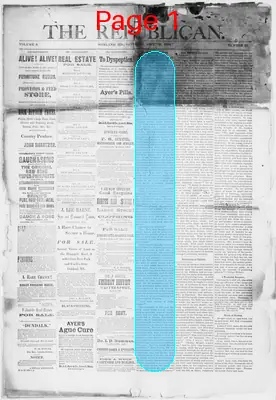
Story
September 26, 1885
The Republican
Oakland, Garrett County, Maryland
What is this article about?
An old antiquarian recounts how John Lynch, a courageous settler, founded Lynchburg, Virginia, by establishing a ferry and becoming a judge to swiftly execute horse thieves, originating the term 'lynch law' before the Revolutionary War.
Clipping

OCR Quality
95%
Excellent
Full Text
The Original Judge Lynch.
(Lynchburg, Va., Letter.)
While chatting with an old antiquarian in his cozy library (his after-noon) I casually inquired how this town came by its peculiarly suggestive name. "Did the original judge of dreadful fame ever live here?" I asked.
"Yes, he did," replied the old Virginia gentleman, with brightening eyes that revealed delight in the topic. "Judge Lynch might fairly be called the founder of the city, and it grieves me angry to see all these newspaper stories, not only locating him in other states, but condemning his mode of procedure as infamous and brutal.
"Not long before the revolutionary war at that time there were a large number of that splendid race, the Scotch-Irish, settled here. Shrewd and brave, cautious, yet daring, dashing, but prudent, honest and energetic. The Lynches were of the same stalwart stock. They settled in Prince William county. There were four Lynches in the family, and one of them, John Lynch, was a bright, quick young fellow, and remarkably courageous. One day in rambling about the head of the James river he found a gap in the mountains on either side of the water which it struck him would make a capital crossing point for travelers, and forthwith he drove his proprietary stake, and shortly after, with a few logs and an old scow, established a primitive ferry.
The horse thieves were among the first to take advantage of the new convenience, and young Lynch, himself scrupulously honest, was disgusted and humiliated at having to take them across. At this time the country was sparsely settled, courts were few, and far apart. The evil continued to increase; finally the ferry became the favorite means of escape for the stock stealers, and John Lynch, thoroughly aroused, proposed to put an end to it.
"What could he do single handed?"
"Well, I will tell you what he actually did. He applied to the governor of Virginia for a commission to act as a justice of the peace. His reputation for honesty and good judgment was beyond a doubt, and his commission was granted. He was qualified, and became a judge. The first use he made of his power was to appoint some special constables and engage a few sharp detectives. They at once began work, with such success that gang after gang were captured."
"Did they have no trial?"
"Yes. They were brought before Judge Lynch, and he never acted until he was positive of their guilt, and his knowledge of the men and the country was an immense advantage to him."
"If he found them guilty he would, according to law, require a good bond, which, of course, in those days, a thief could never get, and when that form was complied with, would start them off well guarded to some far-away jail. The constables knew what the order to march meant, and as soon as they found themselves in a thick wood, chose a stout tree, and, with a good rope, which they carried, created a temporary scaffold from which the horse thieves quickly dangled. Hanging was the legal punishment for horse stealing in those days, but the promptness and dispatch with which Judge Lynch meted out justice at the very door terrorized the evil-doers of the country and between those he hung and those who fled, in two years there was not a horse thief in Virginia.
"And what became of Judge Lynch?"
"He continued to live near the ferry, round which a large village grew up under the name of Lynch's Ferry, and not until long after his death did it become Lynchburg. During his life lynch law was honored and upheld, but since then it has altogether lost its original character and meaning. Now, as I understand it, it is merely the infuriated impulse of a rough mob, who, without waiting for the law at hand to prove innocence or guilt, decide on it according to their own inclination and take a life perhaps more unblemished than their own. No," concluded the old gentleman, "John Lynch did his state a service in ridding it of a lot of miscreants, who, but for him, were out of the reach of the law, but were he living no one would be quicker than he to resent this barbarous mob fashion of putting a man to sudden death, when the law, the courts, the prison and scaffold are close at hand to mete out justice and punishment."
(Lynchburg, Va., Letter.)
While chatting with an old antiquarian in his cozy library (his after-noon) I casually inquired how this town came by its peculiarly suggestive name. "Did the original judge of dreadful fame ever live here?" I asked.
"Yes, he did," replied the old Virginia gentleman, with brightening eyes that revealed delight in the topic. "Judge Lynch might fairly be called the founder of the city, and it grieves me angry to see all these newspaper stories, not only locating him in other states, but condemning his mode of procedure as infamous and brutal.
"Not long before the revolutionary war at that time there were a large number of that splendid race, the Scotch-Irish, settled here. Shrewd and brave, cautious, yet daring, dashing, but prudent, honest and energetic. The Lynches were of the same stalwart stock. They settled in Prince William county. There were four Lynches in the family, and one of them, John Lynch, was a bright, quick young fellow, and remarkably courageous. One day in rambling about the head of the James river he found a gap in the mountains on either side of the water which it struck him would make a capital crossing point for travelers, and forthwith he drove his proprietary stake, and shortly after, with a few logs and an old scow, established a primitive ferry.
The horse thieves were among the first to take advantage of the new convenience, and young Lynch, himself scrupulously honest, was disgusted and humiliated at having to take them across. At this time the country was sparsely settled, courts were few, and far apart. The evil continued to increase; finally the ferry became the favorite means of escape for the stock stealers, and John Lynch, thoroughly aroused, proposed to put an end to it.
"What could he do single handed?"
"Well, I will tell you what he actually did. He applied to the governor of Virginia for a commission to act as a justice of the peace. His reputation for honesty and good judgment was beyond a doubt, and his commission was granted. He was qualified, and became a judge. The first use he made of his power was to appoint some special constables and engage a few sharp detectives. They at once began work, with such success that gang after gang were captured."
"Did they have no trial?"
"Yes. They were brought before Judge Lynch, and he never acted until he was positive of their guilt, and his knowledge of the men and the country was an immense advantage to him."
"If he found them guilty he would, according to law, require a good bond, which, of course, in those days, a thief could never get, and when that form was complied with, would start them off well guarded to some far-away jail. The constables knew what the order to march meant, and as soon as they found themselves in a thick wood, chose a stout tree, and, with a good rope, which they carried, created a temporary scaffold from which the horse thieves quickly dangled. Hanging was the legal punishment for horse stealing in those days, but the promptness and dispatch with which Judge Lynch meted out justice at the very door terrorized the evil-doers of the country and between those he hung and those who fled, in two years there was not a horse thief in Virginia.
"And what became of Judge Lynch?"
"He continued to live near the ferry, round which a large village grew up under the name of Lynch's Ferry, and not until long after his death did it become Lynchburg. During his life lynch law was honored and upheld, but since then it has altogether lost its original character and meaning. Now, as I understand it, it is merely the infuriated impulse of a rough mob, who, without waiting for the law at hand to prove innocence or guilt, decide on it according to their own inclination and take a life perhaps more unblemished than their own. No," concluded the old gentleman, "John Lynch did his state a service in ridding it of a lot of miscreants, who, but for him, were out of the reach of the law, but were he living no one would be quicker than he to resent this barbarous mob fashion of putting a man to sudden death, when the law, the courts, the prison and scaffold are close at hand to mete out justice and punishment."
What sub-type of article is it?
Biography
Historical Event
What themes does it cover?
Justice
Crime Punishment
What keywords are associated?
John Lynch
Lynchburg
Horse Thieves
Lynch Law
Virginia Justice
What entities or persons were involved?
John Lynch
Where did it happen?
Lynchburg, Virginia
Story Details
Key Persons
John Lynch
Location
Lynchburg, Virginia
Event Date
Not Long Before The Revolutionary War
Story Details
John Lynch establishes a ferry at the James River, becomes a judge, captures and executes horse thieves legally, founding Lynchburg and originating lynch law as prompt justice.