Thank you for visiting SNEWPapers!
Sign up free
Editorial
January 29, 1818
Richmond Enquirer
Richmond, Richmond County, Virginia
What is this article about?
Editorial from Richmond criticizes letters by 'A.B.' in the Philadelphia Democratic Press for opposing support for Spanish American independence, defends revolutionaries like Bolivar and McGregor, refutes claims of guerrilla warfare only, questions U.S. recognition as enmity, and defends Henry Clay against charges of warmongering and ambition.
Clipping
OCR Quality
98%
Excellent
Full Text
RICHMOND. JANUARY 29.
SOUTH AMERICAN AFFAIRS.
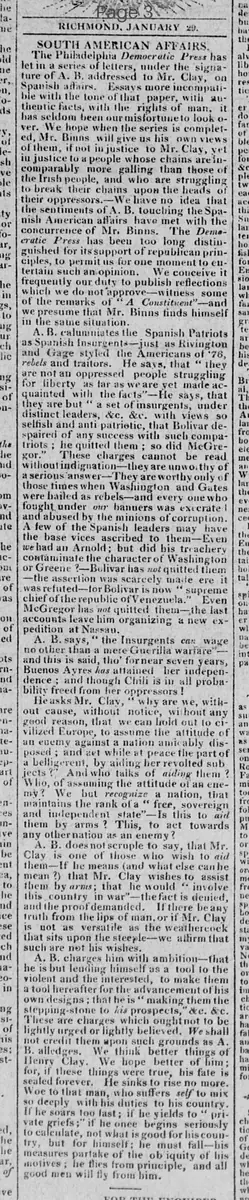
The Philadelphia Democratic Press has let in a series of letters, under the signature of A. B. addressed to Mr. Clay, on Spanish affairs. Essays more incompatible with the tone of that paper, with authentic facts, with the rights of man, it has seldom been our misfortune to look over. We hope when the series is completed, Mr. Binns will give us his own views of them, if not in justice to Mr. Clay, yet in justice to a people whose chains are incomparably more galling than those of the Irish people, and who are struggling to break their chains upon the heads of their oppressors. We have no idea that the sentiments of A. B. touching the Spanish American affairs have met with the concurrence of Mr. Binns. The Democratic Press has been too long distinguished for its support of republican principles, to permit us for one moment to entertain such an opinion. We conceive it frequently our duty to publish reflections which we do not approve—witness some of the remarks of "A Constituent"—and we presume that Mr. Binns finds himself in the same situation.
A. B. calumniates the Spanish Patriots as Spanish Insurgents—just as Rivington and Gage styled the Americans of '76, rebels and traitors. He says, that "they are not an oppressed people struggling for liberty as far as we are yet made acquainted with the facts"—He says, that they are but "a set of insurgents, under distinct leaders, &c. &c. with views so selfish and anti-patriotic, that Bolivar despaired of any success with such compatriots; he quitted them; so did McGregor." These charges cannot be read without indignation—they are unworthy of a serious answer—They are worthy only of those times when Washington and Gates were hailed as rebels—and every one who fought under our banners was execrated and abused by the minions of corruption.
A few of the Spanish leaders may have the base vices ascribed to them—Even we had an Arnold; but did his treachery contaminate the character of Washington or Greene? Bolivar has not quitted them—the assertion was scarcely made ere it was refuted—for Bolivar is now "supreme chief of the republic of Venezuela." "Even McGregor has not quitted them—the last accounts leave him organizing a new expedition at Nassau."
A. B. says, "the Insurgents can wage no other than a mere Guerilla warfare"—and this is said, tho' for near seven years, Buenos Ayres has attained her independence; and though Chili is in all probability freed from her oppressors!
He asks Mr. Clay, "why are we, without cause, without notice, without any good reason, that we can hold out to civilized Europe, to assume the attitude of an enemy against a nation amicably disposed; and act while at peace the part of a belligerent, by aiding her revolted subjects?" And who talks of aiding them? Who, of assuming the attitude of an enemy? We but recognize a nation, that maintains the rank of a "free, sovereign and independent state"—Is this to aid them by arms? This, to act towards any other nation as an enemy?
A. B. does not scruple to say, that Mr. Clay is one of those who wish to aid them—If he means (and what else can he mean?) that Mr. Clay wishes to assist them by arms; that he would "involve this country in war"—the fact is denied, and the proof demanded. If there be any truth from the lips of man, or if Mr. Clay is not as versatile as the weathercock that sits upon the steeple—we affirm that such are not his wishes.
A. B. charges him with ambition—that he is but leading himself as a tool to the violent and the interested, to make them a tool hereafter for the advancement of his own designs; that he is "making them the stepping-stone to his prospects," &c. &c. These are charges which ought not to be lightly urged or lightly believed. We shall not credit them upon such grounds as A. B. alleges. We think better things of Henry Clay. We hope better of him; for, if these things were true, his fate is sealed forever. He sinks to rise no more. Woe to that man, who suffers self to mix so deeply with his duties to his country. If he soars too fast; if he yields to "private griefs;" if he once begins seriously to calculate, not what is good for his country, but for himself; he must fall—his measures partake of the obliquity of his motives; he flies from principle, and all good men will fly from him.
SOUTH AMERICAN AFFAIRS.
The Philadelphia Democratic Press has let in a series of letters, under the signature of A. B. addressed to Mr. Clay, on Spanish affairs. Essays more incompatible with the tone of that paper, with authentic facts, with the rights of man, it has seldom been our misfortune to look over. We hope when the series is completed, Mr. Binns will give us his own views of them, if not in justice to Mr. Clay, yet in justice to a people whose chains are incomparably more galling than those of the Irish people, and who are struggling to break their chains upon the heads of their oppressors. We have no idea that the sentiments of A. B. touching the Spanish American affairs have met with the concurrence of Mr. Binns. The Democratic Press has been too long distinguished for its support of republican principles, to permit us for one moment to entertain such an opinion. We conceive it frequently our duty to publish reflections which we do not approve—witness some of the remarks of "A Constituent"—and we presume that Mr. Binns finds himself in the same situation.
A. B. calumniates the Spanish Patriots as Spanish Insurgents—just as Rivington and Gage styled the Americans of '76, rebels and traitors. He says, that "they are not an oppressed people struggling for liberty as far as we are yet made acquainted with the facts"—He says, that they are but "a set of insurgents, under distinct leaders, &c. &c. with views so selfish and anti-patriotic, that Bolivar despaired of any success with such compatriots; he quitted them; so did McGregor." These charges cannot be read without indignation—they are unworthy of a serious answer—They are worthy only of those times when Washington and Gates were hailed as rebels—and every one who fought under our banners was execrated and abused by the minions of corruption.
A few of the Spanish leaders may have the base vices ascribed to them—Even we had an Arnold; but did his treachery contaminate the character of Washington or Greene? Bolivar has not quitted them—the assertion was scarcely made ere it was refuted—for Bolivar is now "supreme chief of the republic of Venezuela." "Even McGregor has not quitted them—the last accounts leave him organizing a new expedition at Nassau."
A. B. says, "the Insurgents can wage no other than a mere Guerilla warfare"—and this is said, tho' for near seven years, Buenos Ayres has attained her independence; and though Chili is in all probability freed from her oppressors!
He asks Mr. Clay, "why are we, without cause, without notice, without any good reason, that we can hold out to civilized Europe, to assume the attitude of an enemy against a nation amicably disposed; and act while at peace the part of a belligerent, by aiding her revolted subjects?" And who talks of aiding them? Who, of assuming the attitude of an enemy? We but recognize a nation, that maintains the rank of a "free, sovereign and independent state"—Is this to aid them by arms? This, to act towards any other nation as an enemy?
A. B. does not scruple to say, that Mr. Clay is one of those who wish to aid them—If he means (and what else can he mean?) that Mr. Clay wishes to assist them by arms; that he would "involve this country in war"—the fact is denied, and the proof demanded. If there be any truth from the lips of man, or if Mr. Clay is not as versatile as the weathercock that sits upon the steeple—we affirm that such are not his wishes.
A. B. charges him with ambition—that he is but leading himself as a tool to the violent and the interested, to make them a tool hereafter for the advancement of his own designs; that he is "making them the stepping-stone to his prospects," &c. &c. These are charges which ought not to be lightly urged or lightly believed. We shall not credit them upon such grounds as A. B. alleges. We think better things of Henry Clay. We hope better of him; for, if these things were true, his fate is sealed forever. He sinks to rise no more. Woe to that man, who suffers self to mix so deeply with his duties to his country. If he soars too fast; if he yields to "private griefs;" if he once begins seriously to calculate, not what is good for his country, but for himself; he must fall—his measures partake of the obliquity of his motives; he flies from principle, and all good men will fly from him.
What sub-type of article is it?
Foreign Affairs
Partisan Politics
What keywords are associated?
Spanish American Independence
Bolivar
Henry Clay
Spanish Patriots
Republican Principles
Foreign Recognition
What entities or persons were involved?
A.B.
Henry Clay
Mr. Binns
Bolivar
Mcgregor
Spanish Patriots
Philadelphia Democratic Press
Editorial Details
Primary Topic
Critique Of A.B.'S Opposition To Spanish American Independence
Stance / Tone
Strongly Supportive Of Revolutionaries And Defensive Of Henry Clay
Key Figures
A.B.
Henry Clay
Mr. Binns
Bolivar
Mcgregor
Spanish Patriots
Philadelphia Democratic Press
Key Arguments
A.B. Wrongly Labels Spanish Patriots As Selfish Insurgents, Akin To British Slander Of American Revolutionaries.
Bolivar Remains Supreme Chief Of Venezuela And Mcgregor Is Organizing A New Expedition.
Buenos Ayres Has Been Independent For Seven Years And Chile Likely Freed.
Recognizing Independence Is Not Aiding By Arms Or Acting As An Enemy.
Denies Clay Supports Armed Intervention Or War; Demands Proof.
Rejects Charges Of Clay's Ambition As Baseless; Warns Of Consequences If True.