Thank you for visiting SNEWPapers!
Sign up free
Virginia Advocate
Charlottesville, Virginia
What is this article about?
Description of the Hessian Fly's life cycle and a simple lime-based method to destroy its eggs on wheat seeds, preventing crop damage. Proven effective in experiments where treated seeds thrived while untreated failed. Recommended for wide circulation.
Clipping
OCR Quality
Full Text
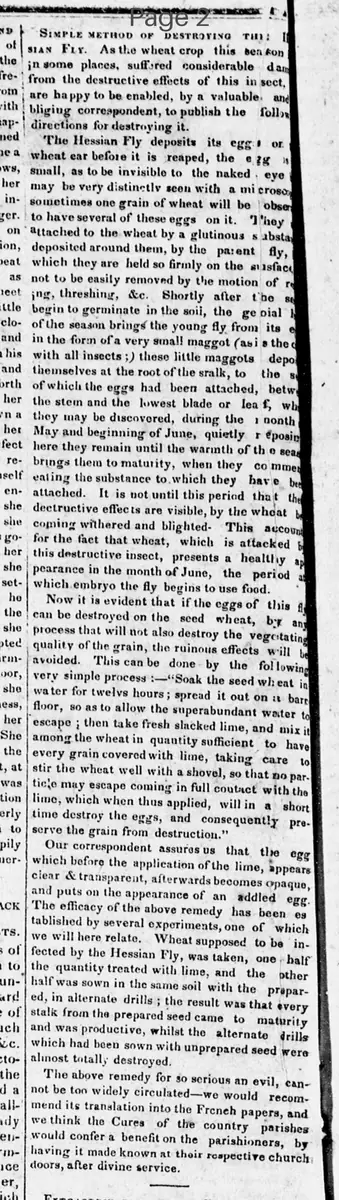
As the wheat crop this season in some places, suffered considerable damage from the destructive effects of this insect, we are happy to be enabled, by a valuable and obliging correspondent, to publish the following directions for destroying it.
The Hessian Fly deposits its egg on wheat ear before it is reaped, the egg is small, as to be invisible to the naked eye, but may be very distinctly seen with a microscope sometimes one grain of wheat will be observed to have several of these eggs on it. They are attached to the wheat by a glutinous substance deposited around them, by the parent fly, by which they are held so firmly on the surface not to be easily removed by the motion of reaping, threshing, &c. Shortly after the seed begin to germinate in the soil, the genial of the season brings the young fly from its egg in the form of a very small maggot (as is the case with all insects;) these little maggots deposit themselves at the root of the stalk, to the surface of which the eggs had been attached, between the stem and the lowest blade or leaf, where they may be discovered, during the month of May and beginning of June, quietly reposing here they remain until the warmth of the season brings them to maturity, when they commence eating the substance to which they have been attached. It is not until this period that the destructive effects are visible, by the wheat becoming withered and blighted-- This accounts for the fact that wheat, which is attacked by this destructive insect, presents a healthy appearance in the month of June, the period which embryo the fly begins to use food.
Now it is evident that if the eggs of this fly can be destroyed on the seed wheat, by any process that will not also destroy the vegetating quality of the grain, the ruinous effects will be avoided. This can be done by the following very simple process:--"Soak the seed wheat in water for twelve hours; spread it out on a barn floor, so as to allow the superabundant water to escape; then take fresh slacked lime, and mix it among the wheat in quantity sufficient to have every grain covered with lime, taking care to stir the wheat well with a shovel, so that no particle may escape coming in full contact with the lime, which when thus applied, will in a short time destroy the eggs, and consequently preserve the grain from destruction."
Our correspondent assures us that the egg which before the application of the lime, appears clear & transparent, afterwards becomes opaque, and puts on the appearance of an addled egg.
The efficacy of the above remedy has been established by several experiments, one of which we will here relate. Wheat supposed to be infected by the Hessian Fly, was taken, one half the quantity treated with lime, and the other half was sown in the same soil with the prepared, in alternate drills; the result was that every stalk from the prepared seed came to maturity and was productive, whilst the alternate drills which had been sown with unprepared seed were almost totally destroyed
The above remedy for so serious an evil, cannot be too widely circulated--we would recommend its translation into the French papers, and we think the Curés of the country parishes would confer a benefit on the parishioners, by having it made known at their respective church doors, after divine service.
What sub-type of article is it?
What keywords are associated?
Domestic News Details
Outcome
in experiments, wheat seeds treated with lime matured productively, while untreated seeds in the same soil were almost totally destroyed by the hessian fly.
Event Details
The Hessian Fly deposits invisible eggs on wheat ears before reaping, which hatch into maggots that damage stalks in May-June, causing withering. A method to destroy eggs: soak seeds in water for 12 hours, dry, mix thoroughly with slaked lime to cover every grain. This kills eggs without harming germination, as shown in tests where treated wheat thrived and untreated failed. Recommended for wide dissemination, including in French papers and churches.