Thank you for visiting SNEWPapers!
Sign up free
Edwardsville Spectator
Edwardsville, Madison County, Illinois
What is this article about?
A Madison County citizen publicly rebukes Abraham Prickett for dodging questions on the legality of introducing slavery into Illinois, alleging he signed deceptive instructions to trick anti-slavery residents into supporting a constitutional convention, violating the 1787 Ordinance. Urges Prickett to support liberty openly. Dated June 26, 1823.
Merged-components note: Continuation of the same letter to Abraham Prickett across pages, sequential reading order.
Clippings
1 of 2
OCR Quality
Full Text
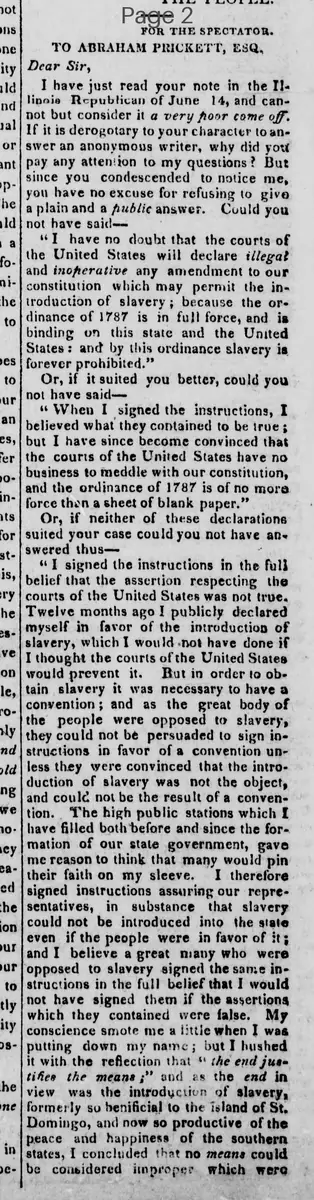
TO ABRAHAM PRICKETT, ESQ.
Dear Sir,
I have just read your note in the Illinois Republican of June 14, and cannot but consider it a very poor come off. If it is derogatory to your character to answer an anonymous writer, why did you pay any attention to my questions? But since you condescended to notice me, you have no excuse for refusing to give a plain and a public answer. Could you not have said—
"I have no doubt that the courts of the United States will declare illegal and inoperative any amendment to our constitution which may permit the introduction of slavery; because the ordinance of 1787 is in full force, and is binding on this state and the United States: and by this ordinance slavery is forever prohibited."
Or, if it suited you better, could you not have said—
"When I signed the instructions, I believed what they contained to be true; but I have since become convinced that the courts of the United States have no business to meddle with our constitution, and the ordinance of 1787 is of no more force than a sheet of blank paper."
Or, if neither of these declarations suited your case could you not have answered thus—
"I signed the instructions in the full belief that the assertion respecting the courts of the United States was not true. Twelve months ago I publicly declared myself in favor of the introduction of slavery, which I would not have done if I thought the courts of the United States would prevent it. But in order to obtain slavery it was necessary to have a convention; and as the great body of the people were opposed to slavery, they could not be persuaded to sign instructions in favor of a convention unless they were convinced that the introduction of slavery was not the object, and could not be the result of a convention. The high public stations which I have filled both before and since the formation of our state government, gave me reason to think that many would pin their faith on my sleeve. I therefore signed instructions assuring our representatives, in substance that slavery could not be introduced into the state even if the people were in favor of it; and I believe a great many who were opposed to slavery signed the same instructions in the full belief that I would not have signed them if the assertions which they contained were false. My conscience smote me a little when I was putting down my name; but I hushed it with the reflection that "the end justifies the means;" and as the end in view was the introduction of slavery, formerly so beneficial to the island of St. Domingo, and now so productive of the peace and happiness of the southern states, I concluded that no means could be considered improper which were calculated to bring about this desirable end.
To one of these three answers, my dear sir, you might doubtless have subscribed without violating the truth; but which would have been the correct answer, is a question for the public to decide, since you have refused to gratify their reasonable curiosity. The public have an objection to call upon you personally for your opinion, as this mode might enable you to give different answers to individuals of different principles. An open, candid, and public avowal of your sentiments, would be considered by all men as far more honorable than the skulking policy which I am sorry to see you have adopted.
Whatever may have been your ideas upon this subject, it is a fact that can be proved if necessary, that some of your coadjutors in this affair have acknowledged that they signed the instructions, knowing, or fully believing that the assertions contained in them were false; that their object in doing so was to deceive the people: and that they succeeded by this means in obtaining the signatures of many who were opposed to slavery, and who would not have signed if they had known the object in view.
Had you been admitted into the nightly rendezvous of these persons, and witnessed their midnight orgies, you would frequently have heard them boast of their success in deceiving particular individuals, and you would have shuddered at the indifference and sang froid with which they recounted the falsehoods and misrepresentations made use of to procure this success. And after witnessing this, you would not have been surprised at the ferocity displayed by these men towards a representative who refused to become their dupe, and whom they expressed a wish to burn at the stake; but who being beyond their reach, they vented all their spite upon a quantity of harmless hay and unoffending old clothes!
Hoping that you will speedily abandon a cause which you espoused in an evil hour, and that your talents and influence will henceforth be employed on the side of liberty, which requires no deception, nor other dishonorable means, to support it, I conclude by signing myself your sincere friend and well wisher,
June 26, 1823.
A Citizen of Madison County.
What sub-type of article is it?
What themes does it cover?
What keywords are associated?
What entities or persons were involved?
Letter to Editor Details
Author
A Citizen Of Madison County
Recipient
Abraham Prickett, Esq.
Main Argument
abraham prickett evaded providing a clear public answer on the legality of introducing slavery in illinois, likely because he signed deceptive instructions to promote a constitutional convention for slavery, misleading anti-slavery citizens in violation of the 1787 ordinance prohibiting it.
Notable Details