Thank you for visiting SNEWPapers!
Sign up free
Editorial
July 2, 1841
Southern Christian Advocate
Charleston, Charleston County, South Carolina
What is this article about?
This editorial excerpt praises the religious education practices of primitive Christians, detailing how they instilled faith in children from infancy through stories, poetry, songs, biblical verses, and works by authors like the Apollinares and Gregory Nazianzen, integrating religion into all aspects of early learning.
Clipping
OCR Quality
98%
Excellent
Full Text
PARENTS.
THE RELIGIOUS EDUCATION OF CHILDREN AMONG THE PRIMITIVE CHRISTIANS.
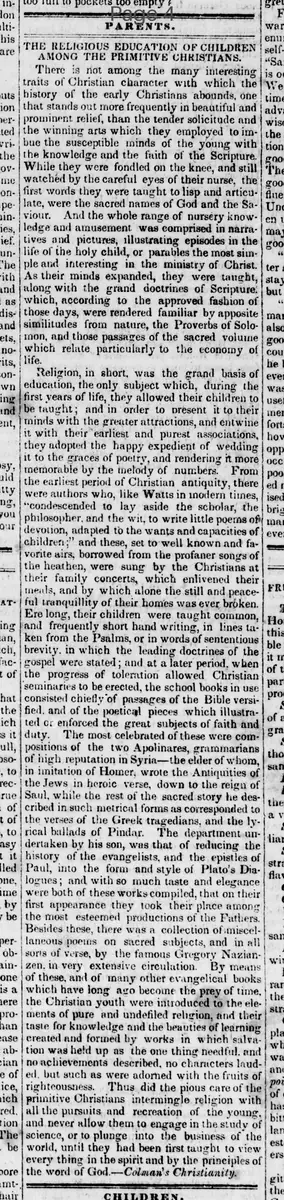
There is not among the many interesting traits of Christian character with which the history of the early Christians abounds, one that stands out more frequently in beautiful and prominent relief, than the tender solicitude and the winning arts which they employed to imbue the susceptible minds of the young with the knowledge and the faith of the Scripture. While they were fondled on the knee, and still watched by the careful eyes of their nurse, the first words they were taught to lisp and articulate, were the sacred names of God and the Saviour. And the whole range of nursery knowledge and amusement was comprised in narratives and pictures, illustrating episodes in the life of the holy child, or parables the most simple and interesting in the ministry of Christ. As their minds expanded, they were taught, along with the grand doctrines of Scripture: which, according to the approved fashion of those days, were rendered familiar by apposite similitudes from nature, the Proverbs of Solomon, and those passages of the sacred volume which relate particularly to the economy of life.
Religion, in short, was the grand basis of education, the only subject which, during the first years of life, they allowed their children to be taught; and in order to present it to their minds with the greater attractions, and entwine it with their earliest and purest associations they adopted the happy expedient of wedding it to the graces of poetry, and rendering it more memorable by the melody of numbers. From the earliest period of Christian antiquity, there were authors who, like Watts in modern times, "condescended to lay aside the scholar, the philosopher, and the wit, to write little poems of devotion, adapted to the wants and capacities of children;" and these, set to well known and favorite airs, borrowed from the profaner songs of the heathen, were sung by the Christians at their family concerts, which enlivened their meals, and by which alone the still and peaceful tranquillity of their homes was ever broken.
Ere long, their children were taught common, and frequently short hand writing, in lines taken from the Psalms, or in words of sententious brevity, in which the leading doctrines of the gospel were stated; and at a later period, when the progress of toleration allowed Christian seminaries to be erected, the school books in use consisted chiefly of passages of the Bible versified, and of the poetical pieces which illustrated or enforced the great subjects of faith and duty. The most celebrated of these were compositions of the two Apollinares, grammarians of high reputation in Syria -- the elder of whom, in imitation of Homer, wrote the Antiquities of the Jews in heroic verse, down to the reign of Saul, while the rest of the sacred story he described in such metrical forms as corresponded to the verses of the Greek tragedians, and the lyrical ballads of Pindar. The department undertaken by his son, was that of reducing the history of the evangelists, and the epistles of Paul, into the form and style of Plato's Dialogues; and with so much taste and elegance were both of these works compiled, that on their first appearance they took their place among the most esteemed productions of the Fathers. Besides these, there was a collection of miscellaneous poems on sacred subjects, and in all sorts of verse, by the famous Gregory Nazianzen, in very extensive circulation. By means of these, and of many other evangelical books which have long ago become the prey of time, the Christian youth were introduced to the elements of pure and undefiled religion, and their taste for knowledge and the beauties of learning created and formed by works in which salvation was held up as the one thing needful, and no achievements described, no characters lauded, but such as were adorned with the fruits of righteousness. Thus did the pious care of the primitive Christians intermingle religion with all the pursuits and recreation of the young, and never allow them to engage in the study of science, or to plunge into the business of the world, until they had been first taught to view every thing in the spirit and by the principles of the word of God. -- Colman's Christianity.
THE RELIGIOUS EDUCATION OF CHILDREN AMONG THE PRIMITIVE CHRISTIANS.
There is not among the many interesting traits of Christian character with which the history of the early Christians abounds, one that stands out more frequently in beautiful and prominent relief, than the tender solicitude and the winning arts which they employed to imbue the susceptible minds of the young with the knowledge and the faith of the Scripture. While they were fondled on the knee, and still watched by the careful eyes of their nurse, the first words they were taught to lisp and articulate, were the sacred names of God and the Saviour. And the whole range of nursery knowledge and amusement was comprised in narratives and pictures, illustrating episodes in the life of the holy child, or parables the most simple and interesting in the ministry of Christ. As their minds expanded, they were taught, along with the grand doctrines of Scripture: which, according to the approved fashion of those days, were rendered familiar by apposite similitudes from nature, the Proverbs of Solomon, and those passages of the sacred volume which relate particularly to the economy of life.
Religion, in short, was the grand basis of education, the only subject which, during the first years of life, they allowed their children to be taught; and in order to present it to their minds with the greater attractions, and entwine it with their earliest and purest associations they adopted the happy expedient of wedding it to the graces of poetry, and rendering it more memorable by the melody of numbers. From the earliest period of Christian antiquity, there were authors who, like Watts in modern times, "condescended to lay aside the scholar, the philosopher, and the wit, to write little poems of devotion, adapted to the wants and capacities of children;" and these, set to well known and favorite airs, borrowed from the profaner songs of the heathen, were sung by the Christians at their family concerts, which enlivened their meals, and by which alone the still and peaceful tranquillity of their homes was ever broken.
Ere long, their children were taught common, and frequently short hand writing, in lines taken from the Psalms, or in words of sententious brevity, in which the leading doctrines of the gospel were stated; and at a later period, when the progress of toleration allowed Christian seminaries to be erected, the school books in use consisted chiefly of passages of the Bible versified, and of the poetical pieces which illustrated or enforced the great subjects of faith and duty. The most celebrated of these were compositions of the two Apollinares, grammarians of high reputation in Syria -- the elder of whom, in imitation of Homer, wrote the Antiquities of the Jews in heroic verse, down to the reign of Saul, while the rest of the sacred story he described in such metrical forms as corresponded to the verses of the Greek tragedians, and the lyrical ballads of Pindar. The department undertaken by his son, was that of reducing the history of the evangelists, and the epistles of Paul, into the form and style of Plato's Dialogues; and with so much taste and elegance were both of these works compiled, that on their first appearance they took their place among the most esteemed productions of the Fathers. Besides these, there was a collection of miscellaneous poems on sacred subjects, and in all sorts of verse, by the famous Gregory Nazianzen, in very extensive circulation. By means of these, and of many other evangelical books which have long ago become the prey of time, the Christian youth were introduced to the elements of pure and undefiled religion, and their taste for knowledge and the beauties of learning created and formed by works in which salvation was held up as the one thing needful, and no achievements described, no characters lauded, but such as were adorned with the fruits of righteousness. Thus did the pious care of the primitive Christians intermingle religion with all the pursuits and recreation of the young, and never allow them to engage in the study of science, or to plunge into the business of the world, until they had been first taught to view every thing in the spirit and by the principles of the word of God. -- Colman's Christianity.
What sub-type of article is it?
Education
Moral Or Religious
What keywords are associated?
Religious Education
Primitive Christians
Children's Faith
Biblical Poetry
Early Christian Seminaries
What entities or persons were involved?
Primitive Christians
Apollinares
Gregory Nazianzen
Colman's Christianity
Editorial Details
Primary Topic
Religious Education Of Children Among Primitive Christians
Stance / Tone
Admiring And Informative
Key Figures
Primitive Christians
Apollinares
Gregory Nazianzen
Colman's Christianity
Key Arguments
Early Christians Taught Children Sacred Names And Biblical Stories From Infancy.
Religion Formed The Basis Of Education, Using Poetry And Songs To Make It Attractive.
Children Learned Writing With Psalms And Gospel Doctrines.
School Books Included Versified Bible Passages And Works By Apollinares And Gregory Nazianzen.
Religion Was Integrated Into All Pursuits Before Worldly Studies.