Thank you for visiting SNEWPapers!
Sign up free
Editorial
September 1, 1862
Indiana State Sentinel
Indianapolis, Marion County, Indiana
What is this article about?
Thurlow Weed's editorial in the Albany Evening Journal critiques abolitionist extremism, arguing the Civil War's goal is Union preservation, not slavery destruction, and warns that radical Northern voices aid the rebellion by alienating border states and the South.
Clipping
OCR Quality
96%
Excellent
Full Text
From the Albany Evening Journal.
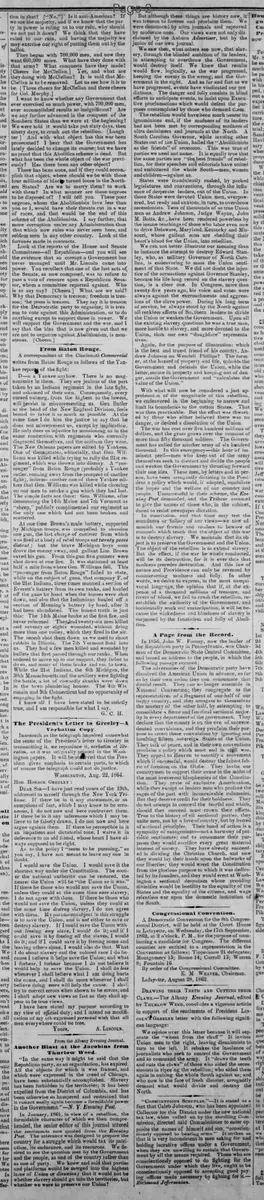
Another Blast at the Jacobins from Thurlow Weed
"In the same way it might be said that the Republican party, as an organization, has expired. All the objects for which it was framed, and which were expressed in the creed of Chicago, have been substantially accomplished. Slavery has been forbidden in the territories; it has been expelled from the District of Columbia, and has been otherwise so hampered and restrained that it cannot easily again become a formidable power in the Government."—N. Y. Evening Post.
In January, 1861, in view of a rebellion, the formidable character of which we then comprehended, the senior editor of this journal uttered the sentiments now quoted from the Evening Post. The utterance was designed to prepare the country for a struggle which would tax its patriotism, its endurance, and its resources. We desired to see the question met by the Government and the people, as one of the country rather than as one of party. We knew and said that parties and platforms would be merged into the highest issue of Union or disunion; that it would not be whether slavery should go into the territories, but whether we were to preserve our Union?
But although these things are history now, it was treason to foresee and proclaim them. We were denounced by ultra journals and reproved by moderate ones. Our views were not only disclaimed by the Auburn Advertiser, but by the junior of our own journal.
We saw then, what others see now, that slavery, through the blinded ambition of its leaders, in attempting to overthrow the Government, would destroy itself. We knew that results would flow, logically, as the war progressed, keeping the enemy in the wrong, and the Government in the right. And as far and fast as we have progressed, events have vindicated our predictions. The danger and folly consists in blind efforts to anticipate events, to insist upon Executive proclamations which would defeat the purposes contemplated by those who demand them. The rebellion would have been much nearer its ignominious end, if the madness of its leaders had not been met by corresponding madness of ultra declaimers and journals at the North. A South Carolina Governor, while inviting other States out of the Union, hailed the "Abolitionists as the friends" of secession. This was true of parties we need not name. It is equally true that the same parties are "the best friends" of rebellion, for their speeches and editorials have united and embittered the whole South—men, women and children—against us.
States were fraudulently rushed, by packed legislatures and conventions, through the influence of desperate leaders, out of the Union. In those States were devoted Union men, overpowered, but ready and anxious, in turn, to overthrow secessionists. Tens of thousands of as true Union men as Andrew Johnson, Judge Wayne, John M. Botts, &c., have been rendered powerless by the insane teachings of those who labor even now to drive Delaware, Maryland, Kentucky and Missouri, whose gallant sons are shedding their heart's blood for the Union, into rebellion.
We can not better illustrate our meaning than to instance the attempt to destroy Edward Stanley, who, as military Governor of North Carolina, is endeavoring to mass the Union sentiment of that State. We did not doubt the injustice of the accusations against Governor Stanley, because his life-long record on the slavery question, is a clear one. In Congress, more than twenty-five years ago, his voice and votes were always against the encroachments and aggressions of the slave power. During his long term of service, he always stood by the North against all reckless efforts of Southern leaders to divide the Union or weaken the Government. Upon all the existing slavery questions he was a true man, more hostile to slavery, and more devoted to the Union, than our own "doughface" representatives.
Again, for the purpose of illustration: which is the best and truest friend of his country, Andrew Johnson or Wendell Phillips? The former, at the hazard of property and life, upholds the Government and defends the Union, while the latter, secure in property and keeping out of danger, assails the Government and "calculates the value of the Union."
With what will now be considered a just apprehension of the magnitude of this rebellion, we endeavored in the beginning to narrow and limit its boundaries to the cotton States. That was then practicable. But the effort was thwarted by those who either believed there was no danger, or desired a dissolution of the Union. The war has cost over five hundred millions of dollars, and the grass grows over the remains of more than fifty thousand soldiers. The Government has called for another army of six hundred thousand. In this emergency—this hour of imminent peril—men who keep out of the army themselves seek to distract and divide the people and weaken the Government by thrusting forward their one idea. These men, by letters and in person, have been arrogantly dictating to the President a policy which would, if adopted, annihilate the hopes and the welfare of our country and people. Unsuccessful in their scheme, the Evening Post demanded, and the Tribune assumed to give the names of—those who, in the cabinet dared to resist newspaper dictation.
In conclusion, and that time may test the soundness or fallacy of our views—we now admonish our friends and readers to beware of counsels which teach that the object of this war is to destroy slavery. We maintain that its object is to preserve the Government and the Union. The object of the rebellion is to extend slavery. But the effect, if the war be wisely conducted, will be its destruction, for it is ever thus that madness precedes destruction. And this law of nature and Providence can only be reversed by counteracting madness and folly. In other words, we desire to express, in the most unequivocal language, the opinion that if, at the expense of a thousand millions of treasure, and rivers of blood, we fail to crush the rebellion, re-establish the authority of the Government, and incidentally work out emancipation, it will be because the wickedness and blindness of slavery is surpassed by the fanaticism and folly of Abolition.
Another Blast at the Jacobins from Thurlow Weed
"In the same way it might be said that the Republican party, as an organization, has expired. All the objects for which it was framed, and which were expressed in the creed of Chicago, have been substantially accomplished. Slavery has been forbidden in the territories; it has been expelled from the District of Columbia, and has been otherwise so hampered and restrained that it cannot easily again become a formidable power in the Government."—N. Y. Evening Post.
In January, 1861, in view of a rebellion, the formidable character of which we then comprehended, the senior editor of this journal uttered the sentiments now quoted from the Evening Post. The utterance was designed to prepare the country for a struggle which would tax its patriotism, its endurance, and its resources. We desired to see the question met by the Government and the people, as one of the country rather than as one of party. We knew and said that parties and platforms would be merged into the highest issue of Union or disunion; that it would not be whether slavery should go into the territories, but whether we were to preserve our Union?
But although these things are history now, it was treason to foresee and proclaim them. We were denounced by ultra journals and reproved by moderate ones. Our views were not only disclaimed by the Auburn Advertiser, but by the junior of our own journal.
We saw then, what others see now, that slavery, through the blinded ambition of its leaders, in attempting to overthrow the Government, would destroy itself. We knew that results would flow, logically, as the war progressed, keeping the enemy in the wrong, and the Government in the right. And as far and fast as we have progressed, events have vindicated our predictions. The danger and folly consists in blind efforts to anticipate events, to insist upon Executive proclamations which would defeat the purposes contemplated by those who demand them. The rebellion would have been much nearer its ignominious end, if the madness of its leaders had not been met by corresponding madness of ultra declaimers and journals at the North. A South Carolina Governor, while inviting other States out of the Union, hailed the "Abolitionists as the friends" of secession. This was true of parties we need not name. It is equally true that the same parties are "the best friends" of rebellion, for their speeches and editorials have united and embittered the whole South—men, women and children—against us.
States were fraudulently rushed, by packed legislatures and conventions, through the influence of desperate leaders, out of the Union. In those States were devoted Union men, overpowered, but ready and anxious, in turn, to overthrow secessionists. Tens of thousands of as true Union men as Andrew Johnson, Judge Wayne, John M. Botts, &c., have been rendered powerless by the insane teachings of those who labor even now to drive Delaware, Maryland, Kentucky and Missouri, whose gallant sons are shedding their heart's blood for the Union, into rebellion.
We can not better illustrate our meaning than to instance the attempt to destroy Edward Stanley, who, as military Governor of North Carolina, is endeavoring to mass the Union sentiment of that State. We did not doubt the injustice of the accusations against Governor Stanley, because his life-long record on the slavery question, is a clear one. In Congress, more than twenty-five years ago, his voice and votes were always against the encroachments and aggressions of the slave power. During his long term of service, he always stood by the North against all reckless efforts of Southern leaders to divide the Union or weaken the Government. Upon all the existing slavery questions he was a true man, more hostile to slavery, and more devoted to the Union, than our own "doughface" representatives.
Again, for the purpose of illustration: which is the best and truest friend of his country, Andrew Johnson or Wendell Phillips? The former, at the hazard of property and life, upholds the Government and defends the Union, while the latter, secure in property and keeping out of danger, assails the Government and "calculates the value of the Union."
With what will now be considered a just apprehension of the magnitude of this rebellion, we endeavored in the beginning to narrow and limit its boundaries to the cotton States. That was then practicable. But the effort was thwarted by those who either believed there was no danger, or desired a dissolution of the Union. The war has cost over five hundred millions of dollars, and the grass grows over the remains of more than fifty thousand soldiers. The Government has called for another army of six hundred thousand. In this emergency—this hour of imminent peril—men who keep out of the army themselves seek to distract and divide the people and weaken the Government by thrusting forward their one idea. These men, by letters and in person, have been arrogantly dictating to the President a policy which would, if adopted, annihilate the hopes and the welfare of our country and people. Unsuccessful in their scheme, the Evening Post demanded, and the Tribune assumed to give the names of—those who, in the cabinet dared to resist newspaper dictation.
In conclusion, and that time may test the soundness or fallacy of our views—we now admonish our friends and readers to beware of counsels which teach that the object of this war is to destroy slavery. We maintain that its object is to preserve the Government and the Union. The object of the rebellion is to extend slavery. But the effect, if the war be wisely conducted, will be its destruction, for it is ever thus that madness precedes destruction. And this law of nature and Providence can only be reversed by counteracting madness and folly. In other words, we desire to express, in the most unequivocal language, the opinion that if, at the expense of a thousand millions of treasure, and rivers of blood, we fail to crush the rebellion, re-establish the authority of the Government, and incidentally work out emancipation, it will be because the wickedness and blindness of slavery is surpassed by the fanaticism and folly of Abolition.
What sub-type of article is it?
War Or Peace
Slavery Abolition
Partisan Politics
What keywords are associated?
Civil War
Union Preservation
Slavery
Abolitionists
Rebellion
Thurlow Weed
Republican Party
Northern Radicals
What entities or persons were involved?
Thurlow Weed
Republican Party
N. Y. Evening Post
Andrew Johnson
Wendell Phillips
Edward Stanley
Abolitionists
South Carolina Governor
Editorial Details
Primary Topic
Preserving The Union Amid Civil War Rebellion, Critiquing Abolitionist Extremism
Stance / Tone
Critical Of Northern Abolitionists And Radicals For Aiding Rebellion; Advocates Focusing On Union Preservation Over Immediate Emancipation
Key Figures
Thurlow Weed
Republican Party
N. Y. Evening Post
Andrew Johnson
Wendell Phillips
Edward Stanley
Abolitionists
South Carolina Governor
Key Arguments
Republican Party's Anti Slavery Objectives Largely Accomplished Through War Measures
War's Primary Aim Is Union Preservation, Not Slavery Destruction
Ultra Northern Abolitionists Embitter South And Aid Secession By Radical Rhetoric
True Union Men In South Like Andrew Johnson Are Undermined By Northern Extremists
Criticism Of Attempts To Dictate Policy To President, E.G., Against Edward Stanley
Rebellion Driven By Slavery's Ambition, But Northern Fanaticism Prolongs It
Wise Conduct Of War Will Incidentally Lead To Emancipation Without Radical Pushes