Thank you for visiting SNEWPapers!
Sign up free
Editorial
December 6, 1808
The Enquirer
Richmond, Henrico County, Virginia
What is this article about?
Editorial No. II addresses Eastern states, comparing current British and French maritime aggressions to 1776, arguing they threaten U.S. independence and trade. Advocates embargo and non-intercourse over war or submission to preserve honor and rights.
Clipping
OCR Quality
95%
Excellent
Full Text
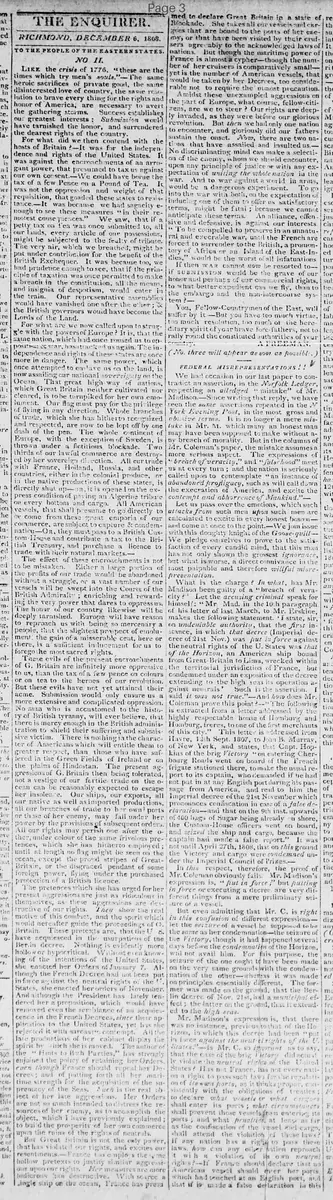
THE ENQUIRER.
RICHMOND, DECEMBER 6. 1808.
TO THE PEOPLE OF THE EASTERN STATES.
NO. II.
Like the crisis of 1776, "these are the times which try men's souls."—The same heroic sacrifices of private good, the same disinterested love of country, the same resolution to brave every thing for the rights and honor of America, are necessary to avert the gathering storms. Success establishes our greatest interests: Submission would have tarnished the honor, and surrendered the dearest rights of the country.
For what did we then contend with the hosts of Britain?—It was for the independence and rights of the United States. It was against the encroachments of an arrogant power, that presumed to tax us against our own consent.—We could have borne the tax of a few pence on a pound of Tea. It was not the oppression and weight of that requisition, that goaded these states to resistance.—It was because we had sagacity enough to see these measures "in their remotest consequences."
We saw, that if a petty tax on Tea was once submitted to, all our lands, every article of our possessions, might be subjected to the fealty of tribute. The very air, which we breathed, might be put under contribution for the benefit of the British Exchequer. It was because too, we had prudence enough to see, that if the principle of taxation was once permitted to make a breach in the constitution, all the means, and insignia of despotism, would enter in the train. Our representative assemblies would have vanished one after the other: & the British governors would have become the Lords of the Land.
For what are we now called upon to struggle with the powers of Europe? It is, that the same nation, which had once roused us to opposition & war, has attacked us again. The independence and rights of these states are once more in danger. The same power, which once attempted to enslave us on the land, is now assailing our national sovereignty on the Ocean. That great high-way of nations, which Great Britain neither cultivated nor cleared, is to be turnpiked for her own emolument. Our flag must pay for the privilege of flying in any direction. Whole branches of trade, which she has hitherto recognized and respected, are now to be lopped off by one dash of the pen. The whole continent of Europe, with the exception of Sweden, is thrown under a fictitious blockade. Two thirds of our lawful commerce are destroyed by her sovereign direction. All our trade with France, Holland, Russia, and other countries, either in the colonial produce, or in the native productions of these states, is directly shut up—on it is open on the express condition of paying an Algerine tribute on every bottom and cargo. All American vessels, that shall presume to go directly to or come from these great emporia of our commerce, are subject to capture & condemnation—Or, they must pass to a British Custom-House and contribute a tax to the British Treasury, and purchase a licence to trade with their natural markets.—
The effect of these encroachments is not to be mistaken. Either a large portion of the profits of our trade would be abandoned without a struggle, or a vast number of our vessels will be swept into the Courts of the British Admiralty: enriching and rewarding the very power that dares to oppress us: The honor of our country likewise will be deeply tarnished. Europe will have reason to reproach us with being so mercenary a people, that the slightest prospect of emolument the gain of a miserable cent, here or there, is a sufficient inducement for us to forego the most sacred rights.
These evils of the present encroachments of G. Britain are infinitely more oppressive to us, than the tax of a few pence on colours or on tea to the heroes of our revolution. But these evils have not yet attained their acme. Submission would only ensure us a more extensive and complicated oppression. No man who is accustomed to the history of British tyranny, will ever believe, that there is mercy enough in the British administration to shield their suffering and submissive victim. There is nothing in the character of Americans which will entitle them to greater respect, than those who have suffered in the Green Fields of Ireland or on the plains of Hindostan. The present aggressions of G. Britain then being tolerated, not a vestige of our fertile trade on the ocean can be reasonably expected to escape her insolence. Our ships, our exports, all our native as well as imported productions, all our branches of trade to her own ports or those of her enemy, may fall under her power by the provisions of subsequent orders. All our rights may perish one after the other, under colour of the same frivolous pretences, which she has hitherto employed; until at length no flag might be seen on the ocean, except the proud stripes of Great-Britain, or the disgraced pendant of some foreign power, flying under the purchased protection of a British licence.
The pretences which she has urged for her present aggressions are just as ridiculous in themselves, as these aggressions are destructive of our rights. They show the real motive of this conduct, and the spirit which would hereafter guide the proceedings of G. Britain. These pretexts are, that the U. S. have acquiesced in the usurpations of the Berlin decree. Nothing is evidently more hollow or hypocritical. Without even knowing of the intentions of the United States, she enacted her Orders of January 7. Although the French Decree had not been put in force against the neutral rights of the U. States, she enacted her orders of November. And although the President has lately tendered her a proposition, which would have removed even the semblance of an acquiescence in the French Decrees, since their application to the United States, yet has she rejected it with sarcastic contempt. All the late productions of her cabinet display the spirit by which she is moved. The author of the "Hints to Both Parties," has strongly enjoined the policy of retaining her Orders, even though France should repeal her Decrees; and of putting forth all her maritime strength for the acquisition of the supremacy of the Seas. Such is the real object of her late aggressions. Her Orders are not so much intended to distress the resources of her enemy, as to accomplish the object, which I have previously explained; to build the prosperity of her own commerce upon the ruins of the rights of neutrals.
But Great Britain is not the only power, that has violated our rights, and excites our resentments.—France too employs the same hollow pretexts to justify similar aggressions upon our rights. Her measures are more ludicrous than destructive. With scarce a single ship on the ocean, France has presumed to declare Great Britain in a state of Blockade. She takes all our vessels and cargoes that are bound to the ports of her enemy, or that have been visited by their cruisers agreeably to the acknowledged laws of nations. But though the maritime power of France is almost a cypher—though the number of her cruisers is comparatively small—yet is the number of American vessels, that would be taken by her Decrees, too considerable not to require the utmost precaution.
Amidst these unexampled aggressions on the part of Europe, what course, fellow-citizens, are we to steer? Our rights are deeply invaded, as they were before our glorious revolution. But then we had only one nation to encounter, and gloriously did our fathers sustain the onset. Now, there are two nations that have assailed and insulted us.—No discriminating mind can make a selection of the enemy, whom we should encounter, upon any principle of justice or with any expectation of uniting the whole nation in the war. And to war against a world in arms, would be a dangerous experiment.
To go into the war with both, on the expectation or inducing one of them to offer us satisfactory terms, might be fatal; because we cannot anticipate these terms. An alliance, offensive and defensive, is against our interests. "To be compelled to persevere in an unnatural and execrable war, until the French are forced to surrender to the British, a promontory of Africa or an Island of the East-Indies," would be the worst of all infatuations.
If then war cannot now be resorted to—if submission would be the grave of our honor and perhaps of our commercial rights, to what better expedient can we fly, than to the embargo and the non-intercourse system?—
You, Fellow-Countrymen of the East, will suffer by it—But you have too much virtue, too much resolution, too much of the hereditary spirit of your brave fore-fathers, not to rally round the constituted authorities of your country.
(No. three will appear as soon as possible.)
RICHMOND, DECEMBER 6. 1808.
TO THE PEOPLE OF THE EASTERN STATES.
NO. II.
Like the crisis of 1776, "these are the times which try men's souls."—The same heroic sacrifices of private good, the same disinterested love of country, the same resolution to brave every thing for the rights and honor of America, are necessary to avert the gathering storms. Success establishes our greatest interests: Submission would have tarnished the honor, and surrendered the dearest rights of the country.
For what did we then contend with the hosts of Britain?—It was for the independence and rights of the United States. It was against the encroachments of an arrogant power, that presumed to tax us against our own consent.—We could have borne the tax of a few pence on a pound of Tea. It was not the oppression and weight of that requisition, that goaded these states to resistance.—It was because we had sagacity enough to see these measures "in their remotest consequences."
We saw, that if a petty tax on Tea was once submitted to, all our lands, every article of our possessions, might be subjected to the fealty of tribute. The very air, which we breathed, might be put under contribution for the benefit of the British Exchequer. It was because too, we had prudence enough to see, that if the principle of taxation was once permitted to make a breach in the constitution, all the means, and insignia of despotism, would enter in the train. Our representative assemblies would have vanished one after the other: & the British governors would have become the Lords of the Land.
For what are we now called upon to struggle with the powers of Europe? It is, that the same nation, which had once roused us to opposition & war, has attacked us again. The independence and rights of these states are once more in danger. The same power, which once attempted to enslave us on the land, is now assailing our national sovereignty on the Ocean. That great high-way of nations, which Great Britain neither cultivated nor cleared, is to be turnpiked for her own emolument. Our flag must pay for the privilege of flying in any direction. Whole branches of trade, which she has hitherto recognized and respected, are now to be lopped off by one dash of the pen. The whole continent of Europe, with the exception of Sweden, is thrown under a fictitious blockade. Two thirds of our lawful commerce are destroyed by her sovereign direction. All our trade with France, Holland, Russia, and other countries, either in the colonial produce, or in the native productions of these states, is directly shut up—on it is open on the express condition of paying an Algerine tribute on every bottom and cargo. All American vessels, that shall presume to go directly to or come from these great emporia of our commerce, are subject to capture & condemnation—Or, they must pass to a British Custom-House and contribute a tax to the British Treasury, and purchase a licence to trade with their natural markets.—
The effect of these encroachments is not to be mistaken. Either a large portion of the profits of our trade would be abandoned without a struggle, or a vast number of our vessels will be swept into the Courts of the British Admiralty: enriching and rewarding the very power that dares to oppress us: The honor of our country likewise will be deeply tarnished. Europe will have reason to reproach us with being so mercenary a people, that the slightest prospect of emolument the gain of a miserable cent, here or there, is a sufficient inducement for us to forego the most sacred rights.
These evils of the present encroachments of G. Britain are infinitely more oppressive to us, than the tax of a few pence on colours or on tea to the heroes of our revolution. But these evils have not yet attained their acme. Submission would only ensure us a more extensive and complicated oppression. No man who is accustomed to the history of British tyranny, will ever believe, that there is mercy enough in the British administration to shield their suffering and submissive victim. There is nothing in the character of Americans which will entitle them to greater respect, than those who have suffered in the Green Fields of Ireland or on the plains of Hindostan. The present aggressions of G. Britain then being tolerated, not a vestige of our fertile trade on the ocean can be reasonably expected to escape her insolence. Our ships, our exports, all our native as well as imported productions, all our branches of trade to her own ports or those of her enemy, may fall under her power by the provisions of subsequent orders. All our rights may perish one after the other, under colour of the same frivolous pretences, which she has hitherto employed; until at length no flag might be seen on the ocean, except the proud stripes of Great-Britain, or the disgraced pendant of some foreign power, flying under the purchased protection of a British licence.
The pretences which she has urged for her present aggressions are just as ridiculous in themselves, as these aggressions are destructive of our rights. They show the real motive of this conduct, and the spirit which would hereafter guide the proceedings of G. Britain. These pretexts are, that the U. S. have acquiesced in the usurpations of the Berlin decree. Nothing is evidently more hollow or hypocritical. Without even knowing of the intentions of the United States, she enacted her Orders of January 7. Although the French Decree had not been put in force against the neutral rights of the U. States, she enacted her orders of November. And although the President has lately tendered her a proposition, which would have removed even the semblance of an acquiescence in the French Decrees, since their application to the United States, yet has she rejected it with sarcastic contempt. All the late productions of her cabinet display the spirit by which she is moved. The author of the "Hints to Both Parties," has strongly enjoined the policy of retaining her Orders, even though France should repeal her Decrees; and of putting forth all her maritime strength for the acquisition of the supremacy of the Seas. Such is the real object of her late aggressions. Her Orders are not so much intended to distress the resources of her enemy, as to accomplish the object, which I have previously explained; to build the prosperity of her own commerce upon the ruins of the rights of neutrals.
But Great Britain is not the only power, that has violated our rights, and excites our resentments.—France too employs the same hollow pretexts to justify similar aggressions upon our rights. Her measures are more ludicrous than destructive. With scarce a single ship on the ocean, France has presumed to declare Great Britain in a state of Blockade. She takes all our vessels and cargoes that are bound to the ports of her enemy, or that have been visited by their cruisers agreeably to the acknowledged laws of nations. But though the maritime power of France is almost a cypher—though the number of her cruisers is comparatively small—yet is the number of American vessels, that would be taken by her Decrees, too considerable not to require the utmost precaution.
Amidst these unexampled aggressions on the part of Europe, what course, fellow-citizens, are we to steer? Our rights are deeply invaded, as they were before our glorious revolution. But then we had only one nation to encounter, and gloriously did our fathers sustain the onset. Now, there are two nations that have assailed and insulted us.—No discriminating mind can make a selection of the enemy, whom we should encounter, upon any principle of justice or with any expectation of uniting the whole nation in the war. And to war against a world in arms, would be a dangerous experiment.
To go into the war with both, on the expectation or inducing one of them to offer us satisfactory terms, might be fatal; because we cannot anticipate these terms. An alliance, offensive and defensive, is against our interests. "To be compelled to persevere in an unnatural and execrable war, until the French are forced to surrender to the British, a promontory of Africa or an Island of the East-Indies," would be the worst of all infatuations.
If then war cannot now be resorted to—if submission would be the grave of our honor and perhaps of our commercial rights, to what better expedient can we fly, than to the embargo and the non-intercourse system?—
You, Fellow-Countrymen of the East, will suffer by it—But you have too much virtue, too much resolution, too much of the hereditary spirit of your brave fore-fathers, not to rally round the constituted authorities of your country.
(No. three will appear as soon as possible.)
What sub-type of article is it?
Foreign Affairs
Economic Policy
War Or Peace
What keywords are associated?
Embargo
Non Intercourse
British Orders
French Decrees
Neutral Rights
American Trade
Maritime Aggressions
What entities or persons were involved?
Great Britain
France
United States
British Admiralty
President
Editorial Details
Primary Topic
Defense Of Embargo Against British And French Maritime Aggressions
Stance / Tone
Strongly Supportive Of Embargo And Non Intercourse, Critical Of British And French Encroachments
Key Figures
Great Britain
France
United States
British Admiralty
President
Key Arguments
Current Crisis Mirrors 1776 Revolution In Threatening American Rights And Independence
British Orders In Council Impose Tribute On U.S. Trade And Violate Neutral Rights
French Berlin Decree And Blockades Similarly Aggress Against U.S. Commerce
Submission Would Lead To Further Oppression And Loss Of Honor
War Against Both Powers Is Impractical And Risky
Embargo And Non Intercourse Are Preferable To Preserve Rights Without War