Thank you for visiting SNEWPapers!
Sign up free
Story
March 1, 1832
Herald Of The Times
Newport, Newport County, Rhode Island
What is this article about?
US Senator Theodore Frelinghuysen delivers a speech at a Washington temperance meeting on January 20, praising the success of total abstinence from ardent spirits, crediting divine providence and written pledges, and urging moderate drinkers to join the cause to protect society from intemperance.
Clipping
OCR Quality
95%
Excellent
Full Text
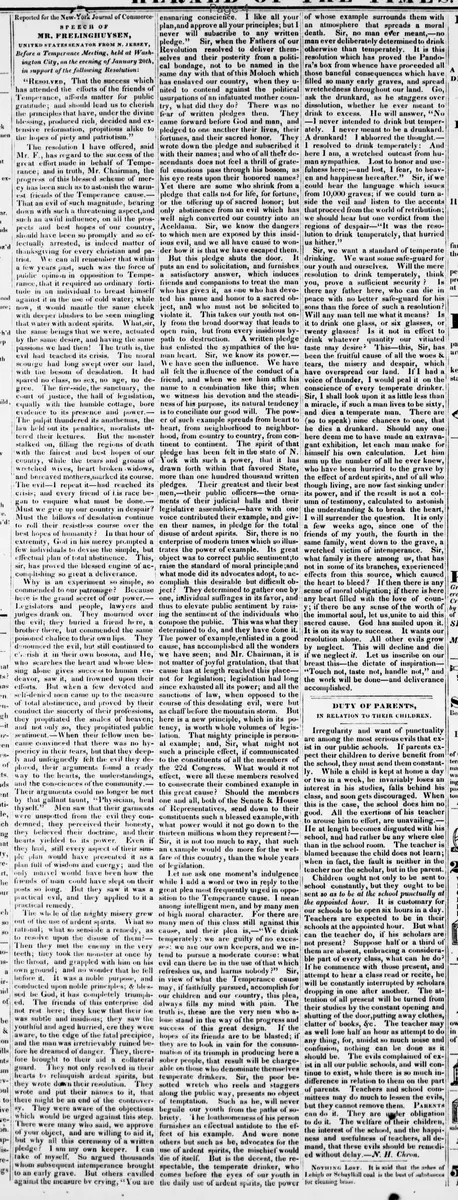
MR. FRELINGHUYSEN, UNITED STATES SENATOR FROM N. JERSEY,
Before a Temperance Meeting, held at Washington City, on the evening of January 20th, in support of the following Resolution:
"Resolved, That the success which has attended the efforts of the friends of Temperance, affords matter for public gratitude; and should lead us to cherish the principles that have, under the divine blessing, produced rich, decided and extensive reformation, propitious alike to the hopes of piety and patriotism."
The resolution I have offered, said Mr. F., has regard to the success of the great effort made in behalf of Temperance; and in truth, Mr. Chairman, the progress of this blessed scheme of mercy has been such as to astonish the warmest friends of the Temperance cause.— That an evil of such magnitude, bearing down with such a threatening aspect, and such an awful influence, on all the prospects and best hopes of our country, should have been so promptly and so effectually arrested, is indeed matter of thanksgiving for every christian and patriot. We can all remember that within a few years past, such was the force of public opinion in opposition to Temperance, that it required no ordinary fortitude in an individual to breast himself against it in the use of cold water; while now, it would mantle the same cheek with deeper blushes to be seen mingling that water with ardent spirits. What, sir, the same beings that we were, actuated by the same desire, and having the same passions we had then! The truth is, the evil had reached its crisis. The moral scourge had long swept over our land, with the besom of desolation. It had spared no class, no sex, no age, no degree. The fire-side, the sanctuary, the court of justice, the hall of legislation, equally with the humble cottage, bore evidence to its presence and power.— The pulpit thundered its anathemas, the law held out its penalties, moralists uttered their lectures. But the monster stalked on, filling the regions of death with the fairest and best hopes of our country, while the tears and groans of wretched wives, heart broken widows, and bereaved mothers, marked its course. The evil—I repeat it—had reached its crisis; and every friend of his race began to enquire what must be done.— Must we give up our country in despair? Must the billows of desolation continue to roll their resistless course over the best hopes of humanity? In that hour of extremity, God in his mercy prompted a few individuals to devise the simple, but effectual plan of total abstinence. This, sir, has proved the blessed engine of accomplishing so great a deliverance. Why is an experiment so simple, so commended to our patronage? Because here is the grand secret of our power.— Legislators and people, lawyers and judges drank on. They mourned over the evil; they buried a friend here, a brother there, but commended the same poisoned chalice to their own lips. They denounced the evil, but still continued to cherish it in their own bosom, and He, who searches the heart and whose blessing alone gives success to human endeavor, saw it, and frowned upon their efforts. But when a few devoted and self-denied men came up to the measure of total abstinence, and proved by their conduct the sincerity of their professions, they propitiated the smiles of heaven; and not only so, they propitiated public sentiment.—When their fellow men became convinced that there was no hypocrisy in their tears, but that they deeply and unfeignedly felt the evil they deplored, their arguments found a ready way to the hearts, the understandings, and the consciences of the community.— Their arguments could no longer be met by that gallant taunt, "Physician, heal thyself." Men saw that their garments were unspotted from the evil they condemned; they perceived their honesty, they believed their doctrine, and their hearts yielded to its power. Even if they had, still every aspect of their simple plan would have presented it as a plan full of wisdom and energy; and the only marvel would have been how the friends of man could have slept on their posts so long. But they saw it was a practical evil, and they applied to it a practical remedy. The whole of the mighty misery grew out of the use of ardent spirits. What so rational; what so sensible a remedy, as to resolve upon the disuse of them?— Then they met the enemy in the very teeth; they took the monster at once by the throat, and grappled with him on his own ground; and no wonder that he fell before it. It was a noble purpose, and conducted upon noble principles; & blessed be God, it has completely triumphed. The friends of this enterprise did not rest here; they knew that their foe was subtle and insidious; they saw the youthful and aged hurried, ere they were aware, to the edge of the fatal precipice, and the man was irretrievably ruined before he dreamed of danger. They, therefore brought to their aid a collateral guard. They not only resolved in their hearts to relinquish ardent spirits, but they wrote down their resolution. They wrote and put their names to it, that there might be an end of the controversy. They were aware of the objections which would be urged against this step. There were many who said, we approve of your object, and are willing to aid it, but why all this ceremony of a written pledge? I am my own keeper. I can take care of myself. 'So argued thousands whom subsequent intemperance brought to an early grave. But others cavilled against the measure by crying, "You are ensnaring conscience. I like all your plan, and approve all your principles; but I never will subscribe to any written pledge." Sir, when the Fathers of our Revolution resolved to deliver themselves and their posterity from a political bondage, not to be named in the same day with that of this Moloch which has enslaved our country, when they united to contend against the political usurpations of an infatuated mother country, what did they do? There was no fear of written pledges then. They came forward before God and man, and pledged to one another their lives, "their fortunes, and their sacred honor. They wrote down the pledge and subscribed it with their names; and who of all their descendants does not feel a thrill of grateful emotions pass through his bosom, as his eye rests upon their honored names? Yet there are some who shrink from a pledge that calls not for life, for fortune, or the offering up of sacred honor; but only abstinence from an evil which has well nigh converted our country into an Aceldama. Sir, we know the dangers to which men are exposed by this insidious evil, and we all have cause to wonder how it is that we have escaped them. But this pledge shuts the door. It puts an end to solicitation, and furnishes a satisfactory answer, which induces friends and companions to treat the man who has given it, as one who has devoted his name and honor to a sacred object, and who must not be solicited to violate it. This takes our youth not only from the broad doorway that leads to open ruin, but from every insidious by-path to destruction. A written pledge has enlisted the sympathies of the human heart. Sir, we know its power.— We have seen the influence. We have all felt the influence of the conduct of a friend, and when we see him affix his name to a combination like this; when we witness his devotion and the steadiness of his purpose, its natural tendency is to conciliate our good will. The power of such example spreads from heart to heart, from neighborhood to neighborhood, from country to country, from continent to continent. The spirit of that pledge has been felt in the state of N. York with such a power, that it has drawn forth within that favored State, more than one hundred thousand written pledges. Their greatest and their best men,-their public officers-the ornaments of their judicial halls and their legislative assemblies, have with one voice contributed their example, and given their names, in pledge for the total disuse of ardent spirits. Sir, there is no enterprise of modern times which so illustrates the power of example. Its great object was to correct public sentiment; to raise the standard of moral principle; and what mode did its advocates adopt, to accomplish this desirable but difficult object? They determined to gather one by one, individual suffrages in its favor, and thus to elevate public sentiment by raising the sentiment of the individuals who compose the public. This was what they determined to do, and they have done it. The power of example, enlisted in a good cause, has accomplished all the wonders we have seen; and Mr. Chairman, it is not matter of joyful gratulation, that that cause has at length reached this place- not for legislation; legislation had long since exhausted all its power; and all the sanctions of law, when opposed to the course of this desolating evil, were but as chaff before the mountain storm. But here is a new principle, which in its potency, is worth whole volumes of legislation. That mighty principle is personal example; and, Sir, what might not such a principle effect, if communicated to the constituents of all the members of the 22d Congress. What would it not effect, were all these members resolved to consecrate their combined example in this great cause? Should the members one and all, both of the Senate & House of Representatives, send down to their constituents such a blessed example, with what power would it not go down to the thirteen millions whom they represent?— Sir, it is not too much to say, that such an example would do more for the welfare of this country, than the whole years of legislation.
Let me ask one moment's indulgence while I add a word or two in reply to the great plea most frequently urged in opposition to the Temperance cause. I mean among intelligent men, and by many men of high moral character. For there are many men of this class still against this cause, and their plea is,-"We drink temperately: we are guilty of no excesses: we are our own keepers, and we intend to pursue a moderate course: what evil can there be in the use of that which refreshes us, and harms nobody?" Sir, in view of what the Temperance cause may, if faithfully pursued, accomplish for our children and our country, this plea, always fills my mind with pain. The truth is, these are the very men who alone stand in the way of the progress and success of this great design. If the hopes of its friends are to be blasted; if they are to look in vain for the consummation of its triumph in producing here a sober people, that result will be chargeable on those who denominate themselves temperate drinkers. Sir, the poor besotted wretch who reels and staggers along the public way, presents no object of temptation. Such as he, will never beguile our youth from the paths of sobriety. The loathsomeness of his person furnishes an effectual antidote to the effect of his example. And were none others but such as he, advocates for the use of ardent spirits, the mischief would die of itself. But it is the decent, the respectable, the temperate drinker, who comes before the eyes of our youth in the daily use of ardent spirits, the power of whose example surrounds them with an atmosphere that spreads a moral death. Sir, no man ever meant,-no man ever deliberately determined to drink otherwise than temperately. It is this resolution which has proved the Pandora's box from whence have proceeded all those baneful consequences which have filled so many early graves, and spread wretchedness throughout our land. 'Go, ask the drunkard, as he staggers over dissolution, whether he ever meant to drink to excess. He will answer, "No -I never intended to drink but temperately. I never meant to be a drunkard. A drunkard! I abhorred the thought.- I resolved to drink temperately: And here I am, a wretched outcast from human sympathies. Lost to honor and usefulness here;-and lost, I fear, to heaven and happiness hereafter." Sir, if we could hear the language which issues from 10,000 graves; if we could turn aside the veil and listen to the accents that proceed from the world of retribution: we should hear but one verdict from the regions of despair-"It was the resolution to drink temperately, that hurried us hither." Sir, we want a standard of temperate drinking. We want some safe-guard for our youth and ourselves. Will the mere resolution to drink temperately, think you, prove a sufficient security? Is there any father here, who can die in peace with no better safe-guard for his sons than the force of such a resolution? Will any man tell me what it means? Is it to drink one glass, or six glasses, or twenty glasses? Is it not in effect to drink whatever quantity our vitiated taste may desire? This—this, Sir, has been the fruitful cause of all the woes & tears, the misery and despair, which have overspread our land. 'If I had a voice of thunder, I would peal it on the conscience of every temperate drinker. Sir, I shall look upon it as little less than a miracle, if such a man lives to be sixty, and dies a temperate man. There are (so to speak) nine chances to one, that he dies a drunkard. Should any one here deem me to have made an extravagant exhibition, let each man make for himself his own calculation. Let him sum up the number of all he ever knew, who have been hurried to the grave by the effect of ardent spirits, and of all who though living, are now fast sinking under its power, and if the result is not a column of testimony, calculated to astonish the understanding & to break the heart, I will surrender the question. It is only a few weeks ago, since one of the friends of my youth, the fourth in the same family, went down to the grave, a wretched victim of intemperance. Sir, what family is there among us, that has not in some of its branches, experienced effects from this source, which caused the heart to bleed? If then there is any sense of moral obligation; if there is here any heart filled with the love of country; if there be any sense of the worth of the immortal soul, let us, unite to aid this sacred cause. God has smiled upon it. It is on its way to success. It wants our resolution alone. All other evils grow by neglect. This will decline and die if we neglect it. Let us inscribe on our breast this-the dictate of inspiration- "Touch not, taste not, handle not," and the work will be done--and deliverance accomplished.
Before a Temperance Meeting, held at Washington City, on the evening of January 20th, in support of the following Resolution:
"Resolved, That the success which has attended the efforts of the friends of Temperance, affords matter for public gratitude; and should lead us to cherish the principles that have, under the divine blessing, produced rich, decided and extensive reformation, propitious alike to the hopes of piety and patriotism."
The resolution I have offered, said Mr. F., has regard to the success of the great effort made in behalf of Temperance; and in truth, Mr. Chairman, the progress of this blessed scheme of mercy has been such as to astonish the warmest friends of the Temperance cause.— That an evil of such magnitude, bearing down with such a threatening aspect, and such an awful influence, on all the prospects and best hopes of our country, should have been so promptly and so effectually arrested, is indeed matter of thanksgiving for every christian and patriot. We can all remember that within a few years past, such was the force of public opinion in opposition to Temperance, that it required no ordinary fortitude in an individual to breast himself against it in the use of cold water; while now, it would mantle the same cheek with deeper blushes to be seen mingling that water with ardent spirits. What, sir, the same beings that we were, actuated by the same desire, and having the same passions we had then! The truth is, the evil had reached its crisis. The moral scourge had long swept over our land, with the besom of desolation. It had spared no class, no sex, no age, no degree. The fire-side, the sanctuary, the court of justice, the hall of legislation, equally with the humble cottage, bore evidence to its presence and power.— The pulpit thundered its anathemas, the law held out its penalties, moralists uttered their lectures. But the monster stalked on, filling the regions of death with the fairest and best hopes of our country, while the tears and groans of wretched wives, heart broken widows, and bereaved mothers, marked its course. The evil—I repeat it—had reached its crisis; and every friend of his race began to enquire what must be done.— Must we give up our country in despair? Must the billows of desolation continue to roll their resistless course over the best hopes of humanity? In that hour of extremity, God in his mercy prompted a few individuals to devise the simple, but effectual plan of total abstinence. This, sir, has proved the blessed engine of accomplishing so great a deliverance. Why is an experiment so simple, so commended to our patronage? Because here is the grand secret of our power.— Legislators and people, lawyers and judges drank on. They mourned over the evil; they buried a friend here, a brother there, but commended the same poisoned chalice to their own lips. They denounced the evil, but still continued to cherish it in their own bosom, and He, who searches the heart and whose blessing alone gives success to human endeavor, saw it, and frowned upon their efforts. But when a few devoted and self-denied men came up to the measure of total abstinence, and proved by their conduct the sincerity of their professions, they propitiated the smiles of heaven; and not only so, they propitiated public sentiment.—When their fellow men became convinced that there was no hypocrisy in their tears, but that they deeply and unfeignedly felt the evil they deplored, their arguments found a ready way to the hearts, the understandings, and the consciences of the community.— Their arguments could no longer be met by that gallant taunt, "Physician, heal thyself." Men saw that their garments were unspotted from the evil they condemned; they perceived their honesty, they believed their doctrine, and their hearts yielded to its power. Even if they had, still every aspect of their simple plan would have presented it as a plan full of wisdom and energy; and the only marvel would have been how the friends of man could have slept on their posts so long. But they saw it was a practical evil, and they applied to it a practical remedy. The whole of the mighty misery grew out of the use of ardent spirits. What so rational; what so sensible a remedy, as to resolve upon the disuse of them?— Then they met the enemy in the very teeth; they took the monster at once by the throat, and grappled with him on his own ground; and no wonder that he fell before it. It was a noble purpose, and conducted upon noble principles; & blessed be God, it has completely triumphed. The friends of this enterprise did not rest here; they knew that their foe was subtle and insidious; they saw the youthful and aged hurried, ere they were aware, to the edge of the fatal precipice, and the man was irretrievably ruined before he dreamed of danger. They, therefore brought to their aid a collateral guard. They not only resolved in their hearts to relinquish ardent spirits, but they wrote down their resolution. They wrote and put their names to it, that there might be an end of the controversy. They were aware of the objections which would be urged against this step. There were many who said, we approve of your object, and are willing to aid it, but why all this ceremony of a written pledge? I am my own keeper. I can take care of myself. 'So argued thousands whom subsequent intemperance brought to an early grave. But others cavilled against the measure by crying, "You are ensnaring conscience. I like all your plan, and approve all your principles; but I never will subscribe to any written pledge." Sir, when the Fathers of our Revolution resolved to deliver themselves and their posterity from a political bondage, not to be named in the same day with that of this Moloch which has enslaved our country, when they united to contend against the political usurpations of an infatuated mother country, what did they do? There was no fear of written pledges then. They came forward before God and man, and pledged to one another their lives, "their fortunes, and their sacred honor. They wrote down the pledge and subscribed it with their names; and who of all their descendants does not feel a thrill of grateful emotions pass through his bosom, as his eye rests upon their honored names? Yet there are some who shrink from a pledge that calls not for life, for fortune, or the offering up of sacred honor; but only abstinence from an evil which has well nigh converted our country into an Aceldama. Sir, we know the dangers to which men are exposed by this insidious evil, and we all have cause to wonder how it is that we have escaped them. But this pledge shuts the door. It puts an end to solicitation, and furnishes a satisfactory answer, which induces friends and companions to treat the man who has given it, as one who has devoted his name and honor to a sacred object, and who must not be solicited to violate it. This takes our youth not only from the broad doorway that leads to open ruin, but from every insidious by-path to destruction. A written pledge has enlisted the sympathies of the human heart. Sir, we know its power.— We have seen the influence. We have all felt the influence of the conduct of a friend, and when we see him affix his name to a combination like this; when we witness his devotion and the steadiness of his purpose, its natural tendency is to conciliate our good will. The power of such example spreads from heart to heart, from neighborhood to neighborhood, from country to country, from continent to continent. The spirit of that pledge has been felt in the state of N. York with such a power, that it has drawn forth within that favored State, more than one hundred thousand written pledges. Their greatest and their best men,-their public officers-the ornaments of their judicial halls and their legislative assemblies, have with one voice contributed their example, and given their names, in pledge for the total disuse of ardent spirits. Sir, there is no enterprise of modern times which so illustrates the power of example. Its great object was to correct public sentiment; to raise the standard of moral principle; and what mode did its advocates adopt, to accomplish this desirable but difficult object? They determined to gather one by one, individual suffrages in its favor, and thus to elevate public sentiment by raising the sentiment of the individuals who compose the public. This was what they determined to do, and they have done it. The power of example, enlisted in a good cause, has accomplished all the wonders we have seen; and Mr. Chairman, it is not matter of joyful gratulation, that that cause has at length reached this place- not for legislation; legislation had long since exhausted all its power; and all the sanctions of law, when opposed to the course of this desolating evil, were but as chaff before the mountain storm. But here is a new principle, which in its potency, is worth whole volumes of legislation. That mighty principle is personal example; and, Sir, what might not such a principle effect, if communicated to the constituents of all the members of the 22d Congress. What would it not effect, were all these members resolved to consecrate their combined example in this great cause? Should the members one and all, both of the Senate & House of Representatives, send down to their constituents such a blessed example, with what power would it not go down to the thirteen millions whom they represent?— Sir, it is not too much to say, that such an example would do more for the welfare of this country, than the whole years of legislation.
Let me ask one moment's indulgence while I add a word or two in reply to the great plea most frequently urged in opposition to the Temperance cause. I mean among intelligent men, and by many men of high moral character. For there are many men of this class still against this cause, and their plea is,-"We drink temperately: we are guilty of no excesses: we are our own keepers, and we intend to pursue a moderate course: what evil can there be in the use of that which refreshes us, and harms nobody?" Sir, in view of what the Temperance cause may, if faithfully pursued, accomplish for our children and our country, this plea, always fills my mind with pain. The truth is, these are the very men who alone stand in the way of the progress and success of this great design. If the hopes of its friends are to be blasted; if they are to look in vain for the consummation of its triumph in producing here a sober people, that result will be chargeable on those who denominate themselves temperate drinkers. Sir, the poor besotted wretch who reels and staggers along the public way, presents no object of temptation. Such as he, will never beguile our youth from the paths of sobriety. The loathsomeness of his person furnishes an effectual antidote to the effect of his example. And were none others but such as he, advocates for the use of ardent spirits, the mischief would die of itself. But it is the decent, the respectable, the temperate drinker, who comes before the eyes of our youth in the daily use of ardent spirits, the power of whose example surrounds them with an atmosphere that spreads a moral death. Sir, no man ever meant,-no man ever deliberately determined to drink otherwise than temperately. It is this resolution which has proved the Pandora's box from whence have proceeded all those baneful consequences which have filled so many early graves, and spread wretchedness throughout our land. 'Go, ask the drunkard, as he staggers over dissolution, whether he ever meant to drink to excess. He will answer, "No -I never intended to drink but temperately. I never meant to be a drunkard. A drunkard! I abhorred the thought.- I resolved to drink temperately: And here I am, a wretched outcast from human sympathies. Lost to honor and usefulness here;-and lost, I fear, to heaven and happiness hereafter." Sir, if we could hear the language which issues from 10,000 graves; if we could turn aside the veil and listen to the accents that proceed from the world of retribution: we should hear but one verdict from the regions of despair-"It was the resolution to drink temperately, that hurried us hither." Sir, we want a standard of temperate drinking. We want some safe-guard for our youth and ourselves. Will the mere resolution to drink temperately, think you, prove a sufficient security? Is there any father here, who can die in peace with no better safe-guard for his sons than the force of such a resolution? Will any man tell me what it means? Is it to drink one glass, or six glasses, or twenty glasses? Is it not in effect to drink whatever quantity our vitiated taste may desire? This—this, Sir, has been the fruitful cause of all the woes & tears, the misery and despair, which have overspread our land. 'If I had a voice of thunder, I would peal it on the conscience of every temperate drinker. Sir, I shall look upon it as little less than a miracle, if such a man lives to be sixty, and dies a temperate man. There are (so to speak) nine chances to one, that he dies a drunkard. Should any one here deem me to have made an extravagant exhibition, let each man make for himself his own calculation. Let him sum up the number of all he ever knew, who have been hurried to the grave by the effect of ardent spirits, and of all who though living, are now fast sinking under its power, and if the result is not a column of testimony, calculated to astonish the understanding & to break the heart, I will surrender the question. It is only a few weeks ago, since one of the friends of my youth, the fourth in the same family, went down to the grave, a wretched victim of intemperance. Sir, what family is there among us, that has not in some of its branches, experienced effects from this source, which caused the heart to bleed? If then there is any sense of moral obligation; if there is here any heart filled with the love of country; if there be any sense of the worth of the immortal soul, let us, unite to aid this sacred cause. God has smiled upon it. It is on its way to success. It wants our resolution alone. All other evils grow by neglect. This will decline and die if we neglect it. Let us inscribe on our breast this-the dictate of inspiration- "Touch not, taste not, handle not," and the work will be done--and deliverance accomplished.
What sub-type of article is it?
Historical Event
What themes does it cover?
Moral Virtue
Triumph
Providence Divine
What keywords are associated?
Temperance Reform
Total Abstinence
Written Pledge
Intemperance
Moral Example
Divine Providence
Ardent Spirits
What entities or persons were involved?
Mr. Frelinghuysen
Where did it happen?
Washington City
Story Details
Key Persons
Mr. Frelinghuysen
Location
Washington City
Event Date
January 20th
Story Details
Senator Frelinghuysen praises the temperance movement's success through total abstinence and written pledges, crediting divine mercy and personal example; critiques moderate drinking as a gateway to ruin; urges Congress to lead by example.