Thank you for visiting SNEWPapers!
Sign up free
Story
November 5, 1853
The Columbian
Olympia, Thurston County, Washington
What is this article about?
San Francisco Herald reports Capt. Joe Walker's 1850 discovery of ancient ruined cities in the Great Basin, destroyed by volcanic fire, indicating a once-civilized population. Lt. Beale found similar ruins. Speculates ties to Aztec ancestors.
Clipping
OCR Quality
98%
Excellent
Full Text
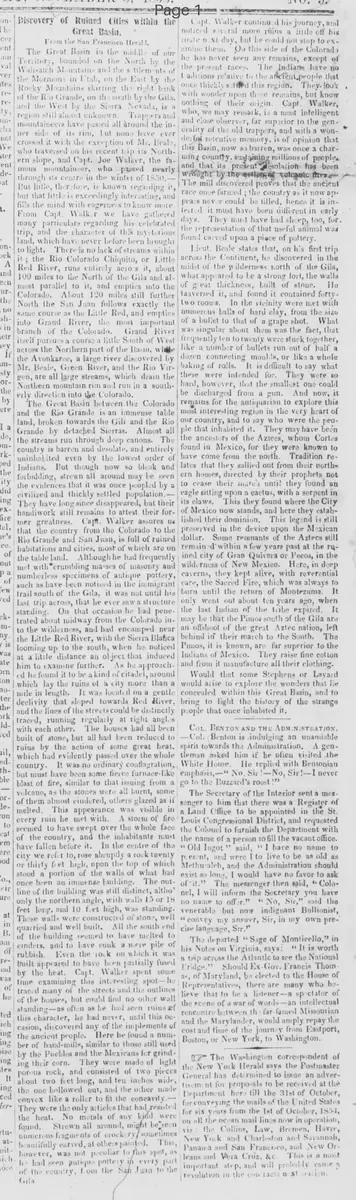
Discovery of Ruined Cities within the Great Basin.
From the San Francisco Herald.
The Great Basin in the middle of our Territory, bounded on the North by the Wahsatch Mountains and the settlements of the Mormons in Utah, on the East by the Rocky Mountains skirting the right bank of the Rio Grande, on the South by the Gila, and the West by the Sierra Nevada, is a region still almost unknown. Trappers and mountaineers have passed all around the inner side of its rim, but none have ever crossed it with the exception of Mr. Beale who traversed on his recent trip its Northern slope, and Capt. Joe Walker, the famous mountaineer, who passed nearly through its centre in the winter of 1850.
But little, therefore, is known regarding it, but that little is exceedingly interesting, and fills the mind with eagerness to know more. From Capt. Walker we have gathered many particulars regarding his celebrated trip, and the character of this mysterious land, which have never before been brought to light. There is no lack of streams within it; the Rio Colorado Chiquito, or Little Red River, runs entirely across it, about 100 miles to the North of the Gila and almost parallel to it, and empties into the Colorado. About 120 miles still further North the San Juan follows exactly the same course as the Little Red, and empties into Grand River, the most important branch of the Colorado. Grand River itself pursues a course a little South of West across the Northern part of the Basin, while the Awonkaree, a large river discovered by Mr. Beale, Green River, and the Rio Virgen, are all large streams, which drain the Northern mountain rim and run in a southerly direction into the Colorado.
The Great Basin between the Colorado and the Rio Grande is an immense table land, broken towards the Gila and the Rio Grande by detached Sierras. Almost all the streams run through deep canons. The country is barren and desolate, and entirely uninhabited even by the lowest order of Indians. But though now so bleak and forbidding, strewn all around may be seen the evidences that it was once peopled by a civilized and thickly settled population.
They have long since disappeared, but their handiwork still remains to attest their former greatness. Capt. Walker assures us that the country from the Colorado to the Rio Grande and San Juan, is full of ruined habitations and cities, most of which are on the table land. Although he had frequently met with crumbling masses of masonry and numberless specimens of antique pottery, such as have been noticed in the immigrant trail south of the Gila, it was not until his last trip across, that he ever saw a structure standing. On that occasion he had penetrated about midway from the Colorado into the wilderness, and had encamped near the Little Red River, with the Sierra Blanca looming up to the south, when he noticed at a little distance an object that induced him to examine further. As he approached he found it to be a kind of citadel, around which lay the ruins of a city more than a mile in length. It was located on a gentle declivity that sloped towards Red River, and the lines of the streets could be distinctly traced, running regularly at right angles with each other. The houses had all been built of stone, but all had been reduced to ruins by the action of some great heat, which had evidently passed over the whole country. It was no ordinary conflagration, but must have been some fierce furnace-like blast of fire, similar to that issuing from a volcano, as the stones were all burnt, some of them almost cindered, others glazed as if melted. This appearance was visible in every ruin he met with. A storm of fire seemed to have swept over the whole face of the country, and the inhabitants must have fallen before it. In the centre of the city we refer to, rose abruptly a rock twenty or thirty feet high, upon the top of which stood a portion of the walls of what had once been an immense building. The outline of the building was still distinct, although only the northern angle, with walls 15 or 18 feet long, and 10 feet high, was standing. These walls were constructed of stone, well quarried and well built. All the south end of the building seemed to have melted to cinders, and to have sunk a mere pile of rubbish. Even the rock on which it was built appeared to have been partially fused by the heat. Capt. Walker spent some time examining this interesting spot—he traced many of the streets and the outlines of the houses, but could find no other wall standing—as often as he had seen ruins of this character, he had never, until this occasion, discovered any of the implements of the ancient people. Here he found a number of hand-mills, similar to those still used by the Pueblos and the Mexicans for grinding their corn. They were made of light porous rock, and consisted of two pieces about two feet long, and ten inches wide. the one hollowed out, and the other made convex like a roller to fit the concavity. They were the only articles that had resisted the heat. No metals of any kind were found. Strewn all around, might be seen numerous fragments of crockery, sometimes beautifully carved, at others painted. Thus, however, was not peculiar to this spot, as he had seen antique pottery in every part of the country, from the San Juan to the Gila.
Capt. Walker continued his journey, and noticed several more ruins a little off his route next day, but he could not stop to examine them. On this side of the Colorado he has never seen any remains, except of the present races. The Indians have no traditions relative to the ancient people that once thickly settled this region. They look with wonder upon these remains, but know nothing of their origin. Capt. Walker, who, we may remark, is a most intelligent and close observer, far superior to the generality of the old trappers, and with a wonderfully retentive memory, is of opinion that this Basin, now so barren, was once a charming country, sustaining millions of people and that its present desolation has been wrought by the action of volcanic fires.
The mill discovered proves that the ancient race once farmed; the country as it now appears never could be tilled, hence it is inferred it must have been different in early days. They must have had sheep, too, for the representation of that useful animal was found carved upon a piece of pottery.
Lieut. Beale states that, on his first trip across the Continent, he discovered in the midst of the wilderness north of the Gila, what appeared to be a strong fort, the walls of great thickness, built of stone. He traversed it, and found it contained forty-two rooms. In the vicinity were met with numerous balls of hard clay, from the size of a bullet to that of a grape shot. What was singular about them was the fact, that frequently ten to twenty were stuck together, like a number of bullets run out of half a dozen connecting moulds, or like a whole baking of rolls. It is difficult to say what these were intended for. They were so hard, however, that the smallest one could be discharged from a gun. And now, it remains for the antiquarian to explore this most interesting region in the very heart of our country, and to say who were the people that inhabited it. They may have been the ancestors of the Aztecs, whom Cortes found in Mexico, for they were known to have come from the north. Tradition relates that they sallied out from their northern homes, directed by their prophets not to cease their march until they found an eagle sitting upon a cactus, with a serpent in its claws. This they found where the City of Mexico now stands, and here they established their dominion. This legend is still preserved in the device upon the Mexican dollar. Some remnants of the Aztecs still remained within a few years past at the ruined city of Gran Quivira or Pecos, in the wilderness of New Mexico. Here, in deep caverns, they kept alive, with reverential care, the Sacred Fire, which was always to burn until the return of Montezuma. It only went out about ten years ago, when the last Indian of the tribe expired.
It may be that the Pimos south of the Gila are an offshoot of the great Aztec nation, left behind in their march to the South. The Pimos, it is known, are far superior to the Indians of Mexico. They raise fine cotton and from it manufacture all their clothing.
Would that some Stephens or Landa would arise to explore the wonders that lie concealed within this Great Basin, and to bring to light the history of the strange people that once inhabited it.
From the San Francisco Herald.
The Great Basin in the middle of our Territory, bounded on the North by the Wahsatch Mountains and the settlements of the Mormons in Utah, on the East by the Rocky Mountains skirting the right bank of the Rio Grande, on the South by the Gila, and the West by the Sierra Nevada, is a region still almost unknown. Trappers and mountaineers have passed all around the inner side of its rim, but none have ever crossed it with the exception of Mr. Beale who traversed on his recent trip its Northern slope, and Capt. Joe Walker, the famous mountaineer, who passed nearly through its centre in the winter of 1850.
But little, therefore, is known regarding it, but that little is exceedingly interesting, and fills the mind with eagerness to know more. From Capt. Walker we have gathered many particulars regarding his celebrated trip, and the character of this mysterious land, which have never before been brought to light. There is no lack of streams within it; the Rio Colorado Chiquito, or Little Red River, runs entirely across it, about 100 miles to the North of the Gila and almost parallel to it, and empties into the Colorado. About 120 miles still further North the San Juan follows exactly the same course as the Little Red, and empties into Grand River, the most important branch of the Colorado. Grand River itself pursues a course a little South of West across the Northern part of the Basin, while the Awonkaree, a large river discovered by Mr. Beale, Green River, and the Rio Virgen, are all large streams, which drain the Northern mountain rim and run in a southerly direction into the Colorado.
The Great Basin between the Colorado and the Rio Grande is an immense table land, broken towards the Gila and the Rio Grande by detached Sierras. Almost all the streams run through deep canons. The country is barren and desolate, and entirely uninhabited even by the lowest order of Indians. But though now so bleak and forbidding, strewn all around may be seen the evidences that it was once peopled by a civilized and thickly settled population.
They have long since disappeared, but their handiwork still remains to attest their former greatness. Capt. Walker assures us that the country from the Colorado to the Rio Grande and San Juan, is full of ruined habitations and cities, most of which are on the table land. Although he had frequently met with crumbling masses of masonry and numberless specimens of antique pottery, such as have been noticed in the immigrant trail south of the Gila, it was not until his last trip across, that he ever saw a structure standing. On that occasion he had penetrated about midway from the Colorado into the wilderness, and had encamped near the Little Red River, with the Sierra Blanca looming up to the south, when he noticed at a little distance an object that induced him to examine further. As he approached he found it to be a kind of citadel, around which lay the ruins of a city more than a mile in length. It was located on a gentle declivity that sloped towards Red River, and the lines of the streets could be distinctly traced, running regularly at right angles with each other. The houses had all been built of stone, but all had been reduced to ruins by the action of some great heat, which had evidently passed over the whole country. It was no ordinary conflagration, but must have been some fierce furnace-like blast of fire, similar to that issuing from a volcano, as the stones were all burnt, some of them almost cindered, others glazed as if melted. This appearance was visible in every ruin he met with. A storm of fire seemed to have swept over the whole face of the country, and the inhabitants must have fallen before it. In the centre of the city we refer to, rose abruptly a rock twenty or thirty feet high, upon the top of which stood a portion of the walls of what had once been an immense building. The outline of the building was still distinct, although only the northern angle, with walls 15 or 18 feet long, and 10 feet high, was standing. These walls were constructed of stone, well quarried and well built. All the south end of the building seemed to have melted to cinders, and to have sunk a mere pile of rubbish. Even the rock on which it was built appeared to have been partially fused by the heat. Capt. Walker spent some time examining this interesting spot—he traced many of the streets and the outlines of the houses, but could find no other wall standing—as often as he had seen ruins of this character, he had never, until this occasion, discovered any of the implements of the ancient people. Here he found a number of hand-mills, similar to those still used by the Pueblos and the Mexicans for grinding their corn. They were made of light porous rock, and consisted of two pieces about two feet long, and ten inches wide. the one hollowed out, and the other made convex like a roller to fit the concavity. They were the only articles that had resisted the heat. No metals of any kind were found. Strewn all around, might be seen numerous fragments of crockery, sometimes beautifully carved, at others painted. Thus, however, was not peculiar to this spot, as he had seen antique pottery in every part of the country, from the San Juan to the Gila.
Capt. Walker continued his journey, and noticed several more ruins a little off his route next day, but he could not stop to examine them. On this side of the Colorado he has never seen any remains, except of the present races. The Indians have no traditions relative to the ancient people that once thickly settled this region. They look with wonder upon these remains, but know nothing of their origin. Capt. Walker, who, we may remark, is a most intelligent and close observer, far superior to the generality of the old trappers, and with a wonderfully retentive memory, is of opinion that this Basin, now so barren, was once a charming country, sustaining millions of people and that its present desolation has been wrought by the action of volcanic fires.
The mill discovered proves that the ancient race once farmed; the country as it now appears never could be tilled, hence it is inferred it must have been different in early days. They must have had sheep, too, for the representation of that useful animal was found carved upon a piece of pottery.
Lieut. Beale states that, on his first trip across the Continent, he discovered in the midst of the wilderness north of the Gila, what appeared to be a strong fort, the walls of great thickness, built of stone. He traversed it, and found it contained forty-two rooms. In the vicinity were met with numerous balls of hard clay, from the size of a bullet to that of a grape shot. What was singular about them was the fact, that frequently ten to twenty were stuck together, like a number of bullets run out of half a dozen connecting moulds, or like a whole baking of rolls. It is difficult to say what these were intended for. They were so hard, however, that the smallest one could be discharged from a gun. And now, it remains for the antiquarian to explore this most interesting region in the very heart of our country, and to say who were the people that inhabited it. They may have been the ancestors of the Aztecs, whom Cortes found in Mexico, for they were known to have come from the north. Tradition relates that they sallied out from their northern homes, directed by their prophets not to cease their march until they found an eagle sitting upon a cactus, with a serpent in its claws. This they found where the City of Mexico now stands, and here they established their dominion. This legend is still preserved in the device upon the Mexican dollar. Some remnants of the Aztecs still remained within a few years past at the ruined city of Gran Quivira or Pecos, in the wilderness of New Mexico. Here, in deep caverns, they kept alive, with reverential care, the Sacred Fire, which was always to burn until the return of Montezuma. It only went out about ten years ago, when the last Indian of the tribe expired.
It may be that the Pimos south of the Gila are an offshoot of the great Aztec nation, left behind in their march to the South. The Pimos, it is known, are far superior to the Indians of Mexico. They raise fine cotton and from it manufacture all their clothing.
Would that some Stephens or Landa would arise to explore the wonders that lie concealed within this Great Basin, and to bring to light the history of the strange people that once inhabited it.
What sub-type of article is it?
Historical Event
Curiosity
Extraordinary Event
What themes does it cover?
Exploration
Catastrophe
Misfortune
What keywords are associated?
Ruined Cities
Great Basin
Ancient Ruins
Volcanic Destruction
Capt Walker
Archaeological Discovery
Aztec Ancestors
What entities or persons were involved?
Capt. Joe Walker
Mr. Beale
Where did it happen?
Great Basin
Story Details
Key Persons
Capt. Joe Walker
Mr. Beale
Location
Great Basin
Event Date
Winter Of 1850
Story Details
Capt. Walker discovers ruined stone cities and artifacts in the Great Basin, destroyed by ancient volcanic fire, suggesting a once-thriving agricultural civilization possibly linked to Aztec ancestors. Lt. Beale finds a stone fort with mysterious clay balls.