Thank you for visiting SNEWPapers!
Sign up free
Virginia Argus
Richmond, Virginia
What is this article about?
On January 31, 1806, Mr. Smith of Maryland introduced a bill in the US Senate to classify able-bodied white male citizens aged 18-45 into junior, middle, senior, and minor militia classes, defining their duties, rotations, exemptions, and penalties for non-compliance. The bill repeals inconsistent laws.
Clipping
OCR Quality
Full Text
JANUARY 31, 1806.
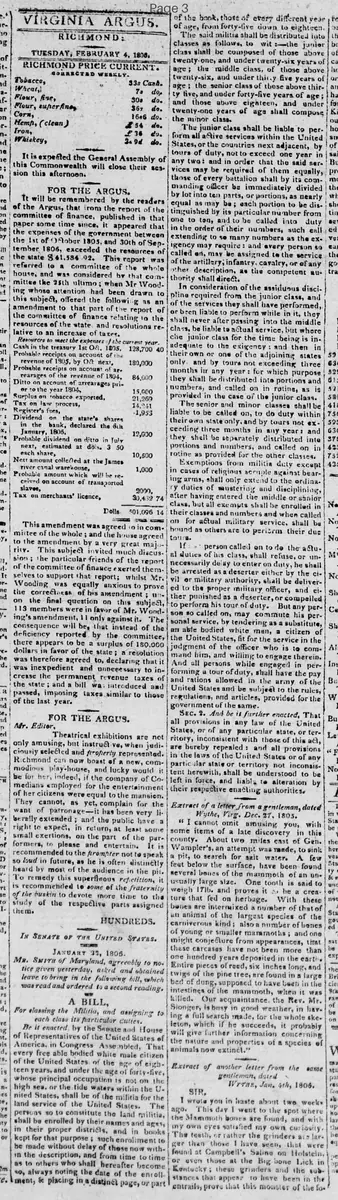
MR. Smith of Maryland, agreeably to notice given yesterday, asked and obtained leave to bring in the following bill, which was read and ordered to a second reading.
A BILL,
For classing the Militia, and assigning to each class its particular duties.
Be it enacted, by the Senate and House of Representatives of the United States of America, in Congress Assembled, That every free able bodied white male citizen of the United States, of the age of eighteen years, and under the age of forty-five, whose principal occupation is not on the high sea, or the tide waters within the United States, shall be of the militia for the land service of the United States.
The persons so to constitute the land militia, shall be enrolled by their names and ages, in their proper districts, and in books kept for that purpose; such enrollment to be made without delay of those now within the description, and from time to time as to others who shall hereafter become so, always noting the date of the enrollment, & placing in a distinct page, or part of the book, those of every different year of age, from forty-five down to eighteen.
The said militia shall be distributed into classes as follows, to wit: the junior class shall be composed of those above twenty-one, and under twenty-six years of age; the middle class, of those above twenty-six, and under thirty five years of age; the senior class of those above thirty five, and under forty-five years of age; and those above eighteen, and under twenty-one years of age shall compose the minor class.
The junior class shall be liable to perform all active services within the United States, or the countries next adjacent, by tours of duty, not to exceed one year in any two: and in order that the said services may be required of them equally, those of every battalion shall by its commanding officer be immediately divided by lot into ten parts, or portions, as nearly equal as may be; each portion to be distinguished by its particular number from one to ten, and to be called into duty in the order of their numbers, such call extending to so many numbers as the exigency may require: and every person so called on, may be assigned to the service of the artillery, infantry, cavalry, or of any other description, as the competent authority shall direct.
In consideration of the assiduous discipline required from the junior class, and of the services they shall have performed, or been liable to perform while in it, they shall never after passing into the middle class, be liable to actual service, but where the junior class for the time being is inadequate to the exigency: and then in their own or one of the adjoining states only, and by tours not exceeding three months in any year: for which purpose they shall be distributed into portions and numbers, and called on in rotation, as is provided in the case of the junior class.
The senior and minor classes shall be liable to be called on, to do duty within their own state only, and by tours not exceeding three months in any year: and they shall be separately distributed into portions and numbers, and called on in rotation as provided for the other classes.
Exemptions from militia duty except in cases of religious scruple against bearing arms, shall only extend to the ordinary duties of mustering and disciplining, after having entered the middle or senior class, but all exempts shall be enrolled in their classes and numbers and when called on for actual military service, shall be bound as others are to perform their due tours.
If any person called on to do the actual duties of his class, shall refuse, or unnecessarily delay to enter on duty, he shall be arrested as a deserter either by the civil or military authority, shall be delivered to the proper military officer, and either punished as a deserter, or compelled to perform his tour of duty. But any person so called on, may commute his personal service, by tendering as a substitute, an able bodied white man, a citizen of the United States, fit for the service in the judgment of the officer who is to command him, and willing to engage therein.
And all persons while engaged in performing a tour of duty, shall have the pay and rations allowed in the army of the United States and be subject to the rules, regulations, and articles, provided for the government of the same.
Sec. 2. And be it further enacted. That all provisions in any law of the United States, or of any particular state, or territory, inconsistent with those of this act, are hereby repealed: and all provisions in the laws of the United States or of any particular state or territory not inconsistent herewith, shall be understood to be left in force, and liable to alteration by their respective enacting authorities.
What sub-type of article is it?
What keywords are associated?
What entities or persons were involved?
Where did it happen?
Domestic News Details
Primary Location
United States
Event Date
January 31, 1806
Key Persons
Outcome
the bill was read and ordered to a second reading.
Event Details
MR. Smith of Maryland introduced a bill to classify the militia into junior (21-26), middle (26-35), senior (35-45), and minor (18-21) classes, defining enrollment, duties by class (active service tours varying by class and location), exemptions (limited, except religious), penalties for refusal (arrest as deserter or substitution), pay/rations equivalent to army, and repeal of inconsistent laws.